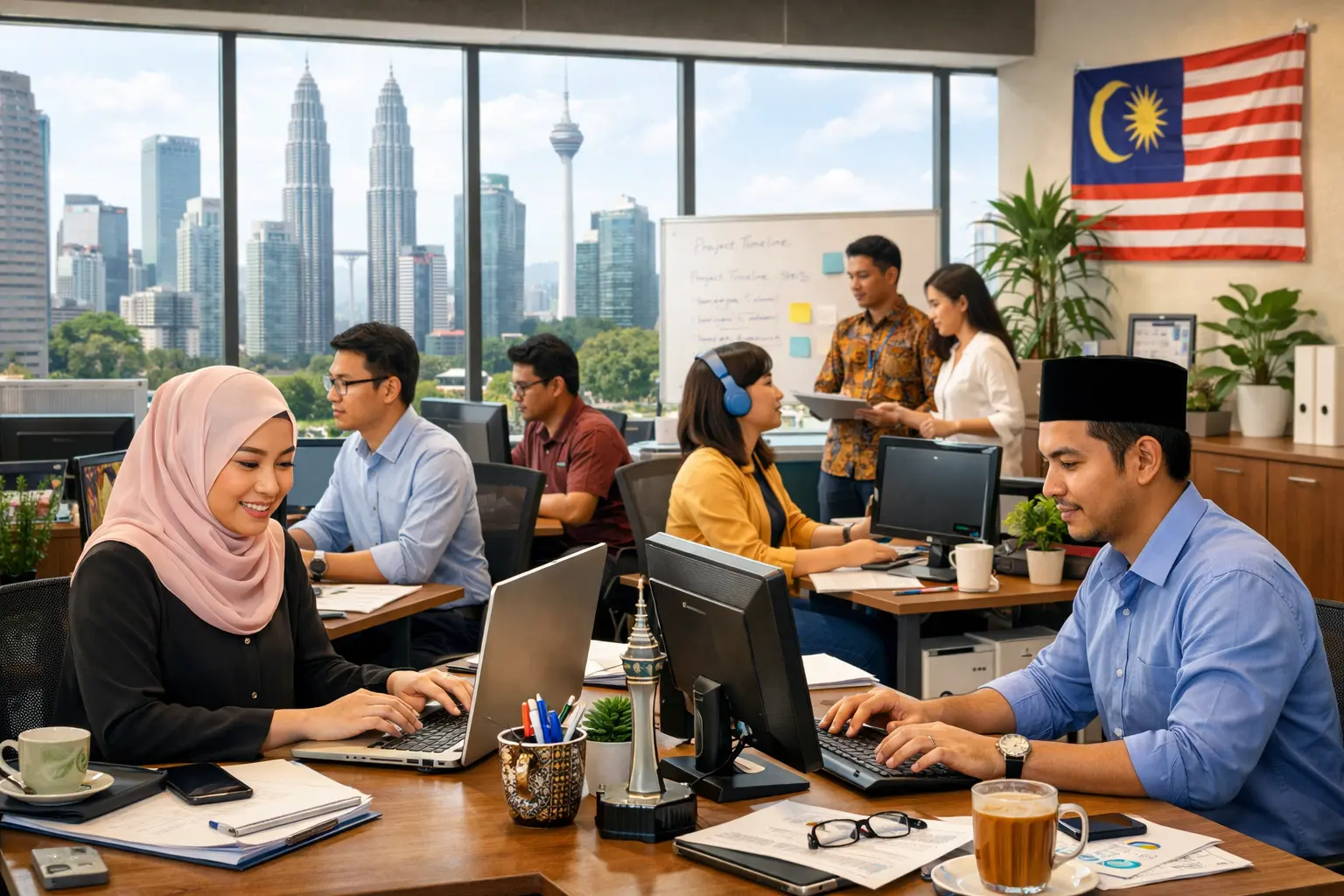
Malaysia is emerging as one of the most practical and promising work destinations for Indian professionals in 2026. Over the past few years, the country has strengthened its position as a regional business hub in Southeast Asia. With steady economic growth, strong foreign investment inflow, and expanding sectors such as information technology, manufacturing, oil and gas, healthcare, and finance, Malaysia continues to create demand for skilled foreign workers. For many Indians looking beyond traditional destinations, Malaysia offers a balanced combination of opportunity, stability, and accessibility.
One of the biggest advantages for Indian professionals is affordability. Compared to many Western countries, the cost of living in cities like Kuala Lumpur and Penang remains manageable while salaries in skilled roles offer meaningful savings potential. The relatively short flight distance from India, similar food habits, a large Indian community presence, and English being widely spoken make cultural adjustment smoother. These factors reduce the emotional and financial pressure that often comes with international relocation.
At the same time, moving to Malaysia is not just about securing a job. Understanding the correct visa category, employer sponsorship rules, salary thresholds, documentation standards, and government compliance procedures is essential. Many applicants assume that once they receive a job offer, the process becomes automatic. In reality, work permit approvals depend heavily on employer eligibility, accurate paperwork submission, medical clearances, and meeting immigration benchmarks.
In this detailed guide, we will cover everything Indian applicants need to know about the Malaysia Work Permit Visa in 2026. You will learn about the different types of work passes available, eligibility requirements, document checklist, visa fees, total estimated costs, processing time, and the exact step by step application process from India. We will also discuss common rejection reasons and realistic expectations regarding long term settlement options.
Having observed multiple work visa applications, one common pattern stands out. Most delays and rejections happen due to incomplete documentation, misunderstanding of employer sponsorship roles, or incorrect assumptions about salary eligibility criteria. This guide aims to simplify those complexities so that you approach the process informed, prepared, and confident. If you are planning to work and possibly settle in Malaysia, understanding the system before applying can save both time and money.
Why Indians Are Choosing Malaysia for Work in 2026
Malaysia has steadily positioned itself as one of Southeast Asia’s most accessible and opportunity rich destinations for skilled Indian professionals. In 2026, the appeal is not just about higher salaries. It is about stable growth, regional exposure, lower relocation risk, and practical long term possibilities. For many Indians, Malaysia offers a middle path between domestic career growth and moving to high cost Western countries.
Economic Growth and Job Opportunities
Malaysia’s economy continues to expand through foreign investment, digital transformation, and infrastructure development. Several sectors are actively hiring skilled foreign professionals, including Indians.
Key sectors with strong demand in 2026:
- Information Technology and Digital Services
Software development, cybersecurity, cloud engineering, data analytics, fintech, and AI driven services are in high demand, especially in Kuala Lumpur and Cyberjaya.
- Oil and Gas
Malaysia remains a significant energy producer in Southeast Asia. Engineers, project managers, safety experts, and technical specialists are frequently recruited.
- Construction and Infrastructure
Ongoing urban development and transport projects create demand for civil engineers, quantity surveyors, and site managers.
- Manufacturing and Electronics
Malaysia is a major electronics manufacturing hub. Skilled technicians, automation engineers, and quality control specialists are needed.
- Healthcare
Private hospitals and medical tourism growth are increasing demand for doctors, nurses, and allied health professionals.
- Hospitality and Tourism
As tourism rebounds strongly, hotels and resorts recruit experienced managers and specialists.
One important practical point many applicants overlook is that work permits are tied to employer sponsorship. Malaysia typically approves foreign hires when employers demonstrate that specific skills are not easily available locally.
Salary Expectations Compared to India
For many Indians, salary comparison is a key deciding factor. While salaries in Malaysia may not match Western countries, they are competitive relative to living costs.
Below is a general comparison of average annual salaries in 2026. Figures are approximate and vary by experience and company.
| Industry |
Average Salary in India (INR per year) |
Average Salary in Malaysia (MYR per year) |
| IT and Software |
8 to 18 lakhs |
90,000 to 180,000 |
| Oil and Gas Engineering |
10 to 22 lakhs |
120,000 to 250,000 |
| Construction Engineering |
6 to 15 lakhs |
70,000 to 150,000 |
| Manufacturing and Electronics |
5 to 12 lakhs |
60,000 to 130,000 |
| Healthcare Specialists |
8 to 20 lakhs |
100,000 to 220,000 |
| Hospitality Management |
4 to 10 lakhs |
50,000 to 110,000 |
While gross numbers may appear moderate, savings potential improves due to relatively lower housing and transportation costs compared to major global cities.
Cost of Living in Malaysia
Affordability is one of the strongest reasons Indians choose Malaysia. Kuala Lumpur offers modern infrastructure at significantly lower living costs than many global metros.
Below is a comparison of estimated monthly expenses for a single professional in Kuala Lumpur versus Tier 1 Indian cities such as Mumbai, Delhi, or Bengaluru.
| Expense Category |
Kuala Lumpur (MYR per month) |
Tier 1 Indian City (INR per month) |
| Rent for 1 BHK Apartment |
1,800 to 3,000 |
20,000 to 45,000 |
| Utilities |
200 to 400 |
3,000 to 6,000 |
| Groceries |
600 to 1,000 |
5,000 to 10,000 |
| Transport |
150 to 300 |
3,000 to 7,000 |
| Dining and Leisure |
500 to 1,000 |
5,000 to 12,000 |
Many Indian professionals report that with disciplined spending, they are able to save a reasonable portion of their salary while enjoying a good standard of living.
Long Term Settlement Opportunities
For Indians considering long term relocation, it is important to understand that Malaysia’s immigration system is structured but selective.
Key long stay and settlement pathways include:
- Long term Employment Pass renewals
- Employer backed residence extensions
- Malaysia My Second Home program for financially eligible individuals
- Permanent Residency through long term stay and contribution
Permanent Residency approval in Malaysia is competitive and not automatic. It typically requires several years of legal employment, strong employer backing, clean immigration records, and financial stability.
Many Indian professionals initially move for career growth and later explore extended stay options based on job stability and family relocation plans. Understanding these pathways early helps in making informed career decisions rather than short term moves.
Overall, Malaysia’s combination of opportunity, affordability, cultural comfort, and manageable immigration structure makes it a practical choice for Indians in 2026.
Types of Malaysia Work Permit Visa for Indians
Before accepting a job offer in Malaysia, it is crucial to understand which work pass category applies to your profile. Malaysia does not issue a generic work visa. Instead, permits are issued based on salary level, job role, employer eligibility, and contract structure. The employer plays a central role in almost every category.
Below is a clear breakdown of the main work permit options available to Indians in 2026.
Employment Pass
The Employment Pass is the most common long term work visa for skilled Indian professionals. It is generally issued to expatriates hired for managerial, executive, technical, or highly skilled positions.
Eligibility criteria typically include:
- A confirmed job offer from a registered Malaysian company
- Minimum salary threshold as prescribed by immigration authorities
- Relevant academic qualifications and work experience
- A valid employment contract
Salary criteria:
The minimum salary requirement varies by category but usually starts from a defined monthly threshold set by Malaysian authorities. Higher salary bands may qualify for longer validity.
Contract requirements:
Applicants must have a formal employment contract specifying role, salary, duration, and employer details. The employer must justify the need to hire a foreign professional.
The Employment Pass is generally issued for one to five years depending on the category and is renewable.
Temporary Employment Pass
The Temporary Employment Pass is issued for semi skilled or sector specific roles where foreign manpower demand is high.
Who qualifies:
- Workers hired in construction, manufacturing, plantation, or certain service sectors
- Applicants recruited through approved quotas
This category is usually employer sponsored and tied strictly to the sponsoring company. Changing employers requires a fresh application.
The duration is shorter than the Employment Pass and is often granted for up to two years with renewal conditions.
Professional Visit Pass
The Professional Visit Pass is meant for short term assignments. It is not a long term employment visa.
Suitable for:
- Consultants
- Technical experts on project deployment
- Trainers
- Foreign employees sent by overseas companies for temporary assignments
This pass is typically valid for short durations such as a few months, depending on the assignment. The applicant usually remains employed by a foreign company and works in Malaysia on a project basis.
Malaysia Digital Nomad Pass
Malaysia has introduced initiatives to attract remote professionals and digital talent. This option is relevant for Indian freelancers, remote employees, and tech entrepreneurs working for foreign clients or companies.
Eligibility generally includes:
- Proof of remote employment or freelance contracts
- Minimum income threshold
- Clean immigration record
- Valid passport and insurance
This pass is particularly attractive for Indian IT professionals who want flexibility without traditional employer sponsorship inside Malaysia.
Comparison of Malaysia Work Permit Types
| Feature |
Employment Pass |
Temporary Employment Pass |
Professional Visit Pass |
Digital Nomad Pass |
| Validity |
1 to 5 years depending on category |
Up to 2 years |
Short term, usually months |
Typically 1 year with renewal |
| Salary Requirement |
Minimum salary threshold required |
Sector specific wage rules |
Based on project contract |
Minimum annual income threshold |
| Sponsorship Requirement |
Malaysian employer sponsorship mandatory |
Malaysian employer sponsorship mandatory |
Local sponsor or host company required |
No traditional employer sponsorship in Malaysia required |
| Renewal Options |
Renewable subject to employer and compliance |
Renewable within sector limits |
Limited extensions |
Renewable if eligibility continues |
| PR Eligibility |
Possible after long term stay and compliance |
Very limited pathway |
Not eligible |
Not direct, depends on future visa conversion |
Understanding the correct visa category before applying is essential. Many applicants assume all work visas function similarly, but approval criteria, renewal rules, and long term prospects vary significantly. Selecting the right category aligned with your career plan improves both approval chances and future settlement options.
Malaysia Work Permit Visa Requirements for Indians in 2026
Understanding the eligibility criteria and documentation requirements is the most critical step in securing a Malaysia work permit. Many applications face delays not because the candidate lacks qualifications, but because paperwork does not meet immigration standards or employer submissions are incomplete. In 2026, compliance checks have become stricter, especially around salary declarations, academic proof, and employer justification.
Below is a structured breakdown of what Indian applicants must prepare.
Basic Eligibility Criteria
To qualify for a Malaysia work permit, applicants must meet the following core requirements:
- Job Offer from a Malaysian Employer
You must have a confirmed employment offer from a legally registered Malaysian company. The employer must be eligible to hire foreign workers under Malaysian immigration guidelines.
- Salary Threshold
Each work pass category has a defined minimum salary requirement. Skilled roles under the Employment Pass must meet the prescribed monthly income benchmark. Salary must be clearly stated in the employment contract and supported by company documentation.
- Relevant Qualifications
Applicants must hold academic degrees, diplomas, or professional certifications relevant to the job role. Work experience must align with the position offered. Immigration authorities may verify whether the qualification matches the job category.
Important practical insight:
Job title, salary level, and qualification must logically align. For example, applying for a senior technical role with a junior level salary or unrelated degree often triggers scrutiny.
Required Documents Checklist
Below is a comprehensive document checklist typically required for Indian applicants in 2026. Exact requirements may vary by visa category.
Personal Documents
- Valid passport with minimum six months validity
- Passport size photographs as per specification
- Updated resume
- Educational certificates and mark sheets
- Professional certifications if applicable
- Experience letters from previous employers
- Signed employment contract
- Offer letter from Malaysian employer
Employer Documents
- Company registration certificate
- Company profile
- Justification letter explaining need to hire foreign employee
- Proof of company compliance with local employment rules
Additional Supporting Documents
- Police clearance certificate if required
- Academic certificate attestation if requested
- Immigration approval letter issued by Malaysian authorities
- Visa approval letter
Expert tip:
Ensure that your name, passport number, and date of birth are consistent across all documents. Even minor spelling differences can delay processing.
Medical and Insurance Requirements
Medical screening is mandatory for most work permit categories.
Medical Process Overview
- Pre departure medical examination may be required
- Post arrival medical screening in Malaysia is often compulsory
- Tests typically include general health screening, blood tests, and chest X ray
Applicants must be medically fit to work. Certain communicable diseases may lead to visa rejection.
Insurance Requirements
- Valid medical insurance coverage
- Some employers provide insurance under company policy
- Digital Nomad applicants may need independent health insurance coverage
It is important to confirm whether your employer arranges insurance or whether you must purchase it independently.
Employer Sponsorship and Company Role
In Malaysia, employer sponsorship is not a formality. It is the backbone of the work permit process.
Employer Responsibilities Include:
- Applying for quota approval if required
- Submitting the work pass application
- Justifying the foreign hire
- Paying applicable government fees
- Ensuring salary compliance
- Facilitating post arrival endorsement
Immigration authorities assess the employer’s financial standing, business activity, and compliance record before approving foreign hires.
Common Document Rejection Reasons
Based on observed application patterns, the following issues frequently cause delays or rejection:
- Salary mentioned does not meet minimum threshold
- Degree not relevant to job role
- Incomplete employer justification
- Incorrect or inconsistent personal details
- Expired passport
- Fake or unverifiable experience certificates
- Employer not eligible to sponsor foreign workers
One recurring mistake Indian applicants make is assuming the process is entirely handled by the employer. While the employer submits the application, the applicant must ensure their documentation is accurate, complete, and aligned with immigration expectations.
Preparation and attention to detail significantly improve approval chances. In work visa processing, small documentation errors often cause major delays.
Malaysia Work Visa Price for Indians in 2026
Understanding the full cost of a Malaysia work visa is essential before accepting a job offer. Many applicants only consider the official government fee, but the total expense includes medical tests, documentation, travel, and sometimes consultancy support. In 2026, costs can vary depending on the type of work pass, duration of validity, and whether the employer covers part of the expense.
Below is a transparent breakdown to help you estimate your total financial commitment.
Government Fees
Government fees differ based on the visa category and duration approved. In most Employment Pass cases, the employer pays the primary application fee, but applicants should still understand the cost structure.
| Fee Type |
Estimated Cost (MYR) |
Approximate Cost (INR) |
| Employment Pass Processing Fee |
200 to 500 |
3,500 to 9,000 |
| Employment Pass Issuance Fee per year |
2,000 to 5,000 |
35,000 to 90,000 |
| Temporary Employment Pass |
1,000 to 2,500 |
18,000 to 45,000 |
| Professional Visit Pass |
800 to 1,500 |
14,000 to 27,000 |
| Visa Endorsement and Sticker Fee |
100 to 300 |
1,800 to 5,500 |
Note: Currency conversions are approximate and may vary based on exchange rates in 2026.
In many skilled job categories, the employer bears the issuance cost. However, this should be clearly discussed before signing the employment contract.
Additional Costs
Beyond government fees, applicants should budget for the following expenses:
Medical Tests
Pre departure and post arrival medical screening can cost between 3,000 to 8,000 INR depending on the city and diagnostic center.
Attestation of Documents
Educational certificate attestation or verification may cost between 5,000 to 15,000 INR depending on the level of authentication required.
Visa Stamping
Visa stamping charges at the Malaysian Visa Application Centre in India may range between 2,000 to 6,000 INR.
Travel
One way airfare from India to Kuala Lumpur generally ranges between 12,000 to 30,000 INR depending on season and departure city.
Insurance
If not covered by the employer, private health insurance may cost approximately 10,000 to 25,000 INR annually depending on coverage.
Consultancy Charges
Many applicants choose to use immigration consultants, especially if they are unfamiliar with documentation procedures. While consultancy services are optional, they are common.
Typical consultancy fees in India may range from 20,000 to 75,000 INR depending on the level of service, documentation support, and job assistance offered.
Important practical advice:
If your employer is directly sponsoring your Employment Pass, external consultancy is often unnecessary unless you require help with documentation or verification.
Total Estimated Cost for Indians in 2026
Below is a general estimate combining government and personal expenses. The final cost depends on visa category and employer coverage.
| Expense Category |
Estimated Range in MYR |
Estimated Range in INR |
| Government Related Fees |
2,500 to 6,000 |
45,000 to 1,10,000 |
| Medical and Documentation |
500 to 1,500 |
10,000 to 30,000 |
| Travel and Insurance |
1,000 to 2,000 |
20,000 to 50,000 |
| Consultancy Optional |
Not applicable |
20,000 to 75,000 |
Approximate Total Estimated Cost:
If employer covers major government fees, personal expense may stay between 40,000 to 90,000 INR.
If applicant bears most costs independently, total expense can range between 1,00,000 to 2,50,000 INR.
Planning finances in advance reduces last minute stress. Before proceeding, always clarify with your employer which costs are covered and which are your responsibility. Transparency at the contract stage prevents confusion later in the process.
Processing Time for Malaysia Work Permit in 2026
Understanding the realistic processing timeline is essential before resigning from your current job or booking tickets. Many applicants assume the process takes only a few weeks, but actual timelines depend on employer quota approval, documentation accuracy, and immigration workload.
In 2026, Malaysia has streamlined many digital processes, but employer compliance checks and background verification still influence overall duration. A properly prepared application generally moves faster than one requiring corrections or additional documents.
Below is a step by step breakdown of the typical timeline.
Step by Step Timeline
Employer Application
The process begins when the Malaysian employer submits the work pass application to the immigration authorities.
This stage includes:
- Company eligibility verification
- Quota approval if required
- Submission of candidate documents
- Justification for hiring a foreign professional
This stage often takes the longest because immigration evaluates both the employer and the employee profile.
Approval Letter
Once immigration approves the application, an official approval letter is issued.
This letter confirms:
- Visa category
- Validity period
- Salary compliance
- Sponsorship details
Without this approval letter, visa stamping cannot proceed.
Visa Endorsement
After receiving the approval letter, the applicant applies for visa endorsement or entry visa at the Malaysian Visa Application Centre in India.
This step includes:
- Passport submission
- Biometric verification if required
- Visa sticker issuance
Processing time at this stage is generally shorter if documents are complete.
Travel and Pass Issuance
After arriving in Malaysia:
- Post arrival medical screening may be conducted
- Immigration endorsement is completed
- The work pass card is issued
Only after this step can the employee legally begin full employment.
Average Processing Duration in 2026
| Stage |
Estimated Time |
| Employer Application and Quota Approval |
2 to 6 weeks |
| Immigration Approval Letter |
1 to 3 weeks |
| Visa Endorsement in India |
5 to 10 working days |
| Post Arrival Formalities |
1 to 2 weeks |
Total Estimated Timeline:
Approximately 4 to 10 weeks depending on visa category and documentation accuracy.
Common Reasons for Delays and How to Avoid Them
Based on observed application trends, delays typically happen due to the following reasons:
- Employer quota not approved in advance
- Salary below required threshold
- Incomplete or inconsistent documents
- Degree not matching job role
- Pending medical clearance
- Errors in passport details
Practical Tips to Avoid Delays
- Ensure your passport is valid for at least 18 months
- Confirm salary meets immigration criteria before signing the contract
- Double check that your name and personal details match across all documents
- Submit clear, properly scanned copies
- Stay in constant communication with your employer’s HR team
One important insight many applicants miss is that the employer’s compliance history directly impacts processing speed. Companies with prior successful foreign hires often experience faster approvals.
Planning your resignation and relocation only after receiving the official approval letter is strongly recommended. Acting too early can create unnecessary financial pressure if timelines extend.
A well prepared application can significantly reduce uncertainty and move through the system smoothly in 2026.
How to Apply for Malaysia Work Permit Visa from India in 2026
Applying for a Malaysia work permit is not an individual online form filling process like tourist visas. It is primarily employer driven. As an applicant, your responsibility is to secure the right job offer, submit accurate documents, and coordinate closely with the sponsoring company.
Below is a clear step by step guide tailored for Indian professionals in 2026.
Step 1: Secure a Job Offer
You cannot apply for most Malaysia work permits without a confirmed job offer from a Malaysian employer.
Practical ways to find jobs:
- Apply through international job portals such as LinkedIn and Malaysia based recruitment websites
- Target multinational companies with offices in Kuala Lumpur, Penang, or Johor
- Use professional networking and referrals
- Attend virtual job fairs focused on Southeast Asia
- Approach recruitment agencies that specialize in overseas placements
Actionable advice:
- Customize your resume to match Malaysian job descriptions
- Clearly mention years of experience and technical skills
- Be transparent about salary expectations
- Confirm whether the employer is willing and eligible to sponsor a work pass
Before accepting the offer, verify that the salary meets Malaysia’s minimum threshold for the relevant work pass category.
Step 2: Employer Applies for Work Pass
Once you accept the job offer, the employer initiates the work permit application.
This stage involves:
- Employer verifying foreign worker quota
- Submission of your personal documents
- Submission of company documents
- Immigration review and compliance checks
Your responsibilities:
- Provide clear scanned copies of passport and certificates
- Ensure all personal details are accurate
- Respond quickly if HR requests additional documents
You cannot independently submit this application unless applying under a Digital Nomad category.
Step 3: Receive Approval Letter
If the application is approved, immigration issues an official approval letter.
This letter confirms:
- Work pass category
- Validity period
- Approved salary
- Sponsoring employer
Do not resign from your current job or book travel until this approval letter is issued.
Carefully check:
- Spelling of your name
- Passport number
- Job title
- Salary mentioned
If errors are found, request correction immediately.
Step 4: Visa Stamping in India
After receiving the approval letter, you must apply for visa endorsement at the Malaysian Visa Application Centre in India.
The process typically includes:
- Submitting passport
- Providing approval letter
- Completing visa forms
- Paying stamping fee
- Biometric verification if required
Processing usually takes several working days. Once stamped, you can legally travel to Malaysia.
Step 5: Arrival and Pass Endorsement in Malaysia
After arrival in Malaysia:
- Complete post arrival medical screening if required
- Submit passport to immigration through employer
- Receive work pass endorsement
- Collect official work pass card
You are legally authorized to begin employment only after final endorsement.
Key Reminders for Indian Applicants
- Keep both digital and physical copies of all documents
- Stay in regular communication with employer HR
- Confirm who is paying which fees
- Avoid middlemen promising guaranteed approvals
- Do not overstay previous Malaysian visits if any
The Malaysia work permit process in 2026 is structured but manageable when handled correctly. With proper preparation, accurate documentation, and a compliant employer, the transition from India to Malaysia can be smooth and predictable.
Can Indians Get Permanent Residency in Malaysia?
Permanent Residency in Malaysia is possible for Indians, but it is important to approach this topic with realistic expectations. Unlike some countries that offer clear point based PR systems, Malaysia follows a selective and discretionary model. PR is not automatic after working for a few years. Approval depends on long term contribution, employer support, financial stability, and clean immigration history.
Many Indian professionals initially move to Malaysia on an Employment Pass with career growth in mind. Only later do they explore permanent stay options. Understanding the available pathways early helps in planning your long term strategy rather than assuming PR will naturally follow employment.
PR Pathways
Below are the main routes through which Indians may explore long term residence in Malaysia.
Long Term Employment
Foreign professionals who have worked legally in Malaysia for several years under valid Employment Pass categories may become eligible to apply for Permanent Residency.
Key considerations include:
- Continuous legal stay in Malaysia
- Stable employment history
- Strong tax compliance record
- Positive employer recommendation
- Clean immigration and criminal record
There is no guaranteed timeline, but long term stay combined with economic contribution improves prospects.
Malaysia My Second Home Program
The Malaysia My Second Home program is a long stay visa option designed for financially stable individuals.
This program typically requires:
- Meeting minimum income criteria
- Maintaining a fixed deposit in Malaysia
- Proof of financial stability
- Health insurance coverage
It is important to understand that this program grants long term residence status, not automatic Permanent Residency. However, it can be a pathway to extended legal stay for Indians with sufficient financial resources.
Employer Sponsorship
In certain cases, Malaysian employers may support PR applications for highly skilled or strategically important foreign professionals.
This route usually applies to:
- Senior executives
- Technical experts
- Long serving employees
- Individuals contributing significantly to business growth
Employer backing strengthens the application but does not guarantee approval. Immigration authorities conduct independent assessment.
Challenges in Getting PR
Permanent Residency in Malaysia is competitive and selective. Applicants must be prepared for uncertainty.
Common challenges include:
- No fixed point based eligibility system
- Long processing timelines
- Discretionary approval process
- High scrutiny of financial and tax records
- Requirement of strong local ties
Many professionals assume that staying five years automatically qualifies them for PR. In reality, duration alone is not sufficient. Contribution to the Malaysian economy, employer endorsement, income level, and compliance history all play major roles.
It is also important to maintain continuous visa validity. Any overstay, tax non compliance, or employment irregularity can negatively impact long term applications.
For Indian professionals considering permanent settlement, Malaysia offers opportunity, but it requires patience, consistent legal compliance, and strong professional standing. Planning for PR should be strategic rather than assumed.
Common Reasons for Malaysia Work Visa Rejection
Malaysia’s work visa process is structured and documentation driven. In many cases, rejections are not due to lack of skill, but due to technical mistakes, compliance gaps, or employer side issues. Based on observed application patterns and documentation reviews, the following are the most common reasons for rejection in 2026.
- Salary Below Minimum Threshold
Immigration authorities strictly evaluate whether the offered salary meets the required benchmark for the specific pass category. Even a small mismatch between declared salary and category requirement can result in rejection.
- Mismatch Between Qualification and Job Role
One frequent issue is applying for a specialized technical or managerial role without a directly relevant degree or experience. Immigration officers assess logical alignment between education, experience, and designation.
- Incomplete or Inconsistent Documentation
Differences in spelling of name, passport number errors, missing pages of degree certificates, or unclear scans can delay or derail approval. Small inconsistencies often trigger additional scrutiny.
- Employer Not Eligible to Sponsor Foreign Workers
Some companies lack proper quota approval or do not meet foreign hiring compliance requirements. Even if the candidate is qualified, the application can be rejected due to employer ineligibility.
- Insufficient Employer Justification
Malaysian immigration requires employers to explain why a foreign candidate is being hired instead of a local applicant. Weak or generic justification letters often lead to rejection.
- Previous Immigration Violations
Past overstays, visa misuse, or incomplete exit records can negatively impact new applications.
- Medical Clearance Issues
Failure in mandatory medical screening or incomplete health documentation can lead to visa denial.
- Fake or Unverifiable Documents
Submission of forged experience letters or unverifiable academic certificates results in immediate rejection and possible blacklisting.
- Quota Exhaustion
If the employer has already utilized its foreign worker quota, new applications may be rejected until quota approval is renewed.
- Tax or Compliance Issues of Employer
Immigration may conduct background checks on the sponsoring company. Financial irregularities or regulatory non compliance can indirectly affect the candidate’s approval.
Expert Insight from Documentation Handling
A recurring mistake Indian applicants make is assuming that once they receive a job offer, approval is guaranteed. In reality, immigration authorities assess both the employer and the employee equally.
From documentation review experience, the most preventable errors are related to:
- Not verifying whether salary matches visa category requirements
- Submitting incomplete academic transcripts
- Ignoring the need for proper employer justification
- Failing to cross check personal details across documents
Another common misunderstanding is rushing the process. Applicants sometimes resign from their current jobs before receiving official approval letters. If the application faces delays or rejection, this creates unnecessary financial stress.
The safest approach is careful document verification, clear communication with employer HR, and ensuring all eligibility criteria are fully met before submission. Attention to detail significantly improves approval success in 2026.
Is Malaysia Safe and Worth Moving for Indians in 2026?
For many Indian professionals, the decision to move abroad is not just about salary. It is about safety, lifestyle, family comfort, long term stability, and financial planning. In 2026, Malaysia continues to be considered one of the more balanced destinations in Southeast Asia for Indian expatriates.
Below is a practical evaluation of key factors that matter most.
Indian Community Presence
Malaysia has a long established Indian community, particularly in cities like Kuala Lumpur, Penang, and Johor Bahru.
Key points to consider:
- Indians form a visible and culturally active community
- Availability of Indian restaurants, temples, and cultural associations
- Festivals such as Deepavali are widely celebrated
- Tamil is commonly spoken in many areas
For new migrants, having an existing Indian community reduces cultural shock and makes settlement smoother. Networking within community groups can also help in housing, schooling, and local guidance.
Cultural Similarity
Malaysia offers a multicultural environment with Malay, Chinese, and Indian influences. For Indians, adaptation tends to be easier compared to Western countries.
Reasons include:
- English is widely used in business and daily communication
- Vegetarian and Indian food options are easily available
- Religious freedom is generally respected
- Family oriented social structure
This cultural familiarity makes Malaysia particularly attractive for professionals relocating with family.
Safety Index
Malaysia is generally considered safe for expatriates.
- Major cities have organized infrastructure and law enforcement
- Violent crime rates are relatively low compared to many global cities
- Public transport is structured and regulated
- Residential areas popular among expatriates are well monitored
However, like any country, petty crimes such as pickpocketing can occur. Choosing safe neighborhoods and following basic precautions is recommended.
Work Life Balance
Malaysia is known for a relatively balanced professional environment compared to high pressure Western economies.
- Standard working hours are typically structured
- Public holidays are frequent due to multicultural celebrations
- Weekend family culture is strong
- Commuting infrastructure in Kuala Lumpur is developed
While workload depends on industry, many Indian professionals report a more manageable work life rhythm compared to certain corporate environments in India.
Tax Structure
Malaysia follows a progressive income tax system.
Important aspects:
- Income tax rates are generally moderate compared to many developed countries
- No tax on foreign sourced income in certain cases
- Employees contribute to statutory funds where applicable
- Tax compliance is strictly monitored
Proper tax planning is essential. Understanding residency status and double taxation agreements between India and Malaysia can help avoid unnecessary financial burden.
Overall Assessment
Malaysia offers a combination of safety, affordability, cultural comfort, and professional opportunity. It may not offer the same high income levels as some Western destinations, but it provides a stable and practical pathway for Indians seeking international exposure with manageable risk.
For professionals prioritizing career growth, quality of life, and regional mobility, Malaysia in 2026 remains a strong and realistic option.
Conclusion
Malaysia continues to stand out in 2026 as a practical and opportunity driven destination for Indian professionals. With growing demand across IT, oil and gas, manufacturing, healthcare, construction, and digital sectors, the country offers structured career pathways combined with affordability and cultural familiarity. However, moving to Malaysia is not simply about receiving a job offer. It requires a clear understanding of the correct visa category, salary eligibility, employer sponsorship rules, cost commitments, and realistic processing timelines.
The most important takeaway is preparation. Successful applicants typically follow a disciplined approach:
- Secure a genuine job offer from a compliant Malaysian employer
- Confirm that the offered salary meets visa category requirements
- Cross check all personal and academic documents for accuracy
- Maintain consistency in passport details and certificates
- Wait for official approval before making travel or resignation decisions
Careful documentation is not optional. It directly influences approval speed and outcome. Even small inconsistencies can delay or complicate the process. Equally important is verifying the credibility and eligibility of the sponsoring employer. A strong employer with prior foreign hiring experience significantly improves application success.
For Indians considering Malaysia for work and long term stay, the country offers a balanced mix of professional growth, safety, and quality of life. While Permanent Residency is selective and competitive, structured employment and compliance over time can open future possibilities.
Approach the process strategically, not emotionally. Research thoroughly, clarify responsibilities with your employer, prepare your documents meticulously, and plan finances in advance. When handled correctly, Malaysia can be a rewarding international move that strengthens both your career and long term prospects.
Frequently Asked Questions
What are the different categories of the Malaysia Employment Pass (EP) in 2026?
The Employment Pass (EP) is divided into three categories based on salary and job role. Category I is for high-level executives earning RM 20,000+ per month, offering a stay of up to 10 years. Category II covers professionals earning between RM 10,000 and RM 19,999 for up to 10 years. Category III is for skilled workers earning RM 5,000 to RM 9,999, valid for up to 5 years. Each category has specific requirements regarding employer succession plans and the ability to sponsor dependents.
What is the minimum salary requirement for an Indian professional to work in Malaysia?
Effective June 1, 2026, Malaysia significantly raised its salary thresholds. To qualify for any Employment Pass, the absolute minimum monthly salary is now RM 5,000 for general sectors and RM 7,000 for manufacturing-related services (Category III). For specialized or managerial roles, the requirements jump to RM 10,000 (Category II) or RM 20,000 (Category I). These new thresholds apply to both new applications and renewals submitted on or after the June 1st deadline.
Can I apply for a Malaysia work permit on my own from India?
No, you cannot apply for a work permit independently. The process must be initiated by a Malaysian employer or an authorized Expatriate Services Division (ESD) registered company. The employer must first obtain approval to hire a foreign worker and then apply for your specific pass through the MYXpats Centre. Only after receiving a formal Visa Approval Letter (VAL) can you proceed with entry visa (VDR) stamping at a Malaysian mission in India.
How long does it take to process a Malaysia Work Permit in 2026?
The processing timeline occurs in two stages. First, the employer’s application to the MYXpats Centre typically takes about 5 working days, provided all documents are correct. Once approved, the employee must apply for the Visa with Reference (VDR) in India, which usually takes another 2 to 4 weeks for stamping and final endorsement. It is highly recommended to begin the entire process at least 2 to 3 months before your intended joining date to account for potential documentation delays.
What are the mandatory documents required for an Indian citizen’s work visa?
You must provide an Indian passport valid for at least six months, a comprehensive resume, and attested educational certificates (degrees or diplomas). Depending on the role, you may need a Degree with 3 years of experience, a Diploma with 5 years, or a Technical Certificate with 7 years. Additionally, a medical fitness certificate from an approved clinic and a copy of the signed employment contract are essential. Before flying, you must also complete the Malaysia Digital Arrival Card (MDAC).
Can I enter Malaysia under the 30-day visa-free policy and then apply for a work permit?
While Indian citizens enjoy visa-free entry for up to 30 days for tourism until December 31, 2026, this stay cannot be converted into a work permit while you are inside Malaysia. If you find employment during a tourist visit, you must leave the country and wait for your employer to process a formal Employment Pass. You must then re-enter using the official Visa with Reference (VDR) to legally begin your employment.
Are Indian citizens allowed to bring family members to Malaysia on a work permit?
Yes, but only if you hold an Employment Pass Category I or II. These categories allow you to apply for Dependent Passes for your spouse, children under 18, and parents. For Category III holders, bringing dependents was historically restricted, but updated 2026 guidelines may allow it under specific conditions with a succession plan. Professional Visit Pass (PVP) holders are generally not permitted to bring family members.
What is the total cost of obtaining a Malaysia Work Permit in 2026?
The government fees for an Employment Pass are approximately RM 800 for the pass and RM 125 for processing. However, when applying through Raizing Global (VLN) in India, there is a service charge of ₹2,720. Total costs, including the levy, VDR fees, and medical exams, can range from ₹35,000 to ₹45,000 depending on the specific visa category and the current exchange rate. Employers are often responsible for paying the primary government fees.
Is a medical examination mandatory for Indian workers in Malaysia?
Yes, a medical check-up is compulsory for all foreign workers. You must undergo a health screening at a clinic recognized by the Malaysian Foreign Workers Medical Examination Monitoring Agency (FOMEMA) or an approved medical centre in India before departure. The medical report must confirm you are free from infectious diseases. Upon arrival in Malaysia, you may be required to undergo a second follow-up medical examination within 30 days to finalize your work permit.
Can I change my employer while holding a valid Malaysia work permit?
Yes, but it is not a direct transfer. Your current employer must first provide a Letter of Release, and your existing Employment Pass must be cancelled. Your new employer must then submit a fresh application to the Expatriate Services Division (ESD). You cannot start working for the new company until the new pass is approved and endorsed. If you leave your job without a release, you may be required to exit the country and undergo a “cooling-off period”.