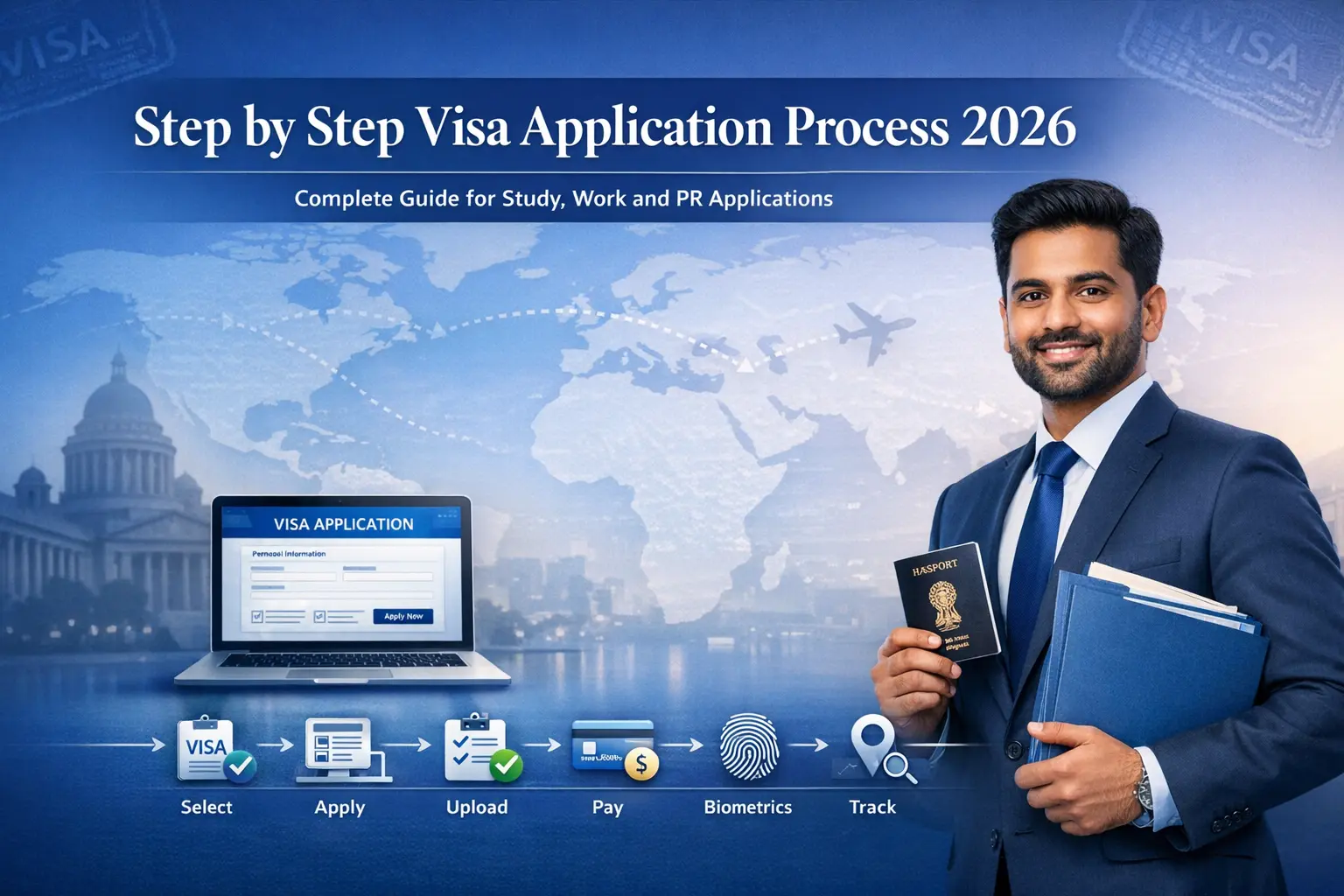
Applying for a visa in 2026 is no longer a paperwork-heavy, agent-driven process that depends on guesswork. It is structured, digitized, and strictly documentation-driven. Most major immigration countries such as Canada, Australia, Germany, United Kingdom, and United States now operate through centralized online portals where every form submission, document upload, payment, biometric record, and status update is digitally tracked. Artificial intelligence based risk assessments, automated background checks, and cross verification of financial records have made the process more transparent but also more unforgiving of mistakes.
For Indian applicants who want to study, work, or permanently settle abroad, this shift has created both opportunity and confusion.
Many applicants still ask:
- Should I apply through an agent or directly online
• Is one bank statement enough
• Can I reuse documents from a previous visa
• Does a tourist visa convert to work permit
• Why was my friend approved while I was rejected
The confusion usually arises because people rely on outdated information, social media groups, or second-hand advice instead of official immigration guidelines. What worked in 2022 may not work in 2026. Financial proof requirements have tightened. Background screening has become more detailed. Even minor inconsistencies in employment letters, tax filings, or travel history can lead to delays or refusals.
Another major misconception among Indian applicants is assuming that all visa processes are similar across countries. In reality, each country has its own structure:
- Canada follows a points-based and program-specific immigration pathway
• Australia uses skill occupation lists and invitation systems
• Germany focuses heavily on qualification recognition
• The UK emphasizes sponsorship compliance
• The US operates through petition-based systems for most work categories
Understanding these differences is critical. A strategy that works for Canada may not apply to Germany. A student visa pathway in Australia may differ significantly from the UK in terms of post-study work options.
Over the years, while assisting applicants with documentation reviews, financial proof structuring, SOP corrections, and rejection case analysis, one consistent pattern becomes clear. Most refusals are not because the applicant was unqualified. They happen because documentation did not clearly match immigration expectations. Missing income tax records, unexplained bank deposits, vague employment letters, or generic statements of purpose often create doubt in an otherwise eligible profile.
Visa approval in 2026 is not about luck. It is about compliance, clarity, and consistency.
This guide breaks down the complete step by step visa application process in a practical, structured manner so Indian applicants can approach immigration with preparation, confidence, and realistic expectations.
What is a Visa and Why It Matters in 2026
A visa is an official authorization granted by a foreign government that allows you to enter, stay, study, work, or settle in that country for a specific purpose and duration.
In 2026, a visa is not just an entry stamp. It is a compliance document linked to:
- Your financial history
• Your education and employment background
• Your travel history
• Your biometric identity
• Your long term immigration intent
Immigration authorities now assess applications using digital databases, risk profiling systems, and cross country information sharing. This means every detail in your application must align with supporting documents.
For Indian applicants planning to study, work, invest, or settle abroad, choosing the correct visa category is the most important first step. Applying under the wrong category or misunderstanding the purpose of a visa can result in rejection and long term immigration complications.
Types of Visas Indian Applicants Commonly Apply For
Below is a structured overview of the most common visa categories Indian applicants pursue in 2026:
| Visa Type |
Purpose |
Validity |
Leads to PR |
Common Destination Countries |
| Student Visa |
To pursue higher education or vocational training |
Duration of course plus limited post study period |
Yes, in many countries through post study work pathways |
Canada, Australia, Germany, United Kingdom |
| Work Permit |
To take up employment with an approved employer |
Based on job contract and employer sponsorship |
Sometimes, depending on country and job category |
Canada, United States, United Kingdom, Germany |
| Permanent Residency Visa |
To live and work permanently in the country |
Indefinite, subject to residency obligations |
Yes, this is direct permanent status |
Canada, Australia |
| Business and Investor Visa |
To establish or invest in a business |
Temporary to long term depending on investment size |
Often structured pathway to PR |
Australia, United Kingdom, United States |
| Tourist Visa |
Short term travel for tourism or family visits |
Short duration, typically 3 to 6 months |
No, cannot directly convert to PR |
United States, United Kingdom, Schengen Area |
Understanding these categories is critical because immigration officers evaluate your application strictly based on declared intent. For example:
- A tourist visa applicant showing strong employment ties in India is positive
• A student visa applicant showing unclear academic progression may raise concerns
• A work permit applicant without a genuine employer offer faces high rejection risk
In 2026, visa strategy is not about choosing the fastest route. It is about selecting the legally appropriate route that aligns with your long term immigration goal.
Step 1: Identify the Correct Visa Category
Choosing the correct visa category is the foundation of a successful application. Many Indian applicants make the mistake of selecting a visa based on what friends applied for, what an agent suggested, or what appears easier. In 2026, immigration systems are purpose driven. Your application must clearly match your intent.
A mismatch between intent and documentation is one of the most common reasons for refusal.
Understanding Your Purpose of Travel
Before looking at eligibility or documentation, ask yourself one clear question:
Why am I going abroad?
Your answer determines everything.
Here are practical scenarios based on real application patterns:
Scenario 1: Fresh Graduate Seeking Career Growth
If you have just completed your degree and want international exposure, a student visa may be more strategic than directly applying for permanent residency. Countries like Canada and Australia offer structured post study work pathways.
Scenario 2: Experienced IT Professional with 8 Years of Experience
A work permit or skilled migration pathway may be appropriate. For example, Germany focuses on qualification recognition, while United Kingdom requires employer sponsorship compliance.
Scenario 3: Business Owner with Capital Investment Plans
A business or investor visa may be suitable. Countries assess not just investment amount but business viability and job creation potential.
Scenario 4: Short Family Visit
A tourist visa is the correct route. Attempting to show immigration intent under a visitor visa can lead to refusal.
The key principle is alignment. Immigration officers evaluate whether your background, finances, and future plans logically support your chosen visa category.
Checking Eligibility Criteria
Once your purpose is clear, evaluate eligibility carefully.
In 2026, most immigration systems screen applications digitally before manual review. Basic eligibility gaps often lead to automatic refusals.
Check the following factors:
- Age requirements
Many skilled migration systems have age caps or reduced points after a certain age.
- Education
Your qualification must be recognized or equivalent to the destination country standards.
- Work experience
Experience must match the occupation category. Job titles alone are not sufficient. Duties must align.
- Language scores
English or other language test scores such as IELTS or equivalent are mandatory for many visa types.
- Financial proof
You must demonstrate genuine, traceable funds. Sudden deposits without explanation are major red flags.
Before proceeding, applicants should cross verify eligibility directly from official immigration portals rather than relying on social media advice.
Country Specific Differences Applicants Often Miss
Through documentation reviews and case evaluations, certain recurring mistakes appear across Indian applications.
- Assuming all point systems are identical
For example, Canada uses a structured ranking system, while Australia uses occupation lists and invitation rounds. Points calculation methods differ significantly.
- Ignoring qualification recognition requirements
In Germany, degree recognition is critical. Many applicants only realize this after applying.
- Underestimating sponsorship compliance
In the United Kingdom, employer sponsorship licenses must be valid. Not all job offers qualify.
- Misunderstanding dual intent rules
The United States treats immigrant and non immigrant intent differently. Applying under the wrong category can create long term complications.
- Overlooking financial structuring
Some countries require proof of funds for specific months. Others assess consistency of income, tax filings, and employment records.
The reality in 2026 is simple. Visa success depends less on ambition and more on regulatory alignment. Identifying the correct visa category is not just a formality. It is a strategic decision that determines your entire immigration journey.
Step 2: Research Official Immigration Sources Only
In 2026, immigration decisions are policy driven and frequently updated. Relying on outdated blogs, WhatsApp forwards, or unverified agents can lead to serious mistakes.
One of the most common patterns seen in rejected cases is applicants following incorrect information about eligibility, proof of funds, or work permit rules. Before preparing documents or paying fees, always verify information directly from official immigration sources.
This step may seem basic, but it prevents most avoidable refusals.
Identifying Genuine Government Websites
Every country has an official immigration portal. These websites:
- End with government domains such as .gov, .gc.ca, .gov.uk
• Clearly mention ministry or department names
• Provide downloadable checklists and updated fee structures
• Offer official application portals for online submissions
For example:
- Canada operates through its official immigration department website
• Australia uses a centralized immigration portal for visa lodgements
• United Kingdom publishes visa rules directly under its government domain
• Germany provides visa guidance through embassy and federal portals
In practical case reviews, applicants often confuse consultancy websites with government portals. A professional website design does not guarantee authenticity. Always check the URL carefully before entering personal details or making payments.
Avoiding Fraud Agents and Fake Job Offers
Fraud related to overseas jobs has increased significantly in recent years.
Common warning signs include:
- Guaranteed visa approvals
• No interview required
• Cash payments without receipt
• Job offers without employer verification
• Salary figures that seem unrealistic
• Pressure to pay immediately
In multiple documentation reviews, applicants submitted job offer letters that were later found to be unverifiable. Immigration authorities conduct background checks. If an employer does not exist or does not hold a valid sponsorship license where required, the application is refused. In serious cases, misrepresentation bans can apply.
Practical advice:
- Verify employer registration in the destination country
• Confirm sponsorship eligibility where required
• Avoid paying large consultancy fees without written agreements
• Never submit altered bank statements or fake employment letters
Remember that no legitimate immigration system guarantees approval. Final decisions always rest with immigration officers.
How Policies Change in 2026 and Why You Must Verify Updates
Immigration rules are dynamic. In 2026, several countries are adjusting:
- Proof of funds requirements
• Post study work durations
• Occupation shortage lists
• Salary thresholds
• Health insurance requirements
Many applicants rely on information shared by friends who applied one or two years earlier. This creates risk. Even a small change in minimum salary threshold or language score requirement can make an application ineligible.
From practical experience, one frequent issue is outdated financial requirements. Applicants show funds based on previous year guidelines and fall short under updated criteria. This results in refusal despite otherwise strong profiles.
Best practice in 2026:
- Check official government portals before submitting
• Review updated checklists
• Confirm visa fees and biometric procedures
• Verify processing timelines
• Cross check document requirements again before final submission
Immigration is a regulated process, not a promotional scheme. Researching only official sources protects your finances, your application history, and your long term immigration goals.
Step 3: Prepare Required Documents Properly
In 2026, documentation is the backbone of every visa application. Immigration systems are digital, but decisions are still evidence based. If your documents do not clearly support your claims, your application can be refused even if you are otherwise eligible.
From practical case reviews, most rejections are not due to lack of qualification. They happen because documents are incomplete, inconsistent, or poorly structured.
Preparing documents correctly is not just about collecting papers. It is about presenting verifiable proof that aligns with your visa category.
Core Documents Required for Most Visa Types
Below is a structured overview of the key documents commonly required for student, work, and permanent residency applications.
| Document |
Why Required |
Common Mistakes |
Verification Tips |
| Passport |
Establishes identity, nationality, and travel history |
Expired passport, damaged pages, missing previous passports |
Ensure validity of at least 6 to 12 months beyond intended travel date |
| Educational Transcripts |
Confirms academic qualifications and eligibility |
Submitting incomplete mark sheets, missing semester results |
Provide consolidated mark sheets and degree certificates; ensure names match passport |
| Work Experience Letters |
Validates professional background |
Generic letters without job duties, unsigned letters |
Include detailed job responsibilities, company letterhead, contact details, and authorized signature |
| Bank Statements |
Demonstrates financial stability and proof of funds |
Sudden large deposits, low average balance, edited statements |
Provide official stamped statements covering required period; explain large transactions |
| Tax Returns |
Shows income consistency and financial credibility |
Not filing ITR despite employment, mismatch between income and bank records |
Submit recent Income Tax Returns and Form 16 if applicable |
| Language Test Scores |
Proves language proficiency |
Expired test scores, insufficient band score |
Check validity period; ensure minimum required score is met |
| Police Clearance Certificate |
Confirms no criminal background |
Submitting outdated certificate |
Obtain recent certificate as per country specific validity rules |
| Medical Reports |
Confirms health compliance |
Using unauthorized medical centers |
Complete medicals only through approved panel physicians |
Document Formatting and Notarization Rules
Many applicants underestimate formatting requirements.
Important considerations:
- Documents must be clear, scanned in high resolution, and fully readable
• File size limits must match online portal requirements
• Non English documents must be officially translated
• Some countries require notarization or attestation
• Name spelling must match across passport, education, employment, and financial documents
A frequent issue seen in reviews is mismatch in names or dates. Even small variations can trigger additional verification or delay.
For countries like Germany, translated and certified copies are often mandatory. For sponsorship based systems such as United Kingdom, employment documentation must align exactly with sponsor details.
Never upload unclear mobile photos of documents. Use proper scanning and review every file before submission.
Real Reasons Applications Get Rejected Due to Documentation
Based on documented case patterns, the following documentation mistakes frequently lead to refusal:
- Inconsistent employment history between resume and experience letters
• Bank statements showing unexplained large deposits
• Tax filings that do not match declared salary
• Fake or unverifiable employment letters
• Expired language test scores
• Missing mandatory documents
• Incorrect translation or missing certification
One recurring issue is financial structuring. Applicants sometimes borrow funds temporarily to meet proof of funds requirements. Immigration authorities now assess transaction history, income consistency, and source of funds. If funds appear temporary or unexplained, credibility is affected.
Another common rejection factor is weak supporting explanation. For example, submitting employment letters without detailed job duties makes it difficult for officers to match experience to occupation codes.
In 2026, documentation must tell a consistent and transparent story. Every document should support your eligibility, financial stability, and genuine intent.
Visa approval is not about submitting many documents. It is about submitting the right documents in the correct format with full clarity and authenticity.
Step 4: Create Online Profile and Submit Application
By 2026, almost all major immigration systems are fully digitized. Whether you are applying to Canada, Australia, United Kingdom, Germany, or the United States, your application begins with an online account.
This stage may look simple, but it is where many avoidable mistakes happen. Once submitted, correcting errors can be difficult and sometimes impossible without withdrawing the application.
Accuracy at this stage is critical.
Filling Online Forms Correctly
Online visa forms are not just basic data entry fields. They are legal declarations.
Important guidelines:
- Enter your name exactly as it appears on your passport
• Declare all previous travel history accurately
• Mention all past visa refusals if any
• Provide complete employment history without gaps
• Ensure dates match supporting documents
Common submission errors seen in real cases:
- Writing nickname instead of passport name
• Incorrect passport expiry date
• Hiding previous refusals
• Leaving employment gaps unexplained
• Selecting wrong visa category
• Choosing incorrect marital status
Even small inconsistencies can trigger additional scrutiny. Immigration systems cross verify details with biometric records, travel databases, and previous applications.
Before final submission, review every section carefully. Many applicants rush through this stage assuming documents will speak for themselves. In reality, officers first assess your form before reviewing uploads.
Uploading Documents Without Errors
Once the form is complete, you will upload supporting documents.
Key points to remember:
- Follow file format instructions such as PDF or JPEG
• Stay within specified file size limits
• Upload each document in the correct category
• Combine multi page documents properly
• Ensure scans are clear and readable
Common upload mistakes include:
- Uploading bank statement under education section
• Submitting blurred scans
• Missing mandatory document uploads
• Uploading password protected files
• Incorrect file naming
In documentation audits, one frequent issue is incomplete uploads. Applicants assume a document is optional when it is mandatory. This leads to refusal without further clarification.
Always download and follow the official checklist before uploading.
Paying Visa Fees Securely
After uploading documents, you must pay the visa fee through the official portal.
Important precautions:
- Pay only through official government websites
• Avoid third party payment links
• Save transaction receipts
• Confirm successful payment confirmation message
• Check currency conversion rates
Common payment errors:
- Payment failure but assuming submission is complete
• Double payment due to repeated clicks
• Paying wrong visa fee category
• Using expired credit or debit cards
• Ignoring confirmation emails
In some cases, applicants believed their application was submitted, but payment was not processed. As a result, their application was never officially lodged.
After payment, always:
- Download submission confirmation
• Save application reference number
• Take screenshot of payment receipt
In 2026, the online submission stage is legally binding. Every declaration, upload, and payment creates a digital record. Careful review at this stage prevents unnecessary delays, refusals, and financial loss.
Step 5: Biometrics, Medical Examination and Background Checks
Once your online application is submitted and fee is paid, the next stage involves identity verification and security screening. In 2026, this step is mandatory for most visa categories including student, work, and permanent residency applications.
Many applicants assume that submission means approval is near. In reality, this stage plays a critical role in the final decision.
Processing does not move forward until biometrics and required examinations are completed.
What Happens During Biometrics
Biometrics typically includes:
- Fingerprint collection
• Digital photograph
• Signature capture
You will receive an appointment letter to visit an authorized Visa Application Centre.
During the appointment:
- Your fingerprints are scanned electronically
• Your photograph is captured according to immigration standards
• Your passport is verified
The process usually takes 15 to 30 minutes.
Important practical observations:
- Carry original passport and appointment confirmation
• Reach early to avoid rescheduling
• Ensure fingers are free from cuts or heavy mehendi, which can affect scanning
Biometric data is stored and cross verified with immigration databases. Countries such as Canada, United Kingdom, and Australia rely heavily on biometric verification for identity matching and background checks.
Timelines:
Biometric confirmation is usually updated within a few days in your online account. Processing may formally begin after biometrics are received.
Medical Test Requirements
Most long term visas require medical examination by approved panel physicians.
Medical tests typically include:
- Chest X ray
• Blood tests
• Urine tests
• General physical examination
You cannot choose any hospital. You must visit an authorized medical center listed on the official immigration website.
Common mistakes seen:
- Visiting non approved clinics
• Delaying medical appointment beyond deadline
• Not disclosing previous medical history
Medical inadmissibility is rare but can occur in cases of serious untreated conditions that may burden the public health system.
Timelines:
Medical reports are usually uploaded electronically by the clinic directly to immigration authorities. Results may take 5 to 10 working days depending on country and clinic workload.
Police Clearance and Security Screening
Police Clearance Certificate confirms that you do not have a criminal background.
Most countries require:
- Clearance from India
• Clearance from any country where you lived for more than a specified duration
Common documentation issues:
- Submitting expired certificates
• Providing incomplete residential history
• Omitting previous international stays
Security screening goes beyond police clearance. Immigration authorities assess:
- Travel history
• Employment background
• Immigration compliance history
• Any previous visa refusals
In some cases, background verification can take longer if additional checks are triggered.
Realistic Processing Expectations in 2026
Processing times vary based on:
- Visa category
• Country
• Application volume
• Background complexity
Student visas may process faster during low season but slower during peak intake months. Work permits tied to employer sponsorship may require additional verification. Permanent residency applications typically take longer due to detailed screening.
From practical experience:
- Biometrics confirmation does not mean approval is guaranteed
• Medical clearance does not automatically finalize decision
• Background checks can extend timelines without visible updates
Applicants should avoid panic if status remains unchanged for several weeks. Immigration systems often do not show intermediate review steps.
In 2026, patience and compliance are essential. Complete every requirement promptly, monitor your online account regularly, and avoid submitting repeated status inquiries unless processing time has officially exceeded published timelines.
This stage ensures identity verification, public safety compliance, and overall credibility before final visa approval.
Step 6: Visa Interview Preparation
Not all visa categories require an interview. However, when an interview is scheduled, it becomes a decisive stage. In 2026, interviews are structured to assess credibility, intent, and consistency between your documents and your answers.
Immigration officers are trained to identify gaps, rehearsed answers, and unclear intentions. The goal is not to trick you. The goal is to verify whether your stated purpose matches your profile.
When Interviews Are Required
Interviews are commonly required for:
- Student visas for countries like the United States and sometimes the United Kingdom
• Certain work visa categories where employer sponsorship must be verified
• Cases where documentation raises questions
• Applications with previous refusals
• Permanent residency files flagged for additional review
Countries such as Canada and Australia may not require interviews in most standard cases, but they reserve the right to call applicants if clarification is needed.
If you receive an interview request, treat it seriously. It means the officer needs direct clarification before making a decision.
Common Interview Questions for Work and Study Visas
Below are typical questions asked during interviews.
For student visas:
- Why did you choose this course
• Why this university and not one in India
• How does this course align with your previous education
• Who is funding your education
• What are your plans after completing the course
For work visas:
- What is your job role in the destination country
• How did you secure this job
• What are your key responsibilities
• Why were you selected over local candidates
• What is your salary and employment contract duration
For both categories:
- Have you previously been refused a visa
• Do you have relatives in the destination country
• How will you support yourself financially
• Do you plan to return to India
Officers are not only evaluating your answers. They assess confidence, clarity, and consistency.
Real Interview Mistakes Indian Applicants Make
Based on documented case patterns and interview feedback analysis, several recurring mistakes appear.
- Memorized and robotic answers
Applicants sometimes rehearse scripted responses given by agents. When asked a follow up question, they struggle to answer naturally.
- Inconsistent financial explanation
Many applicants cannot clearly explain the source of funds. If bank statements show large deposits, you must be able to justify them confidently.
- Weak course justification
For student visas, choosing an unrelated course without explaining career progression raises doubts.
- Overstating immigration intent
In temporary visa categories, openly stating plans to settle permanently without appropriate pathway can create credibility concerns.
- Lack of basic knowledge about employer or university
Work visa applicants sometimes cannot describe their employer’s business operations. This immediately raises red flags.
- Hiding previous refusals
Immigration systems already record refusal history. Non disclosure is treated as misrepresentation.
Practical preparation advice:
- Review your entire application before the interview
• Understand every document you submitted
• Practice explaining your financial structure
• Answer honestly and concisely
• Do not provide extra information unless asked
Interviews in 2026 are credibility checks. Approval depends less on perfect English and more on logical consistency between your profile, documents, and answers.
Confidence comes from preparation, not memorization.
Step 7: Tracking Application Status and Processing Time in 2026
After completing biometrics, medicals, and interviews if required, the next phase is waiting for a decision. In 2026, visa tracking systems are transparent but not always detailed. Applicants can see status updates, but internal review stages are not fully visible.
One of the most common mistakes is comparing timelines with friends or social media posts. Processing depends on visa category, background checks, country workload, and individual profile complexity.
Patience and realistic expectations are essential.
How to Track Your Visa Application
Most countries provide an online tracking system through the same portal used to submit the application.
You can usually track your application using:
- Application reference number
• Registered email ID
• Passport details
• Biometric receipt number
For example:
- Canada updates status directly in the online immigration account
• United Kingdom provides updates through its visa application system
• Australia reflects processing stages inside the ImmiAccount portal
• United States allows case tracking through its official visa status portal
Typical status updates may include:
- Application received
• Biometrics completed
• Medical results received
• Background verification in progress
• Decision made
Important practical advice:
- Do not rely on third party tracking websites
• Check status only through official portals
• Avoid sending repeated email inquiries unless processing exceeds published timelines
Frequent status checking does not speed up the process.
Normal Processing Timelines by Visa Type
Processing times change periodically, but below is a general overview for 2026 based on common visa categories.
| Country |
Student Visa |
Work Visa |
PR Visa |
Average Processing Time |
| Canada |
4 to 8 weeks |
8 to 16 weeks |
6 to 12 months |
Varies by program and volume |
| Australia |
4 to 12 weeks |
8 to 20 weeks |
8 to 18 months |
Depends on occupation and invitation round |
| United Kingdom |
3 to 6 weeks |
3 to 8 weeks |
6 to 12 months |
Faster under priority services |
| United States |
2 to 8 weeks after interview |
Varies widely based on petition category |
Several months to years depending on category |
Highly category specific |
| Germany |
4 to 12 weeks |
6 to 16 weeks |
Long term residence varies |
Embassy workload dependent |
These are estimated ranges. Individual cases may process faster or slower depending on background checks and document clarity.
What Delays Applications in 2026
From documented application patterns, the following factors commonly cause delays:
- Incomplete documentation
• Additional background verification
• Employment verification checks
• Unclear financial transactions
• Pending medical reports
• High seasonal application volumes
• Previous immigration refusals
• Security screening flags
One frequent delay factor is inconsistent employment history. If immigration officers need to verify job roles or employer authenticity, processing can extend significantly.
Another delay trigger is unexplained financial activity. Large recent deposits without documentation often result in additional review.
Applicants should also understand that student visa timelines increase during peak intake months, while work permit processing can slow during policy review periods.
In 2026, immigration systems are efficient but strict. Clear documentation, timely compliance, and realistic expectations reduce anxiety during the waiting period.
Tracking is about monitoring progress, not predicting approval. The final decision depends on overall eligibility, credibility, and regulatory compliance.
Step 8: Visa Approval, Stamping and Travel Preparation
Receiving a visa approval notification is a major milestone. However, approval is not the final step. In 2026, post approval compliance is equally important. Many applicants assume that once the visa is granted, the process is complete. In reality, passport submission, visa conditions, and travel preparation require careful attention.
This stage determines how smoothly you transition into your new country.
Passport Submission Process
Depending on the country and visa category, you may receive:
- A Passport Request letter
• An e visa approval
• Instructions for visa vignette stamping
For countries like Canada and United Kingdom, applicants often need to submit their passport to an authorized Visa Application Centre for visa stamping.
The process generally involves:
- Printing the passport request letter
• Submitting original passport
• Paying passport transmission service charges if applicable
• Tracking passport return through official channels
Common mistakes at this stage:
- Delaying passport submission beyond deadline
• Submitting damaged passport
• Booking travel tickets before receiving stamped passport
Processing after passport submission usually takes a few days to a few weeks depending on workload.
Always wait until you physically receive your passport with visa stamp or official electronic travel authorization before making final travel plans.
Understanding Visa Conditions
Visa approval comes with specific conditions. Ignoring them can create immigration violations.
Carefully check:
- Visa validity dates
• Entry deadline
• Work restrictions
• Study conditions
• Employer restrictions if applicable
• Number of allowed entries
For example:
- A student visa may allow limited work hours per week
• A work visa tied to sponsorship in the United Kingdom cannot be used to change employers without permission
• Some countries require activation of residence permit after arrival
Many applicants do not read visa conditions carefully and unintentionally violate them. This can impact future extensions or permanent residency eligibility.
What to Do After Visa Approval
Visa approval is the beginning of relocation planning.
Here is a structured preparation checklist:
Travel Planning
- Book flights after visa confirmation
• Arrange temporary accommodation
• Purchase required travel insurance
• Keep copies of all documents in physical and digital format
Financial Preparation
- Arrange international debit or forex card
• Carry limited but sufficient funds as per declaration rules
• Inform your Indian bank about international usage
Academic or Employment Preparation
For students:
- Confirm university enrollment
• Arrange accommodation near campus
• Attend pre departure orientation
For work visa holders:
- Confirm joining date
• Understand employment contract terms
• Check local tax registration requirements
Settlement Preparation
- Understand local transportation system
• Research cost of living
• Prepare for initial expenses such as security deposit and utilities
• Check SIM card and banking options after arrival
Countries like Australia and Germany may require local address registration soon after arrival. Failing to complete mandatory post arrival formalities can create administrative issues.
Practical Settlement Guidance
From real relocation cases, initial challenges often include:
- Underestimating cost of living
• Not arranging short term accommodation in advance
• Lack of awareness about local documentation requirements
• Delayed opening of local bank accounts
It is advisable to:
- Carry all original academic and employment documents
• Keep digital backups in secure cloud storage
• Join verified community groups for guidance
• Follow official government arrival instructions
Visa approval in 2026 is not the end goal. It is the gateway to responsible relocation. Careful planning during this stage ensures a smooth transition and protects your long term immigration journey.
Preparation, compliance, and awareness continue even after approval.
Common Reasons Visa Applications Get Rejected
In 2026, visa refusals are rarely random. Immigration decisions are evidence based and digitally verified. Most rejections happen due to documentation gaps, credibility concerns, or financial inconsistencies rather than lack of qualification.
Below are the most common refusal reasons observed across applications to countries such as Canada, United Kingdom, Australia, Germany, and the United States.
Immigration authorities require clear proof that you can support yourself without becoming financially dependent.
Common issues include:
- Bank balance lower than required minimum
- Sudden large deposits just before application
- Funds borrowed temporarily without explanation
- Inconsistent income records
Case example:
A student applicant showed the required amount in the bank, but the statement reflected a large deposit just ten days before submission. No supporting explanation or source documentation was provided. The application was refused due to concerns about genuine access to funds.
Misrepresentation includes providing false information, hiding previous refusals, or submitting altered documents.
This is one of the most serious refusal grounds because it can lead to multi year bans.
Common examples:
- Not declaring prior visa refusal
- Submitting edited bank statements
- Inflated job roles or fake experience letters
- Incorrect marital status declaration
Case example:
A work visa applicant failed to disclose a previous refusal in another country. Immigration systems cross verified historical records. The application was refused for non disclosure, even though the applicant otherwise met eligibility criteria.
Submitting an application without mandatory documents leads to immediate refusal in many cases.
Frequent issues:
- Missing police clearance certificate
- Expired language test results
- Incomplete employment letters
- Missing financial statements
Case example:
An applicant applied for a skilled migration pathway but forgot to upload a required employment reference letter detailing job duties. Because duties were not verifiable, the officer could not confirm eligibility under the occupation category.
- Weak Statement of Purpose
For student and some work visas, the Statement of Purpose plays a critical role. A generic or copied SOP weakens credibility.
Common SOP mistakes:
- No clear career progression explanation
- Copy paste content from internet templates
- No logical link between previous education and chosen course
- Overemphasis on settlement intent under temporary visa
Case example:
A student with a commerce background applied for a completely unrelated technical diploma without explaining career transition. The SOP did not justify the academic shift. The officer questioned genuine study intent and refused the application.
- Unverified employment letters
Employment letters must be authentic, detailed, and verifiable.
Frequent problems:
- Generic one page certificates without duties
- No contact information
- Employer not legally registered
- Salary mismatch with tax returns
Case example:
A skilled migration applicant submitted an experience letter from a company that could not be verified through public records. When the immigration authority attempted verification, the contact number was unreachable. The application was refused due to credibility concerns.
Practical Insight
Across hundreds of documented cases, one pattern stands out. Most refusals happen due to avoidable documentation and credibility errors.
In 2026, immigration systems are interconnected and digitally cross verified. Even minor inconsistencies can trigger deeper scrutiny.
Visa success depends on three core factors:
- Transparency
- Consistency
- Verifiable documentation
A strong profile alone is not enough. Your documents must clearly prove what you claim.
Expert Tips to Increase Visa Approval Chances in 2026
In 2026, visa approvals are no longer influenced by presentation alone. Immigration systems are structured, data driven, and evidence based. From reviewing application patterns across countries like Canada, Australia, United Kingdom, Germany, and the United States, certain practices consistently improve approval probability.
Below are practical, experience driven recommendations.
- Maintain clean financial records
Financial credibility is one of the strongest approval factors.
Practical guidance:
- Maintain consistent bank balances over several months
- Ensure salary credits match employment letters
- File Income Tax Returns regularly
- Avoid unexplained cash deposits
- Keep documentation ready for large transactions
Immigration officers now review transaction history, not just closing balance. A stable and traceable financial pattern builds trust.
- Use clear documentation language
Employment letters, financial affidavits, and supporting explanations must be clear and detailed.
Recommendations:
- Include job duties that match the visa occupation category
- Use official company letterhead and authorized signatures
- Avoid vague phrases such as handled various responsibilities
- Ensure dates are precise and consistent
Ambiguous documentation creates doubt even if the profile is strong.
- Avoid copied Statements of Purpose
For student and certain work visas, the Statement of Purpose reflects genuine intent.
Effective SOP characteristics:
- Personal career progression explanation
- Logical academic or professional transition
- Realistic short term and long term goals
- Clear financial explanation
Officers easily identify template based or copied content. A personalized narrative aligned with your background carries more weight than polished but generic writing.
- Align course selection with career background
This is especially important for student visas.
If your previous education or work experience does not align with your chosen program, you must clearly justify the transition.
For example:
- An IT professional pursuing advanced data analytics shows progression
- A commerce graduate applying for hospitality management without explanation raises concerns
Career continuity strengthens genuine intent.
- Avoid sudden large bank deposits
One of the most frequent refusal triggers is sudden fund infusion shortly before application.
Best practice:
- Maintain required funds well in advance
- Document source of large transfers
- Provide loan sanction letters if education loan is used
- Keep funds in traceable banking channels
Immigration authorities assess whether funds are genuinely available or temporarily arranged.
Additional Strategic Advice
- Double check all forms before submission
• Declare previous refusals honestly
• Review visa conditions carefully
• Keep digital and physical copies of every submission
• Monitor policy updates before applying
In 2026, visa approval is not about luck or influence. It depends on structured preparation, transparent documentation, and regulatory alignment.
Applicants who treat immigration as a compliance process rather than an emotional decision significantly improve their chances of success.
Estimated Cost of Applying for a Visa in 2026
One of the most underestimated parts of the visa journey is the total cost involved. Many applicants plan only for the visa fee and later realize there are multiple additional expenses.
In 2026, visa costs vary depending on country, visa category, and whether you apply independently or through a consultant. Countries such as Canada, Australia, United Kingdom, Germany, and the United States all have different fee structures.
Below is a general cost overview for Indian applicants in 2026.
| Expense Type |
Estimated Cost Range |
Mandatory or Optional |
| Visa Fee |
₹8,000 to ₹45,000 depending on country and visa type |
Mandatory |
| Biometrics |
₹5,000 to ₹8,000 |
Mandatory for most visa categories |
| Medical Test |
₹4,000 to ₹10,000 |
Mandatory for long term visas |
| Language Test such as IELTS |
₹16,000 to ₹18,000 per attempt |
Mandatory for student, work, and PR categories in many countries |
| Travel Insurance |
₹1,000 to ₹5,000 depending on duration and coverage |
Mandatory for some visas, optional for others |
| Consultancy Charges |
₹30,000 to ₹1,50,000 depending on services |
Optional |
Practical Cost Planning Insights
- Visa fees vary significantly by category. Permanent residency applications are usually more expensive than student or tourist visas.
• Language test fees apply per attempt. Retaking the exam increases overall cost.
• Medical tests must be conducted through approved panel clinics.
• Travel insurance is compulsory for certain countries and recommended even when not mandatory.
• Consultancy charges depend on whether services include documentation review, SOP drafting, profile assessment, or full representation.
Additional indirect expenses may include:
- Document translation
• Notarization
• Education credential assessments
• Police clearance processing fees
• Courier and passport transmission charges
From practical case reviews, applicants who budget only for visa fees often face delays due to lack of financial planning.
In 2026, a well prepared applicant should calculate total expected expenses in advance, including possible retest or reapplication scenarios. Financial readiness supports both visa approval and smooth relocation planning.
Conclusion
Applying for a visa in 2026 is a structured legal process, not a matter of chance. Immigration systems across major destinations such as Canada, Australia, United Kingdom, Germany, and the United States are compliance driven, digitally monitored, and evidence based.
Visa success depends on three pillars:
- Preparation
• Accuracy
• Transparency
Applicants who invest time in understanding the correct visa category, maintaining clean financial records, submitting consistent documentation, and verifying official requirements significantly reduce rejection risks.
Immigration should never be treated as an emotional or rushed decision. Choosing a country because a friend migrated or applying under a category that does not align with your profile often leads to unnecessary refusals. Every country has its own legal framework, eligibility standards, and documentation expectations.
In 2026, informed and documentation driven decisions are the strongest advantage an applicant can have.
Approach the process with clarity.
Prepare thoroughly.
Verify everything from official sources.
Submit only authentic and consistent documents.
Visa approval is not about shortcuts. It is about structured compliance.
With careful planning, realistic expectations, and professional execution, your international education, career, or settlement journey can begin on a strong and legally sound foundation.
Frequently Asked Questions
1. Can I apply for a visa without using a consultant?
Yes, you can apply directly through official immigration portals of countries like Canada, Australia, and United Kingdom. Most systems are fully digitized and user-friendly. However, you must carefully review document checklists, eligibility rules, and financial proof requirements. Many rejections occur due to incomplete documentation rather than ineligibility. A consultant is optional, but responsibility for accuracy always remains with the applicant.
2. How much bank balance is required for a student visa?
The required balance depends on tuition fees, living expenses, and country-specific financial thresholds. Immigration authorities assess not just the closing balance but transaction history and source of funds. Sudden large deposits without explanation can raise credibility concerns. Some countries require proof of funds for a specific number of months. Always verify current financial requirements on official immigration websites before applying.
3. Can I convert a tourist visa into a work permit?
In most cases, no. Tourist visas are granted strictly for temporary visits such as tourism or family travel. Working or attempting to convert a visitor visa into a work permit without proper authorization can violate immigration laws. Countries like United States and United Kingdom have strict rules regarding visa intent. Always apply under the correct category aligned with your purpose.
4. What happens if my visa application gets rejected?
A rejection does not permanently block future applications, but it must be handled carefully. First, review the refusal letter to understand the exact reason. Correct documentation gaps or credibility issues before reapplying. Never ignore or hide previous refusals in future applications. Immigration systems are interconnected, and non-disclosure may result in misrepresentation concerns.
5. How long does visa processing take in 2026?
Processing times vary by visa type, country, and background verification requirements. Student visas may take a few weeks during non-peak seasons, while permanent residency applications can take several months. Delays often occur due to incomplete documents or additional security screening. Always check official government portals for updated timelines instead of relying on social media estimates.
6. Is IELTS mandatory for all visa types?
Language tests such as IELTS are mandatory for most student, skilled migration, and work visa categories where English proficiency is required. However, some employer-sponsored roles or specific visa categories may have exemptions. Language test scores also have validity periods, usually two years. Always confirm the required minimum band score and accepted test type for your chosen country.
7. Can I apply for permanent residency directly from India?
Yes, certain countries allow direct permanent residency applications through skilled migration pathways. For example, Canada and Australia offer structured programs based on points systems. However, eligibility depends on age, work experience, education, language score, and occupation demand. Strong documentation and competitive profiles are essential.
8. Do I need travel insurance for my visa application?
Travel insurance is mandatory for many short-term visas and strongly recommended for long-term stays. Some countries require minimum medical coverage amounts as part of visa approval. Even when not compulsory, insurance protects against unexpected medical expenses abroad. Always check visa guidelines to confirm whether insurance must be purchased before submission or after approval.
9. How important is the Statement of Purpose?
For student and certain work visas, the Statement of Purpose is critical. It explains your academic or career goals, financial readiness, and genuine intent. A copied or generic SOP can weaken your application. Immigration officers look for logical progression between past education, chosen course or job role, and future plans. A personalized, well-structured explanation improves credibility.
10. What should I do immediately after visa approval?
After approval, review visa conditions carefully. Check entry deadlines, work limitations, and document requirements. Arrange accommodation, travel insurance, and financial access. Keep copies of all submitted documents. Some countries require local registration after arrival. Proper preparation ensures a smooth transition and avoids post-arrival compliance issues.