The EU’s new Entry/Exit System (EES) is a new digital border management system that records the entry, exit, and refusal of entry data of non-EU nationals traveling to the Schengen area for short stays. It is being gradually introduced starting October 12, 2025, and is expected to be fully operational at all external border points by April 10, 2026.
What is the EES?
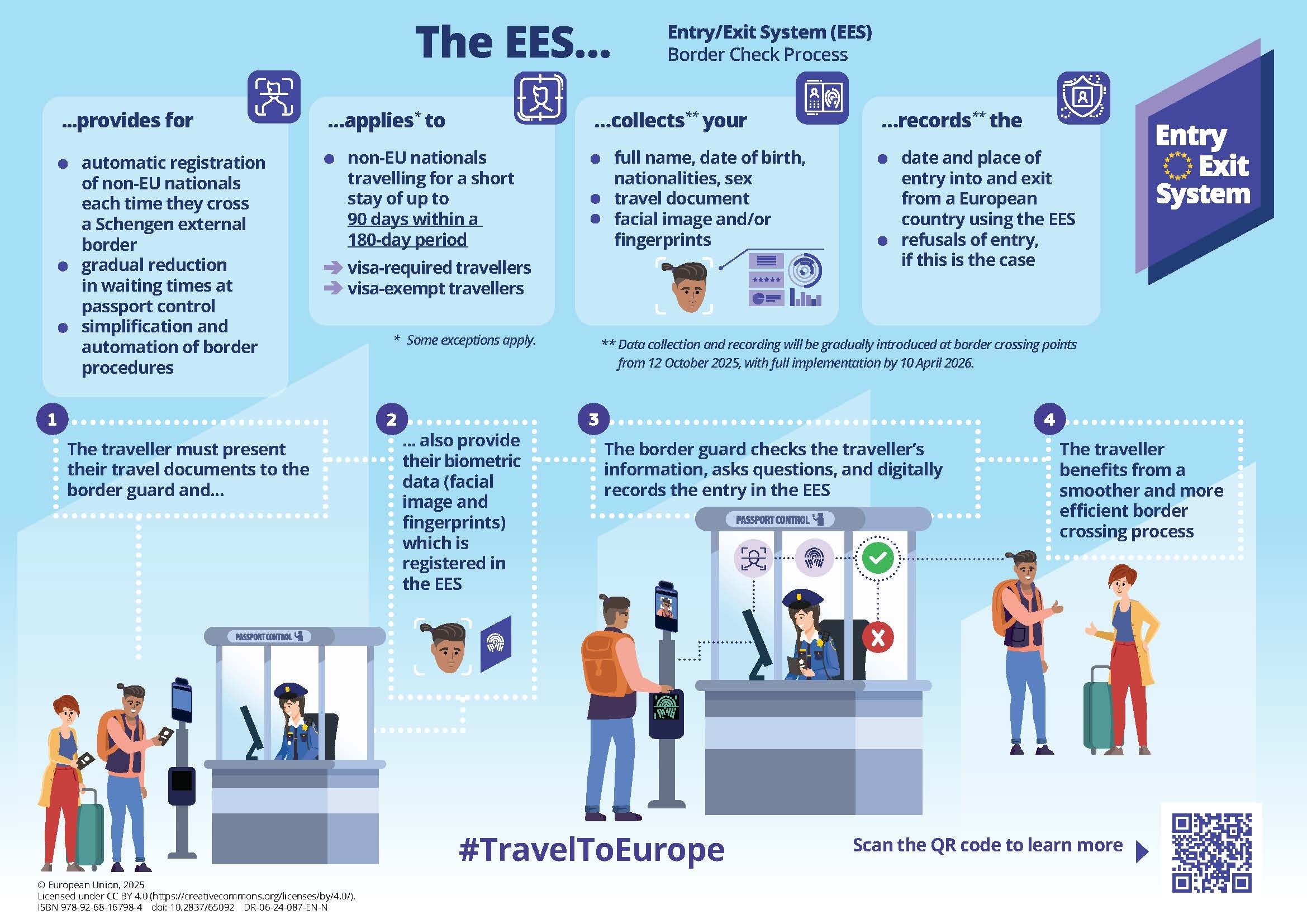
- The EES is an automated IT system created by the European Commission and operated by eu‑LISA for the external borders of the Schengen area.
- It is designed to register the entry, exit, and refusal of entry of non-EU nationals (third-country nationals) when they cross the external borders of the participating countries.
- Key data combined include: name, travel document data, biometric data (fingerprints and facial image), and the date/place of entry and exit.
- It replaces, for these non-EU travellers, the traditional manual passport stamping system at external borders of Schengen states.
- Important timeline:
- Systems roll-out begins 12 October 2025.
- Full operation (i.e., replacement of stamping completely) aimed by 10 April 2026.
Why was it introduced?
- To enhance border security, enable better monitoring of short-stays and overstays, reduce identity/document fraud, and make border processes more automated and efficient.
- As part of the “Smart Borders” agenda of the EU, aimed at modernising how external borders are managed.
How it works — Step by Step
Here’s how the process typically works for a non-EU traveller (including an Indian citizen) entering/exiting a Schengen state that uses EES:
Entry
- Arrival at the external border (airport, ferry, land crossing) of a Schengen country participating in EES.
- At first crossing (after the system is live at that checkpoint) you will:
- Present your passport/travel document.
- Have your facial image taken (photo) and fingerprints scanned (usually four fingers) — this is mandatory for adults; children under a certain age may be exempt from fingerprinting in some countries.
- Border officials or self-service kiosks will record your entry: date, place, travel document details.
- A digital “entry” record is created in EES for you. On subsequent visits (within the 3-year validity) you may simply verify your identity rather than full fingerprinting again.
- Your stay time starts being calculated (for example, the 90-days in any 180-days rule). The system allows border authorities to see when you exit so they can check for overstays, etc.
Exit
- On leaving the Schengen external border, your departure will similarly be recorded (date, place). This enables the system to know you left and can calculate your stay.
- For subsequent entries you will already have a record; you still need to check in (scan passport/biometric) but the “first-time registration” portion may be lighter.
Validity and Data
- Your registration in EES will remain valid up to 3 years or until your travel document expires (whichever is sooner).
- Data protection and fundamental rights provisions apply (facial image/fingerprints are sensitive data).
- During the roll-out period (until April 2026) some borders may still stamp passports; travellers may experience mixed procedures.
Key rule to note
- The common “90 days in any 180-day period” rule for short stays in the Schengen area still applies for many non-EU nationals; EES enables better tracking of this.
- If you overstay, the system helps authorities detect that you’ve done so (since they see entry + absence of exit) and can enforce measures accordingly.
Who is affected — and how for Indian travellers / settlers
A) Tourists (short-stay)
- If you’re an Indian citizen visiting Europe for tourism (e.g., visiting France, Germany, Italy …) and you enter the Schengen area: you will be subject to EES registration when you cross an external border of a participating country (unless exempt).
- On your first arrival post-roll-out you will provide biometrics and passport data, then your stay will be tracked.
- You need to monitor your total days of stay in Schengen: if you have visa-free status (if applicable) or have a Schengen visa, the “90 days in any 180 days” rule may apply (depending on your visa category). EES adds an extra layer of tracking.
- For you as a tourist: be prepared for potentially slightly longer border control times (especially early in rollout) because biometric registration may take time. Some smaller border posts may still stamp passports until full roll-out.
- Good practice: make sure your travel documents (passport, visa, travel insurance, accommodation details) are in order; arrive early at border; know whether the checkpoint has EES kiosks or mixed mode.
B) Business / Short-Term Work Travellers
- Similar to tourists in terms of entry/exit registration. If you’re going for short-term business, meetings, conferences, this system applies if you cross an external Schengen border as a non-EU national.
- If you cross borders frequently (e.g., multiple short trips into the Schengen area), the EES system will help border authorities and you should be aware of how your aggregated days of stay are being tracked.
- If you travel often, you may benefit from the “subsequent visit” scenario once your biometric registration is done — meaning faster checks later.
- Also: Even if you have a short-stay visa or you’re visa-exempt, the EES applies (for short stays) and might affect how border management views your movements (i.e., frequent entries/exits might be scrutinised).
- For business travellers, key tip: keep a clear record of your entries/exits, carry invitation letters, proof of business meetings, accommodation, and be aware of the border rules.
C) Long-Term Settlers / People Planning to Move
- If you plan to move to Europe (e.g., apply for a long-stay visa, residence permit, settle with family, etc.), then strictly speaking the EES for short stays might be less directly relevant once you hold a long-stay residence permit in a Schengen/EU country. The regulation states that the EES applies “non-EU nationals travelling for a short stay” across external borders.
- However, you still need to be aware of border controls when you enter/exit, especially before your settlement status is fully recognised, or when you travel across Schengen countries. Also, your past short-stay visits are recorded – which may matter if authorities check your travel history or compliance with earlier visa rules.
- If you are settling, you’ll need to understand how EES fits into the broader EU migration/visa framework: e.g., residence permits, long-stay visas, permitted stay durations, transition from short-stay to long-stay status.
- Being aware of EES means you’ll avoid surprises at border entry when moving/residing, and can plan compliant entries/exits (especially if you maintain ties with India and travel back/forth).
Who is not (or less) affected?
- EU citizens (i.e., citizens of member states) don’t fall under this system as “non-EU nationals”.
- Persons holding a long-stay visa or residence permit in a Schengen country may be exempt from some aspects of EES — since they are not travelling for a short stay.
- Travellers entering/exiting through countries which are external borders but not yet fully using the EES system (during rollout) may still experience traditional stamping until full deployment.
Key Benefits and Implications
Benefits for the EU / Border Authorities
- Enhanced ability to detect overstays of non-EU nationals, because exit records are captured and stays can be calculated.
- Better fight against identity/document fraud, since biometric data adds security.
- More automation and potentially faster processing of frequent travellers once their biometrics are registered — which in principle means less time at border (after first visit) and more predictable flows.
- Stronger overall border management, fitting into EU’s migration/security policy frameworks.
Benefits for Travellers (non-EU nationals)
- For travellers who visit often: after initial biometric registration you may find future entry/exit smoother and faster.
- A clearer record of your travel stay durations (digital) may help you avoid misunderstandings about how long you stayed.
- Because exit is recorded, you may gain from peace of mind that your stay was properly logged.
- If you stay within rules (90/180 etc) you are less likely to face problems at future border crossings because compliance is easier to demonstrate.
Implications / Things to watch (especially for your Indian audience)
- Border delay risk: At rollout, border checks may take longer because of the biometric registration step and kiosks. Arrive earlier than you used to.
- Stay tracking: Because your entries/exits are digitally recorded, any overstay (or visa rule breach) may be noticed more easily. This can affect future visa/residence permit applications.
- Subsequent entries: If you frequently travel to Europe, ensure you keep your passport and travel document valid, and ensure your biometrics registration is complete.
- Short-stay vs long-stay clarity: Make sure you know whether your visa/travel status is short stay (< 90 days) or long stay. The EES applies to “short stay” regime (in many cases) so mixing roles (tourist + business + hoping to settle) requires clarity.
- Exemptions: If you have a long-stay visa or residence permit, you may not be subject to the same constraints, but you still need to be aware of border entry procedures.
- India-specific planning: Indian travellers (tourists/business/settlers) should check the Schengen entry country procedure (which border is first crossed) because the EES applies on first external border encountered. They should also check whether the country they land in has full EES deployment (some smaller border posts may have limited kiosks initially).
- Data/Privacy: While the system protects data and is regulated by EU law, some travellers may have concerns about biometrics; make sure you explain the safeguards (for your audience).
- Cost: There is no fee specifically for EES registration itself (it is a border control process) but visa/insurance/other requirements still apply.
Specific Impacts and Advice for Indian Travellers (Tourist / Business / Settlement)
Tourist travel
- As an Indian tourist visiting, e.g., France, Italy, Spain: On arrival at the first Schengen country border after 12 October 2025 (or when they change fully over), you will undergo EES registration.
- Tip: For shorter trips, keep your travel itinerary, accommodation proof, travel insurance and sufficient funds ready; the more you are prepared the smoother the border control.
- Make sure your arrival country’s border post is part of the early rollout and KIOSKs are working (some smaller airports may delay full implementation).
- Limit your stay to within the permitted days; keep exit date clear.
- On exit, ensure proper exit formalities so your digital record is clean.
Business / Short-Term visits
- When travelling frequently: if you’re Indian business traveller entering Schengen states often, the EES registration means your entries/exits are being tracked — plan your stays so you don’t inadvertently exceed maximum permitted stay.
- If you land via one Schengen country and then transit to another, remember the entry registration is triggered at first external border.
- If your business travel is short (e.g., 2-3 days) across several countries, ensure immigration formalities are clear and you carry documentation of business purpose (to show you’re under short-stay category).
- If you plan to stay many times over a year, consider how your multiple entries affect your “90/180” rule (if applicable) and whether applying for a longer type of visa/residence permit might suit better.
Settlement / Long-Term Move
- If your aim is to move/settle: you’ll likely be applying for a long-stay visa/residence permit. The EES is less directly applicable once you hold that long-stay status (since your stay is no longer a short stay under Schengen rules).
- But your earlier short-stay travel history matters: entries, exits, compliance with visa rules will all form part of your record. Having clean records (no overstays, proper exits) improves your credibility when applying for residence or citizenship.
- When you move, few things to note:
- Ensure your first move has clear documentation (why moving, which visa/residence permit, joining family/employment).
- Understand which country is your residence country, what rights you have, and how cross-border travel (back to India) may interplay with EES rules (especially if you travel frequently back and forth).
- Keep track of your passport/biometric registration status: if you have changed passport since first EES registration, you may need new registration.
Key Dates and Transition Considerations
- 12 October 2025: Launch of EES operations at external borders of participating Schengen countries.
- 10 April 2026: Target date by which EES expected to replace passport stamping fully and be active at all external border crossing points in participating countries.
- During rollout, some border posts may still use stamping; this means Indian travellers may meet mixed procedures.
- Advice: allow extra time at border, check arrival country’s border process, ensure you keep travel/entry/exit documentation.
Key Takeaways for Indian Audience
- The EES is not a visa but an automated border-registration system for non-EU nationals, including Indians, who make short-stay entries to the Schengen area.
- When you travel as a tourist or on business, you will likely be subject to biometric registration (face + fingerprints) at your first arrival border post after 12 Oct 2025 (or when the post becomes active).
- Your stay will be digitally logged (entry + exit) so ensure your total days in Schengen conform to visa rules (and for visa-exempt cases if applicable).
- For business travellers and prospective settlers, having a clean travel history, properly recorded exits, and avoiding overstays will help your future applications.
- For those planning to settle long-term: although EES is more focused on short stays, being aware of the system helps you plan pre-settlement travel, document your travel history, and avoid surprises at border entry when you move.
- Practical pre-travel checklist: valid passport, visa/residence permit where required, travel insurance, accommodation proof, arrival country border process (EES kiosk/stamping status), allow extra time at border, keep record of entries/exits.
- Ask your travel agent or airline which border crossing point you’ll first use and whether EES kiosks are confirmed operational — especially if you travel via smaller airports or land crossings.
Frequently Asked Questions
Here are sample Q and As you can use in your talk:
Does EES mean I need to apply for a special visa for Europe?
No — EES is not a visa. It is a border-control registration system. Whether you need a visa depends on your nationality (Indian citizens generally need a Schengen visa for short stay, or appropriate national visa for longer stay). EES just adds additional data capture at border.
I’m an Indian tourist going to Europe for 10 days — what extra will I need to do?
On arrival at your first external Schengen border (after EES is live at that checkpoint) you’ll need to provide your passport, biometric registration (face + fingerprints) and your entry will be recorded. On exit your departure will be logged. Ensure your visa (if required) is valid, you have travel insurance, accommodation proof etc. Plan for a bit of extra time at border.
I travel frequently to Europe for business. Will EES slow me down?
Possibly slightly at first, during the rollout stage, because your biometric registration may take time. But once registered, subsequent entries may go faster. Keep travel documentation ready. Also be conscious of how many days you stay in Schengen over time — tracking via EES means authorities can see repeated short visits and total stay duration.
I plan to move to Europe (settle) – how does EES affect me?
If you will apply for a long-stay visa or residence permit you’ll move beyond the short-stay regime. EES still applies if you cross external borders as a short-stay traveller until your long-stay status is established. Also, your earlier travel/exit record matters for your settlement application. Make sure you have a clean stay record.
Are children required to provide fingerprints under EES?
In many countries children under a certain age are exempt from fingerprinting, though they will have facial image taken. Always check country-specific rules at the border.
Will the EES data be used for other purposes (immigration, security)?
Yes — the data may be used for entry/exit control, identifying overstays, and may be accessible for certain law-enforcement uses under strict conditions. The system is governed by EU data protection rules.
If I overstay my permitted stay, what are the consequences under EES?
Because the system tracks both entry and exit, overstays become easier to detect. Consequences vary by country: fines, entry bans, difficulties obtaining future visas/residence permits. It is strongly advisable to comply with stay limits.