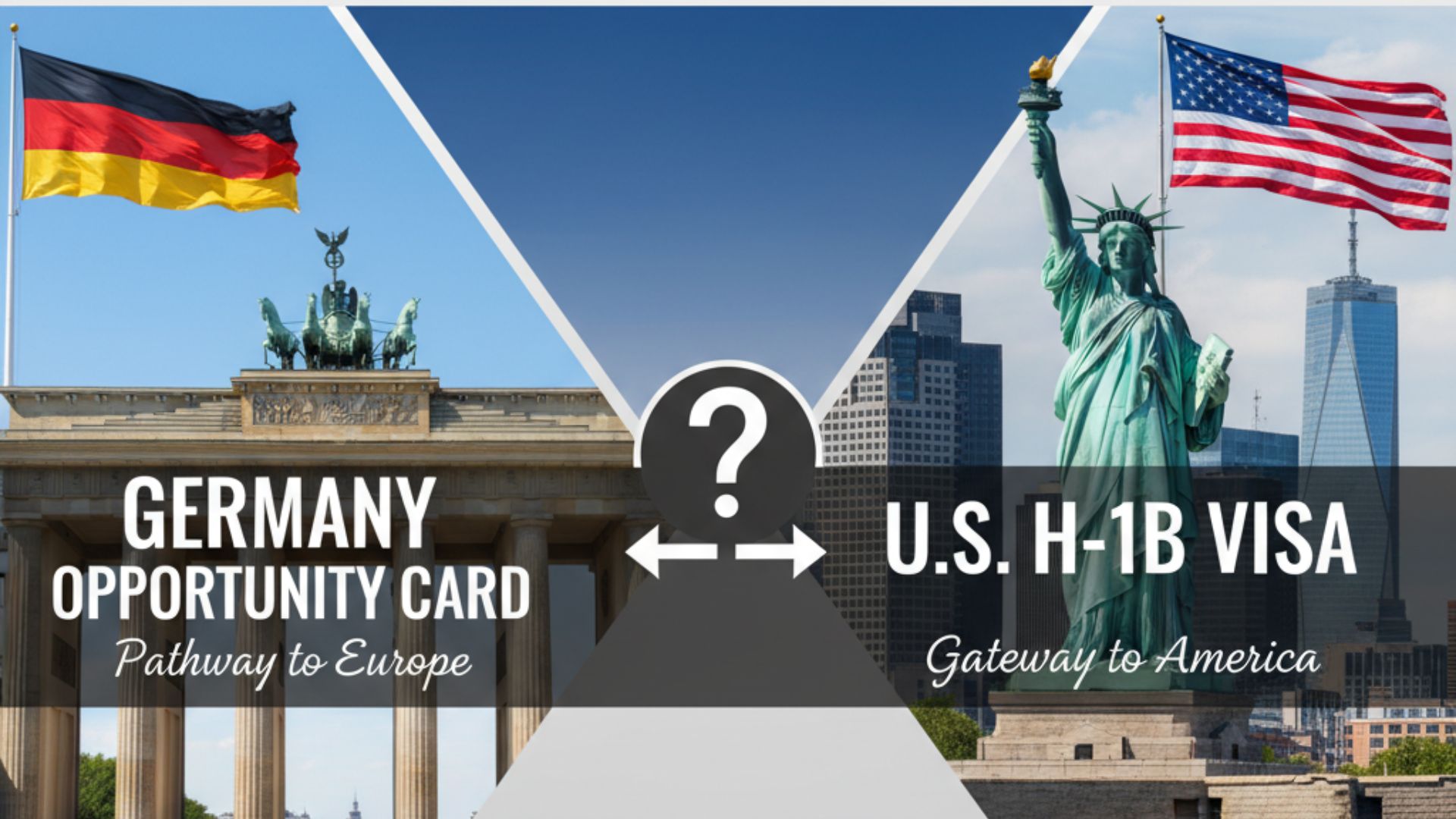
In today’s global job market, thousands of skilled professionals from India and Asia look toward developed nations for better careers and permanent settlement.
For decades, the U.S. H-1B visa was seen as the ultimate dream route — but with rising competition, uncertainty, and strict rules, that dream is becoming harder to reach.
Enter Germany’s Opportunity Card (Chancenkarte) — a new, flexible, and transparent pathway launched in 2024 under the Skilled Immigration Act 2.0, offering professionals the chance to live and work in Germany without a job offer upfront.
Let’s take a closer look at how these two work visas compare in 2025.
Comparison: Germany Opportunity Card vs U.S. H-1B Visa
The key difference between the two lies in their purpose. The Germany Opportunity Card is designed for job seekers — it’s a temporary residence visa that lets you stay in Germany for up to a year while you look for employment. You can even take on part-time or trial work during this period to explore opportunities.
In contrast, the US H-1B visa is a work visa meant for highly skilled professionals in specialized fields. To apply, you must already have a confirmed job offer from a sponsoring employer in the United States.
Another important distinction is the path to permanent residency. Germany’s Opportunity Card offers a clearer and faster route to settle permanently once you secure a job. The US H-1B process, however, is often longer, more competitive, and complex, with limited annual quotas and lottery-based selection.
In short, if you’re looking for flexibility and independence in your job search, Germany’s Opportunity Card gives you that freedom — while the H-1B is ideal if you already have an employer ready to sponsor your move to the US.
| Category |
Germany – Opportunity Card (Chancenkarte) |
United States – H-1B Visa |
Verdict |
| Purpose |
A residence permit that allows skilled professionals from non-EU countries to enter Germany and look for a job. |
A temporary work visa for skilled professionals with a pre-approved U.S. employer. |
✅ Germany – No job offer needed. |
| Job Offer Requirement |
❌ Not required to apply. You can job-hunt after arrival. |
✅ Mandatory. Must have an employer willing to sponsor you before application. |
✅ Germany – More freedom to explore. |
| Selection Method |
Merit-based Points System (education, skills, age, language, experience). Minimum 6 points required. |
Random Lottery System – Out of hundreds of thousands, only 85,000 are selected yearly. |
✅ Germany – Transparent and fair. |
| Chance of Selection |
Depends on meeting points and qualification — high if you’re eligible. |
Around 25–30% selection rate in lottery due to oversubscription. |
✅ Germany – Higher success probability. |
| Visa Type |
Job-search residence permit (up to 12 months), convertible to Work Visa or EU Blue Card. |
Employer-specific work visa (valid 3 years, renewable up to 6). |
⚖️ Different intent – Germany allows job search, U.S. job-specific. |
| Work Permission |
Allowed to work 20 hours/week part-time while job searching + trial employment. |
Can only work for sponsoring employer; job loss = visa loss. |
✅ Germany – Greater flexibility. |
| Processing Time |
6–12 weeks average. |
3–6 months plus lottery delays. |
✅ Germany – Quicker and simpler. |
| PR & Citizenship Path |
PR after 33 months (21 months with B1 German), citizenship after ~5–7 years. |
Green Card process may take 10–15 years for Indians. |
✅ Germany – Clear, fast PR route. |
| Language Requirement |
Minimum German A1 or English B2. |
English only. |
⚖️ Neutral. |
| Family Reunification |
Dependents can join after job placement or Blue Card conversion; spouse allowed to work. |
H-4 dependents can stay, but spouse work authorization is restricted. |
✅ Germany – More family-friendly. |
| Job Market (2025) |
Over 700,000 vacancies — IT, engineering, healthcare, skilled trades. |
U.S. tech layoffs, tighter visa scrutiny, slower job growth. |
✅ Germany – Strong demand for global talent. |
| Success Rate & Stability |
High for qualified applicants; no lottery, fair criteria. |
Highly uncertain; selection depends on luck, not skills. |
✅ Germany – Stable and skill-driven. |
| Living Costs & Benefits |
Affordable cost of living, free healthcare, subsidized education. |
Expensive housing, healthcare, and education. |
✅ Germany |
The Key Difference: Merit vs. Lottery
Germany’s Opportunity Card values your skills, experience, and potential.
If you meet the eligibility points (education, age, work experience, and basic German or English), you can secure your entry permit confidently — no luck involved.
In contrast, the U.S. H-1B visa operates under a lottery system, where even highly qualified applicants might be rejected simply because their name wasn’t drawn.
In 2024, the U.S. received over 750,000 H-1B registrations for only 85,000 slots — meaning most applicants never even got a chance.
Germany’s model is more inclusive and predictable, empowering professionals to plan their move strategically rather than rely on chance.
“Germany Needs Skilled Indians — Over 4 Lakh Vacancies in 2025!”
Industries such as IT, engineering, healthcare, construction, and manufacturing are facing massive labor shortages.
The German Chancellor’s recent initiatives with India aim to simplify migration channels and recognize Indian qualifications faster, strengthening workforce mobility between the two nations.
This growing partnership mirrors the message in the viral post from GloEdge Visas — Germany is actively seeking Indian professionals to fill gaps that are reshaping its post-COVID and green-transition economy.
Why Germany Is the Better Bet
✅ Transparent and merit-based selection
✅ No dependence on luck or sponsorship
✅ Clear PR and citizenship pathway
✅ Lower cost of living than the U.S.
✅ Global recognition of Indian degrees
✅ Excellent work-life balance and safety
At Radvision World Consultancy
At Radvision World Consultancy, the best immigration consultant with over a decade of expertise in overseas migration and global career consulting, we’re committed to helping professionals achieve their European dream.
Whether you’re an IT specialist, healthcare worker, or engineer, our team provides end-to-end support — from Opportunity Card applications to EU Blue Card assistance and settlement guidance.
We believe Germany’s Opportunity Card represents the future of skilled migration — fair, fast, and focused on your abilities, not chance.
Let your skills, not luck, shape your global career. Connect with Radvision today to explore your pathway to Germany’s Opportunity Card and EU Blue Card.
Final Thoughts
While the U.S. H-1B visa still offers prestige, Germany’s Opportunity Card offers certainty.
Instead of relying on a lottery, your skills, experience, and qualifications determine your success.
With India and Germany expanding migration cooperation and 4+ lakh open positions in 2025, the timing couldn’t be better for skilled professionals to build their careers — and their lives — in Europe’s strongest economy.
Frequently Asked Questions
Do I need a job offer before applying for either the Germany Opportunity Card or the US H-1B visa?
For the German Opportunity Card, a job offer is not required for the initial application; it is a job-seeker visa. For the US H-1B visa, you must have a pre-arranged job offer from a U.S. employer to apply.
How is the application process different for each?
The H-1B is a competitive, random lottery system that occurs annually, with strict caps on the number of visas issued. The Opportunity Card uses a transparent points-based system that evaluates a candidate’s qualifications, age, and language skills.
What are the primary costs associated with each visa?
The Opportunity Card has a relatively low, fixed government fee (around €75). The H-1B involves significantly higher costs, including legal fees and various employer-paid government fees, which can add up to tens of thousands of dollars.
Can my family accompany me, and can they work?
Yes, family members can accompany the primary visa holder for both. In Germany, the spouse typically has unrestricted work authorization. In the U.S., H-4 spouses generally have limited work authorization options (EAD) which may have specific conditions.
How long is the path to permanent residency (Green Card in the US) for each?
Germany offers a clear and relatively fast path to permanent residency, potentially within 2-3 years of working in the country. The U.S. Green Card process for H-1B holders can be very long, sometimes taking decades, depending on the applicant’s country of origin.
Does my employer control my status on either of these visas?
The H-1B is tied to the sponsoring employer; if you leave your job, your employer typically revokes the visa, and a new employer must file a new petition. The Opportunity Card offers greater flexibility, allowing you to seek and switch jobs more easily once you have found permanent employment and transitioned to a work permit.
Am I allowed to work part-time while I am searching for a full-time job in Germany?
Yes, holders of the German Opportunity Card are permitted to work up to 20 hours per week in part-time or trial jobs while seeking a qualified full-time position. The H-1B requires the individual to work solely for the sponsoring employer from the start.
What criteria are used to select candidates for the German Opportunity Card?
The Opportunity Card requires applicants to meet a minimum of six points based on criteria such as: educational/professional qualifications, relevant work experience, language proficiency (German and/or English), age, and connection to Germany.
Which visa offers more flexibility in career choice?
The Opportunity Card is explicitly designed to allow you to explore different employers and job opportunities upon arrival in Germany. The H-1B is limited to a “specialty occupation” with the specific employer that sponsored your application.
Which system is more predictable and stable?
Germany’s system is generally seen as more predictable, with clear criteria and a stable legal framework for skilled immigration. The U.S. H-1B program has often been subject to high political volatility, changes in regulations, and uncertainty, particularly regarding the lottery and processing times.
Do I need a job offer to apply for the Germany Opportunity Card or the US H-1B visa?
You do not need a job offer to apply for the German Opportunity Card; it is a job-seeker visa. The US H-1B visa, however, requires a specific, existing job offer from a U.S. employer who must sponsor your application.
Is there a points system for either visa?
Yes, the German Opportunity Card uses a points-based system (requiring a minimum of 6 points based on qualifications, age, language skills, and experience) to determine eligibility. The US H-1B visa does not use a points system but relies on meeting specific educational and occupational requirements and a random lottery selection process.
What are the associated costs for each visa?
The German Opportunity Card has a relatively low application fee of around €75. The H-1B visa process, primarily due to recent fee hikes and legal costs borne by the employer, can be significantly more expensive, with some reports of total costs reaching up to $100,000 for a new petition.
Can I bring my family with me on these visas?
Yes, both visas allow you to bring your spouse and dependent children. A key difference is that, in Germany, accompanying spouses can generally work full-time without restrictions. H-4 spouses in the US may study and can apply for an Employment Authorization Document (EAD) to work, though this has specific conditions.
How long can I stay in the country on each initial visa?
The German Opportunity Card is typically issued for up to 12 months (extendable in some cases). The H-1B visa is initially granted for a period of up to three years, extendable to a maximum of six years.
What is the process for getting permanent residency (Green Card) in the US versus Germany?
The H-1B visa is considered “dual intent,” allowing the holder to apply for permanent residency (a Green Card), but the process can be lengthy, often taking decades for some nationalities due to caps. Germany offers a much faster and more predictable path to permanent residency, which can be achieved in as little as 21-36 months after transitioning to a standard work permit or EU Blue Card.
Can I work while searching for a full-time job in Germany with the Opportunity Card?
Yes, holders of the German Opportunity Card are permitted to work part-time for up to 20 hours per week and take on trial jobs for up to two weeks with a single employer while seeking qualified full-time employment.
What if I lose my job in the US while on an H-1B visa?
If you lose your job while on an H-1B, your status is generally terminated. You usually have a 60-day grace period to find a new employer to sponsor a transfer or change your visa status (e.g., to a tourist visa) to remain legally in the US.
Is language proficiency mandatory for both?
For the H-1B, formal language certificates are not explicitly required by the government, though English proficiency is a practical necessity for the job and interview. For the German Opportunity Card, proof of basic German (A1) or English (B2) language skills is an eligibility requirement and earns points in the application.
Which option offers more flexibility in choosing an employer?
The German Opportunity Card offers high flexibility as you are not tied to a specific employer upon entry and can move freely in the job market. The H-1B visa is highly restrictive, tying you to your sponsoring employer and requiring a new, formal petition process if you wish to change jobs.