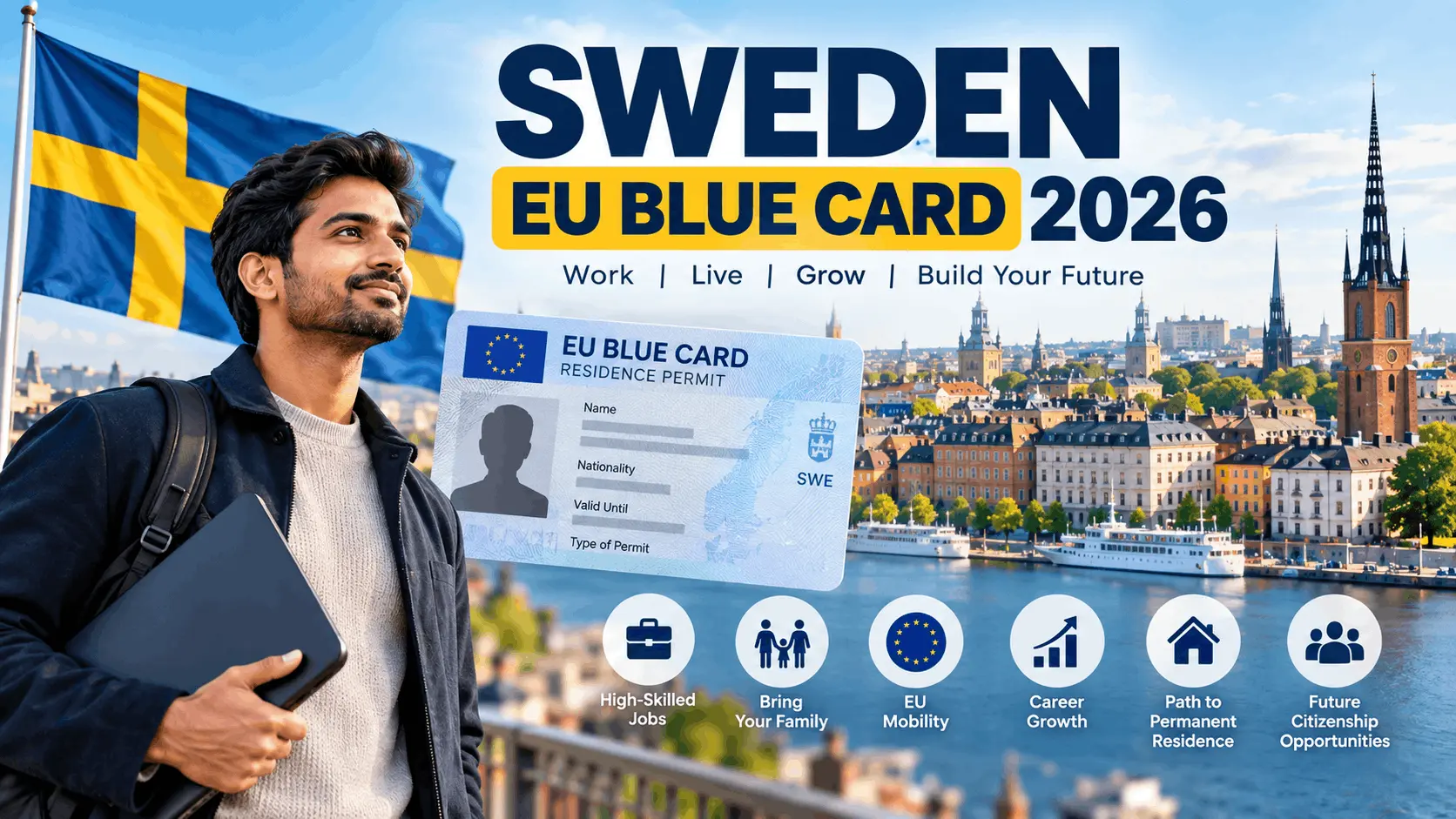
What Is the Sweden EU Blue Card?
The Sweden EU Blue Card is a residence and work permit designed for highly qualified professionals from countries outside the European Union and European Economic Area who have been offered qualifying employment in Sweden. For an Indian professional, it can provide a structured route to live and work legally in Sweden in a highly skilled occupation, provided the applicant and employer meet the applicable requirements.
The Swedish Migration Agency confirms that an EU Blue Card issued by Sweden gives the holder the right to live and work in Sweden for the employer and in the occupation specified in the application. The route is therefore more specialised than the ordinary Swedish work permit because it is specifically intended for highly qualified employment.
For Indian applicants, it is important to understand that getting a Swedish job offer alone does not automatically make you eligible for an EU Blue Card. Your qualification or relevant professional experience, employment contract, salary, insurance and other employment conditions must satisfy the Blue Card rules.
Sweden EU Blue Card meaning and purpose
The EU Blue Card is an immigration route created to help EU countries attract highly qualified professionals from outside the EU. Sweden participates in this system and has its own national procedures for issuing Blue Cards.
In practical terms, the Swedish EU Blue Card connects three things:
- A highly qualified applicant
- A qualifying job in Sweden
- A salary and employment package that meets the required threshold
For someone applying from India, the process normally begins with finding a genuine Swedish employer willing to hire them for a qualifying position. The employer has an important role in the process because Swedish authorities assess the employment conditions as part of the application.
As of 2026, Sweden requires the applicant to have either higher education corresponding to at least 180 higher education credits or at least five years of relevant professional experience. The applicant must also have a highly qualified employment contract lasting at least six months.
One particularly important 2026 update concerns the salary threshold. Since 15 July 2026, the Swedish EU Blue Card salary threshold is SEK 53,625 per month. The threshold is linked to 1.25 times the average gross salary in Sweden and can be updated when the underlying Swedish salary statistics change.
This means an Indian applicant should not rely on an old article, YouTube video or consultant’s previous salary figure. The applicable threshold should always be checked immediately before submitting the application.
Who is the Sweden EU Blue Card designed for?
The Sweden EU Blue Card is primarily designed for highly qualified non-EU/EEA professionals who have secured suitable employment in Sweden.
Typical candidates can include professionals working in areas such as:
- Software development
- Information technology
- Data science
- Artificial intelligence
- Cybersecurity
- Engineering
- Telecommunications
- Research and development
- Finance
- Life sciences
- Highly specialised technical occupations
- Other professional roles requiring advanced qualifications
However, an occupation being considered “highly skilled” or “in demand” does not automatically mean that every position qualifies for an EU Blue Card.
For example, an Indian software engineer may have excellent professional experience, but the application still needs to satisfy the applicable requirements for the job, salary, qualifications, employment contract and other conditions.
The employer also has obligations. For example, the Swedish Migration Agency states that the employer must advertise the vacancy in Sweden and within the EU/EEA and Switzerland for at least 10 days, and employment conditions must be at least on par with Swedish collective agreements or what is customary in the occupation or industry.
This is an important distinction for Indian applicants: your personal qualifications are only one part of the application. The Swedish job itself must also meet the Blue Card requirements.
How the EU Blue Card differs from a standard Swedish work permit
The EU Blue Card and ordinary Swedish work permit are not interchangeable routes.
A standard Swedish work permit is available for a broader range of employment, while the EU Blue Card is specifically designed for highly qualified employment and has a substantially higher salary requirement.
There is also an important 2026 distinction in the salary rules. From 1 June 2026, Sweden introduced a new salary requirement for ordinary work permits, generally requiring at least 90% of the Swedish median salary, which is currently SEK 34,470 per month based on the current median salary. However, the Swedish Migration Agency specifically states that the EU Blue Card follows a separate EU-based salary system and that the Blue Card salary threshold did not change with the June 2026 work permit reforms.
| Factor |
Sweden EU Blue Card |
Standard Sweden Work Permit |
| Target applicant |
Highly qualified non-EU/EEA professionals |
Broader range of non-EU/EEA workers |
| Job offer |
Required |
Required |
| Employment |
Highly qualified employment |
Qualifying employment under Swedish work permit rules |
| Salary threshold |
At least 1.25 times the Swedish average gross salary. SEK 53,625/month from 15 July 2026 |
At least 90% of the Swedish median salary under the new 2026 rules, subject to applicable conditions |
| Qualification |
Higher education of at least 180 credits or at least 5 years of relevant professional experience |
Depends on the applicable work permit requirements |
| Employment contract |
Highly qualified employment for at least 6 months |
Qualifying employment under Swedish rules |
| Employer |
Swedish employer meeting Blue Card conditions |
Swedish employer meeting work permit conditions |
| Family |
Family members can apply for residence permits |
Family reunification may also be available subject to applicable rules |
| Work rights |
Work for the employer and in the occupation specified in the application |
Work rights depend on the permit and applicable conditions |
| EU mobility |
Provides specific mobility advantages under the EU Blue Card framework |
Does not provide the same EU Blue Card mobility framework |
| Long-term residence potential |
Can contribute toward certain Swedish permanent residence routes |
Can also contribute under applicable Swedish rules |
Important: The salary figures in this table are time-sensitive. The EU Blue Card threshold is SEK 53,625 per month from 15 July 2026, while the ordinary work permit threshold is currently SEK 34,470 per month based on the median salary applicable from June 2026. These figures should be rechecked when the article is updated.
Is the Sweden EU Blue Card a residence permit, work permit, or both?
It effectively serves both purposes.
A Swedish EU Blue Card gives the holder the right to live and work in Sweden, subject to the conditions of the permit. The Swedish Migration Agency specifically states that the card permits employment for the employer and within the profession specified in the application.
This is important because the EU Blue Card should not be understood as an unrestricted work authorisation for any Swedish employer or any occupation.
For example, suppose an Indian data scientist receives a Swedish EU Blue Card based on employment with Company A as a data scientist. If that person later receives an offer from Company B for a completely different occupation, they should not simply assume that the existing Blue Card automatically covers the new employment.
Changes affecting the employment, employer or profession may need to be reported to the Swedish Migration Agency, and the applicable rules should be checked before changing jobs.
Which highly qualified professionals can use the EU Blue Card route?
The route can be relevant to professionals whose education or professional background matches the requirements for highly qualified employment.
For example, potential candidates may include:
Technology professionals
- Software engineers
- Full-stack developers
- Cloud engineers
- DevOps specialists
- AI engineers
- Machine learning specialists
- Data scientists
- Cybersecurity specialists
Engineering professionals
- Mechanical engineers
- Electrical engineers
- Electronics engineers
- Industrial engineers
- Automotive engineers
- Renewable energy specialists
Specialised business professionals
- Financial specialists
- Business analysts
- Certain management professionals
- Technology consultants
Science and research professionals
- Researchers
- Life sciences professionals
- Biotechnology specialists
- Highly specialised scientific professionals
Healthcare professionals
Doctors and other highly qualified healthcare professionals may potentially fall within the route, but regulated professions require additional attention because holding an EU Blue Card does not automatically give someone permission to practise a regulated profession in Sweden. Professional licensing or recognition requirements may apply separately.
The key principle is this:
A job being called “highly skilled” is not enough. The applicant, employment contract, salary and professional requirements must all be assessed together.
Does Sweden issue EU Blue Cards to Indian citizens?
Yes. Indian citizens can apply for a Sweden EU Blue Card if they satisfy the applicable eligibility requirements.
Indian citizens are third-country nationals for Swedish immigration purposes. The Swedish Migration Agency’s EU Blue Card route specifically applies to people who are citizens of countries outside the EU/EEA and who have been offered highly qualified employment in Sweden.
There is no general rule that excludes Indian citizens from this route.
However, Indian applicants should be particularly careful about three areas:
- Educational qualification
Your Indian degree or other qualification needs to satisfy the applicable requirement. Sweden currently allows the qualification route through higher education corresponding to at least 180 higher education credits, or an alternative route based on at least five years of relevant professional experience.
- Salary
The employment must meet the applicable Blue Card salary threshold. From 15 July 2026, that threshold is SEK 53,625 per month.
- Genuine employment
The job offer should be genuine, the employment conditions must meet Swedish requirements, and the employer has obligations as part of the process.
Therefore, Indian applicants should be suspicious of anyone promising a “guaranteed Sweden EU Blue Card” merely in exchange for a fee.
Can you apply for the Sweden EU Blue Card without being in Sweden?
Yes. You can apply from outside Sweden, including from India.
In fact, the route is specifically designed to allow qualified professionals from outside Sweden to obtain the necessary authorisation to take up qualifying employment.
The application process involves the Swedish employer providing employment information and initiating the application through the Swedish Migration Agency’s process. The employee then receives a link to complete their part of the application.
For an Indian applicant, the practical sequence is generally:
Swedish job offer → Employer starts the application → Applicant completes the application → Supporting documents and required formalities → Swedish Migration Agency decision → Residence permit card → Travel to Sweden
Do not confuse this with simply entering Sweden as a tourist and starting work. A visitor status does not give you the right to take up employment.
There is also a separate mobility situation for people who already hold an EU Blue Card from another EU country. The Swedish Migration Agency states that a person holding a valid EU Blue Card from another EU country can apply for a Swedish EU Blue Card after having stayed in that other EU country with an EU Blue Card for at least 12 months, subject to the applicable rules.
Is a job offer mandatory for the Sweden EU Blue Card?
Yes. A qualifying employment offer is a fundamental requirement.
You cannot normally apply for a Swedish EU Blue Card simply because you have a university degree, five years of professional experience or a high salary expectation.
The Swedish Migration Agency requires an employment contract for highly qualified employment, and the employment must last for at least six months. The contract must be signed by both the applicant and the employer.
The employer also needs to satisfy specific requirements, including advertising the vacancy for at least 10 days in Sweden and within the EU/EEA and Switzerland, providing appropriate employment conditions and meeting the applicable salary and insurance requirements.
This makes the Sweden EU Blue Card fundamentally different from a job-seeker route. You generally need the qualifying employment first and then apply for the Blue Card based on that employment.
For Indian professionals, the safest approach is therefore to verify the employer, job description, salary, contract and Blue Card eligibility before paying any third party or making major relocation commitments.
Expert takeaway for Indian applicants
The Sweden EU Blue Card can be an attractive route for an Indian professional who already has a strong academic or professional profile and can secure a qualifying Swedish job.
However, do not judge your eligibility based on your degree or job title alone.
Before applying, check these five points:
- Do you have the required higher education or relevant professional experience?
- Is your Swedish job genuinely highly qualified?
- Does your employment contract satisfy the minimum duration requirement?
- Does the salary meet the current Blue Card threshold of SEK 53,625 per month?
- Does the employer satisfy the Swedish employment and insurance requirements?
If the answer to all five is yes, you may have a strong foundation for a Sweden EU Blue Card application. The final decision, however, rests with the Swedish Migration Agency based on the complete application and applicable rules.
Editorial recommendation: For the published article, link the terms Swedish Migration Agency and EU Immigration Portal to their official pages, and add a visible “Last Updated: October 2026” note because the salary threshold and work-permit rules are subject to change.
Below is the fully developed section, written as publish-ready blog content for Indian applicants. I have also updated the 2026 figures and rules against the Swedish Migration Agency, including the SEK 53,625 monthly EU Blue Card salary threshold from 15 July 2026 and the maximum four-year permit period introduced from 1 June 2026.
Sweden EU Blue Card Requirements 2026 for Indian Applicants
If you are an Indian professional planning to work in Sweden, meeting the basic work permit requirements is not enough to qualify for an EU Blue Card. The Blue Card is specifically intended for highly qualified employment, so Swedish authorities assess your qualifications, professional experience, employment contract, salary, insurance and the conditions offered by your employer.
For applicants from India, the most important point is to assess the entire profile together. A good degree alone does not guarantee eligibility. Similarly, having five years of experience does not compensate for a salary that falls below the applicable threshold.
As of 2026, the Swedish Migration Agency requires an applicant to have a valid passport, qualifying higher education or relevant professional experience, a highly qualified employment contract lasting at least six months, a salary meeting the applicable EU Blue Card threshold, and comprehensive health insurance or proof that it has been applied for.
The employer also has separate obligations, including advertising the position for at least 10 days, providing employment conditions comparable with Swedish collective agreements or established industry practice, and arranging the required employee insurance coverage.
Valid Employment Contract or Binding Job Offer from a Swedish Employer
One of the most important Sweden EU Blue Card requirements is having a qualifying employment offer from a Swedish employer.
You cannot normally obtain an EU Blue Card simply because you have a university degree, several years of experience or a high-demand occupation. The Blue Card is employment-based, which means the Swedish authorities assess the actual job you have been offered.
The Swedish Migration Agency requires the applicant and employer to have a signed employment agreement for highly qualified employment. The employment must last for at least six months.
For an Indian applicant, this means the logical sequence is:
Find a qualifying Swedish job → receive the employment offer → sign the employment contract → employer starts the application → complete your part of the application → receive the decision.
Minimum Employment Contract Duration
The employment contract must cover at least six months.
This requirement is important because a short-term project, internship or casual employment arrangement may not satisfy the Blue Card rules simply because the salary is high.
The contract should clearly establish the nature of the employment, including details such as:
- Employer’s identity
- Job title
- Job responsibilities
- Start date
- Employment duration
- Working hours or scope of employment
- Salary
- Applicable collective agreement, where relevant
- Insurance arrangements
- Workplace information
The Swedish Migration Agency’s employer process specifically requires information about the occupation, SSYK occupational code, responsibilities, employment form, start date, scope, salary, collective agreement information and insurance provider.
Practical tip for Indian applicants: Before accepting a Swedish offer, ask the employer for a complete written employment contract rather than relying only on an email stating the salary and job title.
What Information Must the Employment Contract Contain?
Your employment contract should provide enough information for the Swedish authorities to understand exactly what you have been hired to do and under what conditions.
At a minimum, check that the contract clearly identifies:
- Your full name
- Employer’s legal name
- Job title
- Job duties and responsibilities
- Start date
- Duration of employment
- Working hours or employment scope
- Gross salary
- Applicable employment terms
- Insurance arrangements
- Workplace or location
- Collective agreement, if applicable
The employer also provides employment information directly to the Swedish Migration Agency through its e-service before the employee completes their part of the application.
This is why Indian applicants should ensure that the information in the employment contract, CV, educational documents and application form is consistent.
For example, if your CV says you are being hired as a Senior Software Engineer, while the employment contract describes you as a Business Analyst, you should clarify the discrepancy before submitting the application.
Can a Temporary Employment Contract Qualify?
Yes, a temporary contract can potentially qualify, provided it satisfies the applicable EU Blue Card requirements.
The important point is not simply whether the contract is permanent. The Swedish Migration Agency requires the highly qualified employment to last for at least six months.
Therefore, an Indian applicant should not assume that only permanent employment contracts are eligible.
However, you should carefully assess:
- Contract duration
- Job duties
- Salary
- Working conditions
- Employer compliance
- Required insurance
- Whether the role genuinely qualifies as highly qualified employment
A six-month contract that meets the requirements should be assessed differently from a short project-based arrangement lasting only a few weeks or months.
Can Multiple Job Offers Be Combined to Meet the Requirement?
Do not assume that you can simply combine several unrelated Swedish job offers to satisfy the EU Blue Card requirements.
The Blue Card application is based on a specific qualifying employment relationship. The Swedish Migration Agency requires a highly qualified employment contract between the applicant and employer.
For example, having:
- Job A paying SEK 35,000 per month, and
- Job B paying SEK 25,000 per month
does not mean you can automatically combine the two salaries and treat them as a SEK 60,000 Blue Card salary.
If your employment situation involves multiple employers, part-time roles or simultaneous contracts, obtain specific advice before applying rather than assuming the salaries can be aggregated.
Can an Indian Applicant Apply With a Remote Job Offer?
A remote job offer should not automatically be treated as a Sweden EU Blue Card qualifying job.
The Blue Card is intended for highly qualified employment in Sweden, and the employer must provide employment information and meet Swedish requirements. The job must therefore be assessed based on the actual employment arrangement, workplace, employer and applicable conditions.
For example, there is an important difference between:
Scenario A:
A Swedish company hires an Indian professional to relocate to Sweden and perform the qualifying job from the Swedish workplace.
Scenario B:
A Swedish company hires an Indian professional who remains permanently in India and performs the job remotely from India.
The second situation should not be assumed to qualify for a Swedish EU Blue Card simply because the employer is Swedish.
Salary Requirement for the Sweden EU Blue Card in 2026
Salary is one of the most important eligibility conditions for the Swedish EU Blue Card.
The Swedish Migration Agency sets the EU Blue Card salary threshold annually. The threshold is calculated at 1.25 times the average gross salary in Sweden published by the Swedish National Mediation Office.
What Is the Sweden EU Blue Card Salary Threshold in 2026?
From 15 July 2026, the applicable salary threshold is SEK 53,625 per month.
This is a gross monthly salary requirement.
Therefore, an Indian professional receiving an offer of:
- SEK 45,000 per month: below the current Blue Card threshold
- SEK 50,000 per month: below the current Blue Card threshold
- SEK 53,625 per month: at the stated threshold
- SEK 60,000 per month: above the stated threshold
However, applicants should avoid treating the threshold as a permanent number. The Swedish Migration Agency determines the threshold annually, so the applicable figure may change in a future year.
How Sweden Calculates the EU Blue Card Salary Threshold
The calculation is based on:
Swedish average gross salary × 1.25 = EU Blue Card salary threshold
The Swedish Migration Agency publishes the resulting threshold for applicants.
This is different from the ordinary Swedish work permit salary requirement.
From June 2026, the ordinary work permit generally has a requirement linked to 90% of the Swedish median salary, currently SEK 34,470 per month. The Swedish Migration Agency specifically states that this new ordinary work permit salary rule does not replace the EU Blue Card salary threshold. The EU Blue Card continues to use its separate salary system.
This distinction is particularly important when comparing a Swedish EU Blue Card with a standard Swedish work permit.
What Percentage of the Swedish Average Salary Applies?
The EU Blue Card salary threshold is 125% of the average gross salary in Sweden.
In other words:
EU Blue Card salary threshold = 1.25 × Swedish average gross salary
Because the underlying average salary can change, the final SEK amount can also change.
For an Indian applicant planning to apply in a later year, do not copy the 2026 figure into your application without checking the current Swedish Migration Agency information.
How to Check the Latest Salary Threshold Before Applying
Always verify the threshold immediately before submitting the application.
The safest source is the Swedish Migration Agency, rather than:
- An old blog
- A YouTube video
- A social media post
- A recruitment agent
- A consultant’s old checklist
- A job advertisement published several months ago
This matters because the salary threshold is updated according to the applicable Swedish salary statistics.
For a 2026 application, the current figure is SEK 53,625 per month from 15 July 2026.
What Counts Toward the Qualifying Salary?
The salary must satisfy the applicable EU Blue Card threshold.
Indian applicants should distinguish between guaranteed contractual salary and uncertain future earnings.
For example, an offer that says:
Basic salary: SEK 50,000
Performance bonus: up to SEK 10,000
should not automatically be treated as a SEK 60,000 guaranteed salary.
The actual treatment of bonuses and other compensation should be assessed against the current Swedish rules and the terms of the employment contract.
For this reason, applicants should ask the employer for a clear breakdown of:
- Fixed gross salary
- Guaranteed allowances
- Variable bonus
- Overtime
- Commission
- Benefits
- Pension
- Other compensation
Do Bonuses, Overtime, Allowances and Benefits Count?
This is an area where applicants should be particularly careful.
Do not assume that every component of a compensation package automatically counts toward the EU Blue Card salary threshold.
A fixed contractual salary is much easier to assess than discretionary bonuses or compensation dependent on future performance.
For example:
Offer A
- Fixed salary: SEK 56,000
- Performance bonus: SEK 5,000 potentially
- Meal allowance: SEK 1,500
This is easier to assess because the fixed salary already exceeds the current SEK 53,625 threshold.
Offer B
- Fixed salary: SEK 48,000
- Potential annual bonus: SEK 120,000
The applicant should not assume that the potential bonus automatically makes the offer Blue Card compliant.
For borderline cases, obtain confirmation from the employer and assess the compensation structure under the current Swedish rules before submitting the application.
Can a Salary Below the Threshold Lead to Refusal?
Yes.
If the offered salary does not meet the applicable EU Blue Card salary requirement, the applicant may not qualify for the EU Blue Card.
This is one of the clearest differences between a normal skilled job and a Blue Card qualifying job.
An applicant could have:
- A master’s degree
- Ten years of experience
- A Swedish employer
- A highly skilled occupation
and still fail the EU Blue Card salary requirement if the employment does not satisfy the applicable threshold.
Expert insight: Never evaluate a Swedish job offer only by asking, “Is this a good salary for my profession?” The relevant question is, “Does this employment package meet the current EU Blue Card rules?”
Higher Education Qualification Requirement
Education is another important route to EU Blue Card eligibility.
The Swedish Migration Agency currently states that the applicant must have higher education corresponding to at least 180 higher education credits, or alternatively at least five years of relevant professional experience.
This provides an important alternative for experienced professionals who may not have the exact academic profile that another immigration route requires.
Which Degrees Can Qualify?
The qualification should demonstrate higher education appropriate to the highly qualified employment.
Depending on the profession, this could include fields such as:
- Computer science
- Information technology
- Engineering
- Electronics
- Mechanical engineering
- Electrical engineering
- Finance
- Economics
- Mathematics
- Data science
- Business administration
- Life sciences
- Other relevant higher education fields
However, the applicant should not simply assume that any degree qualifies for any job.
The relationship between your qualification and your proposed employment should make sense.
For example:
B.Tech Computer Science → Software Engineer
is a naturally aligned profile.
By contrast:
Bachelor’s degree in an unrelated field → highly specialised engineering role
may require additional explanation and evidence.
Can an Indian Bachelor’s Degree Qualify?
Potentially, yes.
An Indian bachelor’s degree can potentially satisfy the higher education route if it corresponds to the required level of higher education and meets the applicable Swedish assessment requirements.
The Swedish Migration Agency’s requirement is expressed in terms of higher education corresponding to at least 180 higher education credits.
Indian applicants should therefore maintain complete educational documentation, including:
- Degree certificate
- Marksheets
- Academic transcripts
- Relevant certificates
- University information
- Professional certifications, where relevant
Do not assume that a degree title alone establishes eligibility.
Master’s Degree Versus Bachelor’s Degree
A master’s degree can strengthen an applicant’s professional profile, but the Blue Card rules do not simply say that a master’s degree is mandatory.
The Swedish requirement focuses on qualifying higher education corresponding to at least 180 higher education credits, with an alternative based on five years of relevant professional experience.
Therefore:
Bachelor’s degree + relevant employment + qualifying Swedish job + required salary
can potentially be sufficient.
A master’s degree may be valuable professionally, but it should not be presented as a mandatory Blue Card requirement unless the specific occupation or another regulatory requirement makes it necessary.
Recognition and Assessment of Indian Qualifications
Indian applicants should be prepared to demonstrate the authenticity and level of their education.
Keep your original educational records and supporting documentation available.
Where a qualification assessment, translation or additional verification is required, complete it according to the instructions provided by the relevant Swedish authority.
A common mistake is to submit only a final degree certificate when additional academic documentation may be needed to clarify the qualification.
What If the Applicant Has Extensive Professional Experience Instead of a Qualifying Degree?
This is one of the most useful features of the Swedish EU Blue Card route.
The Swedish Migration Agency states that an applicant can qualify through at least five years of relevant professional experience as an alternative to the higher education requirement.
This can be particularly relevant to experienced Indian technology and engineering professionals who have built strong careers but do not have a directly matching university degree.
However, experience must be relevant.
Five years of experience in an unrelated occupation should not automatically be treated as equivalent to five years of experience in the profession for which the applicant has been hired.
When Professional Experience Can Be Relevant
Consider an Indian professional with:
- 7 years of software development experience
- No computer science degree
- A qualifying Swedish software engineering offer
- Salary above the Blue Card threshold
The professional experience route may be relevant.
The applicant should then be able to document the professional history clearly.
This is why employment documentation is extremely important.
Relevant Professional Experience Requirements
Professional experience can be particularly valuable for applicants using the alternative qualification route.
The Swedish Migration Agency currently recognises at least five years of relevant professional experience as an alternative to the higher education requirement.
When Work Experience Can Support EU Blue Card Eligibility
Your experience should be:
- Relevant to the employment
- Genuine
- Verifiable
- Properly documented
- Consistent with your CV and application
For example, if you are applying for a senior cybersecurity position in Sweden, experience in cybersecurity, information security, network security or closely related technical roles will be more relevant than unrelated administrative experience.
How to Document Professional Experience From India
Indian applicants should ideally maintain a complete employment history.
Useful evidence may include:
- Experience certificates
- Employer reference letters
- Appointment letters
- Relieving letters
- Employment contracts
- Salary slips
- Form 16 or other tax records where relevant
- Bank salary credits where appropriate
- Professional registration or certification
- Previous employer contact details
The objective is to make your professional history easy to understand and verify.
Experience Letters, Employment Certificates and Salary Slips
An experience letter should ideally include:
- Employee’s full name
- Job title
- Employment start date
- Employment end date, if applicable
- Job responsibilities
- Employer name
- Employer contact details
- Authorised signatory
Salary slips can provide additional evidence that the employment actually existed.
However, salary slips alone may not fully explain your job responsibilities. A detailed experience letter is generally more useful for demonstrating what you actually did.
What Happens If Employment Experience Cannot Be Verified?
If you rely on professional experience to meet the qualification requirement, weak or inconsistent documentation can create problems.
For example, suppose your CV states:
Senior Software Engineer, January 2019 to December 2024
but your experience letter states:
Software Developer, March 2020 to December 2024
That discrepancy does not automatically mean refusal, but it creates a question that should be explained.
The safest approach is to ensure that:
- Dates are accurate
- Job titles are consistent or explainable
- Employer names match
- Responsibilities are truthful
- Supporting documents are genuine
Never create or modify employment documents to make your profile appear stronger.
Valid Passport and Identity Requirements
A valid passport is a basic requirement for the Sweden EU Blue Card.
The Swedish Migration Agency explicitly states that applicants must have a valid passport.
Indian applicants should check:
- Passport validity
- Name spelling
- Date of birth
- Passport number
- Previous passport information, where relevant
- Blank pages and document condition
Your name should be consistent across your passport, employment contract, education documents and application wherever possible.
If there are differences, such as a different spelling between your passport and degree certificate, address the discrepancy rather than ignoring it.
Health Insurance and Other Applicable Conditions
Health insurance is an important requirement that Indian applicants should not overlook.
The Swedish Migration Agency requires an applicant to have, or have applied for, comprehensive health insurance. The insurance must cover the period of stay and provide coverage for urgent and other medical care, hospitalisation and emergency dental care. It must also cover medical repatriation where required.
For applicants staying in Sweden for less than one year, the Migration Agency states that the health insurance must extend for an additional three months beyond the employment period.
What Does Comprehensive Health Insurance Need to Cover?
According to the Swedish Migration Agency, the insurance should cover:
- Urgent medical care
- Other medical care
- Hospitalisation
- Emergency dental care
- Medical repatriation
Indian applicants should therefore avoid purchasing an ordinary travel insurance policy without checking whether it actually satisfies the Swedish requirement.
What Changed in 2026?
Sweden introduced broader work permit changes from 1 June 2026. For EU Blue Card applicants, the salary threshold remained under the separate EU Blue Card system, while the maximum EU Blue Card permit period was extended from two years to up to four years at a time.
This is an important 2026 update that should be included in any current Sweden EU Blue Card guide.
Employer and Employment Conditions
The applicant is not the only party whose eligibility is assessed.
The Swedish employer also has specific responsibilities.
This is an area that many Indian applicants overlook because they focus mainly on their degree, experience and salary.
Swedish Employment Conditions
The employment conditions must be at least comparable with Swedish collective agreements or what is customary in the occupation or industry.
This means that an employer cannot simply offer a highly skilled job at an unusually low overall employment standard and expect the Blue Card to be approved because the applicant has a good degree.
The Swedish authorities assess the employment conditions as part of the process.
Collective Agreements and Employment Standards
Sweden’s labour market has an important role for collective agreements.
The Swedish Migration Agency requires the terms of employment to be at least on par with applicable Swedish collective agreements or customary practice in the occupation or industry.
The relevant trade union organisation must also be given an opportunity to comment on the employment conditions.
For an Indian applicant, this means you should not evaluate an offer solely on the headline salary.
Look at the entire employment package, including:
- Salary
- Working hours
- Holiday entitlement
- Insurance
- Pension
- Employment duration
- Other contractual conditions
Working Conditions Compared With Swedish Employees
The purpose of these employment requirements is to ensure that international professionals are employed under appropriate Swedish conditions rather than being brought into Sweden under significantly weaker terms.
Therefore, a Swedish EU Blue Card should not be viewed simply as a high-salary immigration route. It is also linked to the standards of the Swedish labour market.
Employer Obligations During the Application
The employer plays a significant role in the application.
According to the Swedish Migration Agency, the employer must:
- Provide information about the employment through the Migration Agency’s e-service.
- Have a signed employment agreement with the employee.
- Ensure the highly qualified employment lasts at least six months.
- Advertise the vacancy in Sweden and within the EU/EEA and Switzerland for at least 10 days.
- Ensure employment conditions meet the applicable Swedish standards.
- Meet the applicable salary requirement.
- Provide the required employee insurance.
- Give the relevant trade union organisation an opportunity to comment on the employment conditions.
The required employer insurance includes medical insurance, life insurance, occupational injury insurance and occupational pension insurance, with the employer required to have these in place by the time the employment begins.
The employer also needs to provide information such as the company’s registration details, workplace location, occupation, SSYK code, job responsibilities, start date, salary, collective agreement information and insurance provider details.
Sweden EU Blue Card 2026 Eligibility Checklist for Indian Applicants
Before proceeding with the application, an Indian applicant should be able to answer yes to the following:
| Requirement |
What to Check |
| Valid passport |
Passport is valid and identity information is consistent |
| Education or experience |
At least 180 higher education credits or at least 5 years of relevant professional experience |
| Swedish employment |
Genuine highly qualified job offer |
| Contract duration |
Employment lasts at least 6 months |
| Salary |
At least SEK 53,625/month under the threshold applicable from 15 July 2026 |
| Employment conditions |
Comparable with Swedish collective agreements or industry practice |
| Health insurance |
Comprehensive coverage available or applied for |
| Employer advertising |
Vacancy advertised for at least 10 days as required |
| Employer insurance |
Required employee insurance arranged |
| Documentation |
Education and employment records are genuine and consistent |
| Application |
Information matches the employment contract and supporting documents |
The Swedish Migration Agency should always be treated as the final authority for the applicable requirements and current thresholds.
Expert Tip for Indian Applicants
Before you submit a Sweden EU Blue Card application, do a three-way cross-check:
Your profile ↔ Employment contract ↔ Employer’s application
The job title, salary, employment duration, responsibilities and other key details should tell the same story across all three.
A strong qualification profile cannot compensate for a non-compliant employment offer. Likewise, a high-paying Swedish job does not automatically qualify an applicant who cannot demonstrate the required education or relevant professional experience.
Most importantly, do not use the SEK 53,625 figure as a permanent number. The Swedish Migration Agency determines the EU Blue Card salary threshold annually, so future applicants must verify the threshold applicable on the date of their application.
This section works best as a practical pre-application self-assessment immediately after explaining the detailed eligibility requirements. It should help an Indian applicant quickly identify gaps before paying fees, submitting documents, or committing to relocation.
Sweden EU Blue Card Eligibility Checklist for Indians
Before applying for a Sweden EU Blue Card, Indian applicants should complete a careful eligibility check. A strong degree or several years of experience alone does not guarantee approval. The application must satisfy the requirements relating to qualification, relevant experience, employment, salary, passport, insurance and supporting documents.
The most useful way to approach the application is to treat it as a checklist rather than assuming that one strong factor will compensate for a missing requirement.
For 2026 applications, the Swedish Migration Agency states that applicants generally need a valid passport, qualifying higher education or at least five years of relevant professional experience, a highly qualified employment contract of at least six months, and a salary that meets the applicable EU Blue Card threshold. From 15 July 2026, the salary threshold is SEK 53,625 per month. Comprehensive health insurance is also required or must have been applied for.
Use the following checklist before starting your application.
Education Checklist
Your educational background is one of the first things you should assess.
The Swedish EU Blue Card route allows applicants to qualify through higher education corresponding to at least 180 higher education credits. There is also an alternative route based on at least five years of relevant professional experience.
Check the following:
☐ Do you have a recognised higher education qualification?
☐ Does your education correspond to at least 180 higher education credits?
☐ Is your degree relevant to the highly qualified job you have been offered?
☐ Do you have your original degree certificate?
☐ Do you have your academic transcripts or marksheets?
☐ Are your university and qualification details consistent across your documents?
☐ Can you provide additional evidence of your qualification if requested?
For Indian bachelor’s degree holders
An Indian bachelor’s degree can potentially satisfy the higher education route, provided it meets the applicable Swedish requirements.
Do not assume that the words “Bachelor’s Degree” printed on a certificate automatically establish eligibility. Keep your complete academic records available so the qualification can be properly assessed if required.
If you do not have the required higher education
Do not immediately assume that you are ineligible.
The Swedish Migration Agency also allows the qualification requirement to be met through at least five years of relevant professional experience.
This can be particularly useful for experienced Indian IT, engineering and other specialist professionals who have strong professional backgrounds but do not have a directly relevant university degree.
Work Experience Checklist
Your professional experience becomes particularly important if you are relying on the experience-based qualification route.
Check the following:
☐ Do you have at least five years of relevant professional experience if using the experience route?
☐ Is your experience related to the Swedish position?
☐ Can you prove your previous employment?
☐ Do you have experience letters from previous employers?
☐ Are your employment dates accurate?
☐ Do your job titles match your supporting documents?
☐ Can you explain any gaps in your employment history?
☐ Do your CV, experience letters and application provide consistent information?
Documents that can help demonstrate employment history
Depending on your circumstances, keep documents such as:
- Experience certificates
- Employment letters
- Appointment letters
- Relieving letters
- Employment contracts
- Salary slips
- Tax-related employment records
- Other genuine evidence of employment
The important point is verifiability.
If your CV says you worked as a Software Engineer from January 2019 to December 2024, your supporting documents should broadly support that claim.
Never create, alter or exaggerate employment documents to meet an immigration requirement.
Job Offer Checklist
The Sweden EU Blue Card is an employment-based route. You therefore need a qualifying employment opportunity in Sweden.
The Swedish Migration Agency requires a signed employment contract for highly qualified employment lasting at least six months.
Check the following:
☐ Do you have a genuine Swedish employer?
☐ Have you received a formal employment offer?
☐ Is the employment contract signed?
☐ Does the contract clearly identify the employer?
☐ Is your job highly qualified?
☐ Does the employment last at least six months?
☐ Are your job duties clearly described?
☐ Does the job match your qualifications or professional experience?
☐ Is the employer complying with Swedish recruitment requirements?
☐ Has the vacancy been advertised for the required period?
The employer has its own responsibilities in the process. For example, the vacancy generally needs to have been advertised in Sweden and within the EU/EEA and Switzerland for at least 10 days before the employment offer is made.
Check the job offer before accepting it
Do not look only at the salary.
Also check:
- Job title
- Job responsibilities
- Contract duration
- Working conditions
- Working location
- Salary
- Insurance
- Applicable collective agreement or industry practice
- Employer’s legal identity
A genuine Swedish job offer should be professionally documented. Be especially cautious if someone offers a “guaranteed Sweden EU Blue Card job” in exchange for a large upfront payment.
Salary Checklist
Salary is one of the most important checks in the entire application.
For applications under the threshold applicable from 15 July 2026, the Sweden EU Blue Card salary requirement is SEK 53,625 per month. The threshold is calculated using 1.25 times the Swedish average gross salary and can change when the underlying salary statistics are updated.
Check the following:
☐ Is your gross monthly salary at least SEK 53,625 under the current 2026 threshold?
☐ Have you checked the threshold directly with the Swedish Migration Agency?
☐ Is the salary clearly stated in your employment contract?
☐ Is the salary guaranteed rather than dependent entirely on future performance?
☐ Have you checked whether bonuses and other compensation are treated as qualifying salary?
☐ Does the employment package comply with applicable Swedish employment conditions?
Do not use outdated salary figures
This is one of the most common mistakes in immigration content and applications.
You may find older websites stating a different amount for the Sweden EU Blue Card. That does not necessarily mean the information is correct for your application.
The applicable threshold should be checked at the time you apply.
For example, an article published before July 2026 may contain a previous salary threshold. Using that figure without checking the current Swedish Migration Agency information could lead to an incorrect eligibility assessment.
Salary self-check
Example:
If your Swedish employment contract states:
Gross monthly salary: SEK 56,000
Your fixed salary is above the current SEK 53,625 threshold.
If it states:
Gross monthly salary: SEK 50,000 + discretionary bonus
you should not automatically assume that the potential bonus makes the offer compliant.
For borderline compensation packages, clarify the structure before submitting the application.
Passport and Identity Checklist
A valid passport is a basic requirement for the Swedish EU Blue Card.
Check the following:
☐ Is your passport valid?
☐ Is your full name correctly stated?
☐ Is your date of birth correct?
☐ Does your passport information match your application?
☐ Does your name match your employment documents?
☐ Does your name match your education documents, or can any difference be explained?
☐ Do you have copies of relevant passport pages?
Pay special attention to name differences
Indian applicants sometimes have differences between their:
- Passport
- Aadhaar or other identity documents
- Degree certificate
- Employment records
- Birth certificate
- Marriage certificate
Not every difference creates an immigration problem, but unexplained discrepancies can create unnecessary questions.
If your educational documents contain a different spelling of your name because of an older record, prepare the appropriate supporting explanation or documentation rather than ignoring the difference.
Document Checklist
Once your education, experience, employment and salary appear to meet the requirements, conduct a complete document audit.
Core documents
☐ Valid passport
☐ Signed Swedish employment contract
☐ Job offer/employment information
☐ Degree certificate, if using the education route
☐ Academic transcripts or supporting educational documents where applicable
☐ Experience certificates, if relying on professional experience
☐ Employment records supporting your professional history
☐ Required health insurance documentation
☐ Documents relating to your family, if family members are applying
☐ Any additional documents requested by the Swedish Migration Agency
Document consistency check
Before submitting, compare the information across your:
Passport → CV → Employment contract → Experience letters → Degree documents → Application form
Check:
- Name
- Date of birth
- Employer names
- Employment dates
- Job titles
- Job responsibilities
- Salary
- Education
- Contact details
A useful approach is to create a simple master information sheet containing your correct personal and employment details and use it to cross-check every document.
Translation and document preparation
If a document is not in an accepted language or format, follow the Swedish Migration Agency’s current instructions regarding translation and certification.
Do not use an unofficial translation simply because it is cheaper.
The goal is not to submit the largest number of documents possible. The goal is to submit complete, relevant, genuine and properly prepared documents.
Family Application Checklist
If your spouse or children will accompany you to Sweden, assess their documentation at the same time rather than leaving family paperwork until the last minute.
Family members may be able to apply for residence permits linked to the EU Blue Card holder, subject to the applicable Swedish requirements.
Check the following:
☐ Is your marriage certificate available, if applicable?
☐ Are children’s birth certificates available?
☐ Do names match across family documents?
☐ Are passports valid for all family members?
☐ Are custody documents available where applicable?
☐ Are translations or certifications required?
☐ Are separate applications required for family members?
☐ Have you checked the current family residence requirements?
Family planning matters
If you are moving from India to Sweden with your spouse and children, do not consider only your own Blue Card eligibility.
Plan for:
- Accommodation
- Family residence permits
- Schooling
- Healthcare
- Travel
- Initial living expenses
- Registration after arrival
This can make the relocation substantially smoother.
Sweden EU Blue Card 2026 Eligibility Quick Check
Use this quick checklist before proceeding with the application:
Applicant Eligibility
☐ Valid passport
☐ Qualifying higher education of at least 180 higher education credits OR at least five years of relevant professional experience
☐ Relevant professional background
☐ Genuine Swedish job offer
☐ Highly qualified employment
☐ Employment contract of at least six months
☐ Gross monthly salary of at least SEK 53,625 under the threshold applicable from 15 July 2026
☐ Required comprehensive health insurance
☐ Complete and genuine supporting documents
☐ Information is consistent across passport, CV, contract and supporting documents
Employer Eligibility
☐ Genuine Swedish employer
☐ Vacancy advertised for the required period
☐ Employment conditions meet Swedish requirements
☐ Required employee insurance arranged
☐ Relevant trade union organisation given the opportunity to comment
☐ Employer has provided the required employment information to the Swedish Migration Agency
Quick Self-Assessment: Are You Ready to Apply?
| Checkpoint |
Yes |
No |
| I have a valid passport |
☐ |
☐ |
| I meet the education or experience requirement |
☐ |
☐ |
| I have a genuine Swedish job offer |
☐ |
☐ |
| My employment lasts at least 6 months |
☐ |
☐ |
| My salary meets the current Blue Card threshold |
☐ |
☐ |
| My job is highly qualified |
☐ |
☐ |
| I have the required insurance |
☐ |
☐ |
| My documents are complete |
☐ |
☐ |
| My employment history is verifiable |
☐ |
☐ |
| My information is consistent across documents |
☐ |
☐ |
| My employer meets its requirements |
☐ |
☐ |
If you answered “No” to any important requirement
Do not rush to submit the application.
First identify exactly which requirement is missing.
For example:
- No qualifying salary: discuss the compensation package with the employer.
- No qualifying degree: check whether you can qualify through relevant professional experience.
- Incomplete employment evidence: obtain proper documentation from previous employers.
- Unclear job duties: ask the Swedish employer for a more detailed employment description.
- Insurance not arranged: follow the applicable Swedish requirements before submission.
- Unverified employer: independently verify the company’s identity and employment offer.
A small documentation issue is often easier to fix before submission than after the Swedish Migration Agency requests clarification.
Expert Tip: Use the “5-Point Blue Card Test”
Before spending money on relocation, flights or third-party consultancy services, check these five fundamentals:
- Qualification: Do you meet the education or relevant experience requirement?
- Job: Is the Swedish position genuinely highly qualified?
- Salary: Does the fixed compensation meet the current Blue Card threshold?
- Employer: Is the Swedish employer fulfilling its immigration and employment obligations?
- Documents: Can you prove every important claim in your application?
If all five areas are strong, you have a much better foundation for preparing the application.
However, passing this checklist does not guarantee approval. The Swedish Migration Agency makes the final decision after assessing the complete application and the applicable rules.
2026 Update: The Sweden EU Blue Card salary threshold is SEK 53,625 per month from 15 July 2026. The threshold is subject to change, so this figure should be verified against the Swedish Migration Agency immediately before any future application.
Who Can Apply for a Sweden EU Blue Card from India?
The Sweden EU Blue Card is intended for highly qualified professionals from outside the EU/EEA, including Indian citizens who have secured qualifying employment in Sweden. The route is not restricted to one profession or industry. What matters is whether the applicant satisfies the qualification or professional experience requirement and has a qualifying highly skilled employment contract that meets the Swedish salary and employment conditions.
For Indian applicants, this distinction is important. Sweden may have demand for a particular profession, but being in an “in-demand” occupation does not automatically make someone eligible for an EU Blue Card. Your individual qualifications, relevant experience, Swedish job, salary, contract and other conditions must be assessed together.
The Swedish Migration Agency currently allows an applicant to qualify through either:
- Higher education corresponding to at least 180 higher education credits, or
- At least five years of relevant professional experience.
The applicant must also have a highly qualified employment contract lasting at least six months, meet the applicable salary threshold and satisfy the other Blue Card requirements.
Indian IT Professionals
IT is one of the areas where Indian professionals may find relevant opportunities in Sweden, particularly when they have specialised technical skills and several years of experience.
Potential profiles can include:
- Software developers
- Cloud engineers
- DevOps professionals
- Data engineers
- Solutions architects
- IT consultants
- Systems specialists
- Technology leads
- Product technology specialists
- Enterprise technology professionals
However, an IT job does not automatically qualify for a Blue Card.
For example, an Indian software developer with a relevant degree, several years of experience, a genuine Swedish employment contract and a salary above the applicable Blue Card threshold may have a profile worth assessing.
By contrast, an IT support role with a salary below the applicable threshold would not become Blue Card eligible simply because it belongs to the technology sector.
As of 15 July 2026, the Swedish EU Blue Card salary threshold is SEK 53,625 per month.
Practical tip: Indian IT professionals should evaluate the actual employment contract rather than relying on the job title alone.
Software Developers and Engineers
Software development is another area where experienced Indian professionals can potentially qualify.
Relevant roles may include:
- Software Engineer
- Senior Software Developer
- Full-Stack Developer
- Backend Developer
- Front-End Developer
- Java Developer
- .NET Developer
- Mobile Application Developer
- Cloud Software Engineer
- Solutions Architect
- Technical Lead
A strong application should demonstrate a clear connection between:
Education or professional experience → technical skills → Swedish job responsibilities → salary → employment contract.
For example, an Indian software engineer with a B.Tech in Computer Science and five years of software development experience who receives a qualifying Swedish employment offer has a substantially clearer profile than someone applying for an unrelated highly specialised position.
The Swedish Migration Agency accepts higher education corresponding to at least 180 higher education credits or, alternatively, at least five years of relevant professional experience.
Data Scientists and AI Professionals
Data science, artificial intelligence and machine learning professionals can also explore the EU Blue Card route when their Swedish employment meets the highly qualified employment requirements.
Potential profiles include:
- Data Scientist
- Machine Learning Engineer
- AI Engineer
- AI Researcher
- Data Engineer
- NLP Specialist
- Computer Vision Engineer
- MLOps Engineer
- Applied Scientist
- AI Solutions Architect
These positions frequently require specialised technical knowledge, making the applicant’s educational and professional background particularly important.
For example:
Indian applicant:
Master’s degree in Data Science + 4 years of relevant experience + Swedish AI role + qualifying salary
This profile can be assessed through the higher education route.
Another applicant may have no directly relevant master’s degree but extensive relevant professional experience. In that case, the five-year professional experience route may be relevant if the experience satisfies the applicable requirements.
Cybersecurity Professionals
Cybersecurity is another specialised area where experienced professionals may explore Swedish opportunities.
Potential positions include:
- Cybersecurity Engineer
- Information Security Specialist
- Security Architect
- SOC Analyst
- Security Consultant
- Cloud Security Engineer
- Application Security Specialist
- Risk and Security Specialist
- Penetration Testing Specialist
For these professionals, documentation of actual responsibilities can be particularly useful.
A CV saying “Cybersecurity Professional” provides limited information. A stronger employment history explains responsibilities such as security architecture, threat detection, incident response, cloud security or information security management.
The Swedish job itself must still satisfy the applicable highly qualified employment and salary requirements.
Engineers and Technical Specialists
The EU Blue Card route can also be relevant to highly qualified engineers and technical specialists.
Potential areas include:
Mechanical Engineering
- Mechanical Engineer
- Automotive Engineer
- Manufacturing Engineer
- Design Engineer
- Industrial Engineer
Electrical and Electronics Engineering
- Electrical Engineer
- Electronics Engineer
- Embedded Systems Engineer
- Automation Engineer
- Control Systems Engineer
Civil and Infrastructure Engineering
- Civil Engineer
- Structural Engineer
- Infrastructure Specialist
- Construction Technology Specialist
Energy and Environmental Engineering
- Renewable Energy Engineer
- Energy Systems Specialist
- Environmental Engineer
- Sustainability Specialist
For regulated occupations, applicants should separately check whether professional authorisation, registration or recognition is required to actually practise the profession in Sweden.
This is an important distinction:
EU Blue Card eligibility does not automatically equal professional licensing.
A professional may satisfy immigration requirements but still need separate approval to practise a regulated occupation.
Healthcare Professionals
Highly qualified healthcare professionals may also explore the Swedish EU Blue Card route, but healthcare requires additional caution because many healthcare professions are regulated.
Potential profiles can include:
- Doctors
- Specialist doctors
- Medical researchers
- Certain healthcare specialists
- Pharmaceutical professionals
- Healthcare technology specialists
For doctors, nurses and other regulated professionals, the applicant may need Swedish professional recognition or a licence in addition to satisfying immigration requirements.
Therefore, an Indian doctor should not assume:
Medical degree + Swedish job offer = immediate permission to practise medicine.
The immigration permission and professional licence are separate issues.
Applicants should check the requirements of the relevant Swedish authority governing their profession before accepting an offer or planning their relocation.
Researchers and Scientific Professionals
Researchers and specialists working in science and technology may also potentially qualify when they have a qualifying Swedish employment arrangement.
Potential fields include:
- Biotechnology
- Life sciences
- Pharmaceutical research
- Chemistry
- Physics
- Environmental science
- Materials science
- Medical research
- Engineering research
- Advanced technology research
The nature of the employment matters.
An applicant should distinguish between a qualifying highly skilled employment contract and a research position that falls under a different Swedish residence permit category.
Sweden has separate immigration routes for certain researchers, so applicants should identify the correct route rather than assuming that every research position should be processed through the EU Blue Card.
Finance and Business Professionals
The EU Blue Card can potentially be relevant to highly qualified professionals in finance and specialised business functions where the employment meets the required conditions.
Potential roles include:
- Financial Analyst
- Risk Specialist
- Investment Specialist
- Financial Controller
- Business Analyst
- Management Consultant
- FinTech Specialist
- Quantitative Analyst
- Financial Technology Professional
For these applicants, the level and nature of the role can be particularly important.
A senior specialist position with substantial qualifications and responsibilities is different from a general administrative position.
Indian applicants should therefore avoid choosing the Blue Card route based only on an attractive salary. The position must also satisfy the applicable highly qualified employment requirements.
Architects and Specialised Professionals
Architects and other specialised professionals can potentially explore the route when their employment and qualifications meet the relevant requirements.
Examples can include:
- Architects
- Urban planning specialists
- Industrial designers
- Technical designers
- Specialised consultants
- Advanced project specialists
- Professional technology consultants
Where the occupation is regulated, applicants should separately verify professional registration or licensing requirements.
This is particularly important for professionals whose Swedish employer expects them to perform duties that legally require authorisation.
Managers and Senior Specialists
Senior professionals and managers may also potentially qualify where their position genuinely represents highly qualified employment.
Examples can include:
- Engineering Managers
- IT Managers
- Technology Directors
- Product Managers
- Technical Project Managers
- Research Managers
- Senior Consultants
- Specialist Operations Managers
However, a managerial title alone does not establish EU Blue Card eligibility.
For example, an applicant should not assume that “Manager” automatically means the position qualifies.
The authorities look at the actual employment arrangement and applicable requirements. The employment contract, job responsibilities, salary and the applicant’s qualifications or professional experience should support the application.
Can Fresh Graduates from India Qualify?
Yes, potentially.
There is no requirement that every Sweden EU Blue Card applicant must have five years of work experience.
The Swedish Migration Agency provides two qualification routes:
- Higher education corresponding to at least 180 higher education credits, or
- At least five years of relevant professional experience.
Therefore, an Indian graduate with a qualifying higher education background may potentially qualify even without extensive professional experience.
However, being a fresh graduate creates a different challenge: finding a qualifying Swedish job that meets the Blue Card salary and employment requirements.
For example, a recent Indian computer science graduate may satisfy the education component but still need to secure a Swedish employment contract with:
- Highly qualified duties
- At least six months’ duration
- Salary meeting the applicable Blue Card threshold
- Appropriate employment conditions
- Required insurance arrangements
The current salary threshold is SEK 53,625 per month from 15 July 2026.
So the correct answer is:
A fresh graduate may satisfy the qualification requirement, but still needs to satisfy all the other Blue Card requirements.
Can Experienced Professionals Switch From Another Swedish Work Route?
Potentially, yes, but the applicant must look at the conditions attached to the existing permit and the requirements for the new EU Blue Card.
The EU Blue Card is a separate permit category. Holding another Swedish work permit does not automatically convert it into a Blue Card.
If an applicant receives a new highly qualified employment offer that meets the Blue Card requirements, they may need to submit the appropriate application rather than simply changing the existing permit category informally.
The Swedish Migration Agency also states that EU Blue Card holders must report changes such as changing jobs, ending employment or changes affecting the permit conditions.
This is particularly important if the applicant’s current permit is tied to a specific employer or occupation.
Example
An Indian software engineer is already working in Sweden under another work permit.
They receive a new offer from a Swedish technology company that:
- Qualifies as highly skilled employment
- Meets the salary threshold
- Meets the employment conditions
- Satisfies the Blue Card requirements
The applicant should not assume that they can simply begin the new role under their existing permit. The correct immigration procedure should be followed before changing employment.
Can Applicants Above a Certain Age Apply?
Yes. There is no general maximum age specified for Sweden EU Blue Card applicants on the Swedish Migration Agency’s current eligibility page.
This means a 35-year-old, 40-year-old or 45-year-old professional should not automatically assume that they are too old for the route.
Instead, the assessment focuses on factors such as:
- Valid passport
- Higher education or relevant professional experience
- Qualifying Swedish employment
- Salary
- Employment duration
- Insurance
- Other applicable requirements
This is particularly relevant for experienced Indian professionals.
Someone with 12 years of experience should not reject the EU Blue Card simply because they believe European immigration programmes are only designed for younger applicants.
At the same time, age can have practical relevance to an individual’s broader immigration planning, such as career progression, retirement planning or future residence goals. Those considerations should be assessed separately from whether the Blue Card itself has an age limit.
Does Sweden Have an Age Limit for the EU Blue Card?
The current Swedish EU Blue Card requirements do not specify a general maximum age limit.
This is an important distinction from immigration systems that use age as an explicit points-based selection factor.
For the Swedish EU Blue Card, you should focus primarily on whether you satisfy the actual eligibility conditions.
For example:
Applicant A
- Age: 24
- Relevant bachelor’s degree
- No significant work experience
- Qualifying Swedish job
- Salary meets Blue Card threshold
Potentially eligible, subject to all requirements.
Applicant B
- Age: 42
- Relevant master’s degree
- 12 years of professional experience
- Qualifying Swedish job
- Salary meets Blue Card threshold
Age alone does not make Applicant B ineligible.
Applicant C
- Age: 48
- No qualifying education
- Only two years of unrelated experience
- Swedish job offer below the Blue Card salary threshold
The issue here is not age. The applicant does not satisfy other essential requirements.
The key takeaway
Do not use age as your first filter when assessing Sweden EU Blue Card eligibility.
Instead, ask:
Do I have the required qualification or relevant professional experience, and do I have a Swedish employment contract that satisfies the Blue Card requirements?
That is a much more useful starting point for an Indian applicant.
Sweden EU Blue Card Applicant Profile: Quick Assessment
| Applicant Profile |
Can Explore EU Blue Card? |
Key Point to Check |
| Indian IT professional |
Yes |
Qualification/experience, job and salary |
| Software engineer |
Yes |
Highly qualified Swedish employment |
| Data scientist |
Yes |
Relevant education/experience and salary |
| AI specialist |
Yes |
Highly qualified role and contract |
| Cybersecurity professional |
Yes |
Relevant professional background |
| Engineer |
Yes |
Qualification/experience and job conditions |
| Doctor |
Potentially |
Blue Card + professional licensing |
| Researcher |
Potentially |
Correct immigration route and employment |
| Finance specialist |
Potentially |
Highly qualified nature of position |
| Architect |
Potentially |
Qualification and any professional authorisation |
| Senior manager |
Potentially |
Actual duties and highly qualified employment |
| Fresh graduate |
Potentially |
Higher education + qualifying job |
| Experienced professional |
Potentially |
Five years of relevant experience can be important |
| Older applicant |
Yes, age alone is not a general barrier |
Other eligibility requirements |
Important: “Potentially” does not mean automatic eligibility. The Swedish Migration Agency assesses the complete application against the requirements applicable to the specific employment and applicant.
Expert Insight for Indian Applicants
The biggest mistake is to ask:
“Is my profession eligible for the Sweden EU Blue Card?”
A better question is:
“Does my complete profile and Swedish employment satisfy the EU Blue Card requirements?”
For example, being a software engineer can make you a relevant candidate, but it does not guarantee a Blue Card. You still need the appropriate qualification or relevant experience, a qualifying Swedish employment contract, the required salary and the other applicable conditions.
Similarly, being a fresh graduate does not automatically exclude you. If your education satisfies the qualification requirement and you secure a qualifying Swedish job, you can potentially apply.
And being 40 or 45 does not automatically exclude you either. The current Swedish Migration Agency requirements do not establish a general maximum age for the EU Blue Card.
One important distinction: “in demand” does not mean “automatically eligible”
This should be made very clear in the published article.
In-demand occupation ≠ automatic EU Blue Card.
High salary ≠ automatic EU Blue Card.
Master’s degree ≠ automatic EU Blue Card.
Five years of experience ≠ automatic EU Blue Card.
The strongest applications are those where the applicant’s qualification or experience, the Swedish job, salary, employment conditions and documentation all align.
For applicants who already hold an EU Blue Card in another EU country, Sweden has a separate mobility route. A holder who has stayed in another EU country with an EU Blue Card for at least 12 months can apply for a Swedish EU Blue Card, subject to the applicable rules, and must apply within one month of entering Sweden. They cannot start working in Sweden before applying for the Swedish Blue Card.
That EU mobility route should be treated separately from the normal India-to-Sweden application process.
Bottom line: For an Indian professional, the Sweden EU Blue Card is best assessed as a profile-plus-job route, not simply as a profession-based visa. Your occupation may make you a suitable candidate, but your actual Swedish employment and complete documentation determine whether the route is available to you.
Jobs in Sweden That May Qualify for the EU Blue Card
Sweden’s EU Blue Card is designed for highly qualified employment, not for a fixed list of occupations. This distinction is important for Indian professionals because you will not find a simple government-approved list saying that a particular profession automatically qualifies for the Blue Card.
Instead, eligibility depends on the actual employment, your qualification or relevant professional experience, salary, contract duration and other conditions applicable to the Swedish EU Blue Card.
For 2026, an applicant generally needs either higher education corresponding to at least 180 higher education credits or at least five years of relevant professional experience. The employment must be highly qualified, last for at least six months and meet the applicable salary threshold. From 15 July 2026, the EU Blue Card salary threshold in Sweden is SEK 53,625 per month.
This means a job can be in a highly skilled sector and still fail to qualify if the salary or other employment conditions do not meet the requirements.
For Indian applicants, the following sectors are particularly relevant when searching for Swedish employment.
IT and Software Jobs
Sweden has a strong technology sector, making IT one of the most relevant areas for Indian professionals seeking highly qualified employment.
Potential roles include:
- Software Engineer
- Software Developer
- Full-Stack Developer
- Backend Developer
- Front-End Developer
- Cloud Engineer
- DevOps Engineer
- Solutions Architect
- Enterprise Architect
- IT Consultant
- Systems Engineer
- Technical Lead
- Product Technology Specialist
An Indian IT professional with a relevant degree and several years of experience may have a strong professional profile, but the Swedish employment itself must still satisfy the Blue Card conditions.
Example
An Indian software engineer has:
- B.Tech in Computer Science
- 6 years of software development experience
- Swedish job offer as Senior Software Engineer
- Gross salary of SEK 60,000 per month
- Employment contract exceeding six months
This profile could be worth assessing for an EU Blue Card because the education, experience, occupation, salary and employment arrangement are aligned.
However, a software job paying below the applicable Blue Card threshold would require a different assessment.
Engineering Jobs
Engineering is another important category for Indian professionals looking at Sweden.
Potential roles include:
- Mechanical Engineer
- Electrical Engineer
- Electronics Engineer
- Civil Engineer
- Automotive Engineer
- Industrial Engineer
- Manufacturing Engineer
- Automation Engineer
- Embedded Systems Engineer
- Control Systems Engineer
- Energy Engineer
- Environmental Engineer
Sweden’s industrial and technology economy creates opportunities across advanced manufacturing, automotive, energy, infrastructure and engineering services.
However, applicants should distinguish between immigration eligibility and professional licensing.
If a particular engineering occupation is regulated or requires specific professional authorisation, obtaining an EU Blue Card does not automatically give you permission to perform every regulated professional function.
Artificial Intelligence and Machine Learning Jobs
AI and machine learning are increasingly relevant to Sweden’s technology and research ecosystem.
Potential positions include:
- AI Engineer
- Machine Learning Engineer
- AI Researcher
- Machine Learning Scientist
- Computer Vision Engineer
- NLP Engineer
- MLOps Engineer
- AI Solutions Architect
- Applied Scientist
- Generative AI Specialist
Indian professionals with qualifications in computer science, mathematics, statistics, data science or related technical fields may find these roles particularly relevant.
For applicants without a directly related degree, substantial relevant professional experience may potentially be used under the experience-based qualification route, provided the applicable requirements are satisfied.
The important point is that “AI job” is not itself an immigration category. The actual job, salary and employment conditions must meet the Blue Card rules.
Data Science Jobs
Data-related roles can also fall within the type of highly skilled employment that Indian professionals may explore.
Potential positions include:
- Data Scientist
- Data Engineer
- Data Analyst
- Machine Learning Specialist
- Business Intelligence Specialist
- Quantitative Analyst
- Data Architect
- Analytics Consultant
The applicant’s background should make sense in relation to the position.
For example:
M.Sc. Data Science + 4 years of relevant experience + Swedish Data Scientist position
is a coherent professional profile.
By comparison, someone with an unrelated qualification and no relevant professional experience applying for a highly specialised data science position may face greater difficulty demonstrating the required professional background.
Cybersecurity Jobs
Cybersecurity is another specialist area that Indian professionals can consider when searching for Swedish employment.
Potential positions include:
- Cybersecurity Engineer
- Information Security Specialist
- Security Architect
- Cloud Security Engineer
- Application Security Engineer
- SOC Specialist
- Security Consultant
- Information Security Analyst
- Cyber Risk Specialist
- Penetration Testing Specialist
For these positions, your CV should clearly explain your technical responsibilities rather than simply stating “cybersecurity professional.”
For example, experience with:
- Cloud security
- Security architecture
- Threat detection
- Incident response
- Identity and access management
- Network security
- Application security
- Security risk management
can help demonstrate the nature of your professional background.
The role must still meet the applicable Swedish employment and salary requirements.
Telecommunications Jobs
Sweden has a significant telecommunications and communications technology sector, creating potential opportunities for highly qualified professionals.
Relevant positions may include:
- Telecommunications Engineer
- Network Engineer
- Radio Network Engineer
- 5G Specialist
- Network Architect
- Wireless Communications Engineer
- RF Engineer
- Telecom Solutions Architect
- Network Security Specialist
Indian professionals with telecommunications, electronics or electrical engineering backgrounds may explore these positions.
A strong profile typically combines:
Relevant education + specialist experience + qualifying Swedish employment + required salary.
Healthcare and Life Sciences
Healthcare and life sciences can provide opportunities for highly qualified professionals, but applicants in regulated professions need to be particularly careful.
Potential areas include:
- Medical research
- Pharmaceutical research
- Biotechnology
- Life sciences
- Clinical research
- Medical technology
- Healthcare technology
- Specialist healthcare roles
Doctors, nurses, pharmacists and other regulated professionals may require separate Swedish professional recognition or licensing.
This creates an important distinction:
An EU Blue Card gives immigration and employment rights under its conditions. It does not automatically replace a Swedish professional licence.
Therefore, an Indian doctor who receives a qualifying Swedish employment offer should check both:
- EU Blue Card eligibility
- Swedish medical licensing requirements
The same principle applies to other regulated healthcare occupations.
Finance and Accounting
Indian professionals in finance and specialised business functions can also explore Swedish employment opportunities.
Potential roles include:
- Financial Analyst
- Financial Controller
- Risk Analyst
- Investment Specialist
- Quantitative Analyst
- FinTech Specialist
- Financial Systems Specialist
- Business Analyst
- Management Consultant
- Senior Finance Specialist
The level of the position matters.
A highly specialised financial technology or risk management role may have a different eligibility profile from a general accounting position.
Applicants should therefore focus on the actual duties and qualification requirements of the position, rather than relying only on the job title.
Research and Development
Research and development is another area where highly qualified professionals may find relevant employment.
Potential sectors include:
- Biotechnology
- Pharmaceuticals
- Artificial intelligence
- Advanced materials
- Automotive technology
- Renewable energy
- Telecommunications
- Engineering
- Medical technology
- Environmental science
Potential roles include:
- Research Scientist
- R&D Engineer
- Research Specialist
- Senior Researcher
- Product Development Specialist
- Laboratory Specialist
- Technology Researcher
However, Sweden has separate immigration provisions for certain researchers. Therefore, an Indian researcher should determine whether the EU Blue Card or another Swedish residence permit category is the appropriate route for the specific position.
Manufacturing and Advanced Technology
Sweden has a highly developed industrial and manufacturing sector, creating potential opportunities for experienced technical professionals.
Potential roles include:
- Manufacturing Engineer
- Production Engineer
- Automation Engineer
- Robotics Engineer
- Industrial Engineer
- Quality Engineer
- Process Engineer
- Mechanical Design Engineer
- Automotive Technology Specialist
- Advanced Manufacturing Specialist
Indian professionals with experience in automation, robotics, manufacturing technology and industrial systems may find these positions relevant.
Again, the occupation itself does not guarantee Blue Card eligibility.
A manufacturing engineer earning below the required salary threshold cannot simply rely on the fact that engineering is a skilled occupation.
Green Technology and Sustainability
Sweden’s focus on sustainability, energy efficiency and environmental technology creates another area of potential interest for highly qualified professionals.
Potential roles include:
- Renewable Energy Engineer
- Sustainability Specialist
- Environmental Engineer
- Energy Systems Engineer
- Climate Technology Specialist
- Environmental Consultant
- Sustainable Manufacturing Specialist
- Clean Technology Engineer
- Energy Analyst
Indian professionals with backgrounds in engineering, environmental science, energy technology or related fields may explore these opportunities.
The same Blue Card principles apply: the applicant needs to satisfy the qualification or experience requirement, secure qualifying employment and meet the applicable salary and employment conditions.
Jobs That May Qualify for the Sweden EU Blue Card
The following table can help Indian applicants understand how different professional profiles may fit the route.
| Occupation |
Typical Qualification |
Relevant Experience |
EU Blue Card Potential |
| Software Engineer |
Computer science, IT or related higher education |
Relevant technical experience |
Potentially high |
| Data Scientist |
Data science, statistics, mathematics, computer science or related field |
Relevant data/AI experience |
Potentially high |
| AI/ML Engineer |
Computer science, AI, mathematics or related field |
Relevant AI/ML experience |
Potentially high |
| Cybersecurity Specialist |
IT, cybersecurity or related field |
Relevant security experience |
Potentially high |
| Mechanical Engineer |
Mechanical/industrial engineering |
Relevant engineering experience |
Potentially high |
| Electrical Engineer |
Electrical/electronics engineering |
Relevant engineering experience |
Potentially high |
| Telecommunications Engineer |
Telecommunications/electronics/engineering |
Relevant telecom experience |
Potentially high |
| R&D Specialist |
Relevant scientific or technical qualification |
Relevant research experience |
Depends on role |
| Finance Specialist |
Finance, economics, accounting or related field |
Relevant specialist experience |
Depends on role |
| Healthcare Professional |
Relevant healthcare qualification |
Profession-specific experience |
Depends on licensing and role |
| Sustainability Specialist |
Environmental science/engineering or related field |
Relevant sustainability experience |
Depends on role |
| Senior Technology Manager |
Relevant higher education or experience |
Significant specialist experience |
Depends on actual duties |
“Potentially high” does not mean guaranteed approval. It indicates that these occupations can commonly involve highly qualified employment, but the applicant and employment must still satisfy all applicable Swedish EU Blue Card requirements.
What Actually Determines Whether a Job Qualifies?
This is the most important point Indian applicants should understand.
There is no simple rule saying that every software engineer, doctor, engineer or data scientist qualifies for the Swedish EU Blue Card.
Think of eligibility as a combination of several factors:
Applicant qualification
↓
Relevant professional background
↓
Highly qualified Swedish job
↓
Employment contract of at least six months
↓
Salary meeting the applicable threshold
↓
Swedish employment conditions
↓
Insurance and other requirements
↓
Complete supporting documents
If one major component does not satisfy the applicable rules, the applicant may not qualify for the Blue Card even if the occupation itself is highly skilled.
High-Demand Job vs EU Blue Card Job: What Is the Difference?
These terms should not be used interchangeably.
A high-demand job
A high-demand occupation means Swedish employers may have difficulty finding enough suitable workers for that type of work.
An EU Blue Card job
An EU Blue Card job must satisfy the specific legal requirements of the EU Blue Card route, including the applicable highly qualified employment, salary, qualification and employment conditions.
Therefore:
High demand ≠ automatic Blue Card eligibility
High salary ≠ automatic Blue Card eligibility
Master’s degree ≠ automatic Blue Card eligibility
Job title ≠ automatic Blue Card eligibility
This distinction can prevent Indian applicants from making expensive mistakes.
How Indian Applicants Should Evaluate a Swedish Job Offer
Before accepting a job, ask these questions:
1. Is the position genuinely highly qualified?
Look beyond the title and examine the actual responsibilities.
2. Does my education or professional experience match the position?
Your professional background should make sense for the role.
3. Does the salary meet the current Blue Card threshold?
For applications under the threshold applicable from 15 July 2026, this is SEK 53,625 per month. Always verify the latest amount before applying because the threshold can change.
4. Is the contract at least six months?
The Swedish Migration Agency requires highly qualified employment lasting at least six months.
5. Does the employer meet its obligations?
The employer must comply with requirements relating to recruitment, employment conditions and insurance.
6. Is the profession regulated?
If yes, investigate Swedish licensing or professional recognition separately.
Expert Tip for Indian Professionals
Do not search for jobs using only the keyword “Sweden EU Blue Card jobs.”
Most legitimate Swedish employers do not advertise vacancies as “EU Blue Card jobs.” They advertise normal professional positions and the immigration route is determined after the employer selects an international candidate.
A better job-search strategy is to search for your actual profession:
- “Software Engineer Sweden”
- “Data Scientist Sweden”
- “Cybersecurity Engineer Sweden”
- “Mechanical Engineer Sweden”
- “AI Engineer Sweden”
- “Telecommunications Engineer Sweden”
- “R&D Engineer Sweden”
Once you find a position, evaluate whether that particular employment can satisfy the Blue Card requirements.
This approach is more realistic because the Blue Card is primarily an employment-based immigration route, not a separate job category.
The most important takeaway
For Indian applicants, the right question is not:
“Is my profession on the Sweden EU Blue Card list?”
The better question is:
“Does my specific Swedish job offer, salary, qualification, experience and employment arrangement satisfy the Sweden EU Blue Card requirements?”
That distinction can save applicants from relying on misleading job lists and outdated visa information. The Swedish Migration Agency remains the authoritative source for determining the applicable requirements and salary threshold.
Sweden EU Blue Card Salary Requirements 2026
Salary is one of the most important eligibility conditions for an Indian professional applying for the Sweden EU Blue Card. Having a relevant degree, several years of experience and a Swedish job offer is not enough if the employment does not meet the applicable salary threshold.
For applications in 2026, the Swedish Migration Agency states that the EU Blue Card salary threshold is SEK 53,625 per month from 15 July 2026. The threshold is based on 1.25 times the average gross salary in Sweden published by the Swedish National Mediation Office.
This salary requirement should not be confused with the ordinary Swedish work permit salary requirement introduced in 2026. From 1 June 2026, the ordinary work permit generally uses a threshold of 90% of the Swedish median salary, but the Swedish Migration Agency specifically confirms that the EU Blue Card continues to use its separate salary threshold.
For an Indian applicant, the practical lesson is simple: check the Blue Card salary threshold that applies on the date you submit your application, not the figure mentioned in an old blog or job advertisement.
What Is the Minimum Salary for the Sweden EU Blue Card?
As of 15 July 2026, the minimum salary threshold for the Sweden EU Blue Card is SEK 53,625 per month.
This is a gross monthly salary, meaning the amount before Swedish income tax and other deductions.
For example:
| Monthly Gross Salary |
Comparison With SEK 53,625 Threshold |
Initial Assessment |
| SEK 45,000 |
Below threshold |
Does not meet the current threshold |
| SEK 50,000 |
Below threshold |
Does not meet the current threshold |
| SEK 53,625 |
At threshold |
Meets the stated threshold |
| SEK 55,000 |
Above threshold |
Meets the salary threshold |
| SEK 60,000 |
Above threshold |
Meets the salary threshold |
| SEK 70,000 |
Above threshold |
Meets the salary threshold |
Meeting the salary threshold does not by itself guarantee an EU Blue Card. The applicant must also meet the other requirements, including the qualification or professional experience requirement, highly qualified employment, contract duration, insurance and applicable employment conditions.
Important wording for applicants
The Swedish Migration Agency describes the requirement as salary of at least 1.25 times the average gross salary in Sweden. It also publishes the actual SEK threshold applicable for the relevant period.
Therefore, do not treat SEK 53,625 as a permanently fixed amount.
How Sweden’s Salary Threshold Is Determined
Sweden does not simply choose a fixed EU Blue Card salary amount that remains unchanged indefinitely.
The Swedish Migration Agency determines the applicable threshold each year. The threshold corresponds to 1.25 times the average gross salary in Sweden, with the underlying average salary published by the Swedish National Mediation Office.
The calculation can be represented as:
Swedish average gross salary × 1.25 = EU Blue Card salary threshold
The resulting amount is then used as the applicable threshold for the relevant period.
Why does this matter for Indian applicants?
Suppose you read an article published in 2025 that says the Sweden EU Blue Card requires a particular salary.
You should not automatically use that figure for a 2026 application.
Similarly, if you are planning to apply in 2027, you should not assume that the 2026 threshold will remain unchanged.
The correct approach is:
Check the Swedish Migration Agency → confirm the current threshold → compare it with your employment contract → then assess your eligibility.
This is especially important because immigration websites and recruitment pages often remain online after their information becomes outdated.
Example of Calculating the Required Salary
The underlying calculation can be explained with an illustrative example.
Suppose, purely for demonstration, that the Swedish average gross monthly salary used for the calculation were:
SEK 42,900
The calculation would be:
SEK 42,900 × 1.25 = SEK 53,625
This produces the applicable threshold of:
SEK 53,625 per month
This example is useful for explaining the formula, but applicants should rely on the officially published threshold, rather than attempting to calculate the figure themselves from an assumed average salary.
For 2026, the Swedish Migration Agency states that the applicable threshold from 15 July is SEK 53,625 per month.
What if the salary is SEK 52,000?
SEK 52,000 is below SEK 53,625.
Even if the applicant has:
- A master’s degree
- 10 years of experience
- A highly skilled occupation
- A Swedish employer
the salary requirement would still need to be addressed before treating the position as qualifying for the EU Blue Card.
What if the salary is SEK 60,000?
SEK 60,000 is above the current threshold.
However, this only satisfies the salary component.
The applicant still needs to meet the other Blue Card requirements.
This is an important point to make clear throughout the article:
Salary above the threshold is necessary, but it is not sufficient on its own.
Gross Salary Versus Net Salary
Indian applicants should pay close attention to the difference between gross salary and net salary.
Gross salary
Gross salary is the amount stated before income tax and other deductions.
Net salary
Net salary is the amount you actually receive after applicable deductions.
For the EU Blue Card salary threshold, the relevant figure is based on gross salary, not the amount deposited into your bank account after tax. The Swedish Migration Agency describes the Blue Card threshold in terms of average gross salary.
Example
Suppose your Swedish employment contract states:
Gross salary: SEK 60,000 per month
After taxes and other deductions, your actual take-home amount will be lower.
That does not mean you have failed the Blue Card salary requirement.
The comparison is made against the applicable gross salary threshold.
Why this matters for Indian applicants
When discussing a Swedish job offer with a recruiter, ask:
“Is the quoted salary gross or net?”
A recruiter saying:
“You will earn SEK 55,000 per month”
is not enough.
You need to understand exactly what the SEK 55,000 represents.
A legitimate employment contract should clearly establish the salary and employment terms.
Annual Salary Versus Monthly Salary
The Swedish Migration Agency publishes the EU Blue Card threshold as a monthly salary. For 2026, the applicable figure is SEK 53,625 per month from 15 July 2026.
For basic annual comparison:
SEK 53,625 × 12 = SEK 643,500 per year
Therefore, the equivalent annualised gross salary is SEK 643,500.
However, Indian applicants should not assume that simply having an annual compensation package above SEK 643,500 automatically satisfies the requirement.
The structure of the salary matters.
Example A: Fixed monthly salary
SEK 60,000 × 12 = SEK 720,000
This gives a fixed annual gross salary of SEK 720,000.
The monthly fixed salary is above the current threshold.
Example B: Lower fixed salary plus variable bonus
Fixed salary: SEK 48,000/month
Potential annual bonus: SEK 120,000
Annual compensation may appear high when the bonus is added, but the applicant should not automatically treat the entire package as equivalent to a fixed SEK 58,000 or SEK 60,000 monthly salary.
The treatment of variable compensation should be assessed based on the actual employment contract and applicable Swedish rules.
Expert recommendation: When comparing a job offer with the Blue Card threshold, focus first on the guaranteed contractual gross salary and obtain clarification about any variable compensation.
Do Bonuses Count Toward the Salary Threshold?
This is an area where applicants should exercise caution.
A compensation package may include:
- Fixed monthly salary
- Annual performance bonus
- Commission
- Overtime payments
- Signing bonus
- Sales incentives
- Profit-sharing
- Other variable compensation
Do not automatically add every possible payment together and assume that the total will satisfy the Blue Card threshold.
For example:
Offer A
Fixed salary: SEK 56,000/month
Performance bonus: Up to SEK 5,000/month
The fixed salary itself is already above the current SEK 53,625 threshold.
Offer B
Fixed salary: SEK 48,000/month
Potential annual bonus: SEK 120,000
The applicant should not automatically assume that the potential bonus brings the fixed salary above the Blue Card threshold.
This distinction becomes particularly important when an Indian applicant is evaluating an offer close to the threshold.
Practical rule
If your guaranteed fixed salary already exceeds the applicable threshold, your salary position is much easier to evaluate.
If you need bonuses, commissions or other uncertain payments to reach the threshold, obtain clarification before proceeding.
The Swedish Migration Agency confirms the required salary threshold, while the employer is responsible for providing information about the employment and salary as part of the Blue Card process.
Can Stock Options or Other Benefits Satisfy the Salary Requirement?
Do not assume that every part of a Swedish compensation package can be treated as salary for Blue Card purposes.
A senior technology offer might include:
- Base salary
- Annual bonus
- Stock options
- Restricted stock
- Company shares
- Private health benefits
- Relocation allowance
- Housing support
- Meal benefits
- Company car
- Pension contributions
These can have substantial financial value, but that does not automatically mean they can be substituted for the required gross salary.
Example
Suppose an Indian software engineer receives:
Base salary: SEK 50,000/month
Stock options: estimated SEK 150,000/year
Relocation package: SEK 50,000
The applicant should not simply calculate the total monetary value and conclude that the salary requirement has been satisfied.
The safer approach is to establish whether the contractual salary itself satisfies the applicable Blue Card threshold.
If the offer is close to the threshold and relies heavily on non-cash benefits or variable compensation, ask the employer to clarify the compensation structure and, where necessary, obtain professional advice before submitting the application.
How Indian Applicants Should Evaluate a Swedish Salary Offer
When you receive a Swedish job offer, do not look only at the headline annual package.
Create a salary assessment using the following structure.
Step 1: Identify the fixed gross monthly salary
Look for wording such as:
“Monthly gross salary: SEK XX,XXX.”
This is the first number you should compare against the Blue Card threshold.
Step 2: Check the current Blue Card threshold
For the period beginning 15 July 2026, the threshold is:
SEK 53,625 per month.
Step 3: Separate fixed and variable compensation
Create separate categories for:
- Base salary
- Guaranteed allowances
- Performance bonus
- Commission
- Overtime
- Stock
- Other benefits
Do not treat them as one figure without checking their nature.
Step 4: Check the employment contract
Make sure the salary stated in the contract matches what the recruiter or employer told you.
For example:
Recruiter: SEK 60,000/month
Contract: SEK 52,000/month + potential bonus
That is a significant difference and should be clarified before you proceed.
Step 5: Check employment conditions
Salary is only one component.
The employer must also meet applicable requirements relating to employment conditions and insurance. Swedish employment conditions must be at least on par with collective agreements or what is customary in the occupation or industry.
Step 6: Check the timing
If you are applying near a salary-threshold update, verify the threshold applicable to your application.
Do not rely on a salary figure from an older application, colleague or website.
Sweden EU Blue Card Salary Examples for Indian Applicants
The following examples are illustrative, using the current 2026 threshold of SEK 53,625 per month. They are intended to explain how applicants can assess an offer and should not be treated as predictions of approval.
| Example |
Fixed Gross Monthly Salary |
Current Threshold |
Salary Assessment |
| Applicant A |
SEK 45,000 |
SEK 53,625 |
Below threshold |
| Applicant B |
SEK 52,000 |
SEK 53,625 |
Below threshold |
| Applicant C |
SEK 53,625 |
SEK 53,625 |
At threshold |
| Applicant D |
SEK 57,000 |
SEK 53,625 |
Above threshold |
| Applicant E |
SEK 65,000 |
SEK 53,625 |
Above threshold |
Example: Indian software engineer
An Indian software engineer receives a Swedish offer:
- Job: Senior Software Engineer
- Contract: 12 months
- Fixed salary: SEK 60,000/month
- Bonus: Performance-based
- Education: B.Tech Computer Science
- Experience: 6 years
The fixed salary is above the current Blue Card threshold.
The applicant would then need to assess the remaining requirements, including the qualification, highly qualified nature of the employment, contract, insurance and other applicable conditions.
Example: Indian data analyst
Another applicant receives:
- Job: Data Analyst
- Contract: 12 months
- Fixed salary: SEK 50,000/month
- Annual potential bonus: SEK 100,000
The fixed salary is below the current SEK 53,625 threshold.
The applicant should not assume that the potential annual bonus automatically solves the salary issue. The compensation structure needs to be assessed before treating the position as a qualifying Blue Card offer.
Sweden EU Blue Card Salary vs Standard Sweden Work Permit Salary
Indian applicants often confuse these two routes.
From 1 June 2026, Sweden introduced a new salary requirement for ordinary work permits. For many ordinary work permit applications, the salary must be at least 90% of the Swedish median salary applicable at the time of application. The Swedish Migration Agency currently lists the median salary as SEK 38,300 and 90% as SEK 34,470 for applications covered by the current figures.
The EU Blue Card follows a different system.
| Factor |
EU Blue Card |
Standard Work Permit |
| Salary basis |
1.25 × Swedish average gross salary |
Generally 90% of Swedish median salary under 2026 rules |
| Current published figure |
SEK 53,625/month |
SEK 34,470/month |
| Target worker |
Highly qualified professionals |
Broader employment categories |
| Threshold update |
Based on EU Blue Card salary calculation |
Based on median salary |
| Same salary system? |
No |
No |
The Swedish Migration Agency specifically confirms that the June 2026 ordinary work permit salary reform did not change the EU Blue Card salary threshold.
This comparison can be particularly useful for Indian readers deciding which Swedish work route applies to their circumstances.
What Happens If Your Salary Is Below the EU Blue Card Threshold?
If your salary does not meet the applicable EU Blue Card threshold, you should not submit the application assuming that your degree or experience will compensate for the shortfall.
Instead, consider the following:
Ask whether the employer can revise the offer
If the employer is genuinely hiring you for a highly qualified position, discuss whether the compensation can meet the applicable threshold.
Check whether another Swedish immigration route is appropriate
A salary below the EU Blue Card threshold does not necessarily mean that you cannot work in Sweden under any circumstances. It may mean that the EU Blue Card is not the correct route.
The ordinary Swedish work permit has separate requirements.
Do not manipulate the salary documents
Never ask an employer to artificially inflate a salary document or create a false compensation arrangement.
The information supplied to the Swedish Migration Agency should accurately reflect the genuine employment relationship.
Expert Tips for Indian Applicants Evaluating a Sweden Job Offer
1. Compare gross salary, not take-home salary
The Blue Card threshold is based on gross salary.
2. Check the current threshold immediately before applying
For the current 2026 period, it is SEK 53,625 per month.
3. Do not rely on old articles
Salary thresholds can change.
4. Do not count every benefit automatically
Stock options, relocation packages and discretionary bonuses should not simply be added to the base salary without checking how they are treated.
5. Read the employment contract
The contract is more important than a verbal promise from a recruiter.
6. Check the employer’s obligations
The employer must meet separate Blue Card requirements, including employment conditions and insurance obligations.
7. Look beyond salary
A SEK 60,000 offer may look attractive compared with an Indian salary, but you should also calculate:
- Swedish income tax
- Rent
- Utilities
- Food
- Transport
- Insurance
- Family expenses
- Childcare, if applicable
- Relocation costs
This will give you a more realistic understanding of the value of the offer.
Sweden EU Blue Card Salary: Quick Calculation
Current 2026 threshold: SEK 53,625 gross per month
Annualised equivalent: SEK 643,500 gross per year
Salary formula: 1.25 × Swedish average gross salary
Threshold applicable from: 15 July 2026
Simple self-check
Your fixed gross monthly salary ≥ SEK 53,625?
Yes: You satisfy the current salary threshold, subject to all other requirements.
No: Your employment does not meet the current published salary threshold for the Sweden EU Blue Card and should be reassessed before applying.
The final decision depends on the complete application and the rules applicable when you apply.
Important 2026 Salary Update
Sweden’s 2026 work permit reforms can cause confusion because the ordinary work permit salary requirement changed from June 2026, while the EU Blue Card follows a separate salary system.
The Swedish Migration Agency explicitly states that there was no change to the EU Blue Card salary threshold under the 1 June 2026 work permit reform. The current EU Blue Card threshold is SEK 53,625 per month.
For content accuracy, this distinction should be highlighted in the published article because readers searching for “Sweden work visa salary 2026” may otherwise apply the ordinary work permit threshold to the EU Blue Card.
Expert takeaway: A Swedish salary offer should be assessed in three stages: first, check the fixed gross salary against the current Blue Card threshold; second, examine the complete compensation structure; and third, verify the remaining employment conditions. Meeting the salary threshold is essential, but it is only one part of Sweden EU Blue Card eligibility.
Below is a detailed, publish-ready version of this section. I have kept the document list aligned with the Swedish Migration Agency’s current 2026 requirements, while adding practical guidance specifically for Indian applicants. The key point is that applicants should not confuse a general “visa document checklist” with the documents actually required for an EU Blue Card application.
Sweden EU Blue Card Documents Required from India
Preparing the right documents is one of the most important parts of a Sweden EU Blue Card application from India. A strong job offer alone is not enough. The Swedish Migration Agency checks whether your identity, employment, qualifications, salary, insurance and other information meet the requirements for an EU Blue Card.
For Indian applicants, document preparation can require extra care because educational records, employment history and supporting documents may come from several institutions and employers. Names, dates, job titles, employment periods and qualification details should be consistent across your passport, CV, degree certificates, employment documents and application form.
The Swedish Migration Agency specifically states that applicants must submit clearly visible copies of the required documents. For an initial EU Blue Card application, the core documents include a valid passport, signed employment contract, degree certificate or employer certificates demonstrating relevant professional experience, and documents showing that the applicant has or has applied for comprehensive health insurance. If family members apply at the same time, additional relationship and identity documents are required.
It is also important to understand that the employer has a separate role in the process. Your Swedish employer starts the application by submitting information about the employment. You then receive an email link to complete your part of the application and upload your documents. The application is only registered after you have completed and submitted your part.
Essential Documents
An Indian applicant should prepare the following documents before starting the personal part of the EU Blue Card application:
Document
|
Why it is required
|
What Indian applicants should check
|
Valid passport
|
Establishes identity and nationality
|
Ensure the passport is valid and all required pages are clearly copied
|
Signed employment contract
|
Demonstrates the qualifying Swedish employment
|
Contract should be signed by both employee and employer
|
Swedish job offer/employment information
|
Confirms the proposed employment
|
Check that job title, salary, employer and employment period match the contract
|
Degree certificate
|
Demonstrates higher education qualification
|
Degree should clearly identify the university, qualification and applicant
|
Employer certificates
|
Can demonstrate relevant professional experience
|
Employment dates, position and employer details should be clear
|
Relevant qualification documents
|
Supports professional eligibility
|
Include relevant professional or sector-specific qualifications where applicable
|
Health insurance documents
|
Demonstrates required comprehensive health insurance
|
Check coverage and validity carefully
|
Family relationship documents
|
Required when dependants apply
|
Marriage and birth records should accurately establish the relationship
|
Passport copies for family members
|
Establishes family members’ identities
|
Check validity and clarity
|
Power of attorney, where applicable
|
Required when someone represents the applicant
|
Use the appropriate authorisation
|
Additional documents requested by authorities
|
Helps clarify eligibility or specific circumstances
|
Respond within the specified time and provide exactly what is requested
|
The Swedish Migration Agency’s current EU Blue Card guidance specifically lists correctly made passport copies, a signed employment contract, a degree certificate or employer’s certificates, health insurance documentation and, where relevant, a copy of an existing EU Blue Card from another EU country.
Educational Documents Indian Applicants Should Prepare
Your education documents are particularly important if you qualify for the EU Blue Card through the higher education route.
Sweden’s EU Blue Card rules require higher education corresponding to at least 180 higher education credits, or alternatively at least five years of relevant professional experience. Therefore, an Indian applicant relying on education should keep a complete and organised academic document set rather than uploading only a degree certificate.
Degree Certificate
Keep a clear copy of your final degree certificate issued by your university or recognised higher education institution.
Examples include:
-
Bachelor of Technology
-
Bachelor of Engineering
-
Bachelor of Computer Applications
-
Bachelor of Science
-
Master of Technology
-
Master of Computer Applications
-
Master of Science
-
Master of Business Administration
-
Other relevant higher education qualifications
The qualification should correspond to the education claimed in your application.
If your final degree certificate has not yet been issued, do not automatically assume that a provisional certificate will always be sufficient. Check the current document requirements and be prepared to provide additional evidence of your completed qualification if requested.
A common practical problem is submitting a certificate that contains a spelling variation in the applicant’s name. If your passport says “Rahul Kumar Sharma” but your university certificate says “Rahul K Sharma”, keep supporting documentation ready if the difference needs to be explained.
Mark Sheets
Indian universities and institutions commonly issue semester-wise or year-wise mark sheets.
Keep copies of:
-
Semester mark sheets
-
Annual mark sheets
-
Consolidated mark sheet
-
Final marks statement, where available
Mark sheets may not always be specifically listed as the primary EU Blue Card attachment, but keeping them ready is useful when the authority needs clarification about your qualification or educational history.
They can also help establish that the degree was actually completed when the final certificate contains limited information.
Transcripts
Academic transcripts provide a more detailed record of your education, including subjects, credits, grades and duration.
Keep an official transcript available if your university issues one.
This is particularly useful for applicants whose degree title alone does not clearly explain the technical or professional area of study.
For example, a software professional applying for a highly qualified technology role may benefit from having academic records that clearly demonstrate the relevant technical education.
Do not submit unnecessary documents simply to make the application larger. The objective is to provide relevant, clear evidence that supports your eligibility.
University Verification
If there is any uncertainty about the authenticity, format or interpretation of your educational qualification, additional verification may become relevant.
Keep the following information available:
-
University name
-
Campus or affiliated institution
-
Course name
-
Degree type
-
Course duration
-
Date of completion
-
Registration or enrolment number, where applicable
-
Official transcript information
-
University contact details
Do not alter, edit or digitally manipulate educational certificates.
If a Swedish authority asks for additional verification, respond using official records or documents that can be independently confirmed.
Professional Certifications
Professional certifications can strengthen your overall professional profile, particularly when they directly relate to your occupation.
Examples include:
-
AWS certifications
-
Microsoft certifications
-
Cisco certifications
-
SAP certifications
-
Project management certifications
-
Accounting certifications
-
Engineering certifications
-
Healthcare-related professional registrations
-
Cybersecurity certifications
-
Data and cloud certifications
However, a professional certification should not be treated as a substitute for the statutory education or professional experience requirement unless the Swedish Migration Agency’s rules specifically allow the qualification to establish that requirement.
Your EU Blue Card eligibility is primarily linked to the qualifying higher education or relevant professional experience, together with the qualifying employment, salary and other requirements.
Employment Documents
Employment documentation is especially important for Indian applicants using the professional experience route or for applicants whose job history supports their professional profile.
The Swedish Migration Agency’s current guidance states that applicants can submit employer certificates from previous employers as evidence of relevant professional experience.
If you are relying on the five-year relevant professional experience route, your employment records should be organised carefully.
Experience Letters
Experience letters should ideally contain:
-
Your full name
-
Employer’s legal name
-
Job title
-
Employment start date
-
Employment end date, if applicable
-
Description of your role
-
Relevant responsibilities
-
Full-time or part-time status, where relevant
-
Employer contact details
-
Authorised signatory details
A simple letter stating only “worked with us from 2018 to 2023” may provide less useful evidence than a properly detailed employment certificate.
For an applicant relying on professional experience, the relevance of the work matters. The documentation should therefore make it possible to understand what you actually did, not merely where you worked.
Appointment Letters
Keep your original appointment or offer letters where available.
These can help establish:
-
Date of joining
-
Position
-
Employer
-
Initial salary
-
Employment conditions
-
Department or functional area
Appointment letters are particularly useful when combined with experience letters and salary records.
However, do not rely on an appointment letter alone to prove the entire period of employment if your employment continued for several years. Use documents that collectively establish the actual employment period.
Relieving Letters
Relieving letters can be useful evidence of the end of employment with a previous Indian employer.
They may help explain the transition between employers and support the employment dates shown in your experience documents.
If you have changed jobs several times, organise the documents chronologically so that your professional history can be understood easily.
For example:
Period
|
Employer
|
Position
|
Supporting document
|
2018 to 2020
|
Company A
|
Software Engineer
|
Experience letter
|
2020 to 2023
|
Company B
|
Senior Software Engineer
|
Experience + relieving letter
|
2023 to 2026
|
Company C
|
Technical Lead
|
Experience letter + salary records
|
This type of internal checklist can help you identify gaps before submitting the application.
Salary Slips
Salary slips can provide supporting evidence of employment and compensation.
Keep several recent salary slips where available, particularly if they help establish:
-
Employer name
-
Employee name
-
Position
-
Gross salary
-
Deductions
-
Net salary
-
Employment period
For an initial EU Blue Card application from India, salary slips are not listed as one of the core documents on the Swedish Migration Agency’s primary document list in the same way as the signed employment contract. However, keeping them available is sensible if additional evidence is requested.
Do not confuse your Indian salary history with the Swedish EU Blue Card salary requirement. The qualifying salary is the salary offered for the Swedish employment.
Bank Statements Where Relevant
Bank statements are generally not something you should upload unnecessarily simply because you have them.
However, they may become relevant when additional evidence is requested to clarify employment income or a specific financial circumstance.
If a bank statement is requested:
-
Provide the relevant period
-
Ensure your name and account details are visible where required
-
Avoid unnecessary transactions unrelated to the request
-
Do not alter or edit statements
-
Make sure the salary credits correspond reasonably with your employment records
The principle is simple: provide financial evidence when it is relevant or requested, rather than submitting large amounts of unrelated financial information.
Income Tax Records Where Relevant
Indian applicants may also keep income tax records available as supporting employment evidence, particularly where there are questions about employment history or income.
Depending on your circumstances, these may include:
-
Income Tax Return acknowledgements
-
Form 16
-
Tax-related salary documentation
-
Employer-issued tax records
Again, these should be treated as supporting evidence rather than automatically required EU Blue Card documents for every first-time applicant.
The Swedish Migration Agency’s documentation requirements can differ between an initial application and an extension or permanent residence application. For example, extension applicants who have worked in Sweden may need income information, payslips and employment certificates.
Translation and Certification Requirements
This is an area where Indian applicants should be particularly careful.
The Swedish Migration Agency states that submitted documents should be in Swedish or English. If documents have been translated, the translation should be certified, and the original-language document should also be included.
This is important because many Indian documents may be issued in English, but documents issued by state authorities or other institutions can sometimes be in another Indian language.
For documents that are not in Swedish or English:
-
Obtain a translation into Swedish or English from an appropriate certified translator.
-
Keep the original-language document.
-
Submit a copy of the original document together with the certified translation.
-
Check that names, dates, qualification titles and employer names have been translated consistently.
-
Do not manually rewrite information on the original certificate.
-
Keep the translator’s certification or required authentication with the translated document where applicable.
For documents already issued in English, such as many Indian university certificates and employment letters, a translation may not be necessary.
Do not assume that notarisation automatically replaces a certified translation. Notarisation and translation certification are different things.
If you are unsure whether a particular document needs translation or certification, follow the latest instructions provided by the Swedish Migration Agency rather than relying on an old checklist from an agent, blog or social media post.
How to Prepare Documents Correctly from India
A good document preparation system can reduce avoidable delays and requests for additional information.
The following approach works well for Indian applicants.
Step 1: Start with the passport
Scan your passport clearly.
Check:
-
Name
-
Date of birth
-
Passport number
-
Nationality
-
Validity
-
Relevant pages requested by the authority
The Swedish Migration Agency states that a permit cannot be granted for a period longer than the validity of the passport.
Therefore, applicants with passports approaching expiry should consider whether renewal is appropriate before the application.
Step 2: Create the employment document folder
Keep the following together:
-
Signed Swedish employment contract
-
Job offer or employment information
-
Job description
-
Employer correspondence
-
Salary information
-
Any relevant supporting employment documentation
Check that the salary and job title shown in different documents are consistent.
Step 3: Create an education folder
Organise:
-
Degree certificate
-
Mark sheets
-
Transcripts
-
Provisional certificate, if relevant
-
Professional certifications
-
Supporting university documents
Use a clear file naming system, such as:
Name_DegreeCertificate.pdf
Name_Transcript.pdf
Name_ExperienceLetter_CompanyA.pdf
This is particularly useful when several documents need to be uploaded to an online application.
Step 4: Build an employment history table
Before applying, create a simple private record of your employment history.
Include:
Information
|
Example
|
Employer
|
ABC Technologies Pvt. Ltd.
|
Position
|
Senior Software Engineer
|
Start date
|
10 January 2021
|
End date
|
30 June 2024
|
Employment type
|
Full-time
|
Main responsibilities
|
Software development and technical leadership
|
Supporting evidence
|
Experience letter, relieving letter, salary records
|
Compare this information against your CV and application.
Step 5: Check every date
Dates are one of the easiest areas for inconsistencies to appear.
Check:
-
Degree completion date
-
Employment start date
-
Employment end date
-
Passport validity
-
Contract start date
-
Contract duration
-
Insurance validity
For example, if your experience letter says you joined on 1 March 2020 but your CV says 15 March 2020, correct the discrepancy before submission or be prepared to explain it.
Step 6: Check your name carefully
Indian names can appear differently across documents because of:
-
Middle names
-
Initials
-
Surname placement
-
Spelling variations
-
Married-name changes
-
Typographical errors
Your passport should generally be treated as the primary identity reference.
If another document contains a genuine variation, do not modify the original certificate. Instead, prepare an appropriate explanation or supporting evidence if required.
Step 7: Check document quality
Every uploaded document should be:
-
Clear
-
Complete
-
Legible
-
Correctly oriented
-
Free from unnecessary cropping
-
Free from editing or manipulation
The Swedish Migration Agency specifically asks applicants to ensure that information on submitted documents is clearly visible.
A technically valid document can still create practical problems if the scan is blurred or important information is cut off.
Step 8: Prepare family documents separately
If your spouse or children are applying with you, create a separate family folder.
Depending on the relationship, this may include:
-
Passport copies
-
Marriage certificate
-
Birth certificates
-
Evidence of cohabitation where relevant
-
Custody documents where relevant
-
Consent from the other parent where applicable
-
Adoption documents where applicable
-
Documents concerning dependency where applicable
The Swedish Migration Agency specifically lists relationship evidence and additional documents for children, including birth records and, in relevant circumstances, custody or parental-consent documents.
Common Document Inconsistencies That Create Problems
Many applicants focus heavily on whether they have all the documents but pay less attention to whether the documents tell the same story.
This is a mistake.
The Swedish Migration Agency reviews the information in the application and can request additional information from the applicant or employer. Complete applications are prioritised, so consistency and completeness matter.
Common problems include:
1. Different name formats
Passport: Amit Kumar Sharma
Degree: Amit K Sharma
Employment letter: Amit Sharma
A variation does not automatically mean rejection, but it can create questions that should be explained when necessary.
2. Different employment dates
Your CV, experience letter and appointment letter should not show unexplained conflicting dates.
3. Job title mismatch
Your employment contract may say “Software Engineer”, while another document says “Business Analyst”. If the difference reflects an internal promotion or different role, maintain documentation that explains the change.
4. Salary mismatch
The salary stated in the employment contract should be consistent with the information provided in the application.
For an EU Blue Card, the Swedish employment must meet the applicable salary threshold. Since 15 July 2026, the threshold is SEK 53,625 per month.
5. Incomplete employment history
If you claim five years of relevant professional experience but provide documentation covering only part of that period, the authority may need additional evidence.
6. Unexplained employment gaps
A short gap between jobs is not automatically a problem, but your CV and supporting records should accurately reflect the gap.
7. Inconsistent university information
The university name, degree title, course duration and completion date should be consistent wherever they are mentioned.
8. Poor-quality scans
A document may be genuine but difficult to verify if the scan is blurred, cut off or unreadable.
9. Uncertified translations
Submitting an unofficial translation of a document that is not in Swedish or English can create avoidable issues.
10. Missing original-language document
Where a translation is submitted, remember that the Swedish Migration Agency states that a copy of the original-language document should also be included.
11. Passport validity problem
Your EU Blue Card cannot be granted for a period longer than the validity of your passport.
12. Insurance evidence that does not cover the required period
Applicants should verify that their comprehensive health insurance meets the applicable requirements. The Swedish Migration Agency states that the insurance must cover the relevant period and specified medical needs.
Expert Document Preparation Checklist for Indian Applicants
Before submitting your Sweden EU Blue Card application, use this final checklist:
-
Valid passport
-
Clear passport copies
-
Signed Swedish employment contract
-
Employment details provided by the employer
-
Degree certificate, if using the education route
-
Employer certificates, if relying on professional experience
-
Relevant professional qualification documents
-
Health insurance evidence
-
Certified translations where required
-
Original-language copies of translated documents
-
Family passports, if dependants are applying
-
Marriage certificate, where applicable
-
Children’s birth certificates, where applicable
-
Custody or parental-consent documents, where applicable
-
Power of attorney, if a representative is applying
-
Additional documents requested by the Swedish Migration Agency
-
All names checked against the passport
-
All employment dates checked
-
All salary information checked
-
All documents scanned clearly
The most important principle is consistency, relevance and completeness. Do not upload dozens of unrelated documents simply to make your application appear stronger. Instead, provide clear evidence that directly supports your identity, qualifications, professional experience, Swedish employment, salary and insurance requirements.
The Swedish Migration Agency also makes clear that additional information may be requested during processing. Therefore, keep your original certificates, employment records and supporting documents safely available even after submitting the online application.
For Indian applicants, document preparation should ideally begin as soon as the Swedish job offer is confirmed. Waiting until the final application stage to search for old experience letters, university transcripts or corrected certificates can create unnecessary delays.
How to Find a Sweden EU Blue Card Job from India
Getting a Sweden EU Blue Card starts with finding a genuine Swedish employer willing to offer you a qualifying highly skilled position. The visa application comes after the employment opportunity. You cannot normally apply for a Sweden EU Blue Card from India simply because you have a degree or several years of experience. You first need a qualifying employment contract with a Swedish employer.
For Indian professionals, the job search should therefore be more targeted than a normal overseas job search. Instead of applying to every vacancy that matches your job title, focus on positions where your qualifications, professional experience, salary expectations and the employer’s recruitment process are compatible with the EU Blue Card requirements.
As of 2026, a Sweden EU Blue Card requires highly qualified employment lasting at least six months, and the salary must meet the applicable Blue Card threshold. Since 15 July 2026, the threshold is SEK 53,625 per month. You also generally need either higher education corresponding to at least 180 higher education credits or at least five years of relevant professional experience.
One important point for Indian applicants is that “visa sponsorship” and “EU Blue Card eligibility” are not exactly the same thing. An employer may be willing to hire candidates from outside the EU, but the specific job still needs to satisfy the requirements for the Blue Card route.
Where Indian Applicants Can Search for Swedish Jobs
There is no single website that contains every Swedish vacancy. A practical job search should combine official employment resources, professional networks, company career pages, European job portals and reputable recruitment firms.
Swedish Public Employment Resources
The Swedish Public Employment Service, known as Arbetsförmedlingen, operates Platsbanken, one of Sweden’s major job vacancy databases.
Platsbanken allows jobseekers to search vacancies across Sweden and filter opportunities by factors such as location and occupation. The Swedish Public Employment Service also provides guidance on CVs, applications and interviews.
This is particularly useful for Indian applicants because it gives you access to vacancies published within Sweden rather than relying only on international recruitment websites.
You may find vacancies in sectors such as:
-
Information technology
-
Engineering
-
Manufacturing
-
Healthcare
-
Construction
-
Civil engineering
-
Education
-
Transport
-
Research
-
Telecommunications
-
Northern Sweden’s expanding industrial sectors
Arbetsförmedlingen currently identifies healthcare, manufacturing, education, construction and civil engineering among areas with good job opportunities, while also highlighting demand in northern regions such as Norrbotten and Västerbotten.
One challenge is language. EURES notes that Swedish job advertisements are often written in Swedish and many employers expect some Swedish-language ability. Therefore, Indian applicants should not limit their search to English keywords alone.
Try searching both English and Swedish versions of your occupation.
For example:
English search
|
Swedish search
|
Software Engineer
|
Mjukvaruingenjör
|
Software Developer
|
Systemutvecklare
|
Civil Engineer
|
Civilingenjör
|
Mechanical Engineer
|
Maskiningenjör
|
Electrical Engineer
|
Elektroingenjör
|
Data Analyst
|
Dataanalytiker
|
Project Manager
|
Projektledare
|
Accountant
|
Redovisningsekonom
|
Nurse
|
Sjuksköterska
|
IT Architect
|
IT-arkitekt
|
You do not need to speak Swedish simply because a vacancy appears on a Swedish job portal. Instead, check the language requirements in the individual job advertisement.
LinkedIn
LinkedIn can be useful for finding Swedish employers, recruiters, hiring managers and vacancies.
Use LinkedIn strategically rather than simply searching for “Sweden jobs”.
For example, search for:
-
Sweden Software Engineer
-
Stockholm Senior Developer
-
Gothenburg Automotive Engineer
-
Sweden Data Scientist
-
Sweden AI Engineer
-
Sweden Cybersecurity Specialist
-
Sweden Mechanical Engineer
-
Sweden Cloud Architect
-
Sweden Life Sciences
-
Sweden R&D Engineer
You can also search for Swedish employers directly and follow their company pages.
However, there is an important immigration point.
A LinkedIn job advertisement by itself does not prove that the position qualifies for an EU Blue Card.
The Swedish Migration Agency states that employers must advertise a vacancy in Sweden and within the EU/EEA and Switzerland for at least 10 days. The authority also states that advertising only on LinkedIn or similar channels is usually not sufficient to meet this employer-side requirement.
Therefore, use LinkedIn primarily as a job discovery and networking tool. Do not assume that a LinkedIn vacancy automatically satisfies the immigration requirements.
Company Career Pages
Applying directly through the employer’s official career page is one of the safest ways to verify that a vacancy is genuine.
If you find a position through LinkedIn, Indeed or another job portal, visit the employer’s official website and check whether the same vacancy appears on its careers page.
For example, if you find a vacancy advertised as:
Senior Software Engineer, Stockholm
do the following:
-
Identify the company’s official website.
-
Open its Careers or Jobs section.
-
Search for the same position.
-
Check whether the job reference number matches.
-
Check the employer’s registered company information.
-
Review the application method.
-
Apply through the official recruitment system whenever possible.
This simple verification step can help identify fake vacancies.
It also gives you a better understanding of the employer’s business, products, Swedish locations, technology stack and recruitment process.
European Job Portals
EURES, the European Employment Services network, is another useful resource for Indian professionals researching jobs in Sweden.
EURES allows jobseekers to search by country, region, occupation and contract type. Its vacancy database is updated regularly, and vacancies remain available while they are current.
EURES also provides services such as:
-
Job search support
-
CV assistance
-
European Job Days
-
Labour-market information
-
Information about working conditions
-
Access to EURES advisers
-
Online recruitment events
The EURES network reported more than 25,000 vacancies published through its 2026 European Job Days campaign and continues to run online recruitment events connecting employers and jobseekers.
For an Indian applicant, EURES can therefore be useful for identifying employers that are already participating in European-level recruitment.
Do not assume that every EURES vacancy automatically qualifies for a Blue Card. Evaluate the individual position against the Swedish immigration requirements.
Recruitment Agencies
Sweden has many staffing and recruitment agencies. The Swedish Public Employment Service itself recommends recruitment agencies as one of the ways jobseekers can find employment.
A recruitment agency can be particularly useful for specialised professionals because recruiters may already have relationships with Swedish employers.
However, Indian applicants should verify:
-
The agency’s official website
-
Swedish company registration details
-
Recruiter’s identity
-
Employer name
-
Official email address
-
Job reference number
-
Employment contract
-
Salary
-
Work location
-
Recruitment process
Be cautious if a recruiter refuses to identify the employer until you make a large payment.
How to Identify Jobs Suitable for EU Blue Card Applicants
Not every highly skilled job in Sweden qualifies for an EU Blue Card.
Before applying, evaluate the vacancy against five major questions:
1. Is the position genuinely highly qualified?
Look for roles requiring specialised education, advanced technical skills, professional expertise or significant experience.
2. Does the position match your qualification or relevant experience?
Your professional background should make sense for the role.
3. Is the employment contract at least six months?
The Swedish Migration Agency requires a highly qualified employment contract lasting at least six months.
4. Does the salary meet the current Blue Card threshold?
For applications under the current 2026 threshold, the offered salary must be at least SEK 53,625 per month.
5. Is the employer prepared to follow the immigration process?
The employer has its own responsibilities, including providing employment information to the Swedish Migration Agency, meeting the advertising requirement, arranging required insurance and giving the relevant trade union organisation an opportunity to comment on the employment terms.
A useful job-screening table is:
Question
|
What you should look for
|
Employer
|
Genuine Swedish company
|
Position
|
Highly qualified professional role
|
Contract
|
At least 6 months
|
Salary
|
At least SEK 53,625/month under the current 2026 threshold
|
Qualification
|
Relevant higher education or professional experience
|
Location
|
Clearly stated Swedish work location
|
Job description
|
Specific responsibilities and requirements
|
Employer process
|
Professional HR/recruitment process
|
Immigration cooperation
|
Employer understands required procedure
|
Insurance
|
Employer can meet applicable insurance obligations
|
How to Read a Swedish Job Description
Do not read a Swedish job advertisement only for the job title.
Read the entire description.
Pay attention to the following sections:
Job title
Does the title accurately describe your professional experience?
Responsibilities
Are the duties consistent with your actual skills?
Required qualifications
Does the employer require a bachelor’s degree, master’s degree, specialised certification or a particular technical background?
Experience
Does the position require three, five, seven or more years of experience?
Language
Does the employer require Swedish, English or both?
Employment type
Look for:
-
Permanent employment
-
Fixed-term employment
-
Full-time
-
Part-time
-
Temporary assignment
-
Consultant position
Salary
If the advertisement gives a salary range, check whether the upper and lower limits are compatible with the EU Blue Card threshold.
For example:
Salary: SEK 45,000 to SEK 52,000/month
This would not meet the current Blue Card salary threshold of SEK 53,625 if the actual contractual salary remains within that range.
By contrast:
Salary: SEK 55,000 to SEK 65,000/month
may be potentially compatible with the salary requirement, subject to the actual contractual salary and all other eligibility requirements.
Do not treat a salary range as a guarantee. The actual employment contract is critical.
How to Check Whether the Salary Is Likely to Meet the Threshold
Salary should be one of the first filters you use, not something you check after spending weeks applying.
The current Sweden EU Blue Card salary threshold is SEK 53,625 per month, applicable since 15 July 2026. The threshold is based on 1.25 times the average gross salary in Sweden.
For initial job screening:
Advertised monthly salary
|
Blue Card salary screening
|
SEK 40,000
|
Below threshold
|
SEK 48,000
|
Below threshold
|
SEK 52,000
|
Below threshold
|
SEK 53,625
|
Meets the stated threshold
|
SEK 55,000
|
Above threshold
|
SEK 60,000
|
Above threshold
|
SEK 70,000
|
Above threshold
|
These figures are useful for initial screening only. Do not assume that every component of a compensation package automatically counts toward the salary requirement.
For example, if an employer says:
Base salary: SEK 50,000
Annual performance bonus: up to SEK 10,000/month equivalent
you should not automatically calculate this as SEK 60,000 and assume the Blue Card salary requirement is satisfied.
Ask the employer or immigration specialist how the proposed remuneration will be assessed and make sure the employment contract clearly states the guaranteed salary.
How to Create a Sweden-Focused CV
A Swedish job application should not simply be a copy of the CV you use for every country.
Your CV should make it easy for a Swedish recruiter to answer three questions quickly:
-
What can this candidate do?
-
How much relevant experience does this candidate have?
-
Why is this candidate suitable for this specific position?
For most professional roles, keep the CV clear and easy to scan.
Include:
-
Full name
-
Contact information
-
Current location: India
-
Professional summary
-
Key technical or professional skills
-
Employment history
-
Education
-
Certifications
-
Major projects
-
Relevant achievements
-
Languages
-
LinkedIn profile, if relevant
For an IT professional, instead of writing:
Responsible for software development.
write something more measurable:
Developed and maintained Java-based microservices supporting high-volume financial transactions and reduced average API response time by 28%.
Instead of listing 20 technologies, prioritise the technologies mentioned in the Swedish job description.
How to Write a Swedish Job Application
Your cover letter should be customised for the employer.
Avoid sending the same generic paragraph to 100 companies.
A strong application can briefly explain:
-
Why you are applying
-
Your relevant experience
-
Why your skills match the role
-
Why you are interested in the company
-
Your availability
-
That you are currently based in India
-
That you would require the appropriate Swedish work authorisation
Do not make immigration the main selling point.
The employer is primarily hiring you for your professional value.
Instead of:
I need a Sweden visa and therefore I want this job.
write:
I am an experienced software engineer specialising in cloud architecture and distributed systems, and my experience closely matches the technical requirements of your Senior Cloud Engineer position.
If the employer asks about work authorisation, answer honestly and professionally.
How to Prepare for Swedish Employer Interviews
Indian professionals interviewing with Swedish companies should prepare for more than technical questions.
Depending on the role, expect questions about:
-
Technical expertise
-
Previous projects
-
Problem-solving
-
Teamwork
-
Communication
-
Leadership
-
Conflict management
-
Working independently
-
Working across cultures
-
Motivation for joining the company
Research the employer before the interview.
Know:
-
What the company does
-
Its products or services
-
Main markets
-
Swedish office location
-
Your department
-
Job responsibilities
-
Technologies used
-
Competitors, where relevant
For technical positions, prepare specific examples from your work.
Use a practical structure:
Problem → Your responsibility → Action → Result
For example:
The company was experiencing frequent application failures. I was responsible for identifying the bottleneck, redesigned the deployment process using automated monitoring and reduced production incidents by 35%.
Also prepare for immigration-related questions.
A Swedish employer may ask:
Are you currently authorised to work in Sweden?
The correct response should be truthful.
If you are in India and do not currently have Swedish work authorisation, say so. Explain that you would require the appropriate residence and work permit route after receiving a qualifying employment offer.
Red Flags When Looking for Sweden Jobs from India
The overseas recruitment market attracts genuine employers and recruiters, but it also attracts fraudsters.
The biggest mistake an Indian applicant can make is treating a promised visa or job offer as proof that the opportunity is genuine.
A genuine employer does not need to convince you with exaggerated claims such as:
“100% Sweden visa guaranteed.”
Instead, you should be able to independently verify the employer, vacancy, contract and recruitment process.
Employer Asking You to Pay for a Job
Be extremely cautious when someone asks you to pay money simply to obtain employment.
There is a major difference between legitimate application-related expenses and paying someone for a job.
Possible legitimate expenses can include:
-
Government application fees
-
Document translation
-
Document certification
-
Travel
-
Medical-related requirements where applicable
-
Professional immigration assistance, if you voluntarily engage a legitimate service provider
A payment described as:
“Job confirmation fee”
“Employer sponsorship fee”
“Seat booking fee”
“Guaranteed employment fee”
should be treated as a major warning sign.
Verify the arrangement independently before paying.
Guaranteed Visa Promises
No legitimate recruiter should promise that a Swedish immigration authority will definitely approve your application simply because you paid an agency.
Statements such as:
-
“100% visa guarantee”
-
“Guaranteed EU Blue Card”
-
“Visa approval fixed”
-
“No documents required”
-
“Government connection”
-
“Embassy approval guaranteed”
are serious warning signs.
Eligibility and approval depend on the applicable immigration rules and the facts of your application.
Fake Employment Contracts
A fraudulent recruiter may send an impressive-looking Swedish employment contract containing:
-
Company logo
-
Salary figures
-
Swedish address
-
Signature
-
HR contact
-
Employment reference number
A professional-looking PDF does not prove that the contract is genuine.
Verify:
-
Employer’s official website
-
Employer’s official contact details
-
Job vacancy on the company website
-
Recruiter’s identity
-
Company registration information
-
Whether the employer actually operates from the stated address
-
Whether the HR contact uses an official company email domain
If possible, independently contact the employer using contact information obtained from its official website rather than the contact details supplied only by the recruiter.
Recruitment Through Unofficial WhatsApp Accounts
WhatsApp itself is not proof of fraud. Legitimate recruiters may use messaging platforms for communication.
The warning sign is when WhatsApp is the only meaningful communication channel.
Be cautious if:
-
The recruiter refuses to use an official email address.
-
There is no identifiable company website.
-
The recruiter will not provide the employer’s name.
-
Documents are sent only through WhatsApp.
-
You are pressured to pay immediately.
-
The recruiter avoids video interviews.
-
The job description is vague.
-
The salary appears unrealistically high.
-
You are told not to contact the employer directly.
Use WhatsApp as a communication channel, not as proof that the recruiter is genuine.
Requests for Large Upfront Payments
Large upfront payments deserve particular scrutiny.
Be cautious about demands for:
-
Recruitment fees
-
Sponsorship charges
-
Employer registration fees
-
“Immigration guarantee” fees
-
Security deposits
-
Refundable job deposits
-
Training fees unrelated to the actual job
-
Charges to release an employment contract
-
Charges to “reserve” a Blue Card position
Before making any payment, ask for a written explanation of:
-
What the payment is for
-
Who receives it
-
Whether it is refundable
-
The legal entity receiving the money
-
An official invoice
-
The contractual basis for the charge
Then independently verify the organisation.
How Indian Applicants Can Verify a Swedish Job Before Applying
A practical verification process can be divided into six checks.
Check 1: Verify the employer
Find the company’s official website and confirm that the organisation actually exists.
Check 2: Verify the vacancy
Search the employer’s career page for the same position.
Check 3: Verify the recruiter
Check whether the recruiter works for the stated recruitment company or employer.
Check 4: Verify the employment terms
Check:
-
Job title
-
Salary
-
Working location
-
Contract duration
-
Working hours
-
Benefits
-
Responsibilities
Check 5: Verify immigration compatibility
Determine whether the proposed employment could satisfy the EU Blue Card requirements, including the highly qualified employment, duration and salary requirements.
Check 6: Verify the recruitment process
The employer should understand its responsibilities. For an EU Blue Card, the Swedish Migration Agency requires the employer to provide employment information through its e-service, and the employee then completes the personal part of the application.
A Practical Sweden EU Blue Card Job Search Strategy from India
Instead of applying randomly to hundreds of jobs, use a targeted system.
Week 1: Build your target employer list
Identify 30 to 50 Swedish employers relevant to your occupation.
Divide them into:
-
Technology
-
Engineering
-
Healthcare
-
Manufacturing
-
Automotive
-
Telecommunications
-
Financial services
-
Life sciences
-
Research
-
Green technology
Week 2: Create your Sweden-focused application materials
Prepare:
-
Sweden-focused CV
-
Customisable cover letter
-
LinkedIn profile
-
Project portfolio, if applicable
-
Degree documents
-
Experience letters
-
Professional certifications
Week 3 onward: Apply strategically
Set a target such as:
-
5 to 10 highly relevant applications per week
-
5 targeted LinkedIn networking messages per week
-
Regular monitoring of company career pages
-
Regular monitoring of Platsbanken
-
EURES vacancy searches
-
Follow-up with recruiters where appropriate
Quality is more important than simply increasing the number of applications.
A candidate with 30 carefully targeted applications can have a stronger strategy than someone sending 500 generic applications.
Important Immigration Point: Your Employer Also Has Responsibilities
Indian applicants sometimes assume that once they receive an offer letter, the immigration process is entirely their responsibility.
That is not correct.
For a Sweden EU Blue Card, the employer has its own obligations. The employer must provide information about the employment to the Swedish Migration Agency, the position must meet the applicable advertising requirements, the employment terms must be at the required level, and the employer must arrange the required insurance. The relevant trade union organisation must also be given an opportunity to comment on the employment terms.
This is why you should ask a prospective employer a practical question:
“Are you familiar with the Swedish EU Blue Card application process for a non-EU employee?”
An employer does not necessarily need to be an immigration expert, but the HR or authorised representative should be able to understand and participate in the required process.
Final Job Search Checklist for Indian Applicants
Before accepting a Swedish job that you intend to use for an EU Blue Card application, check:
-
Employer is genuine and independently verifiable
-
Job appears on a legitimate recruitment channel
-
Employer’s official website exists
-
Job is relevant to your qualifications and experience
-
Position is genuinely highly qualified
-
Employment contract is at least six months
-
Salary meets the applicable EU Blue Card threshold
-
Current 2026 threshold is checked before applying
-
Job responsibilities match your professional profile
-
Required education and experience are achievable
-
Language requirements are understood
-
Employer understands the immigration process
-
No suspicious job payment is demanded
-
No guaranteed visa claim is being made
-
Employment contract can be independently verified
-
Recruiter can be independently verified
-
You have not been pressured to make a large upfront payment
-
Your CV accurately reflects your qualifications and experience
Expert Tip for Indian Applicants
Do not search for a job by asking only:
“Which Swedish jobs sponsor Indians?”
A better question is:
“Which Swedish employers are recruiting for highly qualified roles that match my profile and can meet the EU Blue Card employment and salary requirements?”
That change in approach can significantly improve the quality of your job search.
The goal is not simply to find a Swedish employer. The goal is to find a genuine, qualifying, well-documented employment opportunity where your skills match the employer’s requirements and the proposed employment can support the appropriate immigration route.
Most importantly, never pay a recruiter simply because they claim that they can guarantee a Swedish EU Blue Card. Verify the employer, verify the vacancy and verify the immigration requirements independently before committing money or personal documents.
Sweden EU Blue Card Application Process from India in 2026
For an Indian professional, applying for a Sweden EU Blue Card is a structured process involving both the Swedish employer and the applicant. Unlike some visa systems where the applicant starts the entire process independently, the Swedish employer normally starts the EU Blue Card application by submitting information about the employment to the Swedish Migration Agency.
The applicant then receives a link by email, completes their part of the application, uploads the required documents and submits the application. Only after the applicant has completed and submitted their part is the application registered with the Swedish Migration Agency.
The complete process from India can be understood in the following chronological order.
Step 1: Secure a Qualifying Job Offer
The first step is to obtain a genuine employment offer from a Swedish employer for a position that can meet the EU Blue Card requirements.
You cannot normally start the Sweden EU Blue Card application simply because you have:
- A bachelor’s or master’s degree
- Several years of work experience
- An in-demand occupation
- A Swedish job-seeker profile
- A high salary expectation
You need qualifying employment.
The employment must be for a highly qualified position and the employment contract must last for at least six months. Both you and your employer must sign the employment agreement.
Before accepting the offer, check:
- Employer’s legal name
- Job title
- Job responsibilities
- Work location
- Contract duration
- Working conditions
- Monthly salary
- Employment start date
- Insurance arrangements
- Whether the employer understands the EU Blue Card process
Do not rely only on a verbal job offer or an informal email.
A proper signed employment agreement is an important part of the application.
Step 2: Confirm That the Position and Salary Meet EU Blue Card Requirements
Before the employer begins the immigration process, both sides should confirm that the proposed employment satisfies the relevant requirements.
The main eligibility points include:
| Requirement |
What to check in 2026 |
| Education/experience |
At least 180 higher education credits or at least 5 years of relevant professional experience |
| Employment |
Highly qualified employment |
| Contract |
At least 6 months |
| Salary |
At least SEK 53,625/month under the threshold applicable from 15 July 2026 |
| Insurance |
Required comprehensive health insurance for the applicant |
| Employment conditions |
At least on par with Swedish collective agreements or customary conditions |
| Employer process |
Employer must meet its immigration-related obligations |
The Swedish Migration Agency states that the EU Blue Card salary threshold is based on 1.25 times the average Swedish gross salary. For applications under the current threshold, this is SEK 53,625 per month from 15 July 2026.
The salary should be checked against the actual employment terms, not simply against an approximate salary discussed during an interview.
For example, if an employer verbally says:
“You will earn around SEK 60,000 per month.”
but the written employment contract states:
“SEK 50,000 per month plus a discretionary bonus.”
you should not assume that the application meets the Blue Card salary requirement.
Resolve such discrepancies before the application is submitted.
Step 3: Employer Starts or Participates in the Application Process
This is a critical step because the Swedish EU Blue Card application is normally initiated by the employer.
The employer uses the Swedish Migration Agency’s e-service to provide information about the employment.
The employer generally needs information such as:
- Your name
- Date of birth
- Citizenship
- Email address
- Employment details
- Salary
- Occupation
- Employment conditions
The employer also has separate responsibilities in the process.
For example, the employer must advertise the vacancy in Sweden and within the EU/EEA and Switzerland for at least 10 days. The employment terms must meet the applicable Swedish standards, and the employer must arrange the required insurance by the time the employment begins. The relevant trade union organisation must also be given an opportunity to comment on the employment terms.
This means an Indian applicant should not assume that receiving an offer letter means the employer has completed the immigration process.
Ask the HR or authorised recruiter:
“Have you initiated the EU Blue Card employment information through the Swedish Migration Agency’s e-service?”
This can help you understand where your application actually stands.
Step 4: Submit the EU Blue Card Application
After the employer completes its part, you receive an email containing a link to the Swedish Migration Agency’s e-service.
You then log in and complete your part of the application.
You will provide information about:
- Your identity
- Passport
- Citizenship
- Current residence
- Employment
- Qualifications
- Professional experience
- Insurance
- Family members, if applying together
You should carefully compare the information displayed in the application with your signed employment contract.
The Swedish Migration Agency specifically advises applicants to check that the information about employment terms corresponds with what the applicant and employer have agreed.
This is also the stage where you can include eligible family members in your application if they are applying together with you.
Do not rush through this form.
A common mistake is assuming that because the employer entered the employment information, the applicant does not need to check it.
You should verify:
- Employer name
- Job title
- Salary
- Employment period
- Working location
- Start date
- Contract details
If anything is incorrect, clarify it with the employer before submitting.
Step 5: Upload Supporting Documents
Once you have completed the application details, upload the required supporting documents.
For an Indian applicant, the document package can include:
- Valid passport
- Signed employment contract
- Degree certificate
- Employer certificates demonstrating relevant professional experience
- Health insurance documentation
- Relevant qualification documents
- Family documents, where applicable
- Certified translations, where required
- Additional documents requested by the Swedish Migration Agency
The authority states that applicants should provide complete information and attach all necessary documents. Complete cases are prioritised.
Before uploading, check every document for:
- Correct name
- Correct dates
- Clear scans
- Complete pages
- Correct translation
- Consistent employment information
- Validity
Do not upload edited or manipulated certificates.
If a document is not in Swedish or English, the Swedish Migration Agency states that the translated document should be certified and the original-language document should also be included.
Step 6: Pay the Applicable Application Fee
The application fee must be paid as part of the application process.
For a Sweden EU Blue Card application, the current fee listed by the Swedish Migration Agency is:
| Applicant |
Application fee |
| Employee / EU Blue Card applicant |
SEK 2,000 |
| Adult family member |
SEK 1,500 |
| Child |
SEK 750 |
The Swedish Migration Agency states that the application fee is not refunded if the application is rejected.
For online applications, the applicant must be able to pay using a payment card issued by Visa or Mastercard.
The government application fee should not be confused with private service charges.
If you use an immigration consultant, lawyer or document service provider, their professional fee is separate from the official Swedish Migration Agency application fee.
Similarly, a recruiter demanding a large “EU Blue Card sponsorship fee” should not be treated as an official government charge without independent verification.
Step 7: Complete Passport and Biometric Requirements
After submitting the application, you may need to present your passport and provide fingerprints and a photograph.
The Swedish Migration Agency explains that this biometric information is used to produce the residence permit card.
For applicants outside Sweden, the process may involve a Swedish embassy or consulate-general.
However, the exact procedure can vary because the Swedish Migration Agency now has a digital passport check option in some cases.
If you are notified that you can use the digital passport check, you may be able to complete the passport verification digitally through the relevant application process. If your application requires you to attend an embassy or consulate-general, you will receive instructions regarding the appointment.
In some circumstances, an interview may also be required.
Therefore, do not assume that every Indian applicant will follow exactly the same biometric procedure.
Follow the specific instructions you receive from the Swedish Migration Agency or the responsible Swedish mission.
Step 8: Wait for the Swedish Migration Agency’s Decision
After the application is registered, the Swedish Migration Agency reviews the case.
The authority can examine:
- Your identity
- Passport
- Qualifications
- Professional experience
- Employment contract
- Salary
- Employment conditions
- Insurance
- Employer information
- Family information, if applicable
- Other supporting evidence
The authority may contact you if additional information is required.
It may also contact your employer for further information.
This is why you should not stop monitoring your email after submitting the application.
Check:
- Email inbox
- Spam/junk folder
- Swedish Migration Agency communication
- My Page, where applicable
- Communication from your employer
How long does the decision take?
The Swedish Migration Agency’s current statistics shown on its EU Blue Card application page state that, among recently decided cases, 75% of complete cases were decided within one month, while 75% of incomplete cases were decided within two months. These are historical processing statistics, not a guaranteed decision time for an individual application.
This distinction is important.
An applicant should not make non-refundable travel arrangements simply because a website shows a one-month processing statistic.
A complete application can generally move more efficiently than one requiring additional documents or clarification, but individual processing times can vary.
Step 9: Receive the Residence Permit Card
Once a decision has been made, you will receive information about whether your EU Blue Card has been granted or refused.
If your application is approved, you receive the right to live and work in Sweden for the employer and within the profession specified in your application for the validity period of the permit.
The residence permit card serves as evidence of your residence permit and contains biometric information.
The exact card delivery or collection procedure depends on the arrangements applicable to your case and the Swedish mission involved.
If the card is to be collected from an embassy or representative, follow the instructions provided with the decision.
Step 10: Travel to Sweden
Once you have received the necessary approval and completed the applicable residence permit card or entry formalities, you can make arrangements to travel to Sweden.
Do not book your relocation based only on:
- A job offer
- A recruiter saying the application is approved
- An application submission confirmation
- A predicted processing date
Wait until you have the immigration documentation required for your particular circumstances.
Before travelling, keep both digital and physical copies of important documents, including:
- Passport
- Residence permit card, where issued
- Employment contract
- Employer contact details
- Swedish accommodation details
- Insurance documents
- Educational certificates
- Professional documents
- Family documents, if applicable
- Important Swedish Migration Agency correspondence
It is also sensible to keep copies in secure cloud storage.
Step 11: Complete Post-Arrival Formalities
Receiving the EU Blue Card is not necessarily the end of the relocation process.
If you are granted a permit for at least one year, the Swedish Migration Agency states that you should register in Sweden’s population register. This provides access to healthcare and other services associated with population registration.
After arriving, you may need to complete practical tasks such as:
- Registering with the Swedish Tax Agency
- Completing population registration, where applicable
- Obtaining a Swedish personal identity number if eligible
- Opening a Swedish bank account
- Starting employment
- Arranging accommodation
- Registering for relevant insurance or benefits
- Understanding local tax obligations
- Registering children for school, where applicable
- Completing family-related formalities
The exact post-arrival steps depend on your circumstances and the length of your residence permit.
Sweden EU Blue Card Application Process at a Glance
The complete process can be simplified into the following sequence:
Job offer → Employment contract → Employer’s application stage → Applicant receives application link → Applicant completes application → Documents uploaded → Application fee paid → Passport/biometrics completed → Swedish Migration Agency assessment → Decision → Residence permit card → Travel to Sweden → Post-arrival registration
This sequence is important because there is a common misunderstanding among applicants in India that they should independently submit a Sweden work visa application before the employer has completed its part.
For the EU Blue Card, the employer normally starts the application through the Swedish Migration Agency’s e-service, after which the applicant completes and submits their part. Only after the applicant submits their part is the application registered.
What Happens If the Employer Has Started the Application but You Have Not Submitted Your Part?
Starting the employer’s portion does not mean that your application has already been registered.
The Swedish Migration Agency explicitly states that the employer starts the application and then sends the applicant a link. The application is registered only after the applicant has completed and submitted their part.
Therefore, if your employer tells you:
“We have started your application.”
ask whether you have received the applicant link and whether your part still needs to be completed.
This distinction can prevent unnecessary confusion about whether your processing period has actually begun.
Can You Include Your Family in the Same Application?
Yes, family members can apply together with the EU Blue Card applicant through the online application process.
The Swedish Migration Agency states that family members can be included when you apply through the e-service.
If you intend to bring your spouse or children, prepare their documentation before starting the application.
Depending on the family member and circumstances, documents may include:
- Passport
- Marriage certificate
- Birth certificate
- Custody documents
- Parental consent
- Adoption documents
- Other relationship evidence
Applying together can make document preparation easier because the family applications can be coordinated with the principal applicant’s case.
What Can Cause Delays in the Sweden EU Blue Card Process?
Although processing times vary, several avoidable problems can make an application more complicated.
Common issues include:
- Missing documents
- Blurred passport copies
- Incorrect personal information
- Different names across documents
- Incorrect employment dates
- Salary information that does not match the contract
- Missing insurance evidence
- Incomplete family documents
- Unclear professional experience
- Incorrect translations
- Employer information requiring clarification
- Failure to respond promptly to a request for additional information
The Swedish Migration Agency states that complete applications are prioritised, which makes careful preparation particularly important.
Expert Tip: Do Not Treat Application Submission as Approval
Submitting an EU Blue Card application does not mean that the permit has been approved.
The Swedish Migration Agency still has to assess whether all applicable requirements have been satisfied.
An Indian applicant should therefore distinguish between:
Job offer
The employer has offered you employment.
Application submitted
Your application has been registered with the Swedish Migration Agency.
Application under processing
The authority is assessing the case.
Decision
The authority has approved or refused the application.
Residence permit card
The approved residence permission has been documented through the relevant card process.
These are five different stages.
Understanding the difference can prevent applicants from making premature travel or resignation decisions.
Sweden EU Blue Card 2026 Application Checklist
Before submitting your application, check the following:
- I have a genuine Swedish job offer.
- I have a signed employment contract.
- The employment is highly qualified.
- The contract is for at least six months.
- My salary meets the current EU Blue Card threshold.
- My education or professional experience meets the applicable requirement.
- My passport is valid.
- My health insurance meets the requirement.
- My documents are complete and readable.
- My translated documents meet the applicable requirements.
- My employer has completed its part of the application.
- I have received the applicant link.
- I have checked the employment information in the application.
- I have paid the applicable application fee.
- I have completed passport and biometric requirements as instructed.
- I am monitoring communication from the Swedish Migration Agency.
- I will wait for the required immigration approval before travelling.
- I have prepared for post-arrival registration in Sweden.
Final Expert Advice for Indian Applicants
The Sweden EU Blue Card process is not simply a matter of filling out an online visa form. It begins with a qualifying Swedish employment relationship and involves responsibilities for both the employer and the employee.
The safest approach is to work through the process in sequence:
First, secure the right job.
Second, verify that the employment satisfies the Blue Card requirements.
Third, allow the employer to complete its required part of the application.
Fourth, carefully complete your personal application and submit all supporting documents.
Fifth, complete passport and biometric requirements when instructed.
Finally, wait for the official decision before making irreversible relocation arrangements.
For Indian applicants, the most important practical lesson is to avoid rushing because of an employer, recruiter or agent’s promised timeline. Use the Swedish Migration Agency’s current instructions as the primary source for your application and respond promptly if the authority requests additional information.
The process is much easier to manage when you understand exactly which stage you are in and which responsibility belongs to you versus your Swedish employer.
Sweden EU Blue Card Application Fees in 2026
Understanding the total cost of a Sweden EU Blue Card application is important for Indian applicants planning a move from India to Sweden. The official application fee is only one part of the overall budget. Depending on your circumstances, you may also have expenses for document translation, certification, travel, biometrics or service appointments, medical or insurance requirements, family applications and relocation.
The most important distinction is between mandatory government fees and personal relocation expenses.
For 2026, the Swedish Migration Agency lists the EU Blue Card application fee at SEK 2,000 for the employee/applicant. The fee for an adult family member is SEK 1,500, while the fee for a child is SEK 750.
These are Swedish government application fees. They should not be confused with fees charged by immigration consultants, lawyers, document agencies, recruiters or other private service providers.
EU Blue Card Application Fee
The official application fee for the main Sweden EU Blue Card applicant is:
SEK 2,000
The Swedish Migration Agency lists this fee for an employee or self-employed applicant applying for an EU Blue Card.
For an Indian applicant, the actual INR amount can vary depending on the exchange rate and the payment method used.
Therefore, it is better to use SEK 2,000 as the official fee rather than publishing a fixed INR conversion that can quickly become outdated.
Is the application fee refundable?
Generally, applicants should not assume that the application fee will be refunded if the application is refused.
The Swedish Migration Agency states that the application fee is not refunded if the application is rejected.
This is another reason why applicants should verify their eligibility before submitting the application.
The fee should not be viewed as a payment for visa approval. It is a government application processing fee.
Residence Permit Card Costs
If your EU Blue Card application is approved, you will receive a residence permit card as evidence of your residence permit.
The residence permit card contains biometric information, including your photograph and fingerprints.
Applicants should distinguish between the EU Blue Card application fee and any expenses associated with the practical process of providing biometric information or receiving the card.
The Swedish Migration Agency’s published EU Blue Card fee is SEK 2,000 for the main applicant. It does not list a separate general “EU Blue Card card fee” in addition to that application fee.
Therefore, Indian applicants should avoid websites or agents that describe an additional large amount as an official “Swedish EU Blue Card card fee” without providing an official source.
If a local Swedish mission or service provider applies a separate service charge for a particular appointment or delivery arrangement, verify that charge directly with the relevant official provider.
Biometric-Related Costs, If Applicable
After applying, you may need to provide your passport, fingerprints and photograph.
The Swedish Migration Agency explains that fingerprints and photographs are used to produce the residence permit card. Depending on the instructions applicable to your application, you may be asked to visit a Swedish embassy or consulate-general, while some applicants may be able to use the digital passport check process.
There may therefore be practical expenses associated with completing an appointment, such as:
- Travel to the designated location
- Local transportation
- Courier or document delivery, if offered and selected
- Other officially listed service charges, where applicable
These should not automatically be added to the SEK 2,000 government application fee.
The exact procedure can depend on where you apply and which instructions the Swedish Migration Agency provides for your case.
Document Translation and Certification Costs
Indian applicants may have documents in English, Hindi or another Indian language.
The Swedish Migration Agency states that documents submitted should be in Swedish or English. If documents are translated, the translation should be certified and the original-language document should also be submitted.
If all your relevant documents are already in English, your translation expenses may be minimal.
If you have documents in another language, you may need to pay for:
- Certified translation
- Translation of educational documents
- Translation of marriage certificates
- Translation of birth certificates
- Translation of custody documents
- Certification or authentication where applicable
The cost varies according to:
- Number of pages
- Language
- Type of document
- Translator
- Certification requirements
- Urgency
There is therefore no single official Swedish government price that can be quoted for document translation.
Practical tip for Indian applicants
Do not translate every document you own.
First identify which documents are relevant to your application and which documents actually need translation.
For example, if your degree certificate, transcript and employment documents are already in English, translating them into Swedish may be unnecessary.
Visa Centre or Service Charges, Where Applicable
Applicants sometimes use third-party service centres for document submission, appointments, biometrics or courier services.
These charges are different from the Swedish Migration Agency’s immigration application fee.
Before paying any service charge, check:
- Whether the service is actually required.
- Whether the provider is officially authorised.
- Whether the charge is mandatory or optional.
- Whether the amount is published by the provider.
- Whether you can complete the relevant process without the additional service.
This is particularly important for Indian applicants because unofficial websites and agents sometimes combine government fees, service charges and their own professional fees and present the total amount as a single “visa fee”.
That can make the actual cost difficult to understand.
Travel and Relocation Costs
The official EU Blue Card application fee does not include the cost of moving to Sweden.
Indian applicants should create a separate relocation budget.
Potential expenses can include:
- Flight from India to Sweden
- Airport transportation
- Temporary accommodation
- Rental deposit
- First month’s rent
- Local transportation
- Food during the initial period
- Winter clothing
- Mobile connection
- Household essentials
- Bank-related expenses
- Insurance-related expenses, where applicable
- Shipping personal belongings
- School-related expenses for children
These costs can vary significantly depending on where you live.
For example, the initial relocation budget for Stockholm can be very different from that for a smaller Swedish city.
Do not calculate your budget only around the visa application fee.
For many Indian professionals, the relocation and initial accommodation budget can be significantly larger than the government application fee.
Family Application Costs
If your spouse or children apply with you, each eligible family member has a separate application fee.
The current Swedish Migration Agency fee structure is:
| Family member |
Official EU Blue Card-related application fee |
| Main applicant |
SEK 2,000 |
| Adult family member |
SEK 1,500 |
| Child |
SEK 750 |
These are the current amounts listed by the Swedish Migration Agency.
For example, a family consisting of:
- One EU Blue Card applicant
- One spouse
- One child
would have official application fees of:
SEK 2,000 + SEK 1,500 + SEK 750 = SEK 4,250
This does not include any translation, travel, service or relocation expenses.
For a family of four with two adults and two children:
SEK 2,000 + SEK 1,500 + SEK 750 + SEK 750 = SEK 5,000
Again, this is only the applicable application fee total, not the complete cost of relocating the family to Sweden.
Sweden EU Blue Card Cost Breakdown for Indian Applicants
The following table provides a practical way to understand the expenses.
| Expense |
Approximate Cost |
Who Pays? |
Mandatory? |
| Main EU Blue Card application |
SEK 2,000 |
Applicant |
Yes |
| Adult family member application |
SEK 1,500 each |
Applicant/family |
If applicable |
| Child application |
SEK 750 each |
Applicant/family |
If applicable |
| Document translation |
Varies |
Applicant |
If required |
| Document certification |
Varies |
Applicant |
If required |
| Biometric/appointment-related service |
Varies by applicable arrangement |
Applicant |
If applicable |
| Courier/document delivery |
Varies |
Applicant |
If selected/required |
| Flight to Sweden |
Varies |
Applicant/employer, depending on agreement |
For relocation |
| Temporary accommodation |
Varies |
Applicant/employer, depending on agreement |
If required |
| Rental deposit |
Varies |
Applicant |
Usually required when renting |
| Relocation expenses |
Varies |
Applicant/employer, depending on contract |
If applicable |
| Professional immigration assistance |
Varies |
Applicant/employer |
Optional |
The table should be read carefully. Only the official application fees have fixed amounts published by the Swedish Migration Agency. Other costs depend on your personal circumstances and the arrangements used for your application.
Example: Estimated Official Fee for a Single Indian Applicant
Suppose an Indian professional is applying alone.
The official EU Blue Card application fee is:
SEK 2,000
The applicant may additionally have personal expenses for:
- Document preparation
- Translation, if required
- Travel for passport or biometric requirements, if applicable
- Flight to Sweden
- Initial accommodation
- Relocation
Therefore:
Government application fee ≠ total relocation cost
This distinction is important when planning your budget.
Example: Estimated Official Fee for an Indian Family
Suppose an Indian applicant is travelling with:
- Applicant
- Spouse
- One child
The official application fees would be:
| Person |
Fee |
| Main applicant |
SEK 2,000 |
| Spouse |
SEK 1,500 |
| Child |
SEK 750 |
| Total |
SEK 4,250 |
This amount does not include travel, accommodation, translation, service or relocation expenses.
Does the Employer Pay the Sweden EU Blue Card Fee?
The applicant should not automatically assume that the Swedish employer will pay the government application fee.
The official application fee is generally paid as part of the applicant’s application.
However, some Swedish employers may provide relocation support or reimburse certain immigration and relocation expenses as part of an employment package.
If an employer offers to cover expenses, ask for the arrangement in writing.
For example, the employment package may specify:
- Immigration assistance
- Flight reimbursement
- Temporary accommodation
- Relocation allowance
- Family relocation support
- Initial accommodation support
These are employer benefits and should not be confused with the official Swedish government fee structure.
Beware of Fake Sweden EU Blue Card Fees
Indian applicants should be particularly careful about unofficial fee demands.
A recruiter may say:
“You need to pay SEK 50,000 for the EU Blue Card.”
Do not assume this is an official government fee.
The Swedish Migration Agency’s published EU Blue Card application fee for the main applicant is SEK 2,000.
If someone asks for a much larger amount, ask for a detailed written breakdown.
It may represent a private professional service fee, relocation service, recruitment charge or another expense. But it should never be presented to you as the official Swedish Migration Agency application fee without verification.
Be especially cautious about descriptions such as:
- “Blue Card sponsorship fee”
- “Embassy approval fee”
- “Government connection fee”
- “Guaranteed approval fee”
- “Employer quota fee”
- “Job reservation fee”
- “Visa security deposit”
Verify any such demand independently before making a payment.
How Indian Applicants Can Reduce Unnecessary Costs
You do not need to spend heavily simply because you are applying for a European work permit.
A practical cost-control strategy is:
- Apply through the official Swedish process
Use the Swedish Migration Agency’s official instructions as your primary source.
- Use English documents where accepted
If your documents are already in English, unnecessary translation can often be avoided.
- Do not pay unnecessary intermediaries
A private consultant is optional unless you genuinely need professional assistance.
- Verify service charges
Separate government fees from courier, appointment and other optional services.
- Ask your employer about relocation benefits
Some employers may provide relocation assistance, particularly for specialised international hires.
- Plan your first three months in Sweden
The application fee is relatively small compared with the cost of housing, deposits, travel and daily expenses after arrival.
Important Difference Between Application Costs and Financial Eligibility
The Sweden EU Blue Card application fee should not be confused with the financial requirements connected to the permit.
The SEK 2,000 application fee is simply the government fee for the application.
The SEK 53,625 monthly salary threshold is an eligibility requirement for the employment and is not an amount that you need to pay to the Swedish government.
For example:
Salary requirement: SEK 53,625/month
does not mean:
Visa fee: SEK 53,625
The applicant receives the qualifying salary from the Swedish employer. It is not a visa payment.
This distinction is particularly important when dealing with recruiters or agents who may use confusing terminology.
Expert Cost Checklist for Indian Applicants
Before submitting your Sweden EU Blue Card application, prepare a separate budget for:
- SEK 2,000 main applicant application fee
- Family application fees, if applicable
- Translation costs, if required
- Certification costs, if required
- Biometric or appointment-related travel/service costs, if applicable
- Flight to Sweden
- Temporary accommodation
- Rental deposit
- Initial living expenses
- Local transportation
- Family relocation costs
- Professional service fees, if you voluntarily use them
- Emergency funds for the first few months
Expert Advice for Indian Applicants
Do not judge the affordability of the Sweden EU Blue Card process by looking only at the government application fee.
The official fee for the main applicant is SEK 2,000, but your actual relocation budget can be much higher once flights, accommodation, rental deposits, family expenses and other settlement costs are included.
At the same time, do not allow recruiters to inflate the official visa fee.
Always separate your budget into three categories:
Government fees: What you pay to the Swedish authorities.
Application-related expenses: Translation, certification, travel to appointments and similar costs.
Relocation expenses: Flights, accommodation, deposits and your initial cost of living in Sweden.
Sweden EU Blue Card Processing Time 2026
The Sweden EU Blue Card is designed for highly qualified professionals, and applications can be processed relatively quickly when the application is complete and the employer has correctly completed its part of the process. However, Indian applicants should not treat the published processing time as a guaranteed decision date.
As of 2026, the Swedish Migration Agency states that 75% of recently decided EU Blue Card cases with complete applications were decided within 1 month, while 75% of incomplete applications were decided within 2 months. These figures are based on cases decided during the previous 12 months.
This means that a well-prepared application may receive a decision within a relatively short period, but an individual case can take longer if the Swedish Migration Agency needs additional information, clarification or checks with other authorities.
For an Indian applicant, it is therefore useful to distinguish between:
Published processing statistics: What happened to a percentage of recently decided cases.
Your actual processing time: How long your specific application takes.
These are not necessarily the same.
How Long Does a Sweden EU Blue Card Application Take?
For current 2026 applications, the Swedish Migration Agency’s published statistics show:
| Application status |
Current published statistic |
| Complete EU Blue Card application |
75% decided within 1 month |
| Incomplete EU Blue Card application |
75% decided within 2 months |
The Swedish Migration Agency specifically states that it is not possible to say exactly how long an individual applicant will need to wait because several factors can affect the processing time. These include whether the application was complete from the beginning, whether additional information is required and whether checks with other authorities are necessary.
Therefore, saying that a Sweden EU Blue Card “takes exactly one month” would be misleading.
A better way to understand the current situation is:
A complete application has a strong chance of being decided within the published one-month statistical timeframe, but this is not a guaranteed processing period.
Similarly, the two-month figure for incomplete applications should not be interpreted as a maximum waiting period.
Standard Processing Timeline
For an Indian applicant applying from India, the process can be divided into several stages.
Stage 1: Job offer and employment agreement
Before the immigration application begins, you need a qualifying Swedish employment agreement signed by you and your employer.
This stage can take days or weeks depending on your job search and recruitment process. It is not included in the Swedish Migration Agency’s published decision-processing statistic.
Stage 2: Employer completes its part
The Swedish employer starts the EU Blue Card application through the relevant e-service and provides information about the employment.
The employer also has immigration-related responsibilities, including the applicable vacancy advertising, employment conditions and insurance requirements.
The time taken at this stage depends largely on the employer.
Stage 3: Applicant completes the application
After the employer has completed its part, you receive an email with a link to continue your application.
You must:
- Complete your personal information
- Check the employment details
- Upload supporting documents
- Pay the application fee
- Submit your part of the application
Importantly, the Swedish Migration Agency states that the application is not registered until the applicant has completed and submitted their part.
Stage 4: Swedish Migration Agency processing
This is the stage to which the published processing statistics primarily relate.
For current EU Blue Card applications:
Complete applications: 75% decided within 1 month.
Incomplete applications: 75% decided within 2 months.
Stage 5: Passport, biometrics and residence permit card
Depending on the circumstances of your application, you may need to complete passport verification, provide fingerprints and photograph, attend an appointment or follow the applicable digital passport-check procedure.
These practical steps should also be considered when planning your overall relocation timeline.
Why Processing Times Vary
Two applicants can submit Sweden EU Blue Card applications around the same time and receive decisions at different times.
The reason is that the Swedish Migration Agency does not assess every case under exactly the same circumstances.
Processing can depend on:
- Completeness of the application
- Accuracy of the information
- Quality of supporting documents
- Employer information
- Need for additional information
- Verification of qualifications
- Employment-related checks
- Checks with other authorities
- Family applications
- Passport or identity issues
- Other circumstances specific to the case
The Swedish Migration Agency itself explains that the need for additional information and checks with other authorities can affect waiting times.
This is why an applicant should not compare their application only with a friend’s experience.
For example:
Applicant A receives a decision in 3 weeks.
This does not mean:
Applicant B will receive a decision in exactly 3 weeks.
The two applications may have different documents, employers, qualifications or verification requirements.
Factors That Can Speed Up or Delay Processing
Although applicants cannot control every part of the process, several factors can make the application easier to process.
Factors that can help
- Complete application
- Correct information
- Clear passport copy
- Properly signed employment contract
- Correct salary information
- Valid insurance documentation
- Relevant qualification evidence
- Properly prepared professional experience documents
- Correct translations
- Complete family documentation
- Prompt responses to requests from the authority
- Employer providing accurate information
The Swedish Migration Agency explicitly states that it prioritises complete cases.
Factors that can cause delays
- Missing documents
- Incorrect information
- Conflicting employment dates
- Name discrepancies
- Unclear qualifications
- Missing insurance information
- Incorrect translations
- Additional information requests
- Employer-related issues
- Checks with other authorities
- Problems verifying information
A complete application does not guarantee immediate approval, but it can reduce the risk of avoidable back-and-forth communication.
Employer-Related Delays
The employer plays an important role in a Sweden EU Blue Card application.
The employer does not simply issue a job offer and disappear from the immigration process.
For the EU Blue Card process, the employer must provide employment information to the Swedish Migration Agency and meet specific requirements concerning the position and employment conditions. The vacancy must also have been advertised for at least 10 days so that residents of Sweden, EU/EEA countries and Switzerland have the opportunity to apply.
The employer also has insurance-related obligations.
Therefore, an application can be affected if the employer:
- Provides incomplete employment information
- Gives incorrect salary details
- Delays completing its part
- Fails to provide requested information
- Has not completed the required recruitment/advertising process
- Has unclear employment conditions
- Does not meet applicable insurance obligations
This is one reason Indian applicants should work with the employer’s HR department or authorised representative rather than relying entirely on an external recruiter.
Missing Documents
Missing documentation is one of the most avoidable causes of additional processing.
For an EU Blue Card application, documents can include:
- Passport
- Signed employment contract
- Degree certificate
- Employer certificates
- Health insurance documentation
- Relevant qualification documents
- Family relationship documents, where applicable
- Certified translations, where required
The Swedish Migration Agency advises applicants to provide complete information and attach all necessary documents. It states that complete cases are prioritised.
A missing document does not necessarily mean that the application will be refused.
The authority may request additional information.
However, responding to such a request takes additional time, which is why document preparation should be completed carefully before submission.
Additional Information Requests
The Swedish Migration Agency may contact you or your employer if it needs more information to assess the application.
For example, the authority may need clarification concerning:
- Employment terms
- Professional qualifications
- Work experience
- Insurance
- Identity
- Family relationship
- Other information relevant to the case
If you receive a request for additional information, do not ignore it.
Read the request carefully and provide the information requested within the specified timeframe.
A common mistake is sending a large number of unrelated documents instead of answering the actual question.
A better approach is:
Read the request → identify exactly what is missing → obtain the relevant evidence → check it for accuracy → submit it within the deadline.
Keep a copy of your response and the documents submitted.
Security and Background Checks
The Swedish Migration Agency states that processing times can be affected if it needs to conduct checks with other authorities when investigating an application.
This means that not every part of processing is simply a document checklist.
Depending on the circumstances, authorities may need to verify information connected with the applicant, employment or other aspects of the case.
Applicants should therefore avoid assuming that a complete document package automatically means an immediate decision.
This is also why you should provide accurate information from the beginning.
Do not:
- Hide previous immigration information
- Submit altered certificates
- Provide false employment history
- Misrepresent qualifications
- Use fake employment documents
- Give contradictory information
Attempting to make an application appear stronger through inaccurate information can create much more serious problems than an ordinary processing delay.
Seasonal Application Volumes
Applicants often assume that Swedish immigration processing will automatically become slower during particular months because of “visa season”.
The Swedish Migration Agency does not publish a fixed rule stating that all EU Blue Card applications take longer during a particular month of the year.
Therefore, it is better not to present seasonal workload as a guaranteed reason for delay.
The official position is that processing time depends on factors such as application completeness, requests for additional information and checks with other authorities.
Application volumes can naturally fluctuate, but an Indian applicant should rely on the Swedish Migration Agency’s current waiting-time statistics rather than an unofficial claim such as:
“Applications submitted in December always take three months.”
There is no reliable basis for treating such statements as a fixed rule.
How Indian Applicants Can Avoid Unnecessary Delays
Indian applicants can take several practical steps before submitting their EU Blue Card application.
1. Check the employment contract carefully
Make sure:
- Employer name is correct
- Job title is correct
- Salary is correct
- Contract duration is correct
- Working conditions are clear
- Start date is correct
The information should match what the employer submits.
2. Check your passport
Make sure the passport is valid and that the uploaded copy is clear.
The Swedish Migration Agency states that the permit cannot be granted for a period longer than the validity of the passport.
3. Prepare your qualification documents
If you are relying on higher education, keep your degree certificate and relevant supporting academic records ready.
If you are relying on professional experience, make sure employer certificates clearly establish your relevant work history.
4. Check translations
Documents not in Swedish or English may require certified translation.
Do not wait until the authority requests a translation if the requirement is already clear.
5. Check the salary
For applications under the current 2026 rules, verify that the contractual salary meets the applicable EU Blue Card threshold.
Since 15 July 2026, the threshold is SEK 53,625 per month.
6. Ask the employer to check its part
Your employer should verify its employment information before submitting it.
An applicant cannot independently correct an employer’s submission without coordinating with the employer.
7. Keep family documents ready
If your spouse or children are applying with you, prepare their documents at the same time.
This can prevent the family application from becoming a separate source of missing information.
8. Monitor your email
After the employer completes its part, you receive the link to complete your application.
Continue checking:
- Main inbox
- Spam folder
- Employer communications
- Swedish Migration Agency messages
9. Respond quickly to additional requests
If the Swedish Migration Agency asks for additional information, do not wait until the final days.
Start preparing the response immediately.
10. Do not make travel commitments based only on the average
A one-month published statistic does not mean that your decision will arrive exactly one month after submission.
Keep flexibility in your travel and relocation planning.
Official Processing Time vs Actual Processing Time
This is one of the most important points Indian applicants should understand.
Suppose the Swedish Migration Agency currently reports:
75% of complete EU Blue Card cases decided within 1 month.
This does not mean:
Every applicant will receive a decision within 30 days.
It means that, among the recently decided cases included in that statistic, 75% were decided within the stated period.
Your application could be decided:
- In less than one month
- Around one month
- Later than one month
depending on the circumstances of your case.
The Swedish Migration Agency itself warns that it is not possible to state exactly how long an individual applicant will wait. Its waiting-time statistics are based on cases decided during the previous 12 months.
What Does “Complete Application” Actually Mean?
For practical purposes, a complete application is one where the Swedish Migration Agency does not need additional information from you during processing.
The authority’s general waiting-time statistics explain that “complete” versus “incomplete” refers to whether the applicant has needed to submit additional information during the waiting period.
This is an important distinction.
You might believe your application is complete because you uploaded every document listed on your personal checklist.
However, the authority may still identify an issue requiring clarification.
For example:
You upload an employment certificate covering your previous five years.
The authority may still need clarification about the exact duties performed or the relevance of the experience.
In that situation, the application can require additional information.
How Long Should an Indian Applicant Plan for the Entire Process?
Do not plan your relocation based only on the official one-month processing statistic.
Your overall timeline includes several stages:
Job search
↓
Interview and employer selection
↓
Job offer
↓
Employment contract
↓
Employer’s immigration process
↓
Applicant’s online application
↓
Document submission and fee payment
↓
Passport/biometric requirements
↓
Migration Agency processing
↓
Decision
↓
Residence permit card/required entry formalities
↓
Travel to Sweden
The Swedish Migration Agency’s one-month statistic relates to the decision stage, not the entire journey from the first job application to arrival in Sweden.
This distinction is particularly important for applicants in India who may need to coordinate:
- Notice period with their current employer
- Flight bookings
- Accommodation
- Family relocation
- School arrangements
- Financial planning
- Moving personal belongings
Can You Speed Up a Sweden EU Blue Card Application?
There is no general guarantee that paying a private agent or consultant will make the Swedish Migration Agency decide your case faster.
The best practical way to avoid unnecessary delays is to submit a complete and accurate application and respond promptly to any requests.
Be cautious if someone promises:
“Pay an additional fee and your Blue Card will be approved in 15 days.”
An immigration consultant or recruiter cannot guarantee the Swedish Migration Agency’s decision timeline.
The Swedish Migration Agency’s own guidance states that processing time depends on the circumstances of the case and that an exact individual waiting time cannot be predicted.
What If Your Application Takes Longer Than One Month?
Do not immediately assume that something is wrong.
The one-month figure is a statistical timeframe for 75% of recently decided complete cases, not a legal deadline.
If your application has been pending longer than one month, possible explanations can include:
- Additional assessment required
- Additional information requested
- Employer information being checked
- Checks with other authorities
- Application-specific circumstances
- Normal variation in processing
Check your communication channels first.
If the Swedish Migration Agency has requested additional information, respond as soon as possible.
Also remember that repeatedly contacting the authority does not necessarily make a case move faster. The Swedish Migration Agency states that contacting it by phone, email or visiting does not provide a more specific expected waiting time for an individual case.
Sweden EU Blue Card Processing Time 2026: Quick Summary
| Stage |
Typical consideration |
| Finding a Swedish job |
Depends on applicant and employer |
| Employer starts application |
Depends on employer |
| Applicant completes application |
Depends on document readiness |
| Application registration |
After applicant submits their part |
| Migration Agency decision |
75% of recent complete cases within 1 month |
| Incomplete cases |
75% of recent cases within 2 months |
| Additional information |
Can extend the timeline |
| Other authority checks |
Can extend the timeline |
| Residence permit card/entry formalities |
Depends on individual arrangements |
| Travel to Sweden |
After required immigration formalities are completed |
The published decision statistics should therefore be treated as a planning reference, not a promise.
Expert Tip: Plan Around a Range, Not a Single Date
If you are an Indian applicant planning to move to Sweden, avoid making your entire relocation plan around a statement such as:
“The Sweden EU Blue Card takes one month.”
A more responsible approach is:
Best planning assumption: Prepare for the possibility of a decision within the current published statistical timeframe if your application is complete.
Practical buffer: Keep additional time available in case the authority requests information or conducts further checks.
Travel planning: Avoid non-refundable commitments until the necessary immigration approval and entry documentation are in place.
Employment planning: Coordinate your resignation and joining date with your Swedish employer rather than assuming that the immigration decision will arrive on a particular day.
This approach gives you much more realistic control over your relocation planning.
Final Expert Advice for Indian Applicants
The current 2026 Swedish Migration Agency statistics are encouraging for EU Blue Card applicants: 75% of recently decided complete applications were decided within 1 month, compared with 2 months for incomplete applications.
However, these numbers should never be presented as a guaranteed processing time.
The most important factor you can control is the quality and completeness of your application.
Before submitting, check your:
- Passport
- Employment contract
- Salary
- Qualifications
- Professional experience
- Insurance
- Translations
- Family documents
- Employer information
Then monitor your email and respond promptly if the Swedish Migration Agency asks for additional information.
The key lesson is simple:
A published processing statistic tells you what happened in recently decided cases. It does not tell you the exact date on which your own decision will arrive.
For an Indian professional planning employment and relocation to Sweden, this distinction can prevent unnecessary stress and, more importantly, help you avoid making expensive travel, resignation or accommodation decisions before your immigration status is confirmed.
Sweden EU Blue Card Benefits in 2026
The Sweden EU Blue Card is designed for highly qualified professionals from outside the EU/EEA who have secured qualifying employment in Sweden. For Indian professionals, it can provide more than permission to take up a particular skilled job. It can also provide a structured route to live with family in Sweden, build a professional career, access Swedish employment protections and, subject to meeting separate requirements, work towards permanent residence and eventually Swedish citizenship.
The benefits should, however, be understood correctly.
An EU Blue Card is not the same as Swedish permanent residence or citizenship. Some benefits apply immediately after the Blue Card is granted, while others depend on how long you live in Sweden, whether you continue meeting the relevant requirements and whether you satisfy separate immigration rules.
As of 2026, a Swedish EU Blue Card gives the holder the right to live and work in Sweden for the employer and within the profession specified in the application. The current Swedish rules also allow an EU Blue Card to be granted for up to four years at a time.
Legal Right to Live and Work in Sweden
The most important benefit is the legal right to live and work in Sweden under the EU Blue Card.
Once your application is approved, the Blue Card provides residence and work rights connected to the qualifying employment.
The Swedish Migration Agency states that an EU Blue Card issued in Sweden gives the holder the right to live and work in Sweden, specifically for the employer and within the profession specified in the application.
For an Indian professional, this means you are not entering Sweden merely as a visitor looking for employment. You are moving under an immigration status specifically connected to highly qualified employment.
This distinction is important because a tourist or visitor status does not provide the same right to take up employment.
Your Swedish employment must continue to comply with the conditions attached to your permit. If your employment ends, you change employer or profession, or another circumstance affecting the permit changes, you may need to report the change to the Swedish Migration Agency.
Therefore, the Blue Card should be viewed as a work and residence authorisation, not as unrestricted permission to work for any employer in Sweden without following the applicable rules.
Access to Highly Skilled Employment
The EU Blue Card is specifically designed for highly qualified employment.
For Indian professionals, this can be particularly relevant in sectors such as:
-
Information technology
-
Software development
-
Artificial intelligence
-
Data science
-
Cybersecurity
-
Engineering
-
Automotive technology
-
Telecommunications
-
Life sciences
-
Research and development
-
Advanced manufacturing
-
Finance and specialised business services
The benefit is not simply having a Swedish job. It is having an immigration route specifically designed around highly qualified employment.
This can make the Blue Card particularly relevant to professionals who have:
-
A relevant university qualification
-
At least five years of relevant professional experience where the experience route applies
-
Specialised technical expertise
-
Senior professional experience
-
A qualifying Swedish employment contract
The Swedish EU Blue Card rules require either higher education corresponding to at least 180 higher education credits or at least five years of relevant professional experience, together with qualifying highly skilled employment.
Family Reunification
One of the major advantages for Indian professionals is the ability to bring eligible family members to Sweden.
The Swedish Migration Agency states that family members can apply at the same time as the EU Blue Card applicant. Eligible family members include:
-
Spouse
-
Registered partner
-
Cohabiting partner
-
Children under 18
Family members can receive residence permits for the same period as the principal EU Blue Card holder, subject to the applicable rules.
This can make the Blue Card particularly attractive for Indian professionals who do not want to relocate alone.
For example, an Indian software engineer receiving a qualifying Swedish employment offer may be able to coordinate applications for:
Principal applicant: Sweden EU Blue Card
Spouse: Residence permit as family member
Eligible children: Residence permits as family members
Family applications should be prepared carefully because relationship documents, passports and other supporting documents may be required.
Rights of Accompanying Family Members
The family benefit goes beyond simply allowing relatives to live in Sweden.
Under the applicable Swedish rules, accompanying family members can receive residence permits that allow them to live in Sweden with the Blue Card holder. The EU framework also provides favourable conditions concerning family members’ access to employment.
This can be particularly valuable for an Indian family where the spouse also wants to pursue a career in Sweden.
For example:
An Indian IT professional moves to Stockholm under an EU Blue Card.
The spouse moves with the applicant under a family residence permit.
The spouse may also be able to work in Sweden under the rights attached to the family member’s residence status.
This can create a more practical two-income household than immigration routes where the accompanying spouse faces significant restrictions on employment.
However, family members have their own residence permits and conditions. Applicants should always check the current Swedish Migration Agency rules applicable to their particular family situation rather than assuming that every family member receives exactly the same immigration status as the Blue Card holder.
Access to Swedish Social and Employment Protections
Working legally in Sweden also means that your employment is governed by Swedish employment rules.
The EU Blue Card framework provides equal-treatment rights in areas such as working conditions, professional education and training, recognition of diplomas and qualifications, social security and access to certain publicly available goods and services, subject to the applicable national rules and permitted limitations.
For an Indian professional, this is an important advantage over informal or unauthorised employment.
Your Swedish employment should have proper contractual terms and meet the applicable requirements.
The employer must also meet specific requirements concerning employment conditions and insurance for EU Blue Card employment.
Depending on your circumstances, working in Sweden can therefore provide access to systems connected with:
-
Employment protection
-
Social insurance
-
Healthcare
-
Parental benefits
-
Sick leave arrangements
-
Occupational pension arrangements
-
Workplace protections
However, access to a particular Swedish benefit is not automatically guaranteed simply because you hold an EU Blue Card. Eligibility can depend on residence, employment, contributions and the specific rules governing the benefit.
This distinction is important when comparing Sweden with other immigration destinations.
Access to Healthcare and Population Registration
If you are granted an EU Blue Card for at least one year, the Swedish Migration Agency states that you should register in Sweden’s population register. Population registration provides access to healthcare and medical and dental care under the applicable Swedish system.
This is an important practical benefit for Indian professionals planning a long-term move.
After arriving, eligible residents may need to complete registration with the Swedish Tax Agency.
Population registration can also become important for practical matters such as:
-
Obtaining a Swedish personal identity number
-
Accessing certain public services
-
Banking and administrative processes
-
Healthcare administration
-
Everyday identification in Sweden
The exact registration process depends on your circumstances and whether you meet the relevant requirements.
EU Mobility Advantages
The “EU” in EU Blue Card is significant.
The Blue Card is part of an EU-wide framework designed to make it easier for highly qualified non-EU professionals to work across participating EU countries.
However, an important point must be understood:
A Swedish EU Blue Card does not automatically give you an unrestricted right to move permanently to any EU country and start working there.
The European Commission explains that after legally residing in the first EU Member State for at least 12 months, an EU Blue Card holder may be able to move to another participating EU Member State for highly skilled employment, but they must apply for a new EU Blue Card in the destination country and comply with that country’s rules.
This creates an important mobility advantage.
For example:
Year 1: You work in Sweden under a Swedish EU Blue Card.
Later: You receive a qualifying highly skilled job offer in Germany.
Potential route: You may be able to use the EU Blue Card mobility framework to move to Germany, subject to German requirements and the applicable mobility rules.
This is different from simply assuming that your Swedish permit automatically becomes a German work permit.
The destination country still has its own application and eligibility process.
Easier Professional Mobility Within Europe
The mobility framework can be particularly useful for professionals working in industries where international opportunities are common.
For example:
-
Software engineers
-
AI specialists
-
Data scientists
-
Engineers
-
Researchers
-
Life sciences professionals
-
Financial specialists
-
Technical managers
An Indian professional may begin a career in Sweden and later receive an opportunity in another participating EU country.
The EU Blue Card framework can make such cross-border mobility more structured than starting from zero with a completely unrelated immigration route.
The European Commission also states that Blue Card holders have easier access to EU long-term residence under the EU framework because periods spent in different Member States can, under certain conditions, be combined when calculating the required residence period.
However, this EU-level long-term residence framework should not be confused with Sweden’s own permanent residence rules.
Opportunities for Career Progression
The Blue Card can provide a strong foundation for building a long-term professional career in Sweden.
Indian professionals may initially enter Sweden as:
-
Software engineers
-
Senior developers
-
Data specialists
-
Engineers
-
Researchers
-
Healthcare professionals
-
Technical consultants
-
Business specialists
With Swedish work experience, they may later progress into:
-
Senior specialist positions
-
Team leadership
-
Project management
-
Technical management
-
Department leadership
-
Architecture roles
-
Research leadership
-
Higher-level specialist positions
Working in Sweden can also help professionals develop experience in:
-
Swedish workplace culture
-
European business practices
-
International teams
-
Swedish language
-
Local professional networks
-
European industry standards
For someone planning a long-term international career, these factors can become valuable beyond the immigration benefit itself.
However, the EU Blue Card does not guarantee promotion or salary increases. Career progression depends on your occupation, employer, performance, skills, Swedish language ability where relevant and the labour market.
Opportunities to Change Employer or Profession
The EU Blue Card is linked to the employer and profession specified in the application, so it should not be treated as unrestricted employment permission.
The Swedish Migration Agency states that if an EU Blue Card holder’s employment ceases, they change jobs or make a change affecting the conditions of the permit, they need to report the change to the authority.
This means that if you receive a new job offer from another Swedish company, do not simply assume that you can immediately switch employers without checking the immigration consequences.
Before changing:
-
Review the terms of your existing permit.
-
Check the new job against EU Blue Card requirements.
-
Check whether a new application or notification is required.
-
Confirm the timing with the Swedish Migration Agency.
-
Make sure you remain legally authorised to work during the transition.
This is an important practical distinction between career flexibility and unrestricted job mobility.
Potential Pathway Toward Long-Term Residence
One of the most significant long-term benefits is that the Sweden EU Blue Card can lead toward permanent residence.
Under the current Swedish rules, an EU Blue Card holder who has held an EU Blue Card in Sweden for 36 months may be able to apply for a permanent residence permit, subject to meeting the applicable requirements. The Swedish Migration Agency states that time spent in another EU country on an EU Blue Card cannot be counted toward this specific Swedish 36-month requirement.
This creates a potentially important route for Indian professionals who intend to establish their lives in Sweden.
For example:
Month 0: Arrive in Sweden with an EU Blue Card.
Months 1 to 36: Continue qualifying residence and employment in Sweden while meeting the applicable conditions.
After 36 months: You may be able to apply for permanent residence if you satisfy the requirements.
The 36-month period should not be presented as an automatic PR guarantee.
The Swedish Migration Agency will assess whether the applicable requirements have been met.
The authority also states that family members who have had residence permits to live with the Blue Card holder in Sweden for at least three years may be able to apply for permanent residence at the same time as the principal applicant, subject to the applicable rules.
Potential Pathway Toward Swedish Citizenship
Swedish citizenship is a separate step from permanent residence.
Holding an EU Blue Card does not automatically make an Indian citizen eligible for Swedish citizenship.
Citizenship has its own requirements, including requirements concerning:
-
Identity
-
Habitual residence
-
Conduct
-
Ability to support yourself
-
Swedish language and Swedish society knowledge under the rules currently applicable
The Swedish Migration Agency’s 2026 guidance states that citizenship applicants must meet the applicable residence and other requirements. It also notes that since July 2026 there are specific exemptions to the general requirement to hold a permanent residence permit for certain categories of temporary permit holders.
Therefore, Indian applicants should think of the long-term route as a sequence rather than a guaranteed automatic progression:
EU Blue Card
↓
Continued qualifying residence in Sweden
↓
Potential permanent residence after meeting the applicable requirements
↓
Potential Swedish citizenship after meeting the separate citizenship requirements
The exact citizenship residence requirement should be checked when you are actually preparing a citizenship application because Swedish nationality rules can change.
Sweden EU Blue Card Benefits Compared With a Standard Work Permit
For Indian professionals deciding between different Swedish immigration routes, the Blue Card can offer some specific advantages.
Benefit
|
EU Blue Card
|
Standard work route
|
Designed for highly qualified employment
|
Yes
|
Not specifically
|
Higher education/professional experience route
|
Specific Blue Card criteria
|
Different criteria
|
Family reunification
|
Available
|
Available subject to applicable rules
|
Family employment possibilities
|
Available under applicable family rules
|
Depends on family permit
|
EU mobility framework
|
Yes
|
More limited
|
Potential Swedish permanent residence route
|
Yes, subject to requirements
|
May also be possible under applicable rules
|
Salary threshold
|
Higher Blue Card threshold
|
Separate work permit threshold
|
Maximum Blue Card validity
|
Up to 4 years at a time under current Swedish rules
|
Depends on the applicable permit rules
|
The important point is that the Blue Card is not automatically “better” for every applicant.
If your salary or professional profile does not satisfy the Blue Card criteria, another Swedish work permit route may be more appropriate.
Important Benefit: Stronger International Career Positioning
For Indian professionals, obtaining a Swedish EU Blue Card can also provide international career credibility.
Sweden has strong sectors in:
-
Technology
-
Automotive
-
Engineering
-
Telecommunications
-
Life sciences
-
Clean technology
-
Manufacturing
-
Research
Professional experience in Sweden can help you build an international CV, especially when you work with multinational teams or European clients.
For example, an Indian software engineer who moves to Sweden may gain experience working on:
-
European product development
-
Global software platforms
-
Scandinavian engineering practices
-
International data protection requirements
-
Cross-border technology teams
These experiences can become valuable when seeking future roles in Sweden or elsewhere in Europe.
However, this is a career advantage rather than a guaranteed immigration benefit.
Family and Long-Term Planning Advantage
For many Indian applicants, the most important benefit is not the salary or job title.
It is the ability to build a life in Sweden with family.
A qualifying Blue Card can provide a framework under which the principal applicant and eligible family members can live in Sweden, while the principal applicant develops a professional career.
Over time, this can allow families to plan for:
-
Long-term housing
-
Children’s education
-
Spouse’s career
-
Swedish language learning
-
Financial stability
-
Permanent residence
-
Potential citizenship
This is why Indian applicants should evaluate the Blue Card as a long-term immigration strategy, not simply as a work visa.
Key Sweden EU Blue Card Benefits for Indian Applicants
The major benefits can be summarised as follows:
-
Legal right to live and work in Sweden under the qualifying employment.
-
Access to highly skilled professional employment.
-
Ability to bring eligible family members.
-
Work opportunities for eligible accompanying family members under the applicable rules.
-
Access to Swedish employment and social protections under applicable conditions.
-
Access to healthcare and related services when the relevant residence and registration requirements are met.
-
Potential mobility to another participating EU country under the EU Blue Card mobility framework.
-
Opportunity to build Swedish and European professional experience.
-
Potential permanent residence route after 36 months of EU Blue Card residence in Sweden, subject to requirements.
-
Potential long-term route toward Swedish citizenship, subject to separate citizenship requirements.
-
Up to four years of EU Blue Card validity at a time under current Swedish rules.
What the Sweden EU Blue Card Does Not Guarantee
A trustworthy immigration guide should also explain what the Blue Card does not guarantee.
Holding a Swedish EU Blue Card does not automatically guarantee:
-
Permanent residence
-
Swedish citizenship
-
A particular salary increase
-
Permanent employment
-
Unrestricted employment with every Swedish employer
-
Automatic work rights in every EU country
-
Automatic approval of a family member’s application
-
Automatic access to every Swedish social benefit
-
Automatic approval of a future immigration application
Each subsequent immigration status has its own requirements.
This distinction is especially important for Indian applicants because recruiters sometimes advertise European work permits using phrases such as “direct PR route” or “guaranteed citizenship pathway.”
The correct description is more measured:
The Sweden EU Blue Card can provide a structured route toward long-term residence and potentially citizenship if you continue to meet the applicable requirements.
Expert Verdict: Is the Sweden EU Blue Card Beneficial for Indians?
For a highly qualified Indian professional who has secured a genuine Swedish job offer meeting the applicable requirements, the EU Blue Card can be an attractive immigration route.
Its strongest advantages are the combination of:
Skilled employment + Swedish residence + family reunification + EU mobility + potential long-term residence.
The current Swedish rules also provide an important long-term advantage because EU Blue Card holders may apply for permanent residence after 36 months of qualifying EU Blue Card residence in Sweden, subject to the applicable conditions.
However, the Blue Card should not be marketed as an automatic PR or citizenship route.
For Indian applicants, the most sensible strategy is to view it in three stages:
Stage 1: Build your career in Sweden
Secure qualifying employment and maintain your EU Blue Card conditions.
Stage 2: Build long-term residence eligibility
Maintain lawful residence and meet the requirements for permanent residence when eligible.
Stage 3: Consider citizenship
Once you satisfy the separate Swedish citizenship requirements, evaluate whether citizenship is appropriate for your long-term plans.
This approach gives applicants a realistic understanding of what the Sweden EU Blue Card can offer without turning potential long-term benefits into promises of guaranteed immigration outcomes.
Sweden EU Blue Card Family Reunification
For many Indian professionals, the ability to move to Sweden with their family is one of the biggest advantages of the EU Blue Card.
A Swedish EU Blue Card is not limited to the principal applicant. Eligible family members can also apply for residence permits to live with the Blue Card holder in Sweden. Family members can generally apply together with the principal applicant, or they can apply afterwards if the Blue Card holder has already received the relevant permit.
However, Indian applicants should pay particular attention to the rules applicable from 1 October 2026. Sweden introduced new rules concerning family members of people holding work-related residence permits, and the exact requirements can depend on the type and duration of the permit and the family member’s circumstances. The Swedish Migration Agency specifically states that new requirements now apply to certain family members of EU Blue Card holders, including a comprehensive health insurance requirement where the family member will stay in Sweden for a maximum of one year.
Therefore, family applications should be prepared using the rules that apply at the time of application, rather than relying on an old Sweden visa checklist.
Can Your Spouse Join You in Sweden?
Yes. Your spouse can generally apply for a residence permit to live with you in Sweden when you hold or are applying for a Swedish EU Blue Card.
For Swedish work-related residence permits, family members generally include:
-
Spouse
-
Registered partner
-
Cohabiting partner
-
Eligible unmarried children
The Swedish Migration Agency’s family guidance specifically includes spouses, cohabiting partners and registered partners among the family members of an employee, while children are generally covered up to the applicable age limit.
For an Indian applicant, this means that a married couple can plan the relocation together rather than necessarily requiring the principal applicant to establish residence in Sweden first and bring the spouse later.
For example:
An Indian software engineer receives a qualifying Sweden EU Blue Card job offer.
The applicant can prepare the EU Blue Card application and the spouse’s family residence application together, provided the applicable requirements are satisfied.
Can Children Accompany You?
Yes. Eligible children can apply for residence permits to accompany the EU Blue Card holder.
The Swedish Migration Agency generally considers unmarried children under 21 to be family members of an employee, while certain circumstances can apply to unmarried children aged 21 or above.
Parents should therefore check the child’s:
-
Age
-
Marital status
-
Relationship to the principal applicant
-
Passport validity
-
Birth certificate
-
Custody situation, where applicable
Do not assume that every relative can be included as a dependent.
For example, a dependent parent, sibling or adult relative does not automatically receive the same family reunification rights as a spouse or eligible child under the standard employee family rules.
When Should Family Members Apply?
There are generally two practical options.
Option 1: Apply Together
This is often the most convenient option for a family planning to move to Sweden together.
The principal applicant submits the EU Blue Card application, while eligible family members apply as part of the same overall process.
The Swedish Migration Agency states that family members can be included when the EU Blue Card applicant applies through the e-service.
Applying together can make relocation planning easier because the family can coordinate:
-
Residence permits
-
Passport procedures
-
Travel
-
Accommodation
-
School arrangements
-
Financial planning
Option 2: Family Applies Afterwards
Family members can also apply after the principal applicant has already received the EU Blue Card.
The Swedish Migration Agency has a specific process for family members of someone who already holds a work permit, EU Blue Card, ICT permit, research permit or self-employed residence permit.
This may be useful if:
-
The principal applicant needs to start work first.
-
The family needs additional time to prepare.
-
Children need to complete their academic year in India.
-
The spouse needs time to arrange personal affairs.
-
The applicant wants to establish accommodation in Sweden first.
However, applying separately means the family has another application and processing period to manage.
Documents Required for Family Applications
Family applications should be prepared carefully because the Swedish authorities need evidence of both identity and the family relationship.
Common documents can include:
For the spouse
-
Valid passport
-
Marriage certificate
-
Evidence of registered partnership, where applicable
-
Evidence of cohabitation, where relevant
-
Other relationship evidence requested by the authority
For children
-
Valid passport
-
Birth certificate or birth record
-
Documents showing the parents’ names
-
Custody documents, where applicable
-
Consent from the other parent or legal guardian, where required
-
Adoption documents, where applicable
The Swedish Migration Agency’s family guidance identifies relationship evidence such as marriage certificates for spouses and birth records for children. Additional custody or parental-consent documentation can be required in particular circumstances.
Special Care With Indian Marriage Certificates and Birth Certificates
Indian applicants should check family documents carefully before submitting them.
Common practical issues include:
-
Spelling differences in names
-
Missing middle names
-
Different surname formats
-
Incorrect dates of birth
-
Marriage certificate and passport showing different names
-
Birth certificate containing incomplete parental information
-
Documents issued in a language other than Swedish or English
If a document is not in Swedish or English, follow the Swedish Migration Agency’s applicable translation requirements.
Do not modify an original Indian certificate to make the information match your passport.
If there is a genuine discrepancy, keep appropriate supporting evidence available and explain it when necessary.
Residence Rights of Family Members
If the family member’s application is approved, the family member receives a residence permit to live in Sweden with the principal applicant.
The Swedish Migration Agency states that family members accompanying an EU Blue Card holder can be granted a permit for the same period as the Blue Card holder, although the family member’s permit cannot be valid longer than the validity of their passport.
This means that passport validity becomes an important practical issue for the entire family.
For example:
Principal applicant’s EU Blue Card: valid for 4 years.
Child’s passport: expires in 18 months.
The child’s residence permit cannot simply be issued beyond the applicable passport validity.
Therefore, Indian families should check passport validity before beginning the application.
Can the Spouse Work in Sweden?
Yes, eligible family members of an EU Blue Card holder can have the right to work in Sweden under the applicable family residence permit.
This is one of the important practical advantages of moving as a family.
For an Indian couple, this can mean:
Principal applicant: Highly qualified employment under the EU Blue Card.
Spouse: Residence in Sweden with the family and potential access to employment under the family member’s permit.
This can make relocation financially more manageable.
However, the spouse should not begin employment until the appropriate residence and work rights have been confirmed.
Do not assume that simply submitting a family application gives an applicant the right to start working.
The right to work comes from the residence status actually granted and its conditions.
Can Children Study in Sweden?
Children who receive the appropriate residence permit can generally live in Sweden and participate in the Swedish education system under the applicable rules.
For an Indian family, this can be one of the most significant long-term advantages of relocation.
Parents should consider:
-
Child’s age
-
Current education level
-
Swedish municipality of residence
-
School availability
-
Language support
-
Transition from the Indian curriculum
-
Admission requirements
-
Timing of relocation
Swedish schools may have support arrangements for children who are new to Sweden and do not yet speak Swedish.
The exact schooling arrangements depend on the child’s age and the municipality where the family lives.
Parents should contact the relevant municipality after deciding where they will live rather than assuming that the immigration permit itself automatically assigns a child to a particular school.
New 2026 Family Rule: Health Insurance for Short Stays
This is an important update for an article being published in October 2026.
From 1 October 2026, the Swedish Migration Agency states that family members of holders of ICT permits or EU Blue Cards who will stay in Sweden for a maximum of one year must have comprehensive health insurance. The insurance must cover areas such as medical treatment and hospital care in Sweden.
Indian applicants should therefore not simply reuse an old family-document checklist created before October 2026.
If the accompanying family member’s intended residence period is one year or less, check the current insurance requirement carefully before submitting the family application.
This is particularly important where the Blue Card or family permit duration is short.
Family Application Processing Time
Family applications should not automatically be assumed to have the same processing time as the principal applicant’s EU Blue Card.
The Swedish Migration Agency’s current waiting-time statistics distinguish between highly qualified workers and family members of employees.
For recently decided cases, the Agency currently reports that 75% of complete first-time applications for highly qualified workers, including EU Blue Card applications, were decided within 1 month, while incomplete cases were within 2 months.
Family applications have different processing statistics.
For family members of employees or self-employed persons applying afterwards, the current statistics show 75% of recently decided complete applications within 2 months, compared with 11 months for incomplete applications. These statistics are based on cases decided during the previous 12 months and are not guaranteed timelines for an individual applicant.
This creates an important practical distinction.
If the family applies together with the principal applicant, the application can be coordinated from the beginning.
If the spouse or children apply later, their application should be planned separately because the processing timeline can be different.
Should the Family Apply Together or Later?
There is no single answer for every Indian family.
Situation
|
Applying together
|
Applying later
|
Family wants to relocate together
|
Usually more convenient
|
Less convenient
|
Applicant must start job quickly
|
May require more planning
|
Principal applicant can move first
|
Children need to finish school year in India
|
May be difficult
|
Can be practical
|
Spouse needs time for personal arrangements
|
Less flexible
|
More flexible
|
Family documents ready
|
Strong option
|
Not necessary to delay
|
Applicant wants to arrange housing first
|
Less suitable
|
Potentially useful
|
Family wants coordinated relocation
|
Strong option
|
More complicated
|
If the family is ready and documentation is complete, applying together can simplify planning.
If there are personal, educational or logistical reasons for staggered relocation, applying later may be more appropriate.
Common Mistakes in Family Applications
Family applications can encounter problems even when the principal applicant’s EU Blue Card application is strong.
Some common mistakes include:
1. Using an old family checklist
Swedish family immigration rules changed from 1 October 2026. Applicants should use the current rules applicable to their permit category.
2. Incorrect marriage certificate
The marriage certificate should accurately establish the relationship.
3. Name mismatch
The spouse’s name may differ across the passport, marriage certificate and other records.
Do not ignore the discrepancy.
4. Missing child’s birth certificate
A child’s birth record is important evidence of the parent-child relationship.
5. Ignoring custody arrangements
If a child is travelling to Sweden while another legal guardian remains outside Sweden, additional consent or custody documentation may be required.
6. Passport approaching expiry
Family permits cannot simply extend beyond applicable passport validity.
7. Assuming the spouse automatically receives the same permit
The spouse receives their own residence status as a family member.
8. Assuming application submission gives work rights
Do not begin employment until the appropriate work rights have been confirmed.
9. Ignoring insurance requirements
Short-duration family permits can trigger specific comprehensive health insurance requirements under the rules applicable from 1 October 2026.
10. Submitting incomplete translations
Documents that require translation should be prepared according to the Swedish Migration Agency’s current instructions.
11. Applying with inconsistent information
Names, dates, addresses and relationship details should be consistent across the application and supporting documents.
12. Assuming family processing is identical to the Blue Card processing time
The principal applicant’s processing statistics should not automatically be used for a family member’s separate application.
Family Application Costs
The current Swedish Migration Agency fee structure for EU Blue Card family applications is:
Applicant
|
Current fee
|
Main EU Blue Card applicant
|
SEK 2,000
|
Adult family member
|
SEK 1,500
|
Child
|
SEK 750
|
The Swedish Migration Agency states that these fees apply to the relevant EU Blue Card applications and that fees are not refunded if the application is rejected.
For example, if an Indian family consists of:
-
One Blue Card applicant
-
One spouse
-
One child
the official application fees would be:
SEK 2,000 + SEK 1,500 + SEK 750 = SEK 4,250
This does not include translation, certification, travel, insurance or relocation expenses.
Family Reunification and Long-Term Planning
For many Indian families, family reunification is more than a short-term immigration benefit.
Once the family is living in Sweden, they can begin planning for:
-
Children’s education
-
Spouse’s career
-
Housing
-
Swedish language learning
-
Healthcare
-
Financial planning
-
Long-term residence
-
Potential permanent residence
Family members may also eventually become eligible for longer-term residence status if they satisfy the applicable requirements.
The Swedish Migration Agency states that family members who have lived with an EU Blue Card holder in Sweden for at least three years may be able to apply for permanent residence at the same time as the Blue Card holder, subject to the relevant requirements.
This should not be interpreted as an automatic PR entitlement.
Each applicant’s circumstances and the applicable requirements must be assessed when applying.
Practical Family Relocation Checklist for Indian Applicants
Before submitting the family applications, check:
-
Principal applicant has a qualifying Sweden EU Blue Card application.
-
Spouse has a valid passport.
-
Marriage certificate is available.
-
Marriage certificate information is accurate.
-
Children’s passports are valid.
-
Children’s birth certificates are available.
-
Parent names are consistent across documents.
-
Custody documents are available where relevant.
-
Consent from the other parent is prepared where required.
-
Adoption documents are available where applicable.
-
Documents requiring translation have been translated correctly.
-
Current 2026 family rules have been checked.
-
Comprehensive health insurance requirements have been checked if the family member’s stay is one year or less.
-
Correct application fees have been budgeted.
-
Family members understand their residence and work rights.
-
The family has planned accommodation in Sweden.
-
Children have a plan for schooling.
-
The family has sufficient funds for the initial relocation period.
Expert Advice for Indian Families
The biggest mistake is to treat family reunification as an automatic extension of the principal applicant’s Blue Card.
It is better to think of the process as:
Principal applicant’s EU Blue Card
↓
Eligible family member
↓
Separate family residence application
↓
Verification of relationship and identity
↓
Assessment under the current family rules
↓
Family residence permit
The family application should be prepared with the same level of care as the principal applicant’s application.
This is particularly important in October 2026, because Sweden has introduced new family-related rules from 1 October 2026. Applicants should therefore check the current Swedish Migration Agency requirements immediately before submitting the application rather than relying on a checklist published before the rule change.
For an Indian professional planning to settle in Sweden, the EU Blue Card can provide a strong family relocation option, but the safest approach is to verify the exact rights, documentation, insurance requirements and processing conditions applicable to each family member.
Sweden EU Blue Card Family Reunification
For many Indian professionals, the ability to move to Sweden with their family is one of the biggest advantages of the EU Blue Card.
A Swedish EU Blue Card is not limited to the principal applicant. Eligible family members can also apply for residence permits to live with the Blue Card holder in Sweden. Family members can generally apply together with the principal applicant, or they can apply afterwards if the Blue Card holder has already received the relevant permit.
However, Indian applicants should pay particular attention to the rules applicable from 1 October 2026. Sweden introduced new rules concerning family members of people holding work-related residence permits, and the exact requirements can depend on the type and duration of the permit and the family member’s circumstances. The Swedish Migration Agency specifically states that new requirements now apply to certain family members of EU Blue Card holders, including a comprehensive health insurance requirement where the family member will stay in Sweden for a maximum of one year.
Therefore, family applications should be prepared using the rules that apply at the time of application, rather than relying on an old Sweden visa checklist.
Can Your Spouse Join You in Sweden?
Yes. Your spouse can generally apply for a residence permit to live with you in Sweden when you hold or are applying for a Swedish EU Blue Card.
For Swedish work-related residence permits, family members generally include:
-
Spouse
-
Registered partner
-
Cohabiting partner
-
Eligible unmarried children
The Swedish Migration Agency’s family guidance specifically includes spouses, cohabiting partners and registered partners among the family members of an employee, while children are generally covered up to the applicable age limit.
For an Indian applicant, this means that a married couple can plan the relocation together rather than necessarily requiring the principal applicant to establish residence in Sweden first and bring the spouse later.
For example:
An Indian software engineer receives a qualifying Sweden EU Blue Card job offer.
The applicant can prepare the EU Blue Card application and the spouse’s family residence application together, provided the applicable requirements are satisfied.
Can Children Accompany You?
Yes. Eligible children can apply for residence permits to accompany the EU Blue Card holder.
The Swedish Migration Agency generally considers unmarried children under 21 to be family members of an employee, while certain circumstances can apply to unmarried children aged 21 or above.
Parents should therefore check the child’s:
-
Age
-
Marital status
-
Relationship to the principal applicant
-
Passport validity
-
Birth certificate
-
Custody situation, where applicable
Do not assume that every relative can be included as a dependent.
For example, a dependent parent, sibling or adult relative does not automatically receive the same family reunification rights as a spouse or eligible child under the standard employee family rules.
When Should Family Members Apply?
There are generally two practical options.
Option 1: Apply Together
This is often the most convenient option for a family planning to move to Sweden together.
The principal applicant submits the EU Blue Card application, while eligible family members apply as part of the same overall process.
The Swedish Migration Agency states that family members can be included when the EU Blue Card applicant applies through the e-service.
Applying together can make relocation planning easier because the family can coordinate:
-
Residence permits
-
Passport procedures
-
Travel
-
Accommodation
-
School arrangements
-
Financial planning
Option 2: Family Applies Afterwards
Family members can also apply after the principal applicant has already received the EU Blue Card.
The Swedish Migration Agency has a specific process for family members of someone who already holds a work permit, EU Blue Card, ICT permit, research permit or self-employed residence permit.
This may be useful if:
-
The principal applicant needs to start work first.
-
The family needs additional time to prepare.
-
Children need to complete their academic year in India.
-
The spouse needs time to arrange personal affairs.
-
The applicant wants to establish accommodation in Sweden first.
However, applying separately means the family has another application and processing period to manage.
Documents Required for Family Applications
Family applications should be prepared carefully because the Swedish authorities need evidence of both identity and the family relationship.
Common documents can include:
For the spouse
-
Valid passport
-
Marriage certificate
-
Evidence of registered partnership, where applicable
-
Evidence of cohabitation, where relevant
-
Other relationship evidence requested by the authority
For children
-
Valid passport
-
Birth certificate or birth record
-
Documents showing the parents’ names
-
Custody documents, where applicable
-
Consent from the other parent or legal guardian, where required
-
Adoption documents, where applicable
The Swedish Migration Agency’s family guidance identifies relationship evidence such as marriage certificates for spouses and birth records for children. Additional custody or parental-consent documentation can be required in particular circumstances.
Special Care With Indian Marriage Certificates and Birth Certificates
Indian applicants should check family documents carefully before submitting them.
Common practical issues include:
-
Spelling differences in names
-
Missing middle names
-
Different surname formats
-
Incorrect dates of birth
-
Marriage certificate and passport showing different names
-
Birth certificate containing incomplete parental information
-
Documents issued in a language other than Swedish or English
If a document is not in Swedish or English, follow the Swedish Migration Agency’s applicable translation requirements.
Do not modify an original Indian certificate to make the information match your passport.
If there is a genuine discrepancy, keep appropriate supporting evidence available and explain it when necessary.
Residence Rights of Family Members
If the family member’s application is approved, the family member receives a residence permit to live in Sweden with the principal applicant.
The Swedish Migration Agency states that family members accompanying an EU Blue Card holder can be granted a permit for the same period as the Blue Card holder, although the family member’s permit cannot be valid longer than the validity of their passport.
This means that passport validity becomes an important practical issue for the entire family.
For example:
Principal applicant’s EU Blue Card: valid for 4 years.
Child’s passport: expires in 18 months.
The child’s residence permit cannot simply be issued beyond the applicable passport validity.
Therefore, Indian families should check passport validity before beginning the application.
Can the Spouse Work in Sweden?
Yes, eligible family members of an EU Blue Card holder can have the right to work in Sweden under the applicable family residence permit.
This is one of the important practical advantages of moving as a family.
For an Indian couple, this can mean:
Principal applicant: Highly qualified employment under the EU Blue Card.
Spouse: Residence in Sweden with the family and potential access to employment under the family member’s permit.
This can make relocation financially more manageable.
However, the spouse should not begin employment until the appropriate residence and work rights have been confirmed.
Do not assume that simply submitting a family application gives an applicant the right to start working.
The right to work comes from the residence status actually granted and its conditions.
Can Children Study in Sweden?
Children who receive the appropriate residence permit can generally live in Sweden and participate in the Swedish education system under the applicable rules.
For an Indian family, this can be one of the most significant long-term advantages of relocation.
Parents should consider:
-
Child’s age
-
Current education level
-
Swedish municipality of residence
-
School availability
-
Language support
-
Transition from the Indian curriculum
-
Admission requirements
-
Timing of relocation
Swedish schools may have support arrangements for children who are new to Sweden and do not yet speak Swedish.
The exact schooling arrangements depend on the child’s age and the municipality where the family lives.
Parents should contact the relevant municipality after deciding where they will live rather than assuming that the immigration permit itself automatically assigns a child to a particular school.
New 2026 Family Rule: Health Insurance for Short Stays
This is an important update for an article being published in October 2026.
From 1 October 2026, the Swedish Migration Agency states that family members of holders of ICT permits or EU Blue Cards who will stay in Sweden for a maximum of one year must have comprehensive health insurance. The insurance must cover areas such as medical treatment and hospital care in Sweden.
Indian applicants should therefore not simply reuse an old family-document checklist created before October 2026.
If the accompanying family member’s intended residence period is one year or less, check the current insurance requirement carefully before submitting the family application.
This is particularly important where the Blue Card or family permit duration is short.
Family Application Processing Time
Family applications should not automatically be assumed to have the same processing time as the principal applicant’s EU Blue Card.
The Swedish Migration Agency’s current waiting-time statistics distinguish between highly qualified workers and family members of employees.
For recently decided cases, the Agency currently reports that 75% of complete first-time applications for highly qualified workers, including EU Blue Card applications, were decided within 1 month, while incomplete cases were within 2 months.
Family applications have different processing statistics.
For family members of employees or self-employed persons applying afterwards, the current statistics show 75% of recently decided complete applications within 2 months, compared with 11 months for incomplete applications. These statistics are based on cases decided during the previous 12 months and are not guaranteed timelines for an individual applicant.
This creates an important practical distinction.
If the family applies together with the principal applicant, the application can be coordinated from the beginning.
If the spouse or children apply later, their application should be planned separately because the processing timeline can be different.
Should the Family Apply Together or Later?
There is no single answer for every Indian family.
Situation
|
Applying together
|
Applying later
|
Family wants to relocate together
|
Usually more convenient
|
Less convenient
|
Applicant must start job quickly
|
May require more planning
|
Principal applicant can move first
|
Children need to finish school year in India
|
May be difficult
|
Can be practical
|
Spouse needs time for personal arrangements
|
Less flexible
|
More flexible
|
Family documents ready
|
Strong option
|
Not necessary to delay
|
Applicant wants to arrange housing first
|
Less suitable
|
Potentially useful
|
Family wants coordinated relocation
|
Strong option
|
More complicated
|
If the family is ready and documentation is complete, applying together can simplify planning.
If there are personal, educational or logistical reasons for staggered relocation, applying later may be more appropriate.
Common Mistakes in Family Applications
Family applications can encounter problems even when the principal applicant’s EU Blue Card application is strong.
Some common mistakes include:
1. Using an old family checklist
Swedish family immigration rules changed from 1 October 2026. Applicants should use the current rules applicable to their permit category.
2. Incorrect marriage certificate
The marriage certificate should accurately establish the relationship.
3. Name mismatch
The spouse’s name may differ across the passport, marriage certificate and other records.
Do not ignore the discrepancy.
4. Missing child’s birth certificate
A child’s birth record is important evidence of the parent-child relationship.
5. Ignoring custody arrangements
If a child is travelling to Sweden while another legal guardian remains outside Sweden, additional consent or custody documentation may be required.
6. Passport approaching expiry
Family permits cannot simply extend beyond applicable passport validity.
7. Assuming the spouse automatically receives the same permit
The spouse receives their own residence status as a family member.
8. Assuming application submission gives work rights
Do not begin employment until the appropriate work rights have been confirmed.
9. Ignoring insurance requirements
Short-duration family permits can trigger specific comprehensive health insurance requirements under the rules applicable from 1 October 2026.
10. Submitting incomplete translations
Documents that require translation should be prepared according to the Swedish Migration Agency’s current instructions.
11. Applying with inconsistent information
Names, dates, addresses and relationship details should be consistent across the application and supporting documents.
12. Assuming family processing is identical to the Blue Card processing time
The principal applicant’s processing statistics should not automatically be used for a family member’s separate application.
Family Application Costs
The current Swedish Migration Agency fee structure for EU Blue Card family applications is:
Applicant
|
Current fee
|
Main EU Blue Card applicant
|
SEK 2,000
|
Adult family member
|
SEK 1,500
|
Child
|
SEK 750
|
The Swedish Migration Agency states that these fees apply to the relevant EU Blue Card applications and that fees are not refunded if the application is rejected.
For example, if an Indian family consists of:
-
One Blue Card applicant
-
One spouse
-
One child
the official application fees would be:
SEK 2,000 + SEK 1,500 + SEK 750 = SEK 4,250
This does not include translation, certification, travel, insurance or relocation expenses.
Family Reunification and Long-Term Planning
For many Indian families, family reunification is more than a short-term immigration benefit.
Once the family is living in Sweden, they can begin planning for:
-
Children’s education
-
Spouse’s career
-
Housing
-
Swedish language learning
-
Healthcare
-
Financial planning
-
Long-term residence
-
Potential permanent residence
Family members may also eventually become eligible for longer-term residence status if they satisfy the applicable requirements.
The Swedish Migration Agency states that family members who have lived with an EU Blue Card holder in Sweden for at least three years may be able to apply for permanent residence at the same time as the Blue Card holder, subject to the relevant requirements.
This should not be interpreted as an automatic PR entitlement.
Each applicant’s circumstances and the applicable requirements must be assessed when applying.
Practical Family Relocation Checklist for Indian Applicants
Before submitting the family applications, check:
-
Principal applicant has a qualifying Sweden EU Blue Card application.
-
Spouse has a valid passport.
-
Marriage certificate is available.
-
Marriage certificate information is accurate.
-
Children’s passports are valid.
-
Children’s birth certificates are available.
-
Parent names are consistent across documents.
-
Custody documents are available where relevant.
-
Consent from the other parent is prepared where required.
-
Adoption documents are available where applicable.
-
Documents requiring translation have been translated correctly.
-
Current 2026 family rules have been checked.
-
Comprehensive health insurance requirements have been checked if the family member’s stay is one year or less.
-
Correct application fees have been budgeted.
-
Family members understand their residence and work rights.
-
The family has planned accommodation in Sweden.
-
Children have a plan for schooling.
-
The family has sufficient funds for the initial relocation period.
Expert Advice for Indian Families
The biggest mistake is to treat family reunification as an automatic extension of the principal applicant’s Blue Card.
It is better to think of the process as:
Principal applicant’s EU Blue Card
↓
Eligible family member
↓
Separate family residence application
↓
Verification of relationship and identity
↓
Assessment under the current family rules
↓
Family residence permit
The family application should be prepared with the same level of care as the principal applicant’s application.
This is particularly important in October 2026, because Sweden has introduced new family-related rules from 1 October 2026. Applicants should therefore check the current Swedish Migration Agency requirements immediately before submitting the application rather than relying on a checklist published before the rule change.
For an Indian professional planning to settle in Sweden, the EU Blue Card can provide a strong family relocation option, but the safest approach is to verify the exact rights, documentation, insurance requirements and processing conditions applicable to each family member.
Can You Change Employers on a Sweden EU Blue Card?
Yes, an EU Blue Card holder in Sweden can change employers, but you should not treat an EU Blue Card like an unrestricted work permit. Your Swedish EU Blue Card is connected to the employer and occupation specified in your permit decision, and changes in your employment must be reported to the Swedish Migration Agency.
The most important point for Indian professionals is this: a new job must continue to meet the EU Blue Card requirements. This includes the highly qualified nature of the employment and the applicable salary threshold. As of 15 July 2026, the Swedish EU Blue Card salary threshold is SEK 53,625 per month.
If you change jobs without following the correct procedure, you could create problems with your residence status, future extension application, or even the validity of your permit.
Rules for changing employers
A Swedish EU Blue Card gives you the right to work for the employer and in the occupation specified in your decision. If you move to another employer, the Swedish Migration Agency must be informed about the change.
Your new employment must also satisfy the EU Blue Card conditions. In practical terms, this means the new position should continue to qualify as highly qualified employment and meet the applicable requirements for salary, employment terms and other conditions.
For example, suppose an Indian software engineer receives a Swedish EU Blue Card for a highly qualified software engineering position with Company A.
After one year, Company B offers the person another highly qualified software engineering position.
The applicant should not simply resign from Company A and start working for Company B without checking the immigration requirements. The change needs to be reported, and the new employment must qualify for an EU Blue Card.
The Swedish Migration Agency specifically states that an EU Blue Card holder must notify it if:
-
The employment ends
-
The employee changes jobs
-
Something changes that affects the conditions of the EU Blue Card
-
The salary falls below the applicable EU Blue Card salary threshold
-
Other employment conditions change in a way that could affect eligibility
The notification should clearly explain what has changed and include the applicant’s name and case reference number.
When approval may be required
Changing employers is not simply an internal HR decision. Immigration requirements can be triggered when the employment changes.
For a normal Swedish work permit, changing employer or occupation can require a new work permit. The Swedish Migration Agency also explains that a new employer or a substantially different occupation can require a new permit, depending on how the existing permit is restricted.
For EU Blue Card holders, the specific requirement is that changes in employment must be reported and the new employment must meet the EU Blue Card requirements.
This is why an Indian professional should not assume:
“I already have a Swedish work permit, so I can join any Swedish company.”
That assumption can be risky.
Before accepting a new job, check:
Factor
|
What to check
|
Employer
|
Is the new employer genuine and legally operating?
|
Occupation
|
Does the new position remain highly qualified?
|
Salary
|
Does the gross salary meet the current EU Blue Card threshold?
|
Contract
|
Is there a qualifying employment contract?
|
Employment terms
|
Are the terms consistent with Swedish requirements and applicable collective agreements or established practice?
|
Insurance
|
Will the required insurance arrangements continue to meet the rules?
|
Immigration reporting
|
Have you informed the Swedish Migration Agency about the employment change?
|
Existing permit
|
Check the employer and occupation stated in your current decision
|
As of October 2026, the EU Blue Card salary threshold is SEK 53,625 per month. This threshold is separate from the ordinary work permit salary requirement introduced in 2026. Do not use the ordinary work permit threshold to assess whether a new position qualifies for an EU Blue Card.
What happens if you lose your job?
Losing your job does not necessarily mean you must leave Sweden immediately.
The Swedish Migration Agency states that if you terminate your employment, for example because you are dismissed or resign, you can generally remain in Sweden for three months after your last day of employment to look for a new job, provided your work permit remains valid during that period.
This three-month period is particularly important for Blue Card holders because it gives you a limited opportunity to find another qualifying position.
However, you should not interpret this as an automatic right to remain in Sweden indefinitely while unemployed.
You should:
-
Inform the Swedish Migration Agency that your employment has ended.
-
Confirm the exact validity of your current permit.
-
Start looking for another qualifying job immediately.
-
Check that the new position satisfies the EU Blue Card requirements.
-
Complete any required immigration procedure before starting the new employment.
-
Keep evidence of your job search and employment documents.
The Swedish Migration Agency specifically says that if you do not find a new job within three months, or your permit expires before then, and you have no other legal basis for remaining in Sweden, you must leave Sweden.
How long can an EU Blue Card holder remain unemployed?
Generally, up to three months after the last day of employment, provided the existing work permit remains valid during that period.
This is one of the most important timelines to understand before resigning.
For example:
Scenario 1: Job ends on 1 November
The applicant may have approximately three months to find a new qualifying position, subject to the validity of the existing permit and the applicable rules.
Scenario 2: Job ends shortly before the permit expires
The applicant cannot assume that the full three-month period automatically applies if the permit expires earlier. The Swedish Migration Agency makes clear that if the work permit expires before the three-month period ends, the person may have to leave unless another legal basis for residence applies.
Scenario 3: New qualifying job found within the period
The applicant should immediately follow the applicable procedure for the new employment. Do not wait until the final days of the three-month period.
This is where many applicants make a practical mistake. They start searching only after their employment ends. A better strategy is to begin exploring the Swedish job market before resigning, particularly if the resignation is voluntary.
What happens when changing occupation?
Changing occupation requires even greater caution than changing employers.
An EU Blue Card is issued for highly qualified employment, and the occupation specified in the decision is relevant to the permit. If your new position is substantially different, you cannot assume that your existing Blue Card automatically covers it.
The Swedish Migration Agency states that changes in occupation or completely new work responsibilities can trigger a new work permit requirement.
For an EU Blue Card holder, the new employment must continue to satisfy the EU Blue Card conditions.
Consider these examples:
Current occupation
|
New occupation
|
Practical concern
|
Software Engineer
|
Senior Software Engineer
|
Often closer to the existing occupation, but still verify the change
|
Software Engineer
|
IT Project Manager
|
May involve substantially different responsibilities
|
Data Scientist
|
Machine Learning Engineer
|
Potentially related, but the actual duties matter
|
Civil Engineer
|
Construction Project Manager
|
Requires careful assessment of duties and qualification
|
Accountant
|
Marketing Manager
|
Significant occupational change
|
Nurse
|
Healthcare Administrator
|
Different professional responsibilities and qualification requirements
|
The job title alone is not enough to determine whether the occupation has changed. The actual responsibilities, qualification requirements and employment conditions matter.
For example, changing from “Software Engineer” to “Senior Software Engineer” may look like a promotion rather than a completely different occupation. On the other hand, moving from software development into sales or general administration could represent a significant change.
If the new position has completely new responsibilities, do not assume that your existing Blue Card covers it.
What if the new salary is below the EU Blue Card threshold?
This is another important situation for Indian applicants.
The Swedish Migration Agency specifically gives the example of salary no longer reaching the applicable threshold as a change that must be reported. It also states that the new employment must meet the EU Blue Card requirements.
As of 15 July 2026, the EU Blue Card salary threshold is SEK 53,625 per month.
Therefore, if a new employer offers:
-
SEK 50,000 per month: below the current Blue Card threshold
-
SEK 52,000 per month: below the current Blue Card threshold
-
SEK 53,625 per month: at the stated threshold
-
SEK 60,000 per month: above the current threshold
Do not compare only the annual package shown by a recruiter. Examine the actual employment contract and understand which components constitute salary for immigration purposes.
Variable bonuses, commissions, stock awards and other benefits should not automatically be treated as equivalent to guaranteed contractual gross salary for Blue Card eligibility. If compensation is complicated, obtain clarification before accepting the position.
Can you start the new job immediately?
This is an area where applicants should be especially careful because the rules applicable to ordinary work permits and EU Blue Cards should not be mixed together.
The Swedish Migration Agency’s general guidance says that, for certain work permit changes, an applicant can begin the new employment after submitting a new work permit application, provided the application was submitted before the existing permit expired. However, the specific EU Blue Card rules require changes to be reported and the new employment to satisfy the Blue Card requirements.
For an EU Blue Card holder who has ended the previous employment and then applies for an EU Blue Card with a new employer, the Swedish Migration Agency’s extension guidance states that the person may not work while waiting for the decision on the new Blue Card when the previous employment has ended.
This is a critical distinction.
Therefore, before joining a new employer, an Indian Blue Card holder should confirm the exact procedure applicable to their situation rather than relying on general advice about Swedish work permits.
What Indian applicants should do before accepting a new Swedish job
If you are an Indian professional already holding a Swedish EU Blue Card, changing employers should be treated as an immigration compliance matter, not simply a career move.
Use this checklist before signing a new contract.
1. Check your current Blue Card decision
Look at the original decision and residence permit documents.
Confirm:
-
Employer
-
Occupation
-
Permit validity
-
Any stated restrictions
-
Case/reference number
Keep a digital and physical copy.
2. Check the new employer
Verify that the company is genuine and that the employment is legitimate.
Look for:
-
Swedish company details
-
Official company website
-
Corporate email address
-
Physical business presence where applicable
-
Genuine employment contract
-
Clear salary information
-
Defined job responsibilities
Never pay a person for a “guaranteed Swedish job” or a “Blue Card slot.”
3. Check the new salary
As of October 2026, compare the proposed salary against the SEK 53,625 monthly EU Blue Card threshold.
Do this before resigning from your existing job.
4. Compare the job responsibilities
Do not compare job titles only.
Compare:
-
Current job description
-
New job description
-
Required qualifications
-
Required professional experience
-
Level of responsibility
-
Technical or professional duties
A major change in occupation can affect your immigration status.
5. Ask the employer about the immigration process
A genuine employer familiar with international recruitment should be able to discuss the immigration process clearly.
Ask:
-
Will the company provide the required employment information?
-
Is the position being offered under conditions that meet Swedish requirements?
-
Who will handle the employer-side application?
-
What documents will I need to provide?
-
When should I notify the Swedish Migration Agency?
-
When can I legally start working?
6. Do not resign too early
If your current job is secure, avoid resigning merely because you have received a verbal offer.
Ideally, understand the written contract and immigration implications first.
A verbal promise such as “your visa is already valid, so you can start next week” is not sufficient.
7. Report the change to the Swedish Migration Agency
The agency specifically requires EU Blue Card holders to report changes such as ending employment or changing jobs. The notification should include your name and case reference number and explain what has changed.
8. Keep evidence
Maintain copies of:
-
Current employment contract
-
New employment contract
-
Job descriptions
-
Salary details
-
Employer correspondence
-
Swedish Migration Agency communications
-
Application confirmations
-
Residence permit card
-
Passport
These documents can become important during a future extension assessment.
Employer change vs occupation change
The following comparison makes the distinction easier to understand:
Situation
|
What you should do
|
Same employer, same qualifying role
|
Continue under existing conditions
|
Same employer, significantly different responsibilities
|
Check whether a new permit/application is required
|
New employer, similar highly qualified role
|
Report the change and verify that the new employment meets EU Blue Card requirements
|
New employer and substantially different occupation
|
Immigration assessment is especially important
|
Salary falls below Blue Card threshold
|
Report the change and check whether the employment still qualifies
|
Employment ends
|
Notify the Swedish Migration Agency and use the applicable three-month job-search period if eligible
|
No new qualifying job within the permitted period
|
Leave Sweden unless another legal basis for residence applies
|
A practical example for an Indian IT professional
Suppose an Indian software engineer is working in Stockholm on a Swedish EU Blue Card.
The employee earns SEK 62,000 per month and has a valid Blue Card for the employer and occupation specified in the decision.
After 18 months, another Swedish technology company offers SEK 70,000 per month for a similar highly qualified software engineering position.
The employee should not simply resign on Friday and start at the new company on Monday.
A safer approach is:
-
Review the current Blue Card decision.
-
Compare the new position with the current occupation.
-
Confirm the new salary meets the applicable Blue Card threshold.
-
Confirm the new employment satisfies the other Blue Card conditions.
-
Inform the Swedish Migration Agency about the employment change.
-
Follow the applicable procedure before starting the new employment.
-
Keep copies of all documentation.
Now consider a different scenario.
The same employee receives an offer for a sales manager position paying SEK 58,000 per month.
Although the salary is above the current threshold, that does not automatically mean the new position qualifies. The occupation and highly qualified nature of the employment must also be assessed.
This demonstrates an important point:
Meeting the salary threshold alone does not make a job Blue Card eligible.
What if your employer changes its company registration number?
Indian applicants should also be aware that a corporate restructuring can sometimes have immigration consequences.
The Swedish Migration Agency states that a change in an employer’s company registration number counts as a change of employer for work permit purposes.
Therefore, if your Swedish employer:
-
Merges with another company
-
Changes its legal entity
-
Transfers your employment to another registered company
-
Changes its organisation structure
-
Moves you to a different legal employer
you should not assume that nothing needs to be done simply because you continue working at the same office.
Ask the employer’s HR or immigration team to confirm the impact before the legal change takes effect.
Do not confuse an EU Blue Card with unrestricted employment rights
One of the most common misunderstandings among foreign professionals is assuming that once they obtain a Swedish residence permit, they can work for any employer.
That is not how the Swedish EU Blue Card works.
The Swedish Migration Agency states that the card gives the holder the right to work in Sweden for the employer and within the profession specified in the application/decision.
This means your immigration status remains connected to the qualifying employment.
It is therefore useful to think of your Blue Card in three parts:
Residence permission + qualifying employment + qualifying occupation
If one of these changes, check the immigration consequences before taking action.
Expert advice for Indian Blue Card holders
If you are considering a job switch in Sweden, do not make the decision based only on salary.
A new job may offer SEK 10,000 more per month but still create an immigration problem if the position does not meet the EU Blue Card requirements or if you start work without following the applicable procedure.
A good job-change assessment should consider five factors:
-
Immigration eligibility
-
Salary
-
Occupation and duties
-
Employer reliability
-
Long-term residence strategy
This is particularly important if you are planning to apply for an extension or permanent residence later.
The Swedish Migration Agency can examine whether the terms supporting an EU Blue Card have been met. For extensions, the employer must demonstrate that the applicable employment conditions, including salary and insurance requirements, have been met throughout the relevant period.
Sweden EU Blue Card job-change checklist for Indians
Before accepting a new Swedish employment offer, ask yourself:
-
Is the new employer genuine?
-
Is the employment contract in writing?
-
Does the position remain highly qualified?
-
Is the contract for the required period?
-
Is the gross salary at least SEK 53,625 per month based on the current October 2026 threshold?
-
Are the employment conditions compliant?
-
Does the new occupation match or reasonably relate to my current permitted occupation?
-
Have I checked whether a new application or other immigration procedure is required?
-
Have I notified the Swedish Migration Agency about the employment change?
-
Have I confirmed when I am legally permitted to start the new job?
-
Is my current permit still valid?
-
Have I retained all employment and immigration documents?
Key takeaway
Yes, you can change employers while holding a Sweden EU Blue Card, but the change must be handled carefully.
The new employment must continue to satisfy the EU Blue Card requirements, and changes in employment must be reported to the Swedish Migration Agency. If you lose your job, you generally have up to three months to look for a new job, provided your work permit remains valid during that period.
For Indian applicants, the safest strategy is to check the new employer, salary, occupation, contract and immigration procedure before resigning from the current job.
Most importantly, do not assume that having a Swedish EU Blue Card gives you unrestricted freedom to switch employers or occupations. Your immigration status remains linked to the qualifying employment conditions stated in your permit.
Sweden EU Blue Card and EU Mobility
One of the strongest advantages of the EU Blue Card is that it is not limited to a single national immigration system. The EU Blue Card framework provides qualified non-EU professionals with a simplified route to move between participating EU Member States for highly qualified employment.
For an Indian professional holding a Swedish EU Blue Card, this can be particularly useful if a better career opportunity becomes available in Germany, France, the Netherlands, Belgium, Spain or another participating EU country.
However, there is an important misconception to avoid.
A Swedish EU Blue Card is not a European-wide work permit.
Your Swedish Blue Card gives you residence and work rights in Sweden under the conditions of your Swedish permit. If you want to relocate permanently to another EU country for employment, you normally need to apply for an EU Blue Card in that second country. The advantage is that, after meeting the relevant mobility conditions, the process can be considerably simpler than applying as a completely new third-country worker.
As of October 2026, the revised EU Blue Card framework applies in 25 of the 27 EU Member States. Denmark and Ireland do not participate in the EU Blue Card Directive.
Can a Swedish EU Blue Card holder move to another EU country?
Yes, but not automatically.
If you hold a valid Swedish EU Blue Card and want to move to another participating EU Member State for highly qualified employment, you can use the EU Blue Card mobility framework.
The European Commission explains that EU Blue Card holders can move to a second participating Member State under simplified intra-EU mobility rules after 12 months in the first Member State. The second country remains responsible for assessing the new application under its national implementation of the EU Blue Card rules.
For an Indian professional, this means:
India → Sweden → Germany
can be a possible career path.
But it should not be understood as:
India → Sweden Blue Card → automatic right to work anywhere in Europe.
The second country still needs to issue the appropriate residence and work authorisation.
Sweden’s own Migration Agency confirms that a person who already holds an EU Blue Card issued by another EU country can apply for a Swedish EU Blue Card after having held that Blue Card in the other country for at least 12 months. The person must apply for the Swedish Blue Card within one month of entering Sweden and cannot start working in Sweden before applying.
This demonstrates how the mobility system works in both directions.
Can you work in Germany with a Swedish EU Blue Card?
Not simply on the basis of your Swedish Blue Card.
If you want to relocate from Sweden to Germany and take up employment there, you must follow Germany’s EU Blue Card mobility procedure.
Your Swedish EU Blue Card does not automatically become a German EU Blue Card.
The important advantage is that, if you have already held an EU Blue Card in Sweden for the required period, you may qualify for the simplified long-term mobility route rather than having to approach Germany exactly like a first-time applicant from India.
Germany has its own EU Blue Card requirements, including salary and job-related conditions.
For 2026, Germany’s general EU Blue Card salary threshold is €50,700 gross per year. A lower threshold of €45,934.20 applies to certain shortage occupations and certain new entrants to the labour market.
Therefore, an Indian professional moving from Sweden to Germany should compare:
- Swedish Blue Card conditions
- German Blue Card salary threshold
- German qualification requirements
- The new German employment contract
- The occupation and duties
- German application requirements
- Family mobility requirements
- The validity of the existing Swedish permit
Example: Swedish Blue Card holder moving to Germany
Suppose an Indian software engineer has:
- A Swedish EU Blue Card
- 18 months of qualifying residence in Sweden
- A Swedish salary of SEK 70,000 per month
- A new software engineering offer from a German technology company
- A German salary of €65,000 per year
The person may be able to use the EU Blue Card mobility route to move to Germany.
However, the Swedish Blue Card does not itself authorise employment in Germany.
The applicant must follow the German procedure for obtaining the relevant German EU Blue Card.
This distinction is important because many online articles incorrectly describe the EU Blue Card as a single permit valid throughout Europe.
It is not.
Can you move from Sweden to another EU Member State?
Yes, subject to the mobility rules of the destination country.
The revised EU Blue Card framework was specifically designed to make movement of highly qualified workers between participating Member States easier. The European Commission states that after 12 months in the first Member State, an EU Blue Card holder can move to a second Member State under simplified intra-EU mobility rules.
The process can generally be understood in four stages:
Stage 1: Build qualifying residence in Sweden
You hold your Swedish EU Blue Card and work in Sweden.
Stage 2: Complete the required mobility period
The standard long-term mobility threshold is 12 months of residence with an EU Blue Card in the first Member State.
Stage 3: Secure qualifying employment in the second Member State
For example:
- Sweden → Germany
- Sweden → France
- Sweden → Netherlands
- Sweden → Finland
- Sweden → Belgium
Stage 4: Apply under the destination country’s EU Blue Card rules
The second country assesses the application under its national procedures.
The key point is that mobility simplifies the immigration route, but it does not eliminate the destination country’s application process.
How long must you stay in Sweden before using mobility rights?
For long-term mobility under the revised EU Blue Card framework, the key threshold is generally 12 months of residence in the first EU Member State with an EU Blue Card.
Sweden’s Migration Agency applies this principle when dealing with incoming EU Blue Card holders. It states that a person holding a valid EU Blue Card from another EU country can apply for a Swedish EU Blue Card after having stayed in that other EU country with an EU Blue Card for at least 12 months.
This creates an important planning opportunity for Indian professionals.
For example:
| Time |
Possible situation |
| Month 0 |
Indian professional obtains Swedish EU Blue Card |
| Months 1 to 11 |
Works and lives in Sweden |
| Month 12 |
Long-term EU Blue Card mobility route may become available |
| After Month 12 |
Can explore qualifying opportunities in another participating EU country |
| New country |
Apply under that country’s EU Blue Card mobility procedure |
However, 12 months is not a guarantee of approval in the second country.
You still need a qualifying job and must meet the destination country’s requirements.
What happens to the Swedish permit after moving?
This is an important issue that applicants should understand before making relocation plans.
Your Swedish EU Blue Card is a Swedish residence and work authorisation. It does not simply remain an unrestricted work permit after you permanently transfer your employment to another country.
Once you move your principal employment and residence to another Member State, the immigration status in the destination country becomes relevant.
The destination country will issue its own residence authorisation under its EU Blue Card system.
Therefore, an Indian professional should not assume:
“I have a Swedish Blue Card valid until 2030, so I can live and work in Germany until 2030.”
That is not how the system works.
The residence permit is normally linked to the country that issued it and to the qualifying employment there.
The Swedish Migration Agency also explains more generally that a residence permit is normally valid only in the country in which it was granted. If a person wants to move to or start working in another EU country, they generally need the appropriate new residence or work authorisation there.
Does the Swedish Blue Card remain valid while applying in another country?
This depends on the circumstances and the national procedure in the destination country.
Therefore, do not cancel your Swedish employment or surrender your Swedish residence status simply because you have received a job offer from another EU country.
A safer approach is to:
- Obtain the new employment contract.
- Confirm that you qualify for mobility.
- Identify the destination country’s application procedure.
- Submit the required application within the applicable deadline.
- Understand when you are legally permitted to start working.
- Confirm what happens to your Swedish residence status.
- Plan the move only after understanding the immigration consequences.
This is particularly important if you have a spouse or children in Sweden.
Family mobility should also be planned separately because their residence rights and application requirements need to be considered alongside the principal applicant’s move.
What if you move before completing 12 months?
The simplified long-term mobility route is based on meeting the applicable mobility conditions.
If you have held a Swedish EU Blue Card for less than 12 months, you should not assume that you can use the long-term mobility procedure.
You may still be able to apply under another immigration route available in the destination country, but that would be assessed under that country’s rules.
This is one reason why Indian professionals should not resign from their Swedish job immediately after receiving a foreign offer.
First determine:
- How long you have held the Swedish Blue Card
- Whether you satisfy the 12-month mobility requirement
- Whether the destination country accepts your planned mobility route
- Whether your new employment qualifies
- Whether your family can move with you
- What happens to your Swedish residence status
Can your family move with you?
The EU Blue Card framework provides important family reunification rights, and the revised framework also supports family mobility alongside the Blue Card holder. The European Commission identifies family reunification and access to the labour market as important rights associated with the EU Blue Card framework.
However, family mobility should not be treated as an automatic transfer of Swedish residence permits.
If you move from Sweden to Germany, for example, your spouse and children may need to complete the relevant German residence procedure associated with the move.
This means a family relocation should be planned as a family immigration case, rather than simply moving everyone after the principal applicant receives a German job offer.
Keep ready:
- Passports
- Marriage certificate
- Birth certificates
- Existing Swedish residence permit cards
- Proof of family relationship
- Current residence information
- New employment contract
- Destination-country application documents
Where Indian documents are involved, make sure names, dates of birth and spellings are consistent across passports, marriage certificates, birth certificates and immigration applications.
Sweden versus Germany versus France EU Blue Card mobility
Sweden, Germany and France all participate in the EU Blue Card framework, but their national implementation, salary thresholds, qualification rules, application procedures and administrative requirements can differ.
This is why an Indian applicant should compare the actual destination-country requirements rather than assuming that an EU Blue Card means identical rules everywhere.
| Feature |
Sweden |
Germany |
France |
| EU Blue Card available |
Yes |
Yes |
Yes |
| EU Blue Card framework |
EU Blue Card Directive |
EU Blue Card Directive |
EU Blue Card Directive |
| Salary threshold |
SEK 53,625/month from 15 July 2026 |
€50,700/year for the general 2026 threshold; lower threshold for certain categories |
Country-specific |
| Mobility after 12 months |
Simplified EU mobility framework applies |
Simplified EU mobility framework applies |
Simplified EU mobility framework applies |
| Family rights |
Yes, subject to Swedish rules |
Yes, subject to German rules |
Yes, subject to French rules |
| Long-term residence |
Swedish rules apply |
German rules apply |
French rules apply |
| Permanent residence route |
Sweden-specific requirements |
Germany-specific requirements |
France-specific requirements |
| Destination-country application required |
Yes |
Yes |
Yes |
| Automatic right to work in another EU country |
No |
No |
No |
Sweden’s current EU Blue Card salary threshold is SEK 53,625 per month from 15 July 2026. Germany’s 2026 general threshold is €50,700 per year, with a lower threshold for certain qualifying categories.
France also operates within the EU Blue Card framework, but its national requirements should be checked separately before applying. The European Commission specifically directs applicants to the individual Member State rules because national implementation remains relevant.
Sweden vs Germany vs France: Which is better for mobility?
There is no universal answer.
The better destination depends on your profession, salary, language ability, family plans and long-term residence strategy.
For example:
Sweden may suit you if:
- You already have a Swedish Blue Card.
- You have established employment in Sweden.
- You value Sweden’s work-life balance and social environment.
- Your employer offers strong career progression.
- You are building a long-term residence plan in Sweden.
Germany may suit you if:
- You work in technology, engineering, healthcare or another high-demand field.
- You have access to a strong German employment offer.
- Your salary comfortably exceeds the German Blue Card threshold.
- You are comfortable with Germany’s qualification and immigration requirements.
- You want access to a larger industrial and technology employment market.
Germany’s 2026 EU Blue Card rules are particularly relevant for IT professionals because certain IT specialists can qualify through professional experience without a university degree, subject to the applicable requirements.
France may suit you if:
- You have a qualifying highly skilled offer in France.
- Your professional sector has strong French demand.
- You are comfortable operating in a French-speaking professional environment where language may be important depending on the occupation.
- Your long-term residence plans favour France.
The key lesson is that mobility should be treated as a career planning tool, not as a shortcut around immigration rules.
Does time in Sweden count toward permanent residence in another country?
Do not assume that it does.
Each country has its own rules for permanent or long-term residence.
For Sweden specifically, the Swedish Migration Agency states that after holding an EU Blue Card in Sweden for 36 months, you may qualify to apply for permanent residence if the other requirements are met. Importantly, the agency states that time spent in another EU country with an EU Blue Card cannot be counted toward the Swedish 36-month requirement.
This has a major planning implication.
Suppose an Indian professional spends:
- 18 months in Sweden
- 18 months in Germany
The person should not automatically assume that the 36 months can be combined for a Swedish permanent residence application.
The Swedish Migration Agency specifically says that time spent in another EU country cannot be counted toward the Swedish 36-month EU Blue Card residence requirement.
Therefore, before moving, decide whether your priority is:
Career mobility or building a long-term residence path in Sweden.
Sometimes the two objectives point in different directions.
EU Blue Card mobility vs starting again from India
For an Indian professional, the difference can be significant.
Consider two applicants.
Applicant A: Indian professional applying directly from India
They need to:
- Find a qualifying job
- Meet the destination country’s eligibility rules
- Prepare qualification documents
- Complete the visa/residence process
- Provide biometrics where required
- Wait for the relevant decision
- Relocate from India
Applicant B: Indian professional already holding a Swedish EU Blue Card
After satisfying the applicable mobility requirements, they may be able to use the EU Blue Card’s intra-EU mobility framework when moving to another participating Member State.
Applicant B therefore has a potentially more flexible career path within participating EU countries.
But this flexibility has limits.
The applicant still needs:
- A qualifying employment opportunity
- A compliant salary
- Appropriate qualifications or professional experience
- A destination-country application
- Compliance with the destination country’s immigration rules
A practical example for an Indian software engineer
Imagine an Indian software engineer moves from Bengaluru to Sweden in 2026 with a Swedish EU Blue Card.
The professional works in Sweden for 14 months.
During that time, a German technology company offers a significantly better role.
Instead of returning to India and beginning the German immigration process from scratch, the applicant can explore Germany’s EU Blue Card mobility procedure because the person has already held the Swedish EU Blue Card for more than 12 months.
The correct sequence is:
Swedish EU Blue Card
↓
12+ months of qualifying EU Blue Card residence
↓
German qualifying job offer
↓
German EU Blue Card mobility application
↓
German residence and work authorisation
↓
Relocation to Germany
This is the strategic value of the EU Blue Card.
It can make an experienced non-EU professional more mobile within participating EU labour markets.
Important limitations Indian applicants should know
EU Blue Card mobility is powerful, but it does not mean you can freely move between every European country.
Keep these limitations in mind:
- The Swedish Blue Card is not a Europe-wide work permit.
- You generally need a new authorisation in the destination country.
- The destination country can apply its own national conditions.
- The 12-month mobility rule is important for long-term mobility.
- Denmark and Ireland are outside the EU Blue Card Directive.
- Salary thresholds differ between countries.
- Qualification requirements can differ.
- Family members require separate immigration planning.
- Moving countries can affect your permanent residence strategy.
- Time spent in another EU country may not count toward the Swedish permanent residence requirement.
What Indian Blue Card holders should do before moving from Sweden
Before accepting an offer from Germany, France or another EU country, use this checklist:
- Check how long you have held your Swedish EU Blue Card.
- Confirm whether you have completed the required 12-month period.
- Check whether the destination country participates in the EU Blue Card framework.
- Verify the new job is highly qualified.
- Check the destination country’s salary threshold.
- Check qualification and professional experience requirements.
- Obtain a detailed written employment contract.
- Confirm the destination-country application procedure.
- Check when you can legally start work.
- Understand what happens to your Swedish residence status.
- Assess your spouse’s and children’s immigration position.
- Check whether moving will affect your permanent residence strategy.
- Keep copies of your Swedish Blue Card and employment history.
- Do not resign or relocate solely on the basis of a verbal job offer.
Expert advice: Think beyond the next job offer
For Indian professionals, EU Blue Card mobility can be one of the biggest strategic advantages of entering Europe through a highly skilled employment route.
But the best decision is not always to move to the country offering the highest salary.
Before moving from Sweden, compare at least these five factors:
| Factor |
Questions to ask |
| Salary |
What will I actually earn after tax and living costs? |
| Career |
Does the new job offer better long-term progression? |
| Residence |
Which country offers the stronger long-term residence pathway for my situation? |
| Family |
Can my spouse and children move under manageable conditions? |
| Stability |
How secure is the new employer and employment contract? |
For example, moving from Sweden to Germany for a €10,000 higher annual salary may look attractive. But if the relocation significantly increases housing costs, childcare expenses, commuting costs or family immigration complexity, the financial benefit may be smaller than expected.
Similarly, moving to another country could interrupt the residence period you are building toward a Swedish permanent residence application.
Therefore, EU Blue Card mobility should be planned as an immigration and career decision together.
Key takeaway
A Swedish EU Blue Card can open a pathway to greater career mobility within participating EU Member States, but it does not give an Indian citizen an automatic right to live and work anywhere in Europe.
After generally holding an EU Blue Card in the first Member State for at least 12 months, you may be able to use the simplified intra-EU mobility framework to move to a second participating Member State for highly qualified employment.
If you want to move from Sweden to Germany, France or another participating country, you still need to follow that country’s EU Blue Card procedure.
The most important points to remember are:
Swedish Blue Card ≠ automatic EU-wide work permit
12 months = key mobility milestone
Second country = new immigration procedure
Salary and eligibility = destination-country specific
Denmark and Ireland = outside the EU Blue Card framework
Swedish permanent residence planning = separate consideration
For an Indian professional, the EU Blue Card is therefore best understood as a portable highly skilled immigration pathway within participating EU countries, rather than a single visa that allows unrestricted employment throughout Europe.
Sweden EU Blue Card to Permanent Residence
For many Indian professionals, one of the biggest attractions of the Sweden EU Blue Card is the possibility of building a long-term residence status in Sweden.
However, an important distinction must be made from the beginning:
A Sweden EU Blue Card does not automatically become permanent residence.
Holding a Blue Card for the required period is only one part of the assessment. You must also satisfy the Swedish Migration Agency’s requirements for permanent residence, including the applicable residence history and the ability to support yourself financially.
As of October 2026, Sweden provides a specific permanent residence route for EU Blue Card holders. A person can qualify based on 36 months of EU Blue Card residence, provided the relevant permit periods and other requirements are satisfied.
This makes the EU Blue Card particularly relevant for highly qualified Indian professionals who intend to build a long-term career in Sweden rather than use the country only as a short-term employment destination.
Does an EU Blue Card lead directly to Swedish PR?
No.
An EU Blue Card does not automatically convert into a Swedish permanent residence permit after three years.
Instead, you become eligible to apply for permanent residence after meeting the applicable qualifying period and other conditions.
For EU Blue Card holders, the Swedish Migration Agency currently states that the relevant route generally requires:
- 36 months of EU Blue Card residence, or
- Certain combinations of EU Blue Card and eligible research or doctoral permits for a total of 36 months, subject to continuity rules, or
- Certain combinations involving an EU Blue Card and Swedish work, ICT or seasonal work permits for a total of 48 months during the previous seven years, where the applicable conditions are met.
For a straightforward Indian professional who has continuously held a Swedish EU Blue Card for three years, the first route is the most relevant.
For example:
July 2026: Swedish EU Blue Card begins
July 2027: 12 months completed
July 2028: 24 months completed
July 2029: 36 months completed
At that point, the applicant may be able to apply for permanent residence, provided the other requirements are satisfied.
The important phrase is “may be able to apply.”
The 36-month period does not guarantee approval.
Swedish permanent residence requirements
The Swedish Migration Agency currently requires an applicant for permanent residence through the EU Blue Card route to satisfy the applicable qualifying residence period and demonstrate that they can support themselves financially.
The assessment therefore goes beyond simply counting the number of months you have lived in Sweden.
For an Indian EU Blue Card holder, the application should be viewed as having several components:
- Qualifying residence history
- Compliance with permit conditions
- Qualifying employment
- Sustainable financial support
- Valid documentation
- Compliance with Swedish immigration requirements
The Migration Agency can examine whether the conditions attached to your previous permits were actually fulfilled.
This is why maintaining proper employment records from your first day in Sweden is important.
Keep copies of:
- Employment contracts
- Salary statements
- Employer certificates
- Residence permit decisions
- EU Blue Card cards
- Tax-related records
- Insurance-related documents
- Records of employer changes
- Migration Agency correspondence
- Previous application confirmations
Do not wait until your PR application is due to start collecting evidence.
Residence period requirements for EU Blue Card holders
The most important number for the direct EU Blue Card PR route is 36 months.
The Swedish Migration Agency states that an EU Blue Card holder can qualify for permanent residence based on 36 months of EU Blue Card residence.
This is different from the general work permit route.
For example, the standard work permit route generally requires having held a work permit for at least four years and having worked in Sweden for four of the past seven years.
EU Blue Card holders therefore have a specific route with different qualifying periods.
| Route |
Relevant qualifying period |
| EU Blue Card |
36 months |
| EU Blue Card + eligible research/doctoral permits, continuous |
36 months |
| EU Blue Card + eligible research/doctoral permits, non-continuous |
48 months |
| EU Blue Card + work/ICT/seasonal work permits, continuous |
48 months during the past 7 years |
| General work permit route |
4 years of work permit and work in Sweden during the past 7 years |
The exact combination matters. Applicants should therefore not simply add every type of Swedish residence permit together and assume that all periods will qualify.
How employment history affects permanent residence
Your employment history is particularly important because the Blue Card is an employment-based residence status.
The Swedish Migration Agency can assess whether you actually met the conditions of your permits during the relevant period.
For example, suppose an Indian software engineer obtained a Swedish EU Blue Card based on:
- A highly qualified software engineering position
- The required salary
- A qualifying employment contract
- The required insurance arrangements
If the applicant later changed employers, the immigration consequences of that change must have been handled correctly.
Similarly, if the applicant’s employment ended, the person should have complied with the rules concerning the end of employment and the permitted job-search period.
A PR application is therefore not the right time to discover that employment changes were never properly reported.
Why salary and employment conditions matter
For an EU Blue Card, salary is one of the central eligibility conditions.
As of 15 July 2026, the Swedish EU Blue Card salary threshold is SEK 53,625 per month. The Swedish Migration Agency confirmed in its 2026 work-permit reforms that the EU Blue Card salary threshold remained unchanged at that level.
However, permanent residence assessment is not simply:
“Was your salary high enough when you first received the Blue Card?”
The important question is whether you have continued to satisfy the applicable requirements and whether your current financial position is sufficient for permanent residence.
The Swedish Migration Agency states that an applicant for permanent residence must be able to support themselves financially through employment, self-employment or a combination of qualifying income sources.
Financial conditions for Swedish PR
Financial self-support is a major part of the permanent residence assessment.
The Swedish Migration Agency states that income from employment or a person’s own company can be considered, provided the income satisfies the applicable requirements.
For employment income, the agency looks at whether you can support yourself financially on a sustainable basis.
This means an applicant should not assume that a high historical salary is enough.
The relevant question is your current and sustainable ability to support yourself when the PR application is assessed.
The Migration Agency explains that only income actually available when the application is considered can be used. Future plans, expected salary increases or the possibility of obtaining another job do not by themselves establish financial self-support.
For example:
Applicant A
- Currently employed
- Stable qualifying salary
- Written employment contract
- Regular taxed income
This provides a stronger basis for demonstrating current financial self-support.
Applicant B
- Current employment has ended
- No current qualifying income
- Depending on savings or the possibility of getting a future job
The second situation can create a problem because a PR application is assessed based on the applicant’s actual circumstances, not merely future employment expectations.
How unemployment can affect your PR planning
This is one reason Indian applicants should take unemployment seriously even when they have already completed most of the 36-month period.
Suppose you have completed:
34 months of Swedish EU Blue Card residence
and then lose your job.
You should not assume that completing the remaining two months is simply a matter of waiting.
Your residence and work status must remain lawful, and your financial circumstances must continue to satisfy the applicable requirements when you apply.
The Swedish Migration Agency allows EU Blue Card holders a limited period to look for another job after employment ends, subject to the permit remaining valid. This does not mean that unemployment can continue indefinitely.
Therefore, if your employment ends close to the point when you expect to apply for PR, get your immigration position assessed before relying on the 36-month calculation.
Can EU Blue Card residence count toward long-term residence?
Yes.
Sweden has a separate legal status called long-term resident status for non-EU/EEA citizens who have legally lived in Sweden for the required period.
The Swedish Migration Agency states that a non-EU/EEA citizen who has lived in Sweden for five years continuously with a residence permit or on another qualifying legal basis can apply for long-term resident status, provided the other requirements are satisfied.
This is different from the 36-month EU Blue Card route to Swedish permanent residence.
The two concepts should not be confused.
EU Blue Card PR vs Swedish long-term resident status
| Feature |
Swedish PR through EU Blue Card |
Long-term resident status |
| Main qualifying period |
36 months of EU Blue Card residence under the applicable route |
5 years of continuous residence |
| Main purpose |
Permanent residence in Sweden |
Long-term resident status with additional EU mobility rights |
| Financial self-support |
Required |
Required |
| Automatically granted? |
No |
No |
| Application required? |
Yes |
Yes |
| Work permit required after status is granted? |
No |
No |
| EU mobility advantage |
Based mainly on EU Blue Card rules |
Broader long-term resident mobility rights |
| Status under Swedish law |
Permanent residence permit |
Long-term resident status plus residence permit |
| Citizenship |
Separate process |
Separate assessment, subject to current citizenship rules |
The Swedish Migration Agency says that long-term resident status provides certain rights similar to those of EU citizens and gives more opportunities to move to another EU country for purposes such as work, study or business.
What is the difference between Swedish PR and EU long-term resident status?
This distinction is particularly important for Indian applicants planning a long-term European career.
Swedish permanent residence primarily gives you an indefinite residence status in Sweden, subject to the rules governing that status.
EU long-term resident status is a separate legal status that can provide additional mobility rights within the EU.
For example, an Indian professional who obtains Swedish permanent residence may have strong long-term residence security in Sweden.
An Indian professional who obtains Swedish long-term resident status can also benefit from the EU long-term residents framework, which can make certain moves to other participating EU countries easier.
The Swedish Migration Agency explains that long-term resident status gives the holder more opportunities to move to another EU country for work, study, business or retirement.
This does not mean that the holder can simply move to another EU country without completing that country’s applicable process.
The destination country’s immigration rules still apply.
The 5-year long-term residence route
The long-term resident route generally requires five years of continuous legal residence in Sweden.
The Swedish Migration Agency states that applicants must have lived in Sweden for five years with a residence permit or otherwise legally, without interruption, and must be able to support themselves and their family in the long term.
This means an EU Blue Card holder could potentially have two separate long-term planning milestones:
After 36 months
Potential eligibility for Swedish permanent residence through the EU Blue Card route, subject to the requirements.
After 5 years
Potential eligibility for Swedish long-term resident status, subject to the requirements.
These are not competing applications in the simple sense. They are different legal statuses with different purposes.
Important 2026 change to long-term resident status
There is an important change that Indian applicants should know about.
The Swedish Migration Agency states that following legislative changes taking effect in July 2026, people granted long-term resident status in Sweden after the change receive a five-year residence permit, rather than automatically receiving a permanent residence permit alongside long-term resident status.
The long-term resident status itself remains a distinct legal status.
This means applicants should not rely on older articles that say:
“Long-term resident status automatically gives you a permanent residence permit.”
That information can now be outdated.
As of October 2026, the Swedish Migration Agency explains that a person granted long-term resident status after the relevant July 2026 change receives an EC/EU residence permit card and a residence permit card valid for five years.
Does Swedish PR mean you can work anywhere in Europe?
No.
This is another common misunderstanding.
Swedish permanent residence does not turn an Indian citizen into an EU citizen.
It gives you permanent residence rights in Sweden, but it does not automatically give you the same free movement rights as an EU citizen.
If you later want to move to Germany, France, the Netherlands or another country, you need to examine the immigration rules applicable to that destination.
This is different from EU citizenship.
Therefore:
Swedish EU Blue Card
= highly skilled temporary residence and employment status
Swedish permanent residence
= indefinite residence status in Sweden
Swedish long-term resident status
= a separate EU-related long-term residence status with additional mobility opportunities
Swedish citizenship
= nationality status with substantially broader EU free-movement rights
These four concepts should never be presented as interchangeable.
Can time spent in another EU country count toward Swedish PR?
This is especially important for Blue Card holders who plan to use EU mobility.
The Swedish Migration Agency specifically states that, for the 36-month Swedish EU Blue Card permanent residence route, time spent in another EU country with an EU Blue Card cannot be counted toward the Swedish 36-month requirement.
Consider an example.
An Indian professional spends:
- 18 months in Sweden
- 18 months in Germany
The person cannot simply assume that these 36 months equal 36 months toward Swedish EU Blue Card PR.
If the goal is Swedish permanent residence based on 36 months of Swedish EU Blue Card residence, moving to Germany can interrupt the strategy.
This is one of the most important planning considerations before exercising EU Blue Card mobility rights.
Example: career mobility vs Swedish PR
Imagine an Indian IT professional who arrives in Sweden in January 2027.
By January 2030, the person could potentially reach 36 months of qualifying Swedish EU Blue Card residence.
In December 2029, however, a German technology company offers a substantially better position.
The professional now has two objectives:
Option 1: Stay in Sweden
Continue the Swedish employment and work toward the Swedish EU Blue Card PR route.
Option 2: Move to Germany
Use the EU Blue Card mobility framework, subject to German eligibility and application requirements.
Both may be legitimate career choices.
But they can produce different long-term immigration outcomes.
The applicant should therefore ask:
- Do I want permanent residence in Sweden?
- Do I want maximum career mobility within the EU?
- Do I want to settle permanently in Sweden?
- Do I expect to move between EU countries?
- Where does my family want to live?
- Which country provides the better long-term career opportunity?
- What residence period will I lose by moving?
This is where professional immigration planning becomes more important than simply comparing salaries.
Does salary history matter for PR?
Your employment and income history can matter because the Swedish Migration Agency assesses whether you have complied with the conditions of your permit and whether you can support yourself when applying for permanent residence.
For EU Blue Card holders, keep a complete record of:
- Monthly salary
- Employment contracts
- Employer changes
- Salary changes
- Periods of unemployment
- Taxed income
- Work authorisation
- Residence permit decisions
- Insurance arrangements where relevant
A significant salary reduction should not automatically be assumed to have no immigration consequences.
Similarly, changing from a qualifying Blue Card position to employment that does not meet the applicable conditions can create problems with future extension or PR eligibility.
Can self-employment support the PR application?
The Swedish Migration Agency states that income from your own company can be considered for permanent residence, but specific requirements apply.
The applicant generally needs to demonstrate genuine ownership and responsibility for the business and that the business is being operated professionally, independently and for profit.
Therefore, an EU Blue Card holder should not assume that simply registering a company in Sweden automatically creates a financial basis for permanent residence.
If your financial support comes from self-employment, the business must satisfy the applicable requirements.
What happens if your permit expires before you apply for PR?
Timing is extremely important.
The Swedish Migration Agency warns that if you wait too long and apply after your current permit has expired, you may lose the right to work while waiting for the decision. This can also affect whether you can demonstrate the financial self-support required for permanent residence.
Therefore, do not wait until the last few days before your permit expires.
A practical approach is to:
- Calculate your qualifying residence period well in advance.
- Check the expiry date of your current Blue Card.
- Review your employment history.
- Confirm your current income.
- Collect supporting documents.
- Prepare the extension and PR application within the permitted timeframe.
- Avoid gaps in lawful residence and employment.
What documents should an Indian applicant keep for future PR?
Although the exact documents requested can depend on the applicant’s circumstances, maintaining a complete immigration file is extremely useful.
Keep:
Identity documents
- Passport
- Residence permit cards
- Previous passports if relevant
Immigration documents
- EU Blue Card decisions
- Extension decisions
- Application confirmations
- Swedish Migration Agency correspondence
Employment documents
- Employment contracts
- Employer certificates
- Job descriptions
- Salary records
- Documents relating to employer changes
Financial documents
- Taxed income records
- Salary statements
- Employment evidence
- Business records if relying on self-employment
Residence records
- Dates of residence
- Travel records where relevant
- Evidence of lawful residence
Do not rely entirely on your employer to maintain your immigration history.
Keep your own records from the first year you arrive in Sweden.
Swedish PR vs citizenship
Permanent residence and citizenship are two completely different outcomes.
A Swedish EU Blue Card can provide a route toward permanent residence, but it does not automatically give you Swedish citizenship.
Similarly, obtaining permanent residence does not automatically mean you will become a Swedish citizen.
Citizenship has its own eligibility requirements and assessment.
Therefore, the progression should be understood as:
EU Blue Card
↓
Potential Swedish permanent residence
↓
Potential citizenship, if separately eligible
The exact citizenship requirements should always be checked against the rules in force when you apply because nationality legislation can change.
Can EU Blue Card holders lose permanent residence?
Permanent residence is more secure than a temporary work permit, but it should not be treated as completely immune from Swedish immigration rules.
For example, extended absence from Sweden can have consequences for permanent residence.
Therefore, if you obtain Swedish PR and later plan to live outside Sweden for an extended period, check the current rules before leaving.
This is particularly important for Indian professionals who may receive international assignments after obtaining Swedish permanent residence.
Do not assume that holding the physical permanent residence card alone means you can live outside Sweden indefinitely without consequences.
Practical PR timeline for an Indian EU Blue Card holder
A simple planning example can look like this:
| Stage |
Approximate point |
Main objective |
| Arrival in Sweden |
Month 0 |
Start qualifying employment |
| Year 1 |
12 months |
Maintain compliant employment |
| Year 2 |
24 months |
Continue qualifying residence |
| Year 3 |
36 months |
Potential EU Blue Card PR eligibility |
| Year 4+ |
After PR |
Maintain long-term Swedish residence status |
| Year 5 |
60 months |
Potential long-term resident status eligibility, subject to requirements |
| Later |
Separate timeline |
Potential citizenship if eligible |
The dates above are an illustration, not a guarantee that an applicant will receive PR exactly at month 36.
The actual application depends on permit continuity, employment, financial self-support and the rules applicable when the application is assessed.
What Indian applicants should do from the first day in Sweden
If permanent residence is your long-term objective, do not wait until your third year to start preparing.
From the beginning:
- Keep every residence permit decision.
- Keep employment contracts.
- Maintain accurate salary records.
- Report employment changes correctly.
- Avoid unauthorised employment.
- Avoid unexplained employment gaps.
- Keep tax and income documentation.
- Track your residence dates.
- Check your permit expiry well in advance.
- Review your eligibility before applying.
- Keep your passport valid.
- Avoid relying on outdated immigration articles.
A small documentation problem can become much more difficult to resolve years later.
Expert strategy: decide your long-term objective before using EU mobility
The Sweden EU Blue Card offers two potentially valuable directions for an Indian professional.
Path 1: Sweden settlement
Sweden → EU Blue Card → 36 months → potential Swedish PR → long-term residence planning
Path 2: EU career mobility
Sweden → EU Blue Card → 12+ months → qualifying opportunity in another participating EU country → destination-country EU Blue Card
Neither route is automatically better for every applicant.
The right choice depends on your career, family and residence objectives.
The important point is to understand the consequences before moving.
If your primary objective is Swedish permanent residence, moving to another EU country can affect the qualifying residence calculation.
If your primary objective is career mobility, the EU Blue Card framework can provide a valuable route to move between participating Member States.
Sweden EU Blue Card to PR: quick checklist
Before applying for Swedish permanent residence, an Indian EU Blue Card holder should check:
- Have I completed the applicable qualifying residence period?
- Do my EU Blue Card periods meet the 36-month requirement?
- Have I maintained lawful residence?
- Did I comply with the conditions of my Blue Card?
- Were employer and occupation changes handled correctly?
- Can I currently support myself financially?
- Is my current employment genuine and sustainable?
- Is my current permit still valid?
- Have I maintained complete employment records?
- Have I retained salary and tax documentation?
- Have I avoided relying on future employment or expected income?
- Am I applying within the correct timeframe?
- Have I checked whether Swedish PR or EU long-term resident status better fits my long-term plans?
Key takeaway
A Sweden EU Blue Card can provide a strong route toward permanent residence for Indian professionals, but it is not an automatic PR pathway.
For the specific EU Blue Card route, Sweden currently allows a person to qualify for permanent residence after 36 months of EU Blue Card residence, provided the applicable conditions are satisfied.
You must also demonstrate the required financial self-support and maintain compliance with your immigration and employment conditions.
At the same time, Sweden has a separate long-term resident status that generally requires five years of continuous residence and can provide additional EU mobility rights.
Therefore, an Indian applicant should distinguish between:
EU Blue Card: temporary highly skilled residence and employment status
Swedish PR: permanent residence in Sweden, subject to eligibility
EU long-term resident status: a separate status with additional EU mobility rights
Swedish citizenship: a separate nationality application
The most important lesson is simple:
Do not treat 36 months as an automatic PR guarantee. Treat it as the point at which you may become eligible to apply, provided you meet all other requirements.
If Sweden is your intended long-term home, maintaining compliant employment, stable finances and complete immigration records from the beginning can make your future PR application much easier to document.
Sweden EU Blue Card to Swedish Citizenship
For Indian professionals, obtaining a Sweden EU Blue Card can be the beginning of a long-term immigration plan that may eventually lead to Swedish citizenship.
However, there is an important distinction between holding an EU Blue Card, obtaining permanent residence and becoming a Swedish citizen.
A Swedish EU Blue Card does not automatically lead to citizenship.
You must separately satisfy the Swedish citizenship requirements that apply when you submit your application. These rules became significantly stricter from 6 June 2026, so older articles stating that most applicants can become Swedish citizens after five years are no longer reliable for applications assessed under the new rules.
As of October 2026, the main rule for an adult applicant is generally eight years of habitual residence in Sweden. Applicants must also meet requirements concerning identity, residence status, financial self-support, knowledge of Swedish and Swedish society, and an orderly and honourable life.
Can EU Blue Card holders eventually apply for Swedish citizenship?
Yes.
An Indian citizen who legally lives and works in Sweden on an EU Blue Card can potentially progress toward Swedish citizenship if they later satisfy the citizenship requirements.
The EU Blue Card itself is not a citizenship route with automatic conversion. Instead, the Blue Card provides a legal basis for living and working in Sweden while you build the residence history needed for a future citizenship application.
A simplified long-term pathway can therefore look like:
India
↓
Sweden EU Blue Card
↓
Qualifying residence in Sweden
↓
Potential permanent residence or another qualifying long-term residence status
↓
Meet Swedish citizenship requirements
↓
Apply for Swedish citizenship
There is no guarantee that every Blue Card holder will reach the citizenship stage.
For example, problems can arise if you:
-
Spend significant periods living outside Sweden
-
Lose your qualifying residence basis
-
Have unresolved debts
-
Have relevant criminal convictions
-
Cannot demonstrate sufficient self-support
-
Do not meet the language or Swedish society knowledge requirements
-
Cannot prove your identity
-
Move permanently to another country
Therefore, Indian applicants who see Swedish citizenship as a long-term objective should plan their residence and employment decisions accordingly.
Residence requirements for Swedish citizenship
This is one of the biggest changes Indian applicants need to understand in 2026.
From 6 June 2026, the general habitual residence requirement for Swedish citizenship increased from five years to eight years.
For an adult Indian professional using the standard route, the basic planning assumption should therefore be:
8 years of habitual residence in Sweden
However, the law contains exceptions for certain categories.
The Swedish Migration Agency currently lists shorter periods for specific groups, including:
Applicant category
|
General habitual residence period
|
Standard adult applicant
|
8 years
|
Spouse/registered partner/cohabiting partner of Swedish citizen, subject to conditions
|
7 years
|
Refugee with refugee status declaration
|
7 years
|
Person under 21
|
7 years
|
Stateless person
|
5 years
|
Former Swedish citizen
|
2 years
|
Nordic citizen
|
2 years
|
Person unable to prove identity
|
10 years
|
These exceptions are subject to additional conditions and do not apply simply because an applicant has lived in Sweden for the stated number of years.
For most Indian EU Blue Card holders, the eight-year general rule is the relevant starting point unless another statutory exception applies.
What does “habitual residence” mean?
Habitual residence is more than simply counting the number of days your residence permit was valid.
The Swedish Migration Agency explains that habitual residence means that you are actually resident in Sweden and intend to stay there. How the period is calculated can depend on the type of residence permit and the circumstances under which you settled in Sweden.
For an Indian professional entering Sweden on an EU Blue Card, maintaining a genuine residence in Sweden is therefore important.
Consider this example:
An Indian software engineer moves to Stockholm in January 2027 and works continuously in Sweden.
If the person remains habitually resident in Sweden, the eight-year period could potentially be reached around January 2035, subject to the detailed rules applicable to the applicant and the citizenship law in force at that time.
This is an illustration only. It should not be treated as a guaranteed citizenship date.
Does the EU Blue Card period count toward citizenship?
Potentially, yes, provided the residence is of a type that can be counted toward habitual residence and the applicant otherwise meets the citizenship requirements.
The Swedish Migration Agency explains that the calculation of habitual residence depends on the type of residence permit held and the circumstances of the applicant’s settlement in Sweden.
For an Indian professional who enters Sweden with a work-based residence permit and genuinely settles in Sweden, the period can form part of the habitual residence calculation.
However, do not confuse this with the 36-month EU Blue Card requirement for Swedish permanent residence.
These are two different calculations.
Immigration objective
|
Main period to understand
|
EU Blue Card to Swedish PR
|
36 months of qualifying EU Blue Card residence, subject to requirements
|
Swedish citizenship
|
Generally 8 years of habitual residence under the rules effective from June 2026
|
Swedish long-term resident status
|
Generally 5 years of continuous qualifying residence
|
The same period of residence can therefore be relevant to more than one future immigration objective, but the legal tests are not identical.
Does permanent residence need to be obtained first?
For most adult applicants, having a permanent residence permit, residence status, right of residence or residence card is part of the citizenship eligibility requirements.
However, there is an important change from 12 July 2026.
Sweden introduced exemptions from the general requirement to hold a permanent residence permit for certain groups. These include people with:
-
Long-term resident status in Sweden
-
Refugee status or subsidiary protection
-
Certain exceptionally distressing circumstances
-
Certain persistent impediments to enforcement
-
Certain family members of people in these categories
Applicants covered by the exemption may be able to apply for citizenship without a permanent residence permit if they have well-founded prospects of receiving a long-term residence permit.
A normal EU Blue Card holder should not assume that this exemption applies to them.
For a typical Indian professional following the EU Blue Card route, obtaining a qualifying long-term residence status remains an important part of citizenship planning.
What happens after an EU Blue Card holder obtains Swedish PR?
For many Indian professionals, the progression may look like this:
Stage 1: EU Blue Card
You live and work in Sweden under a highly skilled employment permit.
Stage 2: Permanent residence
After meeting the relevant EU Blue Card residence and other PR requirements, you may apply for Swedish permanent residence.
Stage 3: Citizenship eligibility
You continue building habitual residence and meet the citizenship requirements.
Stage 4: Swedish citizenship application
Once the applicable residence period and other requirements have been satisfied, you can submit a citizenship application.
The important point is that PR does not reset or replace the citizenship residence calculation.
Similarly, obtaining PR does not mean that citizenship will automatically be granted.
Good conduct and other requirements
Swedish citizenship requires more than residence.
The Swedish Migration Agency states that applicants must have lived an orderly and honourable life, and the requirement was strengthened from 6 June 2026 to include conduct both in Sweden and outside Sweden.
The assessment can include information concerning:
-
Criminal offences
-
Debts
-
Conduct in Sweden
-
Conduct outside Sweden
-
Compliance with legal obligations
The Swedish Migration Agency can obtain information from Swedish authorities including the Swedish Enforcement Authority, Police Authority and Security Service.
Can unpaid debts affect Swedish citizenship?
Yes.
Unpaid debts can affect when citizenship can be granted.
The Swedish Migration Agency explains that applicants with debts may still eventually qualify, but a qualifying period can apply after the debt record has ceased. The applicable period depends on the circumstances.
For an Indian professional, this means that financial compliance should be treated as part of long-term immigration planning.
Avoid allowing:
-
Unpaid government debts
-
Unresolved enforcement claims
-
Serious unpaid financial obligations
-
Other legal issues
to accumulate without addressing them.
Can criminal offences affect citizenship?
Yes.
A criminal offence does not necessarily mean citizenship will permanently become impossible, but it can significantly delay eligibility.
Swedish citizenship law provides qualifying periods after certain offences or sentences.
The Swedish Migration Agency gives examples ranging from several years for fines to much longer periods following serious imprisonment.
Therefore, an applicant should never assume:
“I have completed eight years, so I automatically qualify.”
The residence requirement is only one component of the assessment.
Self-support requirement for Swedish citizenship
Another major 2026 change is the introduction of a maintenance or self-support requirement.
The Swedish Migration Agency states that applicants generally must have their own income from employment or self-employment and must meet the applicable income requirement. For 2026, the minimum annual income is three income base amounts, SEK 250,200, which corresponds to approximately SEK 20,850 per month before tax.
The requirement applies generally to applicants aged 18 to 67, subject to specified exemptions.
The income must be the applicant’s own qualifying income.
This means you should not assume that:
-
Your spouse’s salary can satisfy your requirement
-
Savings alone will automatically satisfy the requirement
-
Investment income will satisfy the requirement
-
Temporary or subsidised employment will necessarily qualify
The Migration Agency specifically states that capital or investment income cannot be used to satisfy the maintenance requirement, and certain benefits and subsidised employment are excluded.
Social assistance can affect citizenship eligibility
The Swedish citizenship maintenance requirement also looks at social assistance received during the previous three years.
The Migration Agency states that applicants generally must not have received income support for more than six months in total during the previous three years.
This creates an important planning point for EU Blue Card holders.
If you lose your job, do not assume that receiving every form of financial support has no immigration consequences.
Before relying on a particular benefit, understand whether it can affect your future citizenship application.
Swedish language and Swedish society knowledge
From 6 June 2026, knowledge of Swedish and Swedish society became part of the citizenship requirements.
However, there is an important current implementation detail.
As of 30 September 2026, the Swedish Migration Agency states that the planned Swedish language test may be introduced later than originally expected. The requirement to demonstrate Swedish knowledge remains, but for the time being applicants may demonstrate their knowledge through other accepted methods.
Therefore, Indian applicants should not rely on an old article saying either:
“There is no Swedish language requirement.”
or
“You must already pass a specific Swedish language exam.”
Both statements can be misleading in October 2026.
The legal requirement exists, while the precise testing mechanism is still evolving.
How absences from Sweden can affect eligibility
Living in Sweden for eight calendar years does not necessarily mean that every day outside Sweden will count toward habitual residence.
The Swedish Migration Agency states that short trips, such as normal holidays and visits abroad, generally do not affect habitual residence.
However, if you are abroad for more than six weeks in a year, the entire period spent outside Sweden is deducted from the habitual residence period.
For example, suppose an Indian professional spends:
-
3 weeks visiting India
-
2 weeks travelling elsewhere
-
4 weeks on another overseas trip
That totals nine weeks abroad.
The calculation may therefore require the relevant period outside Sweden to be deducted from the habitual residence period.
This is why keeping travel records can be useful.
What if you move permanently to another country?
A permanent move is much more significant than a holiday.
The Swedish Migration Agency states that if you move to another country and settle there, your habitual residence in Sweden ends. If you later return to Sweden, a new habitual residence period may begin.
This has major implications for EU Blue Card holders who use EU mobility.
For example:
India → Sweden → Germany
may be beneficial from a career perspective, but if the move means you actually settle in Germany, it can interrupt your Swedish habitual residence calculation for citizenship.
Similarly:
Sweden → France → Sweden
does not necessarily mean that all previous Swedish residence can simply be added together without considering the circumstances of the move.
If Swedish citizenship is your primary objective, long-term moves to another country should therefore be planned carefully.
Do EU Blue Card holders lose their citizenship residence period when they use EU mobility?
Not every trip or temporary assignment means your Swedish residence period automatically resets.
The critical distinction is between:
Temporary travel or short absence
and
Actually moving and settling in another country.
The Swedish Migration Agency explicitly states that a person who moves to another country and settles there ends their Swedish habitual residence period.
This is another reason Indian EU Blue Card holders should think carefully before using intra-EU mobility if Swedish citizenship is their long-term objective.
Does obtaining Swedish permanent residence guarantee citizenship?
No.
Permanent residence can satisfy an important immigration-status requirement for citizenship, but it does not guarantee naturalisation.
You still need to satisfy the applicable:
-
Habitual residence requirement
-
Identity requirement
-
Self-support requirement
-
Swedish language requirement
-
Swedish society knowledge requirement
-
Good conduct requirement
-
Other statutory conditions
The Swedish Migration Agency makes clear that citizenship applications are assessed against these requirements.
Therefore:
EU Blue Card ≠ citizenship
36 months of Blue Card residence ≠ citizenship
Swedish PR ≠ citizenship
Eight years of residence ≠ automatic citizenship
Each is a separate immigration milestone.
Swedish citizenship timeline for an Indian EU Blue Card holder
A simplified example can help.
Suppose an Indian professional arrives in Sweden in January 2027.
Year
|
Potential immigration milestone
|
2027
|
Start qualifying Swedish employment
|
2028
|
1 year of Swedish residence
|
2029
|
2 years
|
2030
|
3 years, potentially relevant to EU Blue Card PR eligibility
|
2031
|
4 years
|
2032
|
5 years, potentially relevant to long-term resident status
|
2033
|
6 years
|
2034
|
7 years
|
2035
|
8 years, potentially relevant to the general citizenship residence requirement
|
This is a planning illustration, not a guaranteed timeline.
The actual citizenship date could differ because of:
-
Time spent outside Sweden
-
Changes in residence status
-
Periods that do not count toward habitual residence
-
Changes in Swedish citizenship law
-
Individual circumstances
-
Whether the applicant satisfies all other requirements
Dual citizenship considerations for Indian citizens
This is one of the most important issues for Indian applicants.
Sweden permits dual and multiple citizenship. The Swedish Migration Agency states that Sweden allows a person who becomes Swedish to retain their previous citizenship if the other country permits it.
However, India does not recognise dual citizenship in the same way.
The Government of India’s Ministry of External Affairs explains that an OCI cardholder is a foreign national and not an Indian citizen. OCI is therefore not dual Indian citizenship.
For an Indian citizen who voluntarily acquires Swedish citizenship, Indian citizenship consequences must therefore be considered separately from Swedish citizenship law.
What happens to Indian citizenship after acquiring Swedish citizenship?
Indian citizenship law does not permit a person to hold Indian citizenship simultaneously with foreign citizenship.
Therefore, an Indian professional who becomes a Swedish citizen should understand that acquiring Swedish citizenship can result in loss of Indian citizenship under Indian law.
The practical process can involve:
-
Acquisition of Swedish citizenship
-
Indian citizenship ceasing under the applicable Indian citizenship rules
-
Surrender of the Indian passport
-
Application for an OCI card if eligible
-
Use of the Swedish passport for international travel
Do not continue using an Indian passport after acquiring foreign citizenship.
The exact surrender and OCI process should be confirmed with the Government of India, Ministry of External Affairs, or the relevant Indian mission/consulate at the time citizenship is acquired because procedural requirements can change.
What is OCI?
OCI stands for Overseas Citizenship of India.
Despite its name, OCI is not Indian citizenship.
The Ministry of External Affairs specifically states that an OCI cardholder is a foreign national holding a foreign passport and is not an Indian citizen.
For an Indian-origin person who becomes Swedish, OCI can provide certain immigration and economic privileges in India, subject to the applicable rules.
However, an OCI card does not provide:
-
Indian voting rights
-
Indian citizenship
-
An Indian passport
-
The unrestricted constitutional rights of an Indian citizen
Therefore, before applying for Swedish citizenship, an Indian professional should understand both sides:
Swedish citizenship rights
and
the consequences for Indian citizenship and OCI eligibility
Can an Indian citizen keep an Indian passport after becoming Swedish?
No.
Once an Indian citizen voluntarily acquires foreign citizenship, the person cannot continue to hold Indian citizenship and use an Indian passport as if they remained an Indian citizen.
This is why the citizenship decision should not be treated merely as an additional passport option.
For an Indian applicant, it is a significant legal change in nationality status.
Before naturalisation, review the current Government of India requirements concerning:
-
Indian citizenship cessation
-
Passport surrender
-
Surrender certificate
-
OCI eligibility
-
Property and financial matters
-
Travel to India
-
Tax and residency implications
The immigration and citizenship rules of Sweden and India operate separately, so compliance with one country’s law does not replace compliance with the other.
Should an Indian EU Blue Card holder apply for Swedish citizenship?
This is ultimately a personal and long-term decision.
Before applying, consider:
Sweden
-
Permanent settlement plans
-
Career opportunities
-
Family residence
-
Social and economic ties
-
EU mobility advantages of citizenship
India
-
Family connections
-
Property and financial interests
-
Future residence plans
-
Travel requirements
-
Loss of Indian citizenship
-
OCI eligibility
Swedish citizenship can provide important advantages, including EU citizenship rights and easier movement within the EU. The Swedish Migration Agency notes that citizenship can make it easier to work in other EU countries.
But for an Indian citizen, the decision also involves giving up Indian citizenship.
It should therefore be considered carefully rather than simply viewed as the final step of a visa process.
Sweden EU Blue Card to citizenship: practical checklist for Indians
If Swedish citizenship is your long-term objective, start preparing well before the application date.
-
Maintain lawful residence in Sweden.
-
Track your actual residence dates.
-
Keep records of international travel.
-
Avoid unnecessarily long absences.
-
Maintain valid immigration status.
-
Work toward permanent residence or another qualifying status.
-
Maintain stable personal income.
-
Keep salary and employment records.
-
Avoid unresolved debts.
-
Avoid criminal or legal problems.
-
Maintain evidence of Swedish language knowledge.
-
Prepare for the Swedish society knowledge requirement.
-
Keep your identity documents consistent.
-
Check the citizenship rules in force when you apply.
-
Understand Indian citizenship consequences before naturalisation.
-
Research the Indian passport surrender process.
-
Check OCI eligibility if you intend to retain strong ties with India.
Common mistakes Indian EU Blue Card holders make
Mistake 1: Assuming five years is still the standard citizenship period
This is outdated after the June 2026 changes.
The general requirement is now eight years for adult applicants, subject to exceptions.
Mistake 2: Assuming three years of Blue Card residence means citizenship
Three years is relevant to the specific Swedish EU Blue Card permanent residence route, not the general citizenship residence requirement.
Mistake 3: Ignoring travel history
Long periods outside Sweden can reduce the habitual residence period.
Mistake 4: Moving permanently to Germany and assuming Swedish residence continues
Settling in another country can end the Swedish habitual residence period.
Mistake 5: Ignoring the new self-support requirement
Citizenship applicants are now subject to a maintenance requirement, with specific income rules.
Mistake 6: Assuming Swedish PR guarantees citizenship
It does not.
Mistake 7: Assuming Sweden allows you to retain Indian citizenship
Sweden allows dual citizenship, but Indian law must be considered separately.
Mistake 8: Continuing to use an Indian passport after acquiring Swedish citizenship
Indian citizenship and passport consequences should be addressed immediately after naturalisation.
Key takeaway
An Indian professional can potentially progress from a Swedish EU Blue Card to Swedish citizenship, but the process is longer and more demanding under the rules introduced in 2026.
For most adult applicants, the general habitual residence requirement is now eight years, compared with five years under the previous rules. Applicants must also satisfy requirements relating to identity, self-support, Swedish language and Swedish society knowledge, and an orderly and honourable life.
The long-term pathway can therefore be understood as:
Sweden EU Blue Card
↓
Potential Swedish permanent residence after meeting the applicable Blue Card PR requirements
↓
Continue qualifying habitual residence
↓
Meet the strengthened citizenship requirements
↓
Swedish citizenship application
For Indian citizens, there is one additional consideration that should never be overlooked:
Sweden permits dual citizenship, but India does not permit an Indian citizen to retain Indian citizenship after voluntarily acquiring foreign citizenship. OCI may provide certain rights and privileges to eligible former Indian citizens, but OCI is not Indian citizenship.
Therefore, Swedish citizenship should be viewed not simply as an immigration upgrade, but as a major nationality decision.
For an Indian EU Blue Card holder, the best approach is to maintain accurate residence records, stable employment and income, good legal and financial standing, and awareness of both Swedish and Indian citizenship rules throughout the process.
Below is a concise, publish-ready version of all the requested sections. I have kept the explanations focused on the core decision-making information, while preserving the important 2026 distinctions between EU Blue Card, ordinary work permit, PR, citizenship, mobility and professional licensing.
Sweden EU Blue Card vs Sweden Work Permit
The Sweden EU Blue Card is designed for highly qualified professionals, while the standard Swedish work permit covers a much broader range of employment. The Blue Card has a higher salary threshold but offers specific advantages for highly skilled workers, including EU mobility.
| Factor |
Sweden EU Blue Card |
Sweden Work Permit |
| Main purpose |
Highly qualified employment |
Employment in Sweden |
| Salary threshold |
SEK 53,625/month from 15 July 2026 |
SEK 34,470/month under the current 2026 threshold |
| Qualification |
180 higher education credits or 5 years relevant professional experience |
Qualification depends mainly on the job and applicable rules |
| Job offer |
Required |
Required |
| Minimum contract |
At least 6 months |
Depends on applicable permit rules |
| Employment level |
Highly qualified |
Broader range of occupations |
| Health insurance |
Required where applicable |
Employer insurance requirements apply |
| Initial validity |
At least 9 months, maximum 4 years |
Depends on permit period |
| Employer change |
Must follow Blue Card rules and report relevant changes |
Separate rules apply when changing employer/occupation |
| Unemployment |
Limited job-search period may apply |
Permit-specific rules apply |
| Family |
Family reunification available |
Family reunification available subject to requirements |
| EU mobility |
Specific EU Blue Card mobility framework |
No equivalent Blue Card mobility benefit |
| PR route |
Specific 36-month Blue Card route may apply |
General work-permit PR route has different requirements |
| Processing |
75% of recently decided complete cases within 1 month |
Varies by permit and case |
| Best suited for |
Highly qualified Indian professionals |
Workers who do not meet Blue Card criteria |
The key difference is that a higher salary alone does not make a job eligible for an EU Blue Card. The employment must also satisfy the highly qualified employment and qualification requirements.
Salary requirements
As of 15 July 2026, the Swedish EU Blue Card salary threshold is SEK 53,625 per month. The ordinary work permit threshold is currently SEK 34,470 per month. These are separate thresholds and should not be confused.
Qualification requirements
For an EU Blue Card, you generally need higher education corresponding to at least 180 higher education credits or at least five years of relevant professional experience. The ordinary work permit does not use the same EU Blue Card qualification test.
Processing
The Swedish Migration Agency currently reports that 75% of recently decided complete EU Blue Card applications were decided within one month, while 75% of incomplete applications were decided within two months. These are statistics, not guaranteed processing times.
Family rights
Both routes can allow eligible family members to obtain residence permits. The exact rights, financial requirements and documentation differ depending on the permit type and family circumstances.
Employer change rules
An EU Blue Card holder must report relevant employment changes and ensure that the new employment continues to satisfy the applicable Blue Card requirements. Do not assume that a Swedish Blue Card permits unrestricted employment with any company.
Mobility
This is one of the biggest Blue Card advantages. After meeting the applicable EU mobility conditions, including the general 12-month threshold for long-term mobility, an EU Blue Card holder may use a simplified route to move to another participating EU Member State.
A normal Swedish work permit does not provide the same EU Blue Card mobility framework.
Permanent residence implications
An EU Blue Card holder can potentially qualify for Swedish permanent residence after 36 months of qualifying EU Blue Card residence, subject to the other requirements.
The ordinary work permit route has different residence-period requirements.
Important: Neither permit automatically guarantees permanent residence or citizenship.
Sweden EU Blue Card vs EU Blue Card in Other European Countries
The EU Blue Card uses a common European framework, but each participating country applies its own salary, qualification, application and residence rules.
For Indian professionals, Sweden should therefore be compared with the actual destination country rather than assuming that all EU Blue Cards work identically.
Sweden vs Germany EU Blue Card
Germany’s 2026 general EU Blue Card salary threshold is €50,700 gross per year. A lower threshold of €45,934.20 applies to specified shortage occupations and certain qualifying applicants.
Germany also has a particularly established route for technology professionals and offers a settlement permit after 27 months, or 21 months with B1 German, subject to requirements.
Sweden vs Netherlands EU Blue Card
The Netherlands has a 2026 EU Blue Card salary requirement of €5,942 gross per month excluding holiday allowance. The IND has a 30-day decision period for applications submitted by recognised sponsors and certain long-term mobility applications.
The Dutch system is therefore highly structured, but the salary requirement is substantially higher than Sweden’s current Blue Card threshold when converted to an annual comparison.
Sweden vs France EU Blue Card
France offers the EU Blue Card under its multi-category “Talent” residence framework. Applicants must satisfy French requirements concerning highly qualified employment, salary, qualifications and residence.
For an Indian professional, French language ability can become practically important depending on the employer and occupation, even where immigration eligibility itself is based on the Blue Card criteria.
Sweden vs Finland EU Blue Card
Finland’s 2026 EU Blue Card salary threshold is €3,937 gross per month. Applicants need confirmed employment lasting at least six months and higher professional qualifications or qualifying professional experience.
The Finnish Blue Card can be issued for a maximum of two years.
Sweden vs Austria EU Blue Card
Austria’s 2026 EU Blue Card salary requirement is at least €55,678 gross annually, including the applicable special payments. Applicants generally need a university or tertiary qualification of at least three years, although certain ICT professionals can qualify through relevant experience.
Austria also applies a labour market test for EU Blue Card applications.
EU Blue Card comparison
| Factor |
Sweden |
Germany |
Netherlands |
Finland |
Austria |
| 2026 salary threshold |
SEK 53,625/month |
€50,700/year |
€5,942/month |
€3,937/month |
€55,678/year |
| Qualification |
3-year higher education or 5 years relevant experience |
Recognised/comparable qualification; special IT rules apply |
EU Blue Card qualification rules |
3-year higher education or usually 5 years comparable experience |
3-year tertiary education; special ICT experience route |
| Minimum employment |
6 months |
6 months |
Country-specific Blue Card conditions |
6 months |
Binding job offer |
| Maximum initial validity |
Up to 4 years |
Up to 4 years |
Country-specific |
Up to 2 years |
Country-specific |
| Processing |
75% complete cases within 1 month |
Depends on authority/procedure |
30 days for recognised sponsor applications |
Depends on application |
Depends on procedure |
| Family |
Yes |
Yes |
Yes |
Yes |
Yes |
| Job change |
Specific Blue Card rules |
Generally possible; first-year changes subject to notification/check |
Sponsor and permit rules apply |
Permit conditions apply |
Immigration rules apply |
| EU mobility |
Yes |
Yes |
Yes |
Yes |
Yes |
| PR/settlement |
Swedish rules |
Settlement route after qualifying period |
Dutch rules |
Finnish rules |
Austrian rules |
| Language |
Swedish useful; required in some professions |
German often important professionally |
Dutch useful depending on role |
Finnish/Swedish often useful |
German important in many sectors |
| Regulated professions |
Licensing may apply |
Licensing may apply |
Licensing may apply |
Licensing may apply |
Licensing may apply |
| Labour market test |
Blue Card-specific framework |
Generally no standard labour-market test for normal Blue Card |
Blue Card framework |
Blue Card framework |
Labour market test applies |
| Main advantage |
EU mobility + Swedish settlement route |
Large skilled labour market + strong settlement route |
Structured immigration system |
Lower salary threshold |
Strong route for certain highly qualified roles |
| Main caution |
High salary threshold |
Qualification recognition |
High salary threshold |
Smaller labour market |
Labour market test |
Salary figures above are official 2026 figures where the relevant national authority publishes a fixed threshold. French requirements should be checked against the applicable French decree and official immigration guidance at the time of application.
Cost of Living in Sweden for Indian EU Blue Card Holders
Salary should never be assessed separately from living costs.
Stockholm generally costs more than smaller Swedish cities, especially for housing. The following figures are illustrative planning estimates, not official government rates. Actual expenses depend heavily on location, accommodation type, family size and lifestyle.
| Expense |
Stockholm |
Other Swedish Cities |
| Rent |
SEK 10,000 to 18,000+ |
SEK 7,000 to 14,000+ |
| Food |
SEK 3,000 to 5,000 |
SEK 2,500 to 4,500 |
| Transport |
SEK 800 to 1,100 |
SEK 600 to 1,000 |
| Utilities |
SEK 1,000 to 2,000 |
SEK 900 to 1,800 |
| Internet/mobile |
SEK 400 to 700 |
SEK 400 to 700 |
| Miscellaneous |
SEK 2,000 to 5,000+ |
SEK 1,500 to 4,000+ |
Average monthly expenses
A single professional living carefully may spend roughly SEK 18,000 to 30,000 per month, depending mainly on rent and lifestyle.
A family of three or four can spend substantially more.
Rent in Stockholm
Housing is usually the largest expense. First-hand rental contracts can be difficult for newcomers to obtain, so many international professionals initially use second-hand rentals or employer-supported accommodation.
Rent outside Stockholm
Cities such as Gothenburg, Malmö, Uppsala, Linköping and Västerås can offer different housing costs and job opportunities. The exact balance varies by profession and neighbourhood.
Food and groceries
Cooking at home can reduce monthly expenses. Imported Indian groceries and restaurant meals can cost more than comparable local staples.
Public transportation
Major cities have reliable public transport. Costs vary by city and ticket type.
Utilities and internet
Electricity, heating arrangements, water, internet and mobile services vary according to the rental contract and accommodation.
Health-related expenses
Sweden has a publicly funded healthcare system, but patients may still pay regulated patient fees and other charges. Do not treat healthcare as completely free.
Childcare and education
Public education is broadly accessible to eligible children, while childcare costs depend on municipal rules and household income. International or private schooling can cost considerably more.
Lifestyle expenses
Eating out, travel, entertainment, gyms and international travel can significantly increase monthly spending.
How much can an Indian professional potentially save?
Savings depend on:
Net salary – housing – household expenses – transport – lifestyle – family costs
For example, a professional earning well above the Blue Card threshold and living alone may have substantially more disposable income than a family with two children paying high rent in Stockholm.
Therefore, compare net income and total living costs, not gross salary alone.
Taxes in Sweden for EU Blue Card Holders
Swedish taxation is based on your tax status, income, municipality and other personal circumstances.
How Swedish income tax works
Employees generally pay municipal income tax, while state income tax can apply above the relevant taxable-income threshold.
For 2026, the state income tax threshold is SEK 643,000 of taxable earned income, with 20% state income tax on the amount above that threshold.
Gross salary versus take-home salary
If your employment contract says SEK 60,000 per month, this is gross salary, not the amount you receive in your bank account.
Your take-home salary will be lower after applicable taxes and deductions.
Municipal taxation
Municipal and regional tax rates vary depending on where you live. The average municipal tax rate for 2026 is 32.38%, but your actual rate depends on your municipality.
Higher-income taxation
Higher earners can become subject to the additional 20% state income tax above the applicable taxable-income threshold.
Tax registration after arrival
Your employer normally handles payroll withholding, but you need to ensure that your tax affairs are correctly registered.
Personal identity number and tax administration
If you are registered in the Swedish population register and meet the relevant conditions, you may receive a Swedish personal identity number. This is widely used for banking, healthcare, employment and government services.
Tax considerations for Indian professionals
Indian professionals should consider:
- Swedish salary taxation
- Indian income or assets
- Tax residency
- Foreign investments
- Bank accounts
- Capital income
- Property
- Employer stock or equity
- Pension arrangements
Double taxation between India and Sweden
India and Sweden have a tax treaty framework designed to address situations where income may be taxable in both countries.
However, tax residency and cross-border income can be complicated. If you retain substantial financial interests in India after moving to Sweden, obtain advice from a qualified tax professional rather than assuming that the Blue Card determines your tax position.
Living and Working in Sweden as an Indian Professional
Swedish workplace culture
Swedish workplaces generally value collaboration, employee participation, punctuality, transparency and relatively flat organisational structures.
Working hours and work-life balance
Sweden is known for a strong emphasis on work-life balance. Actual hours and flexibility depend on the employer, occupation and collective arrangements.
Communication style
Communication is generally direct but polite. Employees are often expected to contribute ideas rather than simply follow instructions.
English-speaking jobs in Sweden
English is widely used in international technology, engineering, research and multinational companies.
However, the availability of English-only positions varies by sector and employer.
When Swedish language skills become important
Swedish becomes much more important in healthcare, customer-facing roles, government-related positions and professions requiring communication with local clients or patients.
Professional networking
LinkedIn, industry events, professional associations, employer events and Swedish networking groups can help international professionals access opportunities.
Indian community in Sweden
Indian professionals can find Indian cultural associations, community groups, student networks and professional communities in larger Swedish cities.
Education opportunities for children
Children may access Swedish schools depending on residence and municipal arrangements. Families should investigate school availability before choosing accommodation.
Healthcare and social services
Eligible residents can access Sweden’s public healthcare system under applicable rules. Families should complete registration formalities after arrival.
Housing challenges for newcomers
Housing is one of the most common practical difficulties. New arrivals should budget for deposits, temporary accommodation and potentially higher initial rent.
Most In-Demand Skilled Jobs in Sweden for Indian Professionals in 2026
Sweden continues to report recruitment difficulties in areas including data/IT and healthcare, while 2026 forecasts identify strong demand in several highly skilled occupations.
IT and software
Software developers, system analysts, IT architects and related technology specialists remain relevant areas for international recruitment.
AI and machine learning
AI engineers, machine learning specialists and professionals combining AI with software, data or industrial applications can find opportunities where employers have genuine specialist requirements.
Data science
Data scientists, data engineers, analytics specialists and related roles can be relevant to Sweden’s technology-intensive industries.
Cybersecurity
Cybersecurity specialists are specifically identified by Swedish labour-market analysis as an area with strong demand.
Engineering
Electrical, power, mechanical, industrial and specialised engineering roles remain important to Swedish industry.
Healthcare
Nurses and other healthcare professionals are in demand, but regulated healthcare professions usually require Swedish professional licensing.
Life sciences
Biotechnology, pharmaceuticals, medical technology and research can offer highly qualified opportunities.
Green technology
Renewable energy, electrification, battery technology and environmental engineering are relevant to Sweden’s industrial transition.
Manufacturing
Advanced manufacturing requires engineers, automation specialists, production experts and technical professionals.
Telecommunications
Telecom engineering, network architecture, cloud infrastructure and related technology roles can provide opportunities.
Finance and fintech
Financial technology, risk, data, compliance and specialist financial roles can be relevant, particularly in major business centres.
Expert insight: “in demand” does not automatically mean “Blue Card eligible”
This distinction is critical.
A job can be in demand but still fail the EU Blue Card requirements.
For example:
High demand + low salary = potentially not Blue Card eligible
High demand + insufficient qualification = potentially not Blue Card eligible
High demand + regulated profession without required licence = cannot simply start practising
The Blue Card assessment depends on the actual employment, salary, qualifications and other immigration conditions, not merely whether Sweden needs workers in that occupation.
How to Prepare a Sweden EU Blue Card Application from India
A structured 90-day preparation plan can reduce avoidable errors.
90-day preparation checklist
Month 1: Job and eligibility preparation
Weeks 1 to 2
- Identify qualifying occupations.
- Check your education or professional experience.
- Calculate the applicable salary threshold.
- Prepare a Sweden-focused CV.
- Research employers.
- Start targeted applications.
Weeks 3 to 4
- Attend interviews.
- Verify employers.
- Review job descriptions carefully.
- Confirm salary and contract duration.
- Avoid paying for job offers.
Month 2: Documentation and application preparation
Prepare:
- Passport
- Degree certificates
- Transcripts where relevant
- Experience letters
- Employment documents
- Signed employment contract
- Professional certificates
- Family documents if applicable
- Translation documents where required
- Health insurance evidence where applicable
Create one master employment-history document showing:
Employer | Position | Start date | End date | Country | Key duties
Month 3: Application and relocation planning
- Employer begins the application.
- Review all employer-submitted information.
- Complete your applicant section.
- Upload documents.
- Pay the official fee.
- Complete passport/biometric requirements.
- Prepare accommodation and relocation plans.
- Do not book irreversible travel before approval.
Sweden EU Blue Card document folder structure
Use a simple folder structure:
01 Passport
02 Employment Contract
03 Education
04 Work Experience
05 Professional Certifications
06 Family Documents
07 Insurance
08 Application & Payments
09 Migration Agency Communications
10 Biometrics & Residence Card
How to check every document before submission
Check:
- Name spelling
- Date of birth
- Passport number
- Employment dates
- Job title
- Salary
- Employer name
- Company details
- Qualification dates
- Translation accuracy
How to avoid inconsistent information
Your CV, employment contract, application form and experience letters should tell the same employment story.
Do not write:
CV: Software Engineer, 2019 to 2023
and submit:
Experience letter: Developer, 2020 to 2023
without being able to explain the difference.
Small inconsistencies can create unnecessary questions.
Common Reasons Sweden EU Blue Card Applications Can Face Problems
Salary does not meet the required threshold
A salary below the applicable Blue Card threshold can make the application ineligible.
Qualification does not satisfy requirements
The applicant may not have the required higher education or qualifying professional experience.
Employment contract issues
Problems can arise from insufficient contract duration, unclear duties, unsuitable employment terms or salary conditions.
Employer-related problems
The employer must meet applicable requirements. Since June 2026, Swedish authorities have also received stronger powers concerning employer-related deficiencies.
Missing documentation
Missing documents can cause an application to be treated as incomplete and may increase processing time.
Incorrect information
False or misleading information can create serious immigration consequences.
Inconsistent employment history
Unexplained gaps or contradictory employment dates can raise questions.
Unclear job duties
A job title alone does not establish highly qualified employment. The actual responsibilities matter.
Problems proving qualifications
Foreign degrees and professional experience must be supported by credible evidence.
Failure to respond to authority requests
If the Migration Agency asks for additional information and the applicant does not respond within the required period, the case can be adversely affected.
Incomplete vs delayed vs refused vs withdrawn
These terms should not be treated as synonyms.
Incomplete: Information or documentation is missing.
Delayed: A decision has not yet been made within the expected processing period.
Refused: The authority has decided that the requirements have not been met.
Withdrawn: The applicant or authorised party has withdrawn the application.
Understanding the difference helps applicants respond appropriately instead of assuming every delay means refusal.
Common Mistakes Indian Applicants Make When Applying for the Sweden EU Blue Card
- Applying without a qualifying job offer.
- Ignoring the current salary threshold.
- Using an outdated salary figure from an old article.
- Assuming every Swedish IT job qualifies.
- Treating the Blue Card as an ordinary work permit.
- Not checking whether the job is genuinely highly qualified.
- Ignoring employment conditions.
- Submitting incomplete education documents.
- Providing inconsistent work experience.
- Using incorrect or incomplete translations.
- Relying on unverified immigration agents.
- Paying for fake Swedish job offers.
- Assuming an EU Blue Card guarantees PR.
- Assuming the Blue Card automatically permits work anywhere in Europe.
- Ignoring family documentation.
- Delaying passport, photo or biometric requirements.
- Failing to monitor Migration Agency communications.
- Leaving unexplained gaps in employment history.
- Misrepresenting qualifications or experience.
- Using a generic CV for Swedish employers.
- Failing to research the employer.
- Planning flights and relocation before permit approval.
- Resigning from the current job too early.
- Confusing ordinary work-permit rules with EU Blue Card rules.
- Assuming salary alone determines eligibility.
How to Avoid Sweden EU Blue Card Visa Scams from India
Fake Swedish job offers
Scammers may offer jobs with unusually high salaries and ask for an advance payment.
A genuine job should involve a real employer, formal recruitment and a verifiable employment relationship.
Fake employment contracts
A professionally designed PDF does not prove that an employer or job is genuine.
Verify the company independently.
Fake migration agents
Be cautious of agents who claim to have direct access to Swedish officials or guaranteed approvals.
“Guaranteed EU Blue Card” claims
No legitimate consultant can guarantee a Swedish immigration decision.
Fake salary certificates
Never submit fabricated salary slips, experience letters or employment certificates.
Recruitment scams on WhatsApp and Telegram
WhatsApp or Telegram can be used for genuine communication, but they should not be the only source through which you verify an employer.
How to verify a Swedish employer
Check:
- Swedish company registration information
- Official website
- Corporate email domain
- Physical business presence
- Employee information
- Job advertisement
- Employment contract
- Company history
What a legitimate immigration consultant should and should not promise
A legitimate consultant can explain:
- Eligibility
- Documentation
- Application procedure
- Risks
- Timelines
- Government fees
- Possible problem areas
A consultant should not promise:
- Guaranteed approval
- Guaranteed employment
- Guaranteed PR
- Guaranteed citizenship
- Fake documents
- Special access to immigration officers
Sweden EU Blue Card Application Timeline: From Job Search to Arrival
A realistic end-to-end process should be divided into immigration stages rather than presenting one artificial processing time.
Stage 1: Job search
Potentially several weeks to several months
The duration depends on occupation, experience, Swedish language skills, employer demand and competition.
Stage 2: Interview and job offer
Several weeks
The employer completes interviews, negotiations and the employment contract.
Stage 3: Employer/application preparation
The Swedish employer begins the Blue Card application and provides the required employment information.
Stage 4: Application submission
The applicant receives a link, completes their part and submits the required documents and fee.
Stage 5: Biometrics
Passport, fingerprints and photograph must be completed according to the Migration Agency’s instructions.
Stage 6: Migration Agency processing
Current statistics show 75% of recently decided complete EU Blue Card applications were decided within one month and incomplete applications within two months.
Stage 7: Decision
The applicant receives the Migration Agency’s decision.
Stage 8: Residence permit card
If approved, the residence permit card process follows the applicable procedure.
Stage 9: Travel and settlement
After receiving the necessary authorisation, the applicant can plan travel, accommodation, registration and employment commencement.
Timeline: India → Swedish job → Employer application → Applicant submission → Biometrics → Processing → Decision → Residence card → Sweden
What to Do After Your Sweden EU Blue Card Is Approved
When you can travel to Sweden
Travel should be planned according to the permit decision and residence-card requirements. Do not rely solely on an approval email if the applicable entry documentation has not yet been completed.
Residence permit card
Keep the card safe and carry it when travelling where required.
Registration and personal identity number
If you are granted a permit for at least one year, you should generally register in Sweden’s population register.
Tax registration
Make sure your employer has the information required for payroll taxation.
Opening a Swedish bank account
A Swedish bank account can make salary payments, rent and regular bills easier. Banks may require identity and registration documents.
Finding accommodation
Secure temporary accommodation if permanent housing is not available immediately.
Healthcare registration
Complete the applicable population registration and healthcare formalities.
Mobile phone and internet
Choose a Swedish mobile and internet provider after arrival.
Local transportation
Learn the local public transport system and purchase the appropriate travel pass.
Understanding employment rights
Keep your employment contract and understand salary, working hours, leave, insurance and termination conditions.
What Happens If Your Sweden EU Blue Card Application Is Refused?
A refusal does not necessarily mean that you can never qualify for a Swedish EU Blue Card.
Common reasons for refusal
Possible issues include:
- Salary below threshold
- Qualification problem
- Employment not qualifying
- Incorrect information
- Employer problems
- Missing evidence
- Failure to satisfy insurance requirements
- Failure to respond to requests
How the refusal decision is communicated
The applicant receives a formal decision explaining the outcome and applicable appeal information.
Can you appeal?
If the decision is appealable, the decision will explain how and when to appeal.
How the appeal process works
An appeal should directly address the reasons stated in the refusal. Simply submitting the same documents again may not resolve the underlying problem.
How to identify the reason for refusal
Read the decision carefully and identify:
- Which requirement failed?
- What evidence was considered?
- What information was missing?
- Was the problem related to the employer or applicant?
- Is an appeal available?
Can you submit a new application?
Potentially, yes. If the underlying problem has been corrected, a new application may be possible.
When professional legal or immigration advice may be appropriate
Professional advice can be useful when the refusal involves:
- Complex qualification recognition
- Employer compliance
- Alleged incorrect information
- Previous immigration violations
- Multiple permit types
- An appeal
- Family complications
Sweden EU Blue Card for Indian IT Professionals
Sweden’s technology sector can provide opportunities for qualified Indian professionals, but the job must still meet the Blue Card criteria.
Software developer eligibility
A software developer may qualify if the job is highly qualified, salary requirements are met and the applicant satisfies the education or experience requirements.
Data engineer eligibility
Data engineering can fit the highly skilled profile where the job requires specialised technical expertise.
AI engineer eligibility
AI and machine learning roles can be relevant when the position requires advanced technical skills and meets the salary and qualification requirements.
Cybersecurity specialist eligibility
Cybersecurity is a strong area of Swedish labour-market demand, but demand alone does not guarantee Blue Card eligibility.
Cloud engineer eligibility
Cloud architecture, infrastructure and platform engineering can qualify where the employment meets the Blue Card conditions.
DevOps engineer eligibility
DevOps roles should be assessed based on actual duties, qualifications and salary rather than job title alone.
Product and technology roles
Product managers, technical product specialists and technology leadership roles require individual assessment because not every product role is automatically treated as highly qualified employment.
Salary considerations
The current Blue Card threshold is SEK 53,625 per month. Technology professionals should therefore evaluate the fixed contractual salary before accepting an offer.
Skills that improve employability
Useful skills can include:
- Cloud computing
- AI/ML
- Cybersecurity
- Data engineering
- DevOps
- Software development
- Automation
- Telecom
- Distributed systems
- Enterprise architecture
Swedish employers hiring international technology professionals
Focus on employers with:
- International teams
- English-language vacancies
- Established recruitment processes
- Experience hiring non-EU professionals
- Genuine technical roles
Sweden EU Blue Card for Indian Engineers
Mechanical engineers
Opportunities can exist in manufacturing, automotive, industrial equipment and energy.
Electrical engineers
Electrical and power engineering are particularly relevant to Sweden’s energy and industrial sectors.
Civil engineers
Construction, infrastructure and industrial projects can create opportunities, subject to the role and qualification requirements.
Electronics engineers
Electronics, embedded systems and automation can provide highly skilled opportunities.
Industrial engineers
Manufacturing, supply-chain optimisation and production engineering can be relevant.
Automotive engineers
Sweden’s automotive industry creates opportunities in engineering, electrification, autonomous technology and manufacturing.
Renewable energy engineers
Renewable energy, electrification, batteries and power systems are important areas of Swedish industrial development.
Qualification recognition considerations
Engineering qualifications should be clearly documented. Certain roles may require additional recognition or professional authorisation.
Swedish professional licensing where applicable
The EU Blue Card and professional licensing are separate issues.
A person may qualify for immigration but still need Swedish authorisation before legally practising a regulated profession.
Sweden EU Blue Card for Indian Healthcare Professionals
Healthcare is an important area of Swedish labour demand, but it requires special caution because many healthcare occupations are regulated.
Doctors
Doctors generally need Swedish professional authorisation before practising independently.
Nurses
Indian nurses may find opportunities, but professional licensing, qualification assessment and Swedish language requirements are important.
Pharmacists
Pharmacists also fall within regulated healthcare professions and require appropriate Swedish authorisation.
Medical specialists
Specialist doctors must consider both basic professional authorisation and specialist recognition.
Healthcare technology professionals
Health-tech professionals working in software, medical devices, data or technology may have a different immigration and licensing pathway because they may not be practising as healthcare professionals.
Why regulated professions require additional licensing
The Blue Card determines whether you can obtain residence and work authorisation.
A professional licence determines whether you can legally practise a regulated profession.
These are separate assessments.
Swedish language requirements in healthcare
Swedish language skills are often essential for patient-facing healthcare roles because professionals must communicate safely with patients and colleagues.
Typical pathway for an Indian healthcare professional
Qualification → Swedish recognition/licensing → language preparation → qualifying job → EU Blue Card assessment → residence permit
The exact order can vary according to the profession and authority requirements.
Practical Case Studies: How Indian Applicants Can Approach the Sweden EU Blue Card
The following examples are hypothetical illustrations, not real applicants or guaranteed outcomes.
Case Study 1: Indian Software Engineer
Age: 30
Education: B.Tech in Computer Science
Experience: 7 years
Job offer: Software Engineer in Stockholm
Salary: SEK 68,000/month
Eligibility assessment: Potentially strong, subject to full assessment of the job and contract.
Documentation: Degree, experience letters, passport, employment contract and supporting documents.
Potential issue: Actual job duties must demonstrate highly qualified employment.
Recommended next step: Verify employer, contract, salary and qualification evidence before application.
Case Study 2: Indian Data Scientist
Age: 29
Education: Master’s in Data Science
Experience: 4 years
Job offer: Data Scientist
Salary: SEK 61,000/month
Eligibility assessment: Potentially qualifying.
Potential issue: Ensure the contract and job description clearly establish the specialist nature of the position.
Recommended next step: Prepare complete academic and employment documentation.
Case Study 3: Indian Mechanical Engineer
Age: 34
Education: B.E. Mechanical Engineering
Experience: 9 years
Job offer: Senior Mechanical Engineer
Salary: SEK 59,000/month
Eligibility assessment: Potentially qualifying if the employment and other Blue Card conditions are satisfied.
Potential issue: Qualification documentation and professional requirements should be checked.
Recommended next step: Verify the employer and employment conditions.
Case Study 4: Indian Healthcare Professional
Age: 32
Education: Bachelor of Nursing
Experience: 8 years
Job offer: Registered Nurse
Salary: SEK 55,000/month
Eligibility assessment: Salary may satisfy the Blue Card threshold, but immigration eligibility does not replace Swedish professional licensing.
Potential issue: Swedish healthcare authorisation and language requirements.
Recommended next step: Start the professional recognition/licensing process and confirm the employer’s immigration pathway.
Case Study 5: Salary Does Not Meet the Threshold
Age: 28
Education: Master’s degree
Experience: 5 years
Job offer: Software Developer
Salary: SEK 50,000/month
Eligibility assessment: The salary is below the current SEK 53,625 Blue Card threshold.
Potential issue: The job may be suitable for another Swedish work-permit route, but it does not meet the current Blue Card salary threshold.
Recommended next step: Ask whether the employer can offer a qualifying salary or assess another appropriate immigration route.
Expert Checklist Before Applying for the Sweden EU Blue Card
Employment
- I have a genuine Swedish job offer.
- The contract is signed by both parties.
- The employment lasts at least six months.
- The role is highly qualified.
- The employer is genuine and verifiable.
- The job duties are clearly described.
Salary
- My gross salary is at least SEK 53,625/month.
- I have checked the threshold applicable on the application date.
- I understand which compensation is guaranteed contractual salary.
- My salary is consistent across the contract and application.
Education
- I have the required higher education qualification or qualifying professional experience.
- My degree documents are genuine and complete.
- My qualification details are consistent across documents.
Experience
- Employment dates are accurate.
- Experience letters support my claims.
- Job titles and duties are explainable.
- Employment gaps are documented where necessary.
Documents
- Passport is valid.
- Employment contract is ready.
- Education documents are ready.
- Experience documents are ready.
- Required translations are complete.
- Family documents are ready if applicable.
- Insurance documentation is available where required.
Family
- Spouse/partner documents are ready.
- Children’s birth documents are ready.
- Custody/consent documents are ready where applicable.
- Family applications are planned alongside the principal application where appropriate.
Application
- Employer has started the application.
- I have received the applicant link.
- All information is accurate.
- The application fee is paid.
- I have retained application confirmation.
- I am monitoring Migration Agency communications.
Biometrics
- I know where biometrics/passport verification must be completed.
- Passport is available.
- I will complete the requirement within the instructed timeframe.
Post-approval planning
- I have not made irreversible travel arrangements too early.
- I have planned temporary accommodation.
- I understand population registration requirements.
- I have planned tax registration.
- I have budgeted for initial living expenses.
- I understand my employment conditions.
- I know the conditions for changing employer.
- I understand the long-term PR implications.
- I have a plan for family relocation if applicable.
2026 verification notes for publication: Sweden’s current Blue Card threshold is SEK 53,625/month, while the ordinary work permit threshold is SEK 34,470/month. Sweden’s Blue Card qualification standard is 180 higher-education credits or five years’ relevant professional experience, with employment of at least six months. The Blue Card can now be granted for up to four years.
For processing, the Swedish Migration Agency currently reports 75% of recently decided complete Blue Card cases within one month and incomplete cases within two months.
For the country comparison, the verified 2026 figures are Germany €50,700/year, with €45,934.20 for specified categories; Netherlands €5,942/month; Finland €3,937/month; and Austria €55,678/year. Make it in Germany
Swedish 2026 taxation includes an average municipal tax rate of 32.38%, while 20% state income tax applies above the SEK 643,000 taxable-income threshold. Skatteverket
For the jobs section, Swedish labour-market analysis identifies areas including IT, cybersecurity, engineering and healthcare as having significant demand, but labour-market demand should not be presented as proof of EU Blue Card eligibility. arbetsformedlingen.se
Below is a concise, FAQ-focused section designed for the end of the blog. I have kept each answer short enough for featured snippets and AI search results while making the 2026 figures and rules precise.
Frequently Asked Questions About Sweden EU Blue Card 2026
1. What is the Sweden EU Blue Card?
The Sweden EU Blue Card is a residence and work permit for highly qualified non-EU/EEA professionals who have a qualifying Swedish job offer. It allows the holder to live and work in Sweden for the employer and profession specified in the permit.
2. Can Indians apply for the Sweden EU Blue Card?
Yes. Indian citizens can apply because India is outside the EU/EEA. You must have a qualifying Swedish employment offer and meet the education or professional experience, salary, contract and insurance requirements.
3. What are the Sweden EU Blue Card requirements in 2026?
The main requirements include a valid passport, higher education corresponding to at least 180 higher education credits or at least five years of relevant professional experience, a highly qualified job lasting at least six months, the required salary and comprehensive health insurance.
4. What is the minimum salary for the Sweden EU Blue Card?
As of 15 July 2026, the salary threshold is SEK 53,625 per month. This threshold is based on 1.25 times the average Swedish gross salary.
5. Is a job offer mandatory?
Yes. You need a signed employment contract for highly qualified employment in Sweden. The employment must normally be for at least six months.
6. Can I apply from India?
Yes. Indian applicants can apply from India after securing a qualifying Swedish job. The Swedish employer normally starts the application process, after which the applicant receives a link to complete their part.
7. Can freshers apply?
A fresher can potentially qualify if they have the required higher education corresponding to at least 180 higher education credits and obtain a qualifying highly skilled job. However, having a degree does not guarantee employment or Blue Card eligibility.
8. Can IT professionals apply?
Yes. Software developers, data professionals, AI specialists, cybersecurity professionals, cloud engineers and other highly qualified IT professionals can potentially qualify if the specific employment meets all Blue Card conditions.
9. Can Indian engineers apply?
Yes. Engineers in areas such as mechanical, electrical, electronics, civil, industrial, automotive and renewable energy can potentially qualify. The actual job, salary, qualification and professional requirements must be assessed.
10. Can healthcare professionals apply?
Yes, but regulated healthcare professions require additional professional authorisation. A Blue Card can provide immigration permission, but it does not replace the Swedish licence required to practise a regulated healthcare profession.
11. Is IELTS required?
IELTS is not a general Sweden EU Blue Card requirement. The Blue Card requirements focus on the qualifying job, salary, education or professional experience and other permit conditions. However, an employer may require English-language evidence for recruitment.
12. Is Swedish language required?
Swedish is not a general EU Blue Card eligibility requirement. However, it can be essential for certain jobs, particularly patient-facing healthcare and other roles requiring communication with Swedish-speaking clients or authorities.
13. How long does the Sweden EU Blue Card take?
The Swedish Migration Agency currently reports that 75% of recently decided complete EU Blue Card applications were decided within one month, while 75% of incomplete applications were decided within two months. These are statistics, not guaranteed processing times.
14. How much does the Sweden EU Blue Card application cost?
The main applicant’s application fee is SEK 2,000. An adult accompanying family member costs SEK 1,500 and a child costs SEK 750. The fee is generally not refunded if the application is refused.
15. How long is the Sweden EU Blue Card valid?
A Swedish EU Blue Card can be granted for at least nine months and up to four years at a time, subject to the employment contract and applicable conditions. The permit cannot exceed the validity of the passport where that limitation applies.
16. Can I bring my spouse?
Yes. An eligible spouse, registered partner or cohabiting partner can apply for a residence permit to accompany an EU Blue Card holder. The family can generally apply at the same time as the principal applicant.
17. Can my children join me?
Yes. For an EU Blue Card holder, eligible unmarried children under 18 can generally apply for residence permits. The family member rules and documentation should be checked according to the child’s circumstances.
18. Can my spouse work in Sweden?
Yes. Adult family members who receive the relevant residence permit can work in Sweden. The Swedish Migration Agency also states that children who turn at least 16 during the current year may be permitted to work under the applicable family permit.
19. Can I change employers?
Yes, but you must follow the applicable rules. An EU Blue Card holder must report relevant employment changes, and the new employment must continue to satisfy the Blue Card conditions. Do not assume that the Blue Card permits unrestricted employment with any Swedish company.
20. What happens if I lose my job?
You should notify the Swedish Migration Agency. An EU Blue Card holder who stops working can generally remain in Sweden for up to three months to look for a new job, provided the existing permit remains valid during that period and the applicable conditions are met.
21. Can I move from Sweden to Germany on an EU Blue Card?
Potentially, yes, under the EU Blue Card mobility framework. After generally holding an EU Blue Card in the first Member State for at least 12 months, you may use the simplified mobility route to apply for an EU Blue Card in another participating EU country. The Swedish Blue Card itself does not automatically authorise employment in Germany.
22. Can the Sweden EU Blue Card lead to PR?
Yes, potentially. A qualifying EU Blue Card holder can generally apply for Swedish permanent residence after 36 months of qualifying EU Blue Card residence, provided the other requirements are satisfied. The 36-month period does not guarantee approval.
23. Can the EU Blue Card lead to Swedish citizenship?
Potentially, but citizenship is a separate process. Under the rules effective from June 2026, the general habitual residence requirement for adult applicants is eight years, along with additional requirements concerning identity, self-support, Swedish language and Swedish society knowledge, and an orderly life.
24. Can I apply without a degree?
Yes, potentially. You can qualify through at least five years of relevant professional experience instead of the higher education requirement, provided the other Blue Card conditions are met.
25. Does work experience substitute for education?
Yes. For the Swedish EU Blue Card, at least five years of relevant professional experience can substitute for the requirement of higher education corresponding to 180 higher education credits. The experience must be relevant to the highly qualified employment.
26. Can I apply for jobs while living in India?
Yes. In fact, this is the normal approach for many Indian applicants. You can search Swedish employer websites, LinkedIn, EURES and Swedish employment portals from India and complete interviews remotely.
27. Is Sweden’s EU Blue Card better than a normal work permit?
It depends on your profile. The Blue Card has a higher salary threshold and is limited to highly qualified employment, but it offers specific advantages such as EU Blue Card mobility and a dedicated permanent residence route. A normal work permit may be more suitable if you do not meet the Blue Card criteria.
28. What happens if my application is refused?
You will receive a formal refusal decision explaining the outcome and applicable appeal information. Read the decision carefully to identify whether the problem concerns salary, qualifications, employment, documentation or another requirement.
29. Can I apply again after refusal?
Potentially, yes. If you submit a new application, you should first correct the reason for the previous refusal. Simply submitting the same application again without addressing the underlying problem may lead to another refusal.
30. How can I avoid Sweden job and visa scams?
Never pay for a guaranteed Swedish job or guaranteed EU Blue Card. Verify the employer independently, check the employment contract, confirm the salary and job duties, use official Swedish immigration information and be cautious about agents demanding large upfront payments through WhatsApp, Telegram or personal bank accounts.
31. Can an agent guarantee my Sweden EU Blue Card?
No legitimate consultant can guarantee an immigration approval. A consultant can assess eligibility, help prepare documents and explain the procedure, but the Swedish Migration Agency makes the immigration decision.
32. Can I get a Sweden EU Blue Card without an employer?
No. The Swedish EU Blue Card is employment-based. You need qualifying highly skilled employment and a signed employment contract before applying.
33. Can I use a Swedish EU Blue Card to work anywhere in Europe?
No. A Swedish EU Blue Card gives you the right to work in Sweden for the employer and profession covered by the permit. EU mobility rules can allow qualifying Blue Card holders to move to another participating EU country, but the destination country has its own application process.
34. Does the Sweden EU Blue Card guarantee permanent residence after three years?
No. Three years of qualifying EU Blue Card residence can make you eligible to apply for Swedish permanent residence under the applicable route, but you must satisfy the other requirements as well.
35. Does Swedish permanent residence automatically give me citizenship?
No. Permanent residence and citizenship are separate legal statuses. Citizenship requires a separate application and compliance with the citizenship rules in force when you apply.
36. Can I get Swedish citizenship after five years?
For most adult applicants, not under the current 2026 general rule. Since 6 June 2026, the general habitual residence requirement is eight years. Certain categories have shorter qualifying periods.
37. Do I need to know Swedish to get an EU Blue Card?
No general Swedish-language requirement applies to the EU Blue Card itself. However, Swedish can be important for employment and becomes relevant to the citizenship process under the rules introduced in 2026.
38. Can I bring my family after I receive the Blue Card?
Yes. Eligible family members can apply afterwards if they did not apply together with you. They generally need to obtain their residence permits before travelling to Sweden.
39. What happens if my Swedish employer changes?
If the employment relationship changes in a way that affects your Blue Card conditions, you should report the change to the Swedish Migration Agency. This can include changing employer, changing jobs or ending employment.
40. Is the Sweden EU Blue Card suitable for Indian professionals planning long-term settlement?
It can be a strong option for highly qualified Indian professionals who have a qualifying Swedish job and want to build a long-term career in Sweden. However, applicants should evaluate salary, employment stability, family needs, PR requirements, citizenship rules and the cost of living before making a relocation decision.