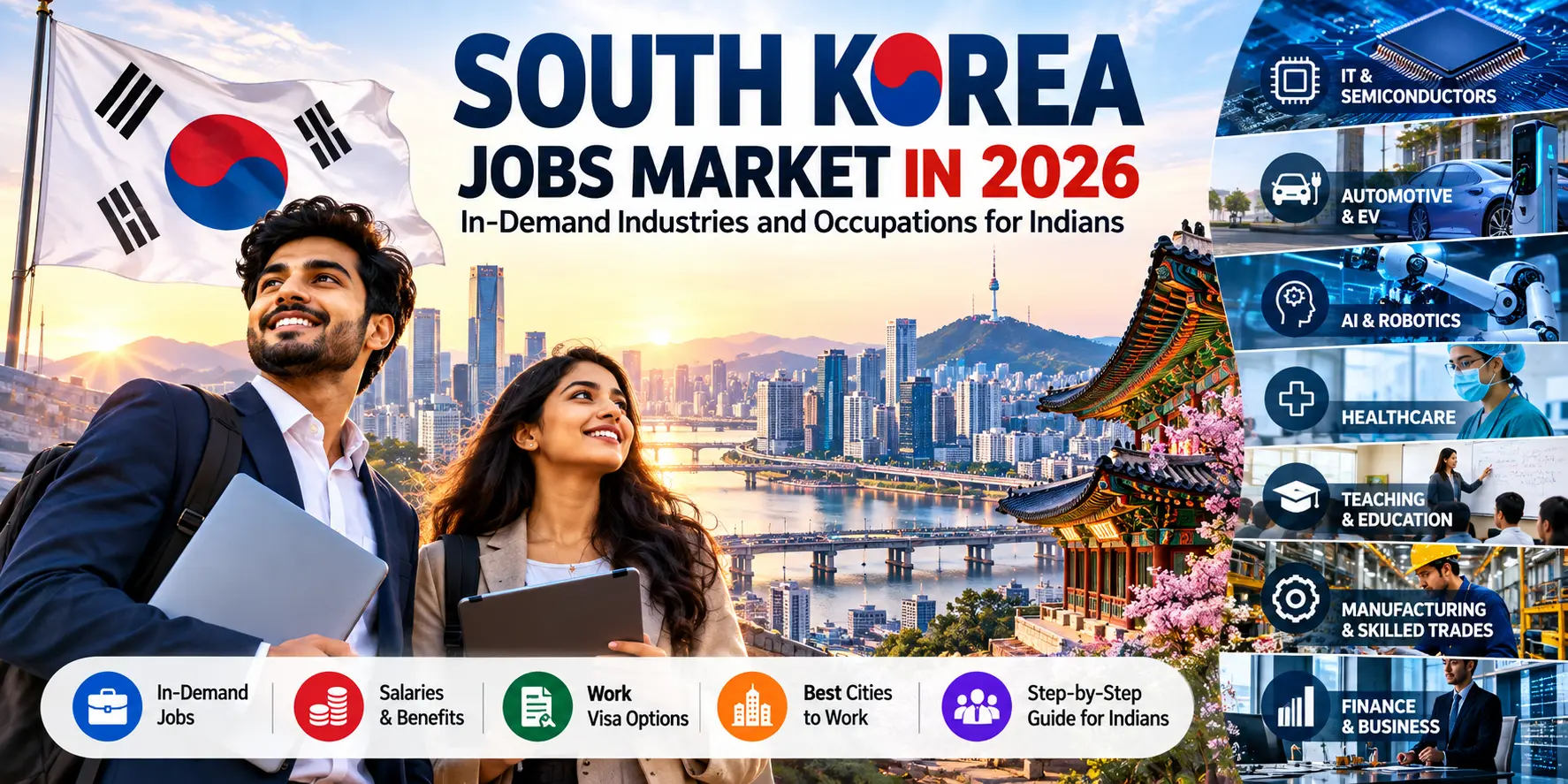
What Is the South Korea Jobs Market in 2026?
The South Korea jobs market in 2026 refers to the overall employment environment in the country, including the industries hiring workers, occupations experiencing demand, salary levels, skills employers are looking for, and the opportunities available to both Korean citizens and foreign nationals. For Indian job seekers, however, understanding the Korean labour market requires looking beyond the number of vacancies. A job may be in demand, but an Indian applicant must also meet the employer’s qualification requirements and the immigration conditions attached to the relevant work status.
South Korea’s employment market in 2026 is being shaped by several structural changes. The country is dealing with an ageing population, a declining working-age population and persistent labour shortages in certain industries and regions. At the same time, South Korea continues to strengthen industries such as semiconductors, advanced manufacturing, artificial intelligence, robotics, batteries, automobiles, biotechnology and other high-value technologies. This is creating two different types of employment demand: specialised professionals for technology-intensive industries and foreign workers for occupations where employers face persistent shortages of available labour.
The latest labour data also shows that the Korean employment market is not expanding uniformly across every industry. In June 2026, employment increased by 63,000 compared with the previous year, while the employment rate for people aged 15 and above was 63.4%. The Ministry of Employment and Labour reported that services continued to provide employment growth, while manufacturing and construction faced weaker conditions.
For Indian applicants, this distinction is important. South Korea does not have a single “foreign worker job market”. Opportunities vary significantly according to occupation, education, experience, Korean language ability, employer requirements and visa category.
How Has the South Korea Job Market Changed for Foreign Workers in 2026?
One of the most significant changes is that South Korea’s immigration and employment policies are increasingly focused on addressing specific labour shortages while also attracting highly skilled international talent.
In March 2026, South Korea announced its 2030 Immigration Policy Future Strategy, which recognises low birth rates, population ageing and changing industrial and technological conditions as reasons to rethink the country’s approach to immigration. The strategy includes measures aimed at attracting highly skilled talent, addressing labour shortages in manufacturing, supporting businesses in population-declining regions and improving pathways for certain foreign workers to remain in Korea longer.
This means the opportunities available to foreign nationals are becoming more closely connected to South Korea’s actual economic and regional labour needs.
For example, the government introduced a new regional employment special provision in May 2026 that allows certain businesses and agricultural corporations in population-declining areas to employ foreign nationals holding the regional specialised talent F-2-R status, subject to the applicable requirements.
South Korea has also continued expanding structured foreign-worker programmes. For 2026, the government planned to introduce approximately 80,000 E-9 non-professional foreign workers, while the broader planned intake of non-professional foreign workers, including seasonal and other categories, was around 191,000.
This provides an important insight for Indian applicants: foreign-worker demand exists at different skill levels, but the pathway is not the same for an IT engineer, a semiconductor specialist, a factory worker, a healthcare professional or a seasonal agricultural worker.
Why Is South Korea Looking Overseas for Workers?
Several factors are contributing to foreign-worker demand.
- Population ageing
South Korea’s ageing population is increasing pressure on industries that need a steady supply of workers. This is particularly relevant to healthcare, caregiving, manufacturing, agriculture, construction and other labour-intensive sectors.
- Declining working-age population
The number of people available to fill certain jobs is becoming a structural concern. This has encouraged the government to develop more targeted foreign-worker policies rather than relying exclusively on the domestic workforce.
- Shortages in specific industries
Some employers struggle to recruit sufficient workers for physically demanding, technical or less attractive occupations. The government has responded by expanding or modifying foreign-worker programmes.
For example, South Korea allocated 109,000 seasonal foreign workers for 2026, representing a 14.1% increase from the previous year, primarily to address labour shortages in rural agricultural and fishing communities.
- Demand for advanced technical talent
South Korea is also competing internationally for highly skilled professionals in areas such as advanced technology, science and engineering. The 2030 immigration strategy specifically includes measures to attract highly qualified talent and expand the country’s top-tier talent visa framework.
- Regional labour shortages
Employment demand is not limited to Seoul. Population-declining regions are facing particularly acute recruitment challenges, which has resulted in policies designed to encourage qualified foreign workers to live and work outside the country’s largest metropolitan areas.
South Korea’s 2026 Jobs Market Has Two Broad Foreign-Worker Segments
For an Indian applicant, it is useful to think of the market as having two broad segments.
| Foreign-worker segment |
Typical opportunities |
Main consideration |
| Professional and highly skilled workers |
IT, engineering, AI, semiconductors, research, specialised technology |
Qualifications, experience, specialised skills and appropriate visa |
| Skilled and shortage occupations |
Manufacturing, technical trades, agriculture, food processing and other shortage occupations |
Approved employment route, occupation eligibility, employer requirements and applicable visa conditions |
These categories should not be treated as interchangeable. A professional who wants to work as a software engineer may follow a very different immigration pathway from a worker entering Korea through an approved labour programme.
What Does This Mean for Indian Job Seekers?
For Indians, South Korea’s 2026 employment market can offer opportunities across technology, engineering, manufacturing, semiconductors, automotive, batteries, research, healthcare, construction, logistics and selected skilled occupations.
However, applicants should avoid a common mistake: searching for “jobs in South Korea” first and checking immigration eligibility later.
A more practical approach is:
Your qualification → occupation → employer demand → language requirement → employment conditions → eligible visa route
For example, an Indian software engineer with specialised AI experience may need to focus on technology employers and professional employment routes. An experienced welder may need to investigate a completely different skilled-worker pathway. A nurse must consider professional licensing and Korean-language requirements in addition to finding an employer.
Is South Korea Easy for Foreign Workers in 2026?
The answer depends heavily on the applicant’s profile.
South Korea is clearly expanding mechanisms to address labour shortages and attract foreign talent, but this does not mean every foreign applicant can easily obtain employment. The government is simultaneously introducing measures intended to protect domestic employment conditions, including appropriate wage requirements for foreign workers.
The labour market itself is also mixed. Official June 2026 data showed employment growth overall, but manufacturing and construction remained weaker than some service sectors.
Therefore, an Indian applicant should assess occupation-specific demand rather than assuming that South Korea is hiring equally across all sectors.
What Are the Biggest Employment Trends for Indians to Watch in 2026?
The following trends are particularly relevant:
- Semiconductors and advanced electronics: South Korea remains heavily focused on technology-intensive industries.
- AI and robotics: Automation and advanced technology are increasing demand for specialised technical skills.
- Automotive and batteries: EV-related manufacturing and technology continue to create specialised roles.
- Manufacturing: Certain manufacturing occupations continue to experience labour shortages.
- Healthcare and care services: Demographic ageing is increasing the importance of healthcare and care-related employment.
- Skilled technical occupations: Some employers continue to face difficulty filling technical and physically demanding roles.
- Agriculture and fisheries: Seasonal foreign-worker programmes remain an important part of addressing rural labour shortages.
- Regional employment: Government policy is increasingly encouraging foreign workers to contribute to areas experiencing population decline.
- Highly skilled immigration: South Korea is developing stronger mechanisms to attract and retain advanced technical and scientific talent.
South Korea Jobs Market in 2026: What Indians Should Understand
The most important point is that South Korea’s employment market is becoming more specialised for foreign workers. The country needs workers in certain shortage occupations while also competing globally for highly skilled professionals.
For an Indian applicant, the strongest starting point is therefore not simply asking, “Which jobs are available in South Korea?” Instead, ask:
“Which South Korean industries need my particular skills, and which legal employment route allows me to work in that occupation?”
This approach helps you avoid unsuitable vacancies, unqualified applications and misleading recruitment promises. It also makes it easier to identify the next steps, such as improving Korean language ability, obtaining a relevant certification, targeting specific employers or determining the appropriate work visa before accepting an employment offer.
2026 Expert Tip: Do not treat labour shortage statistics as a guarantee of employment. A shortage means employers or industries have difficulty filling particular positions. Your individual eligibility still depends on the occupation, employer, qualifications, experience, language ability and immigration rules applicable to your case.
Why Is South Korea Hiring Foreign Workers in 2026?
South Korea’s demand for foreign workers in 2026 is closely connected to demographic change, labour shortages, industrial expansion, technological development and regional workforce gaps. The country is facing a long-term decline in its working-age population while several strategic industries need specialised skills and other sectors continue to struggle to recruit enough workers locally.
The Korean government is therefore moving towards a more targeted immigration model. Instead of treating foreign workers only as a source of additional labour, its 2026 immigration strategy places greater emphasis on attracting highly skilled professionals, filling genuine workforce shortages, supporting industries facing labour constraints and encouraging foreign workers to contribute to regions experiencing population decline.
This creates opportunities for Indian professionals and skilled workers, but there is an important distinction to understand: South Korea’s need for foreign workers does not mean that every foreign applicant can obtain a job or work visa. Your occupation, qualifications, experience, employer, salary, language ability and immigration category all matter.
South Korea’s Declining Working-Age Population
One of the biggest reasons South Korea is looking overseas for workers is its changing population structure.
South Korea has been experiencing very low birth rates and rapid population ageing. According to the Korea Employment Information Service’s 2024 to 2034 labour-market projections, the country’s working-age population aged 15 to 64 is expected to continue declining, while the proportion of people aged 65 and above is projected to reach 31.7% by 2034. The same government analysis expects the economically active population to enter a more pronounced decline from 2030.
For employers, this creates a fundamental problem. Even if a company has sufficient orders, investment and production capacity, it may not have enough people available to fill the required positions.
This pressure is particularly relevant to industries that require:
- Production workers
- Skilled technicians
- Engineers
- Machine operators
- Welders
- Maintenance workers
- Construction workers
- Agricultural workers
- Care workers
- Specialist technology professionals
The demographic issue also explains why foreign-worker policy is increasingly becoming part of South Korea’s broader economic strategy rather than simply a temporary response to isolated labour shortages.
For Indian applicants: This does not mean South Korea is opening all occupations to foreigners. Instead, demographic pressure is encouraging the government to create or expand specific immigration and employment channels where foreign workers can address identified workforce needs.
Labour Shortages in Specific Industries
South Korea does not have the same level of labour shortage in every occupation. This distinction is important when researching jobs from India.
A job can be popular among foreign workers without actually being a government-identified shortage occupation. Similarly, an industry can have a shortage of workers while a particular professional position within that industry remains highly competitive.
The Korean government has continued to adjust foreign-worker employment quotas and eligible industries according to labour-market requirements. For 2026, the government planned to bring in approximately 191,000 non-professional foreign workers, including 80,000 workers under the Employment Permit System (E-9) and 109,000 seasonal workers under E-8.
The Ministry of Employment and Labor also issued a 2026 notice identifying additional industries and regions where employers could receive increased foreign-worker employment allowances.
This shows that foreign-worker recruitment is being managed according to specific labour requirements.
Genuine shortage vs popular occupation
Indian applicants should therefore distinguish between these two situations:
| Situation |
What it means |
| Genuine labour shortage |
Employers have difficulty finding sufficient workers for particular eligible occupations or regions |
| Popular foreign-worker occupation |
Many foreign nationals already seek these jobs, but demand does not necessarily exceed supply |
| High-skilled talent demand |
Employers need specialised expertise that may be difficult to source domestically |
| Temporary labour demand |
Employers require workers for seasonal or time-bound activities |
| Regional shortage |
Employers outside major metropolitan areas struggle to recruit workers |
This distinction is particularly important for anyone searching online for phrases such as “South Korea shortage jobs” or “South Korea jobs for foreigners.” A vacancy appearing online does not automatically mean that it qualifies for foreign-worker sponsorship.
Expert Tip: Always check three things separately: Is the occupation in demand? Is the employer permitted to hire a foreign worker? Can your specific visa or immigration status legally cover that employment?
Expansion of Semiconductors, Batteries and Advanced Manufacturing
South Korea’s demand for specialised international talent is also connected to its position in advanced manufacturing and strategic technology industries.
The country has major economic interests in sectors including:
- Semiconductors
- Artificial intelligence
- Secondary batteries
- Future vehicles
- Biotechnology
- Robotics
- Displays
- Defence technology
South Korea’s 2030 immigration strategy specifically identifies these high-tech areas as important fields for attracting top international talent.
This is particularly relevant for Indian engineers and technology professionals because many of these industries require specialised knowledge rather than general labour.
Potential roles can include:
- Semiconductor process engineers
- Equipment engineers
- Electrical engineers
- Electronics engineers
- Battery engineers
- Materials scientists
- AI engineers
- Robotics engineers
- Software developers
- Automation specialists
- Research scientists
- Quality and manufacturing engineers
The latest 2026 industry employment outlook also indicates that semiconductor and shipbuilding employment was expected to increase in the second half of 2026, while several other major manufacturing industries were expected to maintain broadly stable employment levels.
For an Indian professional, this creates an important opportunity: South Korea’s foreign-worker strategy is not limited to filling lower-skilled vacancies. It is also increasingly focused on attracting people who can contribute to strategic industries.
Why Indian professionals may be relevant
India has a large pool of professionals in:
- Software engineering
- Electronics
- Electrical engineering
- Mechanical engineering
- Data science
- AI
- Research
- Automotive engineering
- Industrial automation
However, having one of these qualifications does not guarantee employment in Korea. Employers may still require industry-specific experience, Korean-language ability, professional credentials or other qualifications.
Technology and Digital Transformation
Another reason South Korea needs international talent is the rapid transformation of traditional industries through AI, automation and digital technologies.
South Korean companies are increasingly integrating technologies such as:
- Artificial intelligence
- Machine learning
- Robotics
- Cloud computing
- Big-data analytics
- Cybersecurity
- Industrial automation
- Computer vision
- Smart factories
- Autonomous systems
The country’s labour-market projections explicitly identify AI technology expansion as a factor accelerating changes in the structure of workforce demand.
This creates two related employment trends.
First, companies need specialists who can build and manage new technologies.
Examples include:
- AI engineers
- Machine-learning engineers
- Data scientists
- Cloud engineers
- Cybersecurity specialists
- Software developers
- Robotics engineers
- Automation engineers
Second, traditional industries are changing the skills they require.
A manufacturing company may increasingly need workers who understand automated production systems, industrial software, robotics and data-driven quality control rather than relying exclusively on conventional manual production skills.
For Indian professionals, this means that technology skills can be valuable even when the underlying employer operates in a traditional Korean industry.
For example, an automotive company may require software engineers, data specialists and automation professionals in addition to traditional mechanical engineers.
Healthcare and Elderly Care Demand
South Korea’s demographic transition is also increasing pressure on healthcare and care-related services.
As the older population grows, demand for healthcare, long-term care and elderly support services can increase. At the same time, the shrinking working-age population makes it more difficult to staff labour-intensive care services.
This creates potential demand across areas such as:
- Nursing
- Elderly care
- Healthcare support
- Rehabilitation
- Medical technology
- Healthcare administration
- Social care
However, healthcare is one area where Indian applicants must be particularly careful.
A shortage of healthcare workers does not automatically mean that an Indian nurse, doctor or allied-health professional can start working immediately after receiving a Korean job offer. Regulated healthcare professions can involve qualification recognition, licensing, examinations, language requirements and registration with the relevant Korean authorities.
Therefore, healthcare applicants should evaluate:
Indian qualification → Korean recognition → professional licence → employer eligibility → visa eligibility
This is very different from applying for a general non-regulated occupation.
Expert Tip: Never pay a recruitment agency simply because it claims that “South Korea has a shortage of nurses” or “Korea urgently needs healthcare workers.” Ask the recruiter to identify the exact occupation, licensing pathway, employer and immigration category applicable to your profile.
Construction and Infrastructure Requirements
Construction and technical occupations can also experience workforce shortages, particularly where employers need workers with practical skills and are finding it difficult to recruit locally.
Potential areas include:
- Construction
- Welding
- Electrical work
- Machinery operation
- Equipment maintenance
- Fabrication
- Plumbing
- Industrial installation
- Civil construction
- Infrastructure-related technical work
The opportunity, however, depends heavily on the specific employment programme and occupation.
This is particularly important because the Korean government manages foreign-worker recruitment through defined systems and quotas rather than allowing employers to freely sponsor unlimited numbers of foreign workers.
In 2026, South Korea continued making adjustments to foreign-worker employment allowances and regional eligibility to respond to workforce shortages.
For Indian skilled workers, this means that practical experience and trade qualifications may be valuable, but they should be matched against the exact Korean employment route before starting the application process.
Government Policies Supporting Foreign Workers
South Korea’s 2026 immigration policy provides one of the clearest indications of how the country intends to use foreign talent.
In March 2026, the Ministry of Justice announced its 2030 Immigration Policy Future Strategy. The strategy was developed in response to low birth rates, population ageing and rapid changes in industrial and technological conditions. It aims to move beyond a model focused mainly on low-skilled and low-wage foreign labour and place greater emphasis on highly skilled talent, industrial workforce shortages, regional economic needs and longer-term integration.
Several measures are particularly relevant.
Expansion of high-skilled talent pathways
South Korea expanded its Top-Tier Visa programme in 2026. From June, eligibility was expanded beyond employees in eight high-tech industries to include outstanding professors and researchers in science and technology fields. The identified high-tech sectors include semiconductors, AI, secondary batteries, future vehicles, biotechnology, robotics, displays and defence.
The programme provides qualifying top-tier talent and their families with enhanced residence and settlement benefits, subject to the programme’s conditions. The government has stated a target of attracting 350 such top-tier individuals by 2030.
Support for manufacturing workforce development
The 2030 strategy also proposes a professional technical workforce development system aimed at helping address labour shortages in manufacturing.
This is significant because it shows that South Korea is attempting to create a more structured progression from foreign-worker employment towards higher-skilled technical roles.
Regional employment initiatives
South Korea is also targeting population-declining regions.
In May 2026, the government introduced a pilot Regional Vitality Small Business Employment Special Provision, allowing qualifying small businesses and agricultural corporations in designated population-declining areas to employ certain foreign nationals holding the regional specialised talent F-2-R status, subject to the applicable requirements.
This demonstrates another important trend: foreign-worker demand is increasingly being linked to where workers are needed, not just what jobs they perform.
Structured foreign-worker programmes
For lower-skilled and non-professional employment, South Korea continues to use structured systems such as the E-9 Employment Permit System and seasonal-worker programmes. The government’s 2026 plan set an E-9 intake of 80,000 and a broader non-professional foreign-worker intake of approximately 191,000 when E-8 seasonal and other categories are included.
These programmes demonstrate that South Korea is actively using overseas workers to address specific labour shortages, but they also show why applicants must understand the exact rules attached to each employment route.
What Does South Korea’s Foreign-Worker Strategy Mean for Indians?
For Indian applicants, the changing Korean labour market can broadly be understood through two parallel requirements.
South Korea needs workers
Demographic ageing, declining working-age population and sector-specific shortages are increasing the need for additional workers.
South Korea needs the right workers
The government is simultaneously becoming more targeted about the type of foreign talent it wants to attract, including highly skilled professionals in strategic industries and workers who can fill defined shortages.
Therefore, the most useful question for an Indian applicant is not simply:
“Is South Korea hiring foreigners?”
A better question is:
“Does my occupation, qualification, experience and profile match a Korean employer’s demand and an available legal employment route?”
That distinction can prevent one of the biggest mistakes made by overseas job seekers: assuming that a national labour shortage automatically translates into a personal job opportunity.
Why “South Korea Has Labour Shortages” Does Not Mean Everyone Can Get a Work Visa
A shortage of workers is only one part of the immigration process.
An Indian applicant may still need to satisfy requirements relating to:
- Occupation: The job must be eligible under the relevant employment or immigration route.
- Employer: The employer must be legally permitted to employ foreign workers where sponsorship or an employment permit is required.
- Qualifications: Your degree, trade qualification, certification or professional licence may need to meet specific requirements.
- Experience: Certain professional or skilled positions may require relevant work experience.
- Language: Some jobs can require Korean proficiency or other language capability.
- Salary and employment conditions: Certain immigration pathways impose employment or wage conditions.
- Quota or regional restrictions: Some programmes operate within defined worker numbers, industries or locations.
- Visa category: You must hold the immigration status that legally permits the proposed employment.
- Professional licensing: Regulated occupations such as healthcare may involve additional licensing requirements.
- Employer and government approval: Depending on the route, the employer and relevant Korean authorities may need to complete specific procedures.
Expert Insight: Think of labour demand as the first filter, not the final approval. The fact that Korea needs semiconductor engineers, welders, healthcare workers, software professionals or manufacturing workers does not by itself establish that a particular Indian applicant qualifies for employment or a visa.
For this reason, Indian job seekers should assess their profile in this order:
Occupation → Skills → Qualifications → Korean language → Employer → Employment contract → Visa eligibility → Application
This approach is considerably safer than choosing a job based solely on an online article claiming that an occupation is “in demand.”
What Are the Most In-Demand Industries in South Korea in 2026?
South Korea’s employment market in 2026 is not driven by one single industry. Demand is spread across advanced technology, semiconductors, engineering, manufacturing, healthcare, logistics, construction, education and selected service industries, but the strength of demand differs significantly from one sector to another.
Official 2026 employment projections provide an important reality check. For the second half of 2026, the Korea Employment Information Service and Korea Institute for Advancement of Technology projected employment growth in semiconductors and shipbuilding, while employment in machinery, electronics and displays, steel, automobiles, metal processing, petroleum and chemicals was expected to remain broadly at the previous year’s level. Textile employment was projected to decline.
The broader labour market also shows a mixed picture. In July 2026, employment-insured workers increased by 277,000 year on year, with services contributing strongly to growth, while manufacturing and construction employment declined. Within services, health and social welfare, accommodation and food services, business services, professional scientific and technical activities, and education recorded increases.
For Indian applicants, this means “in demand” should not be interpreted as “easy to get.” A sector can be growing while individual occupations remain competitive. Likewise, a labour-shortage occupation may be accessible only through a specific foreign-worker programme or visa category.
South Korea’s Most Relevant Industries for Foreign Workers in 2026
| Industry |
Demand Level/Trend in 2026 |
Common Occupations |
Typical Qualifications |
Korean Language Requirement |
Potential Visa Route |
| Information Technology & Software |
Strong specialist demand, particularly in software, cloud, data and digital technology |
Software developers, cloud engineers, DevOps engineers, cybersecurity specialists, data engineers |
Bachelor’s degree or relevant technical background, experience and specialised skills |
English may be sufficient for some international roles; Korean is useful for domestic employers |
Professional/specialised employment routes such as applicable E-series categories |
| Semiconductors & Electronics |
Growing semiconductor employment outlook in H2 2026 |
Semiconductor engineers, process engineers, equipment engineers, electronics engineers, chip specialists |
Engineering/science degree, technical expertise and relevant experience |
Varies by employer; Korean increasingly useful for workplace integration |
Professional/high-skilled employment routes |
| AI & Robotics |
Strategic growth area |
AI engineers, ML engineers, robotics engineers, computer vision specialists, researchers |
Computer science, engineering, mathematics or related qualifications |
Often employer-dependent; Korean useful for research and domestic teams |
High-skilled/professional routes |
| Engineering |
Stable to specialised demand, depending on discipline |
Mechanical, electrical, civil, chemical, industrial engineers |
Engineering degree, experience and technical certifications where required |
Moderate to high depending on employer and role |
Professional employment routes |
| Automotive & EVs |
Broadly stable employment outlook, with specialised technology opportunities |
Automotive engineers, EV engineers, software engineers, production engineers, quality engineers |
Engineering/technology degree and relevant experience |
Korean often useful in manufacturing environments |
Professional/specialised employment routes |
| Batteries & Energy Technology |
Strategic growth sector |
Battery engineers, materials scientists, process engineers, R&D specialists |
Engineering/science degree and relevant technical experience |
Employer-dependent; Korean useful for plant-based roles |
High-skilled/professional routes |
| Manufacturing |
Large foreign-worker requirement, but conditions differ by subsector |
Production workers, machine operators, quality workers, technicians |
Technical qualification or relevant experience depending on occupation |
Korean often important, especially for operational safety |
E-9 and other applicable routes depending on occupation |
| Biotechnology & Pharmaceuticals |
Specialist and research-oriented demand |
Scientists, laboratory specialists, QC/QA professionals, clinical research specialists |
Life-science/pharmaceutical degree and relevant experience |
Korean varies; higher importance in domestic operations |
Professional/research employment routes |
| Healthcare |
Growing need associated with ageing population |
Nurses, doctors, allied health professionals, care workers, healthcare support |
Relevant healthcare qualification, licensing/recognition where applicable |
Often significant, particularly for patient-facing roles |
Relevant professional/employment routes |
| Construction & Infrastructure |
Labour shortages exist, although overall construction employment has been under pressure |
Engineers, electricians, welders, equipment operators, technicians |
Trade qualifications, engineering degree or experience |
Korean important for safety and site communication |
E-9 or professional route depending on occupation |
| Education |
Employment growth within services, but foreign-worker eligibility varies by role |
English teachers, lecturers, researchers, education specialists |
Degree, teaching credentials and visa-specific requirements |
Depends on position and institution |
Education-specific or professional route |
| Research & Academia |
Specialist demand in science and technology |
Researchers, professors, postdoctoral researchers, R&D specialists |
Master’s/PhD and research experience for many roles |
Korean may not be essential in international research environments |
Research/professor/high-skilled routes |
| Finance & Banking |
Selective demand, particularly for specialised and international roles |
Financial analysts, risk specialists, FinTech professionals, international business specialists |
Finance/business/technology degree and experience |
Korean often important for domestic-facing roles |
Professional employment routes |
| Logistics & Supply Chain |
Service-sector demand and strategic importance |
Supply chain specialists, logistics managers, procurement specialists, warehouse supervisors |
Relevant degree or experience |
Korean generally useful, particularly in operational roles |
Professional or applicable employment routes |
| Hospitality & Tourism |
Service employment remains significant, with opportunities varying by location |
Hotel staff, chefs, hospitality managers, tourism professionals |
Relevant qualification/experience depending on role |
Korean generally important for customer-facing positions |
Applicable employment categories; eligibility varies |
| Food Processing |
Foreign-worker demand in selected production occupations |
Food production workers, machine operators, quality-control workers, technicians |
Relevant experience/technical qualification depending on job |
Basic Korean can be important for workplace safety |
E-9 and other applicable routes |
| Shipbuilding & Marine Engineering |
Growing employment outlook in H2 2026 |
Welders, marine engineers, naval architects, fabrication workers, production technicians |
Trade certification or engineering qualification and experience |
Korean useful for industrial sites; requirement depends on role |
E-9 or professional route depending on occupation |
| Renewable Energy & Environmental Technology |
Emerging/specialised demand |
Environmental engineers, energy engineers, sustainability specialists, technicians |
Engineering/science qualification and relevant experience |
Employer-dependent |
Professional/high-skilled routes |
| E-commerce & Digital Business |
Digital-service demand |
Product managers, digital marketers, developers, data analysts, e-commerce specialists |
Business/technology degree and relevant experience |
Korean often useful for Korean-market roles |
Professional employment routes |
| Skilled Trades & Technical Occupations |
Persistent demand in selected occupations |
Welders, electricians, CNC operators, mechanics, maintenance technicians |
Trade certification, skills and experience |
Korean important for many workplace environments |
E-9 or other occupation-specific routes |
Visa categories above are indicative rather than automatic. The appropriate status depends on the exact occupation, employer, qualifications and immigration requirements.
1. Information Technology and Software
Technology remains one of the most relevant sectors for highly skilled foreign professionals. South Korea’s broader labour-market projections identify AI and technological change as major forces reshaping workforce demand over the coming decade.
Indian professionals may find opportunities in areas such as:
- Software development
- Backend and frontend development
- Cloud computing
- DevOps
- Cybersecurity
- Data engineering
- Data science
- Mobile application development
- IT infrastructure
- Enterprise software
- Product management
- Technology consulting
The most attractive opportunities are generally not simply “computer jobs.” Employers increasingly look for specific technical expertise that solves a business or engineering problem.
For example, an Indian software engineer with experience in AI infrastructure, cloud architecture or semiconductor software may have a different employment profile from a general junior developer.
What Indian IT professionals should focus on
A strong profile should demonstrate:
- Relevant technical experience
- Projects with measurable outcomes
- Current programming skills
- Industry-specific expertise
- International work experience where available
- English communication ability
- Korean language ability where relevant
Korean language requirements vary considerably. Multinational companies and international teams may operate partly or primarily in English, whereas positions involving Korean clients, domestic teams or internal business operations can require Korean.
2. Semiconductors and Electronics
Semiconductors are one of the clearest areas of employment growth in South Korea in 2026.
The official H2 2026 industry outlook specifically projects an increase in semiconductor employment compared with the second half of 2025.
Potential occupations include:
- Semiconductor process engineers
- Equipment engineers
- Semiconductor manufacturing engineers
- Electronics engineers
- Electrical engineers
- Process integration specialists
- Quality engineers
- Materials specialists
- Packaging and testing specialists
- Semiconductor R&D professionals
This sector is particularly relevant to Indian applicants with backgrounds in:
- Electronics engineering
- Electrical engineering
- Semiconductor technology
- Materials science
- Chemical engineering
- Mechanical engineering
- Physics
- Computer engineering
South Korea’s immigration strategy also identifies semiconductors as one of the country’s strategic high-tech industries for attracting international talent.
Indian applicant insight: A general engineering degree may not be enough for a highly specialised semiconductor position. Relevant plant, fabrication, process, equipment, materials or R&D experience can make a significant difference.
3. Artificial Intelligence and Robotics
AI and robotics are increasingly connected to South Korea’s manufacturing and technology strategy.
Potential occupations include:
- AI engineers
- Machine-learning engineers
- Robotics engineers
- Computer-vision engineers
- AI researchers
- Data scientists
- Automation engineers
- Autonomous-systems specialists
- Industrial AI specialists
South Korea’s government has specifically identified AI and robotics among the strategic high-tech industries relevant to attracting highly skilled international talent.
For Indian professionals, the opportunity extends beyond technology companies. AI and robotics skills can also be relevant to:
- Manufacturing
- Automotive
- Semiconductors
- Logistics
- Healthcare
- Electronics
- Smart factories
This makes AI one of the more transferable skill sets in the Korean employment market.
4. Engineering
Engineering remains an important part of South Korea’s industrial economy, although demand varies by discipline.
Potential areas include:
- Mechanical engineering
- Electrical engineering
- Electronics engineering
- Chemical engineering
- Industrial engineering
- Civil engineering
- Automotive engineering
- Materials engineering
- Environmental engineering
- Automation engineering
The official H2 2026 outlook expects machinery employment to remain broadly at the previous year’s level rather than showing a major increase. This is a useful reminder that a large engineering industry does not automatically mean employment growth across every engineering occupation.
For Indian engineers, specialised experience can therefore be more valuable than simply having an engineering degree.
5. Automotive and Electric Vehicles
South Korea has a substantial automotive industry, including conventional vehicles, electric vehicles, automotive electronics and software.
Potential occupations include:
- Automotive engineers
- EV engineers
- Battery integration specialists
- Vehicle software engineers
- Embedded systems engineers
- Production engineers
- Quality engineers
- Automotive R&D specialists
- Manufacturing engineers
The official H2 2026 outlook projects automobile employment to remain broadly stable year on year.
That distinction matters. The automotive industry remains strategically important, but applicants should target specific technology and engineering skills rather than assume that every automotive occupation is experiencing a shortage.
6. Batteries and Energy Technology
Battery technology is another strategic area connected to South Korea’s advanced manufacturing ecosystem.
Potential jobs include:
- Battery engineers
- Materials scientists
- Process engineers
- Cell-development specialists
- Battery quality engineers
- Energy-storage specialists
- Chemical engineers
- R&D scientists
- Production and manufacturing engineers
These positions typically require technical education and relevant experience.
For Indian applicants, degrees in chemical engineering, materials science, electrical engineering, mechanical engineering and related disciplines can be relevant depending on the position.
7. Manufacturing
Manufacturing is one of the most important sectors for foreign-worker employment, but the employment picture is mixed.
South Korea planned to admit 80,000 E-9 workers in 2026, with manufacturing forming a major part of the Employment Permit System. The government also introduced additional foreign-worker employment allowances for selected industries and regions.
Potential occupations include:
- Production workers
- Machine operators
- Assembly workers
- Quality-control workers
- Packaging workers
- Maintenance technicians
- Production technicians
- Factory equipment operators
However, manufacturing employment itself has been under pressure in some areas. In July 2026, employment-insured workers in manufacturing decreased year on year, although certain manufacturing subsectors such as electronics/communications and pharmaceuticals showed increases in earlier labour-market data.
Therefore, foreign-worker demand and overall manufacturing employment growth are not the same thing.
8. Biotechnology and Pharmaceuticals
Biotechnology and pharmaceuticals are increasingly important knowledge-intensive industries.
Potential roles include:
- Pharmaceutical scientists
- Biotechnology researchers
- Laboratory scientists
- Clinical research professionals
- Quality-control specialists
- Quality-assurance professionals
- Regulatory affairs specialists
- Bioprocess engineers
These jobs are generally more qualification-intensive than ordinary manufacturing positions.
Indian applicants with master’s or doctoral degrees, laboratory experience, pharmaceutical experience or specialised research backgrounds may find relevant opportunities, particularly in R&D environments.
9. Healthcare
Healthcare is becoming increasingly important because of South Korea’s ageing population.
Official labour statistics in 2026 showed strong employment growth in health and social welfare, making it one of the stronger service-sector areas. In June 2026, health and social welfare accounted for the largest increase among service industries, with employment rising by approximately 112,000.
Potential occupations include:
- Nurses
- Doctors
- Allied healthcare professionals
- Medical laboratory professionals
- Rehabilitation specialists
- Care workers
- Healthcare support staff
- Healthcare administrators
However, healthcare should not be treated like an ordinary job category.
For regulated professions, Indian applicants may need:
- Recognition of qualifications
- Korean professional licensing
- Korean-language proficiency
- Registration with the relevant authority
- Additional examinations or training
Therefore, healthcare demand does not automatically make an Indian healthcare qualification valid for employment in Korea.
10. Construction and Infrastructure
Construction and infrastructure continue to require engineers, technicians and skilled workers, but the broader construction labour market has faced weakness.
Official July 2026 labour statistics showed construction employment continuing to decline, although the rate of decline had moderated.
At the same time, South Korea continues to use foreign workers to address labour shortages in selected industries and regions.
Potential occupations include:
- Civil engineers
- Construction engineers
- Welders
- Electricians
- Equipment operators
- Maintenance technicians
- Plumbers
- Fabrication workers
- Site technicians
Indian applicants should therefore distinguish between overall construction employment trends and specific skilled-worker shortages.
11. Education
Education remains a significant service-sector employer.
Potential opportunities for foreign nationals can include:
- English teaching
- University teaching
- Research positions
- International education
- Language instruction
- Education management
However, foreign-worker eligibility differs substantially between teaching categories.
An Indian applicant should not assume that having a bachelor’s degree automatically makes them eligible for every English-teaching position in South Korea. Visa requirements, nationality rules, educational background, employer type and teaching qualifications can affect eligibility.
12. Research and Academia
South Korea is also interested in attracting international researchers and highly qualified academics.
Potential areas include:
- Semiconductor research
- AI
- Robotics
- Biotechnology
- Materials science
- Physics
- Engineering
- Battery technology
- Advanced manufacturing
Researchers with master’s or doctoral qualifications may find opportunities through universities, research institutes and corporate R&D centres.
South Korea’s 2026 immigration strategy expanded the scope of its top-tier talent approach to include outstanding professors and researchers in science and technology fields.
This makes research and academia particularly relevant for highly qualified Indian professionals.
13. Finance and Banking
Finance and banking remain important sectors, particularly in Seoul and other major business centres.
Potential roles include:
- Financial analysts
- Risk specialists
- Investment professionals
- FinTech specialists
- Business analysts
- Data analysts
- Compliance specialists
- International banking professionals
For foreign professionals, opportunities are often more specialised than general banking positions.
Korean language ability can be particularly important for positions involving domestic customers, Korean regulatory requirements and internal Korean-language operations.
Professionals with a combination of finance + technology, such as FinTech, data analytics or cybersecurity, may have a broader range of potential opportunities than applicants with only general business qualifications.
14. Logistics and Supply Chain
South Korea’s manufacturing, export and retail economies create continuing demand for logistics and supply-chain professionals.
Potential occupations include:
- Supply-chain managers
- Logistics coordinators
- Procurement specialists
- Inventory managers
- Warehouse supervisors
- Import-export specialists
- Freight professionals
- Operations analysts
Foreign professionals with international supply-chain experience may be relevant to companies dealing with global suppliers and customers.
Korean language skills can become more important in operational roles that involve local suppliers, warehouse teams and domestic logistics networks.
15. Hospitality and Tourism
Hospitality and tourism provide a significant number of service-sector jobs.
Potential occupations include:
- Hotel professionals
- Chefs
- Restaurant managers
- Hospitality supervisors
- Tourism professionals
- Guest-service staff
- Food-service workers
Employment in accommodation and food services increased in 2026 labour statistics.
However, foreign-worker eligibility varies considerably by occupation and visa category. Customer-facing positions generally require stronger Korean communication than back-office or internationally oriented positions.
16. Food Processing
Food processing is one of the areas where foreign-worker programmes can be particularly relevant.
Potential jobs include:
- Food production workers
- Machine operators
- Packaging workers
- Quality-control workers
- Production technicians
- Processing workers
For lower-skilled employment, the relevant foreign-worker programme is more important than simply finding an employer willing to hire foreigners.
South Korea’s 2026 foreign-worker policy continued to support structured recruitment to address labour shortages in eligible sectors.
17. Shipbuilding and Marine Engineering
Shipbuilding stands out in the official H2 2026 employment outlook.
The government projected increased employment in shipbuilding compared with H2 2025, alongside semiconductor employment growth.
Potential occupations include:
- Marine engineers
- Naval architects
- Welders
- Fabrication workers
- Electrical technicians
- Mechanical engineers
- Production technicians
- Quality inspectors
- Shipyard workers
This can be relevant to Indian engineers and skilled tradespeople with directly relevant experience.
For industrial roles, Korean language ability can be valuable because safety instructions, technical communication and workplace procedures may be conducted in Korean.
18. Renewable Energy and Environmental Technology
South Korea is also developing technology and industrial capabilities connected to energy transition and environmental management.
Potential areas include:
- Renewable-energy engineering
- Environmental engineering
- Energy systems
- Battery technology
- Waste management
- Sustainability
- Environmental compliance
- Energy efficiency
These are generally more specialised opportunities rather than large-scale foreign-worker recruitment categories.
Indian applicants should therefore focus on specific technical skills and employer demand rather than treating “green jobs” as a single employment category.
19. E-commerce and Digital Business
South Korea has a highly developed digital consumer economy, creating opportunities across:
- E-commerce
- Digital marketing
- Product management
- Software development
- Data analytics
- UX/UI
- Digital operations
- Marketplace management
- Customer technology
Professionals with experience in international markets can be particularly relevant to companies expanding beyond Korea.
However, domestic-facing digital marketing and customer roles can require strong Korean language ability because the target market is primarily Korean.
20. Skilled Trades and Technical Occupations
Skilled trades remain important because demographic changes affect occupations that require practical technical skills.
Potential roles include:
- Welders
- Electricians
- CNC operators
- Machine technicians
- Mechanics
- Maintenance technicians
- Fabricators
- Industrial equipment operators
- HVAC technicians
- Production technicians
South Korea’s foreign-worker employment system specifically addresses labour shortages through structured employment routes, with the government setting quotas and eligible industries rather than allowing unlimited foreign recruitment.
For Indian skilled workers, actual trade experience and recognised qualifications can be more important than a general academic degree.
Which Industries Should Indian Applicants Watch Most Closely?
There is no single industry that suits every Indian applicant. The practical approach is to match your profile with the type of demand South Korea is experiencing.
For Indian IT professionals
Focus on:
- Software
- AI
- Cloud
- Cybersecurity
- Data
- Robotics
- Digital business
For engineers
Consider:
- Semiconductors
- Electronics
- Batteries
- Automotive
- Advanced manufacturing
- Shipbuilding
- Energy
- Industrial technology
For skilled workers
Look at:
- Manufacturing
- Shipbuilding
- Food processing
- Construction-related trades
- Machinery
- Maintenance
- Other occupations covered by applicable foreign-worker programmes
For healthcare professionals
Research:
- Healthcare
- Nursing
- Elderly care
- Rehabilitation
- Medical technology
But verify licensing and Korean-language requirements before applying.
For researchers and highly qualified professionals
Focus on:
- AI
- Semiconductors
- Biotechnology
- Robotics
- Battery technology
- Engineering
- Scientific research
South Korea’s immigration policy is increasingly focused on attracting specialised international talent in strategic technology sectors.
Important: Industry Demand Is Not the Same as Visa Eligibility
This is one of the most important points Indian applicants should understand.
Suppose semiconductor employment is growing in 2026. That does not mean every electronics graduate from India can obtain a semiconductor job in Korea.
Similarly:
Healthcare demand ≠ automatic nurse employment
Construction shortage ≠ automatic construction work visa
IT demand ≠ automatic employer sponsorship
Manufacturing recruitment ≠ eligibility for every manufacturing position
The final opportunity depends on the combination of:
Industry demand + occupation + qualification + experience + employer + salary/contract + language + applicable immigration route
South Korea’s 2026 foreign-worker policy itself demonstrates this targeted approach. The government planned around 80,000 E-9 workers and approximately 109,000 seasonal workers, while separately developing mechanisms to attract highly skilled international talent.
For an Indian applicant, therefore, the most useful next step is to identify your occupation first, then determine which Korean industries hire that occupation, which employers recruit foreign nationals, and which visa or employment route applies to your specific profile.
Information Technology and Software Jobs in South Korea for Indians
Information technology is one of the most relevant professional sectors for Indians considering employment in South Korea in 2026. South Korea has a highly developed technology ecosystem spanning software, electronics, semiconductors, telecommunications, gaming, e-commerce, financial technology, automotive technology, artificial intelligence and smart manufacturing.
For Indian IT professionals, the opportunity is particularly relevant because many of the skills used in India’s technology industry are transferable to Korean employers. However, the Korean market is not simply looking for more software developers. Employers increasingly want professionals with specialised, immediately usable technical skills, particularly in AI, cloud computing, data, cybersecurity, automation and advanced software engineering.
South Korea is also actively developing its AI workforce. In 2026, the Ministry of Employment and Labor launched its K-Digital Training “AI Campus” programme with a focus on training AI specialists, including AI engineers and AI application developers. The government also reported that its AI-based employment matching service had connected more than 21,000 people with jobs, up 61% from the previous year.
At the same time, South Korea’s semiconductor industry is showing a particularly strong employment outlook. The official second-half 2026 industry forecast projects semiconductor employment to increase by 5.1%, or approximately 8,000 jobs, compared with the second half of 2025, supported by AI-server and data-centre investment and increased investment in advanced semiconductor processes.
This combination of technological investment and specialised skills creates potential opportunities for Indian professionals. But there is an important qualification: having an IT degree or experience does not automatically make an applicant eligible for a Korean job or work visa. The employer, occupation, salary, qualifications, experience and applicable immigration category must all be considered.
In-Demand IT Occupations in South Korea
The South Korean IT market covers a wide range of roles, from traditional software development to highly specialised AI and infrastructure positions.
Software Developers
Software developers design, develop, maintain and improve applications and systems used by businesses and consumers.
Indian professionals with experience in enterprise applications, SaaS products, fintech, e-commerce, telecommunications or large-scale systems can potentially target Korean employers looking for international technical expertise.
Common requirements include:
- Strong programming skills
- Software development experience
- Understanding of databases and APIs
- Version-control experience
- Testing and debugging
- Knowledge of software development methodologies
- Relevant degree or equivalent professional experience
Full-Stack Developers
Full-stack developers work across both frontend and backend systems.
Employers may expect experience with:
- JavaScript or TypeScript
- React or similar frameworks
- Node.js
- Java
- Python
- REST APIs
- Databases
- Cloud platforms
- CI/CD
For Indian candidates, demonstrating complete product-development experience can be more useful than simply listing a large number of programming languages.
Backend Developers
Backend development is particularly relevant to companies operating large-scale platforms, financial systems, e-commerce services and enterprise applications.
Common technologies include:
- Java
- Python
- Go
- Node.js
- C#
- SQL
- PostgreSQL
- MySQL
- Redis
- REST
- GraphQL
- Microservices
Backend professionals should be prepared to explain how they have handled scalability, performance, security and reliability.
Frontend Developers
Frontend professionals may work with:
- JavaScript
- TypeScript
- React
- Vue
- Angular
- HTML
- CSS
- Design systems
- Web performance
- Accessibility
A strong portfolio can be particularly useful for demonstrating practical ability.
Mobile App Developers
South Korea has a mature mobile and digital consumer ecosystem, creating opportunities for:
- Android developers
- iOS developers
- Cross-platform developers
- Mobile UI specialists
- Mobile application architects
Experience with Kotlin, Swift, Flutter or React Native can be relevant depending on the employer.
AI Engineers
AI is one of the areas receiving significant attention from South Korean policymakers and employers.
Potential roles include:
- AI engineer
- Generative AI engineer
- AI application developer
- AI platform engineer
- Applied AI engineer
- AI solutions engineer
South Korea’s Ministry of Employment and Labor specifically identified AI engineers and AI application developers as high-demand areas when launching its 2026 AI Campus training programme.
Indian candidates with practical experience deploying AI systems can therefore target a more specialised segment of the Korean technology market.
Machine Learning Engineers
Machine learning engineers typically need a combination of software engineering and ML expertise.
Relevant skills include:
- Python
- PyTorch
- TensorFlow
- Machine learning algorithms
- Deep learning
- Model deployment
- MLOps
- Data pipelines
- Cloud infrastructure
Experience taking models from experimentation to production can be particularly valuable.
Data Scientists
Data scientists may work across:
- Predictive analytics
- Customer analytics
- Financial modelling
- Recommendation systems
- Marketing analytics
- Manufacturing analytics
- AI
- Business intelligence
Strong SQL, Python, statistics and machine-learning knowledge can strengthen an applicant’s profile.
Data Engineers
Data engineering is increasingly important because AI and analytics systems require reliable data infrastructure.
Relevant technologies may include:
- Python
- SQL
- Spark
- Kafka
- Airflow
- Databricks
- Data warehouses
- Cloud platforms
- ETL/ELT systems
Cloud Engineers
Cloud professionals can work on infrastructure, migration, security and application deployment.
Common skills include:
- AWS
- Microsoft Azure
- Google Cloud
- Linux
- Networking
- Infrastructure as Code
- Terraform
- Containers
- Kubernetes
DevOps Engineers
DevOps professionals help companies automate software delivery and improve system reliability.
Typical skills include:
- CI/CD
- Docker
- Kubernetes
- Git
- Jenkins
- GitHub Actions
- Terraform
- Cloud infrastructure
- Monitoring
- Infrastructure automation
Cybersecurity Specialists
As companies increase their reliance on digital infrastructure, cybersecurity skills become increasingly important.
Potential roles include:
- Security engineer
- Security analyst
- Cloud security specialist
- Application security engineer
- Penetration tester
- SOC analyst
- Security architect
- Risk and compliance specialist
Foreign applicants should check whether a position involves sensitive information or Korean regulatory requirements that could affect eligibility.
Network Engineers
Network specialists can work with:
- Enterprise networking
- Cloud networking
- Telecommunications
- Data centres
- Network security
- Infrastructure
Certifications such as CCNA, CCNP or equivalent experience can strengthen a profile, although the exact employer requirements vary.
Database Specialists
Potential roles include:
- Database administrators
- Database engineers
- Data architects
- SQL developers
- Database performance specialists
Experience with PostgreSQL, MySQL, Oracle, SQL Server, MongoDB or cloud databases can be relevant depending on the position.
QA Engineers
Quality-assurance professionals can work in manual testing, automation or specialised quality engineering.
Skills can include:
- Selenium
- Cypress
- Playwright
- API testing
- Performance testing
- Test automation
- CI/CD
- Software quality management
IT Project Managers
IT project managers coordinate development teams, timelines, budgets, technical requirements and stakeholders.
International candidates may find opportunities where the company works across multiple countries, although Korean language ability can become important when managing Korean-speaking teams or customers.
Product Managers
Product management positions can be more challenging for foreign applicants because they frequently involve deep understanding of the local market and close communication with Korean teams.
However, professionals with:
- Technology experience
- Product strategy
- Analytics
- User research
- Agile experience
- International product experience
may find opportunities, particularly with global-facing businesses.
UX/UI Professionals
UX and UI roles can include:
- UX designers
- UI designers
- Product designers
- Interaction designers
- UX researchers
- Design-system specialists
A strong portfolio is usually more important than simply listing design software on a CV.
Technology Skills Korean Employers May Look For
The exact technology stack varies by employer, but Indian IT professionals should focus on depth in a relevant technology area rather than collecting certifications or programming languages without practical experience.
Python
Python is particularly relevant to:
- AI
- Machine learning
- Data science
- Automation
- Backend development
- Data engineering
It is one of the most useful languages for professionals targeting AI-related roles.
Java
Java remains relevant for:
- Enterprise software
- Banking
- Large-scale applications
- Backend development
- Android-related ecosystems
- Corporate systems
Indian developers with substantial Java and Spring experience may find their existing expertise transferable.
JavaScript and TypeScript
These remain important for:
- Frontend development
- Full-stack development
- Web applications
- Node.js backend systems
React
React can be useful for frontend and full-stack positions, particularly where employers are developing modern web applications.
C++
C++ is particularly relevant to specialised technology areas such as:
- Embedded systems
- Robotics
- Automotive software
- Semiconductor-related systems
- High-performance computing
- Gaming
For Indian engineers targeting South Korea’s hardware and advanced technology ecosystem, C++ combined with domain expertise can be more valuable than general web-development experience alone.
Cloud Platforms
Experience with:
can be relevant to software, data, DevOps and infrastructure positions.
AI and Machine Learning
Candidates targeting AI roles should consider skills such as:
- Python
- PyTorch
- TensorFlow
- LLMs
- Generative AI
- Computer vision
- NLP
- Model deployment
- MLOps
- Data pipelines
South Korea’s 2026 government training initiatives demonstrate the country’s focus on developing AI capabilities and expanding AI-related employment skills.
Data Analytics
Useful skills include:
- SQL
- Python
- Statistics
- Power BI
- Tableau
- Data visualisation
- Machine learning
- Business intelligence
Cybersecurity
Professionals should consider:
- Network security
- Cloud security
- Application security
- Identity and access management
- Security monitoring
- Incident response
- Security testing
DevOps and Kubernetes
Modern infrastructure positions may require:
- Docker
- Kubernetes
- Terraform
- CI/CD
- Linux
- Cloud
- Monitoring
- Infrastructure as Code
Cloud Architecture
Experienced professionals can target architecture positions involving:
- Distributed systems
- Cloud migration
- High availability
- Security
- Cost optimisation
- Infrastructure design
Expert Tip: For an Indian IT professional, “I know Python, Java, React, AWS and Kubernetes” is not as persuasive as demonstrating what you built, at what scale, what problem you solved and what measurable result you delivered.
Do Indian IT Professionals Need Korean Language Skills?
Not necessarily for every IT job, but Korean language ability can significantly affect the range of jobs available to you.
This is one of the most important differences between applying to an international technology company and applying to a traditional Korean company.
Multinational and International Technology Companies
Some multinational companies and globally oriented technology teams use English as a significant working language.
In these environments, strong technical skills and English communication may be more important than advanced Korean.
Potentially suitable roles can include:
- Software engineering
- Cloud engineering
- Data science
- AI
- Cybersecurity
- International product development
- Global technical support
However, applicants should always check the individual job description rather than assuming English is sufficient.
Korean Technology Companies
Korean companies may have stronger expectations around Korean communication.
Korean can become important for:
- Internal meetings
- Documentation
- Team communication
- Customer discussions
- Product planning
- Management reporting
- Collaboration with non-technical departments
This is especially relevant to product managers, project managers, business analysts and customer-facing technology professionals.
Client-Facing IT Positions
If your job involves Korean customers or business partners, Korean language ability can be much more important.
For example, a backend developer working entirely with an international engineering team may have fewer language requirements than an IT consultant who regularly communicates with Korean clients.
Should Indian IT Professionals Learn Korean?
Yes, if they are serious about building a long-term career in South Korea, learning Korean can expand the number of employers and positions they can realistically consider.
However, the required level depends on the occupation.
A practical approach is:
English-only profile: Target international and English-speaking technology teams.
Basic Korean: Better workplace integration and broader job-search options.
Intermediate/advanced Korean: Potentially more options with Korean employers and domestic-facing positions.
Professional Korean: Particularly useful for project management, product management, consulting and customer-facing roles.
Do not claim that TOPIK is universally mandatory for IT jobs. The requirement depends on the position, employer and applicable immigration route.
IT Salary Expectations in South Korea in 2026
IT salaries in South Korea vary substantially according to experience, technical specialisation, employer, location and compensation structure.
A single “average IT salary” can therefore be misleading.
A 2026 survey of 166 developers reported a median total compensation of approximately ₩60 million to ₩70 million, while also finding that compensation varies considerably according to experience and employer type. (Dev Korea)
Another useful market indicator is Levels.fyi, which reported a ₩96.6 million median total compensation for software engineers in Seoul, based on 291 salary submissions, as of October 1, 2026. Its reported 25th to 75th percentile range was approximately ₩67.5 million to ₩135.7 million. This is a technology compensation dataset rather than an official national wage statistic, so it should not be treated as the salary every developer will receive. (Levels.fyi)
Indicative IT Salary by Experience
| Career stage |
Indicative annual gross salary |
Typical profile |
| Entry level / Junior |
Approximately ₩40M to ₩60M |
0 to 3 years, depending on employer and skills |
| Mid-level |
Approximately ₩60M to ₩100M |
3 to 7 years, specialised technical experience |
| Senior |
Approximately ₩90M to ₩140M+ |
8+ years, senior engineering or technical leadership |
| Specialist / Staff / Architect |
Approximately ₩120M to ₩200M+ at stronger employers |
Advanced expertise, architecture, AI, cloud, security or leadership |
These should be treated as indicative market ranges, not guaranteed salaries. Public salary sources use different methodologies and may measure base pay, total compensation or employee-reported figures.
For example, a 2026 Korean software-developer salary guide places junior developers around ₩40M to ₩60M, mid-level developers around ₩60M to ₩90M and senior developers around ₩90M to ₩130M+ in annual base salary. (Hire From Korea)
Entry-Level IT Professionals
A fresher or junior professional may encounter offers around:
₩40 million to ₩60 million per year
The actual amount can be lower or higher depending on:
- Company size
- Technical skills
- Degree
- Korean language
- Internship experience
- Location
- Role
- Employer’s salary structure
A graduate applying from India should not assume that an Indian IT salary can simply be converted into Korean won and used as a negotiation benchmark.
Mid-Career IT Professionals
Professionals with approximately 3 to 7 years of experience may encounter a broader range around:
₩60 million to ₩100 million per year
Specialisation can have a major impact.
For example, experience in:
- Cloud
- AI
- Data engineering
- Cybersecurity
- Backend architecture
- DevOps
- Semiconductor software
may position a candidate differently from general software-development experience.
Senior IT Professionals
Professionals with 8 or more years of experience can potentially move into:
₩90 million to ₩140 million+
Technical leadership, architecture, management and specialist expertise can push compensation higher.
At major technology employers, total compensation can exceed these figures because of bonuses, stock or other incentives. Levels.fyi’s Seoul data, for example, shows a 90th-percentile total compensation figure of approximately ₩163 million. (Levels.fyi)
However, these higher figures should not be presented as normal salaries for every senior Indian applicant.
Specialist IT Roles
Specialists in areas such as:
- AI
- Machine learning
- Cloud architecture
- Cybersecurity
- Data engineering
- Distributed systems
- Robotics
- Semiconductor software
may command higher compensation when their skills are scarce and directly relevant to an employer’s requirements.
This is also where South Korea’s strategic technology priorities become relevant. Semiconductor employment was forecast to grow 5.1% in H2 2026, while the government continues to invest in AI talent development.
Gross Salary vs Take-Home Salary in South Korea
Indian applicants should never compare Korean salaries with Indian salaries using gross annual compensation alone.
If a company offers:
₩72 million per year
that does not mean the employee receives ₩6 million every month in their bank account.
Gross compensation can be subject to applicable:
- Income tax
- Local income tax
- National pension contributions
- National health insurance
- Employment insurance
- Other applicable deductions
The actual take-home amount depends on the employee’s circumstances, salary structure and applicable Korean tax and social-insurance rules.
There is another important issue: total compensation is not always the same as base salary.
A Korean technology company may structure compensation as:
Base salary + performance bonus + stock/equity + allowances + benefits
Therefore, when comparing two offers, an Indian applicant should ask:
- What is the annual base salary?
- Is the quoted figure gross or net?
- Is the bonus guaranteed?
- Is the bonus included in the advertised salary?
- Is stock included?
- Are housing benefits included?
- Is relocation assistance provided?
- What deductions will apply?
- Is severance handled separately?
- What salary will be stated in the employment contract?
This becomes particularly important when assessing whether an offer meets the applicable immigration requirements.
South Korea’s Ministry of Justice publishes annual wage requirements for the E-7 Special Occupation status. The 2026 E-7 wage requirements were officially announced in December 2025.
Therefore, an applicant should not only ask “How much does this company pay?” but also “Does this employment contract satisfy the requirements of the immigration route applicable to my occupation?”
What Makes an Indian IT Professional More Competitive in South Korea?
A strong Indian candidate typically needs more than a generic IT degree.
The profile becomes more compelling when it combines:
Technical specialisation + relevant experience + demonstrable projects + English communication + Korean ability where required + visa-compatible employment
For example:
Profile A: General Junior Developer
- Bachelor’s degree
- 1 year experience
- Basic JavaScript
- No Korean
- No significant projects
This candidate may face a more limited employer pool.
Profile B: Experienced Cloud Engineer
- Engineering/CS degree
- 5 years’ experience
- AWS
- Kubernetes
- Terraform
- CI/CD
- Production-scale infrastructure
- English communication
This profile can target a more specialised segment.
Profile C: AI Engineer
- Master’s degree
- 4 years’ experience
- Python
- PyTorch
- LLM applications
- MLOps
- Production deployment
- Research or project portfolio
This profile aligns more closely with South Korea’s expanding AI focus.
These examples do not guarantee employment. They demonstrate why specialisation and evidence of practical capability can matter more than simply having an IT qualification.
Where Are IT Jobs Concentrated in South Korea?
For Indian IT professionals, Seoul and the surrounding Gyeonggi technology corridor are particularly important employment markets.
Technology opportunities can also be found around locations such as:
- Seoul
- Pangyo
- Seongnam
- Suwon
- Incheon
- Daejeon
The location matters because South Korea’s technology ecosystem is not limited to the administrative boundaries of Seoul.
A candidate should therefore search using both:
Occupation + city
and
Occupation + Korean technology keyword
rather than searching only for “IT jobs in Seoul.”
South Korea IT Jobs: What Indian Applicants Should Check Before Applying
Before submitting an application, check these points:
1. Is the job open to foreign applicants?
Some vacancies are intended specifically for Korean-speaking domestic candidates.
2. Does the employer support foreign-worker employment?
A company may employ foreign nationals but still have restrictions or internal policies concerning particular positions.
3. Does the job meet the relevant visa conditions?
The job title alone does not establish visa eligibility.
4. Does your qualification match the position?
A computer science degree may be relevant to software development, but specialised positions can require a more specific academic or professional background.
5. Does your experience match the job description?
Five years of general IT experience may not substitute for five years of cybersecurity, semiconductor software or AI experience if the employer specifically requires that specialisation.
6. What language will you use at work?
Do not rely solely on the statement “English is accepted.” Check whether meetings, documentation and customer communication are conducted in English or Korean.
7. What exactly does the salary include?
Separate:
Base salary + bonus + equity + allowances + benefits
before comparing offers.
Expert Insight for Indian IT Professionals
South Korea’s technology market in 2026 should not be viewed simply as another destination where Indian developers can transfer their existing skills and expect the same career trajectory.
The market is increasingly connected to AI, semiconductors, robotics, advanced manufacturing, cloud infrastructure and digital transformation. Official employment forecasts show particularly strong momentum in semiconductors, while government programmes are actively expanding AI training and talent development.
This creates an important opportunity for Indian professionals with specialised skills.
At the same time, Korean language ability, employer type and immigration requirements can significantly affect the practical size of your job market.
The most effective strategy is therefore:
Identify your specialisation → research Korean employers → check language requirements → verify salary and employment conditions → confirm visa eligibility → apply with a targeted CV.
Do not start with the assumption that “South Korea needs IT workers.” Start with a much more specific question:
“Which Korean employers need my exact technical skills, and can they legally employ me in that role under the applicable 2026 immigration rules?”
That distinction can save an Indian applicant considerable time and help avoid unsuitable job offers or recruitment claims.
Semiconductor and Electronics Jobs in South Korea
South Korea is one of the world’s most important semiconductor and electronics manufacturing centres, making this sector particularly relevant for Indian engineers and technology professionals in 2026. The country’s semiconductor ecosystem covers memory chips, foundry services, system semiconductors, chip design, advanced packaging, semiconductor equipment, materials, displays and electronics manufacturing.
The employment outlook is also unusually strong compared with several other manufacturing segments. South Korea’s official second-half 2026 industry forecast projects semiconductor employment to increase by 5.1%, or approximately 8,000 jobs, compared with the second half of 2025. The forecast attributes the growth partly to continuing investment in AI servers and data centres and increased investment in advanced semiconductor processes.
For Indian applicants, this creates opportunities across both engineering and highly specialised technical roles. However, semiconductor recruitment is considerably more specialised than general IT recruitment. An electrical or electronics engineering degree alone may not be sufficient for a process, fabrication, chip-design or advanced packaging position. Employers commonly look for a combination of relevant academic background, semiconductor knowledge, practical experience and specialised technical skills.
In-Demand Semiconductor Occupations
The semiconductor industry has a wide range of career paths. Some roles work directly on chip design, while others focus on manufacturing processes, equipment, materials, quality or testing.
Semiconductor Engineers
Semiconductor engineers work on the development, production and improvement of semiconductor technologies.
Depending on the employer, responsibilities can involve:
- Semiconductor device development
- Process optimisation
- Manufacturing technology
- Yield improvement
- Failure analysis
- Device characterisation
- Production support
- Technology development
A relevant degree in electronics, electrical engineering, semiconductor engineering, materials science, physics or a related discipline can be useful.
Process Engineers
Process engineers are closely involved with semiconductor manufacturing.
They may work on:
- Wafer fabrication
- Process development
- Yield improvement
- Lithography
- Etching
- Deposition
- Cleaning
- Diffusion
- Process control
- Defect reduction
This is a highly specialised area. Candidates with semiconductor fabrication experience can have an advantage over applicants with only general electronics experience.
Equipment Engineers
Equipment engineers maintain, troubleshoot and improve the highly specialised machinery used in semiconductor production.
Typical responsibilities can include:
- Equipment maintenance
- Troubleshooting
- Equipment optimisation
- Preventive maintenance
- Equipment installation
- Process-equipment integration
- Reliability improvement
Mechanical, electrical, electronics and semiconductor engineering backgrounds can be relevant depending on the equipment.
Electrical Engineers
Electrical engineers can work across:
- Semiconductor manufacturing
- Equipment
- Power systems
- Circuit design
- Testing
- Automation
- Industrial systems
Experience with semiconductor equipment, electronics manufacturing or industrial automation can make an electrical engineer’s profile more relevant to semiconductor employers.
Electronics Engineers
Electronics engineers can work in:
- Integrated circuits
- Embedded systems
- Electronic components
- Semiconductor equipment
- Testing
- Consumer electronics
- Automotive electronics
Indian electronics engineers should avoid presenting themselves as general engineers when applying for highly specialised semiconductor positions. Instead, their CV should clearly demonstrate the specific technologies, equipment, processes and projects they have worked with.
Chip Design Engineers
Chip design is one of the more specialised semiconductor career paths.
Potential roles include:
- Analog design
- Digital design
- RTL design
- SoC design
- Physical design
- Verification
- Digital IP
- Memory design
- High-speed interface design
Current SK hynix recruitment information illustrates the breadth of specialist roles being recruited in the semiconductor sector. Its 2026 Talent hy-way postings include SoC design, SoC design verification, digital IP design, high-speed interface, HBM digital design, analog design and product engineering, among other positions. (SK hynix Talent Hub)
For Indian VLSI professionals, this is particularly relevant because experience in RTL, verification, ASIC, FPGA, SoC or semiconductor IP can map more directly to these specialised positions.
Manufacturing Engineers
Manufacturing engineers work between engineering, production and process teams.
Their responsibilities may include:
- Production optimisation
- Yield improvement
- Manufacturing process control
- Automation
- Production efficiency
- Equipment coordination
- Quality improvement
Experience in semiconductor manufacturing, electronics production or advanced industrial automation can be relevant.
Quality Engineers
Quality engineers help identify and prevent manufacturing defects.
They may work on:
- Defect analysis
- Root-cause analysis
- Statistical process control
- Quality systems
- Reliability testing
- Failure analysis
- Process improvement
Experience with semiconductor quality standards and manufacturing environments can be particularly useful.
R&D Specialists
South Korea’s semiconductor industry requires research talent for developing next-generation technologies.
R&D opportunities can include:
- Semiconductor materials
- Device physics
- Process technology
- Memory technology
- Advanced packaging
- AI semiconductors
- Semiconductor architecture
- New manufacturing processes
Applicants with master’s or PhD qualifications may be particularly relevant for research-intensive positions.
Materials Specialists
Semiconductor production relies on highly specialised materials.
Potential areas include:
- Semiconductor chemicals
- Wafer materials
- Photoresists
- Advanced materials
- Packaging materials
- Process materials
- Materials characterisation
Relevant backgrounds include materials science, chemistry, chemical engineering and semiconductor engineering.
Packaging and Testing Professionals
Advanced packaging has become increasingly important as chip performance and AI computing requirements increase.
Potential roles include:
- Semiconductor packaging engineers
- Test engineers
- Product engineers
- Assembly engineers
- Reliability engineers
- Failure-analysis engineers
- Advanced packaging specialists
These roles can be particularly relevant to professionals with experience in semiconductor assembly, testing, packaging or product engineering.
Skills and Qualifications Required for Semiconductor Jobs in South Korea
A semiconductor employer usually looks for a much more specific technical profile than a general engineering employer.
Educational Qualifications
Common academic backgrounds include:
- Electronics Engineering
- Electrical Engineering
- Semiconductor Engineering
- Computer Engineering
- Mechanical Engineering
- Chemical Engineering
- Materials Science
- Physics
- Chemistry
- Computer Science
The required qualification depends heavily on the job.
For example:
Chip design: Electronics, electrical engineering, computer engineering or related fields
Process engineering: Semiconductor, electrical, electronics, chemical, materials or related engineering
Equipment engineering: Mechanical, electrical, electronics or industrial engineering
Materials: Materials science, chemistry or chemical engineering
Research: Often master’s or PhD-level education for advanced R&D roles
Semiconductor-Specific Technical Skills
Indian applicants can strengthen their profiles by developing skills in areas such as:
- Semiconductor fabrication
- VLSI
- CMOS
- ASIC
- FPGA
- RTL
- Verilog
- SystemVerilog
- UVM
- Physical design
- Analog circuit design
- Digital circuit design
- Semiconductor process technology
- Wafer fabrication
- Lithography
- Etching
- Deposition
- Yield analysis
- Failure analysis
- Semiconductor testing
- Advanced packaging
The important point is specialisation.
An applicant who writes “Electronics Engineer with 5 years of experience” provides limited information.
A stronger professional profile might say:
“Electronics Engineer with 5 years of experience in RTL design, SystemVerilog verification and SoC development for high-speed semiconductor applications.”
That immediately tells a recruiter what technical problem the applicant can potentially solve.
Skills Indian Electronics and Electrical Engineers Should Develop
Indian engineers targeting Korean semiconductor companies should consider developing a combination of core engineering knowledge + semiconductor specialisation + practical tools.
For Chip Design Professionals
Focus on:
- Verilog
- SystemVerilog
- UVM
- RTL
- ASIC design
- FPGA
- SoC
- Digital verification
- Physical design
- EDA tools
For Process Engineers
Focus on:
- Semiconductor fabrication
- Wafer processing
- Process control
- Lithography
- Etching
- Deposition
- Yield improvement
- Statistical process control
For Equipment Engineers
Focus on:
- Equipment maintenance
- Automation
- PLC
- Electrical systems
- Mechanical systems
- Troubleshooting
- Preventive maintenance
- Semiconductor equipment
For Materials Professionals
Focus on:
- Materials characterisation
- Semiconductor materials
- Chemical processes
- Thin films
- Nanomaterials
- Wafer materials
- Packaging materials
For Testing Professionals
Focus on:
- Semiconductor testing
- Test engineering
- Failure analysis
- Reliability
- Automated test equipment
- Product engineering
Opportunities for Indian Electronics and Electrical Engineers
Indian electronics and electrical engineers can potentially target several parts of South Korea’s semiconductor ecosystem.
The opportunity is particularly relevant for professionals with experience in:
- Semiconductor manufacturing
- VLSI
- Embedded systems
- Electronics design
- ASIC
- FPGA
- SoC
- Semiconductor equipment
- Industrial automation
- Power electronics
- Testing
- Quality
- Semiconductor R&D
Fresh Indian Graduates
Fresh graduates face a different situation.
Large Korean companies do conduct graduate recruitment. For example, Samsung announced its 2026 second-half recruitment across 19 affiliated companies, including Samsung Electronics, Samsung Display, Samsung SDI, Samsung Electro-Mechanics and Samsung SDS. The recruitment process included job-fit assessment, GSAT, interviews and health screening. (Samsung Global Newsroom)
However, domestic graduate recruitment should not be confused with an easy international hiring route. Indian graduates applying from India need to check whether the particular vacancy accepts foreign applicants and whether the employer can support the relevant immigration process.
Experienced Indian Engineers
Experienced professionals may have more opportunities to target specialised positions because they can demonstrate practical semiconductor expertise.
For example, SK hynix’s 2026 experienced-professional recruitment included positions across product engineering, system analysis, application engineering, software, analog design, SoC design, SoC verification, digital IP design, HBM design, manufacturing and materials technology. (SK hynix Talent Hub)
SK hynix also introduced its “Talent hy-way” recruitment strategy in 2026, describing it as a global, regional and AI-driven recruitment system designed to broaden access to semiconductor talent. (SK hynix Newsroom)
This is particularly relevant to Indian professionals because it shows that semiconductor hiring is increasingly organised around specific technical capabilities rather than only broad academic qualifications.
Korean Language Requirements in Semiconductor Companies
One of the most common questions Indian engineers ask is:
“Do I need to speak Korean to work for a semiconductor company in South Korea?”
There is no single answer for every employer and role.
Technical Roles in International Teams
Some highly specialised engineering and R&D teams may use English for technical documentation, research and communication, particularly where the work involves international collaboration.
For such positions, strong technical expertise can be extremely important.
However, applicants should not assume that English alone will be sufficient.
Manufacturing and Plant-Based Roles
Korean language ability can become more important in manufacturing environments.
Engineers may need to understand:
- Safety procedures
- Equipment instructions
- Production meetings
- Quality documentation
- Shift communications
- Workplace instructions
- Communication with technicians
Even where Korean is not formally listed as a mandatory requirement, it can improve day-to-day workplace communication.
Management and Cross-Functional Roles
Korean becomes increasingly useful for:
- Project managers
- Manufacturing managers
- Product managers
- Customer-facing engineers
- Supplier management
- Technical sales
- Business development
These positions require communication beyond a purely technical team.
Should Indian Semiconductor Engineers Learn Korean?
For an Indian professional planning a long-term career in Korea, learning Korean is a practical advantage.
You do not necessarily need advanced Korean before applying to every semiconductor position. Instead, assess the individual job description.
A useful strategy is:
Technical specialisation first + workplace Korean progressively
This allows you to compete for positions based on your technical expertise while improving your ability to integrate into the Korean workplace.
Semiconductor Salary Expectations in South Korea
Semiconductor salaries vary significantly according to:
- Employer
- Job function
- Experience
- Technical specialisation
- Location
- Base salary
- Performance bonus
- Stock or other incentives
- Seniority
Current 2026 employee-reported salary data provides a useful market reference, although it should not be treated as an official salary scale.
For semiconductor engineers in Seoul, Glassdoor’s 2026 data shows a reported median total compensation of approximately ₩104.5 million per year, with a reported total-pay range of approximately ₩75.6 million to ₩143.5 million. The reported base-pay range is approximately ₩53.1 million to ₩92.5 million, with additional compensation potentially making up a substantial part of total pay. (Glassdoor)
For context, Glassdoor’s employer-level data reports median total compensation of approximately:
- Samsung Electronics semiconductor engineer: ₩110 million
- SK hynix semiconductor engineer: approximately ₩99 million to ₩101 million
- Amkor semiconductor engineer: approximately ₩60 million
These are employee-reported estimates and can vary substantially by role, experience and compensation structure. (Glassdoor)
Indicative Semiconductor Salary Structure
| Career stage |
Indicative annual compensation |
Typical profile |
| Entry-level engineer |
Around ₩40M to ₩65M+ |
Graduate/junior engineer, employer-dependent |
| Mid-career engineer |
Around ₩60M to ₩100M+ |
Several years of specialised experience |
| Senior engineer |
Around ₩90M to ₩140M+ |
Advanced technical experience |
| Specialist/R&D/technical leader |
₩120M+ possible |
Highly specialised expertise or leadership |
These figures are indicative rather than guaranteed salaries. Employee-reported datasets can contain differences in sample size, job titles and compensation methodology.
Base Salary vs Total Compensation
An Indian applicant should also understand the difference between:
Base salary
and
Total compensation
For example, an offer might contain:
Base salary + annual bonus + performance incentive + allowances + other benefits
Therefore, do not compare a Korean job offer with your Indian salary simply by converting the annual figure into INR.
Before accepting an offer, ask the employer:
- What is the fixed annual salary?
- What is the expected bonus?
- Is the bonus guaranteed?
- Is overtime included?
- Are housing or relocation benefits provided?
- Are insurance contributions deducted?
- Is severance separate?
- What amount is written in the employment contract?
Major Korean Companies Hiring in Technology and Semiconductor Industries
South Korea has several major companies operating across semiconductors, electronics, displays, batteries and related technologies. For an Indian applicant, the important point is to verify current vacancies directly through the company’s official careers portal rather than relying on third-party recruitment advertisements.
Samsung Electronics
Samsung Electronics is one of the most important technology and semiconductor employers in South Korea.
Samsung’s 2026 recruitment activity provides clear evidence of ongoing hiring. Its September 2026 second-half recruitment included Samsung Electronics along with other Samsung affiliates, while Samsung’s careers information states that it recruits both entry-level and experienced professionals. (Samsung Global Newsroom)
Samsung’s technology ecosystem includes:
- Memory semiconductors
- Foundry
- System LSI
- Electronics
- Displays
- AI-related technology
- Consumer devices
- Semiconductor R&D
Samsung Electronics Careers
SK hynix
SK hynix is another major semiconductor employer and is particularly relevant to memory semiconductor and AI-memory technology professionals.
Its 2026 recruitment listings demonstrate active demand across:
- Product engineering
- System analysis
- Application engineering
- Software
- Analog design
- SoC design
- SoC verification
- Digital IP
- HBM design
- Manufacturing
- Materials technology (SK hynix Talent Hub)
SK hynix also launched its “Talent hy-way” recruitment strategy in 2026, describing it as a borderless recruitment approach intended to connect global talent with semiconductor opportunities. (SK hynix Newsroom)
SK hynix Talent Hub
Samsung Display and Samsung Electro-Mechanics
Samsung’s 2026 recruitment announcements included both Samsung Display and Samsung Electro-Mechanics among the participating affiliates. (Samsung Global Newsroom)
These businesses can be relevant to professionals in:
- Electronics
- Displays
- Components
- Materials
- Manufacturing
- Electrical engineering
- Mechanical engineering
- R&D
Applicants should check the specific company’s careers page and vacancy requirements rather than assuming that all Samsung affiliates recruit for the same occupations.
Samsung SDI
Samsung SDI was also included in Samsung’s 2026 recruitment activity. (Samsung Global Newsroom)
It is relevant to professionals working across battery and energy technology as well as related engineering disciplines.
Other Semiconductor Ecosystem Employers
The South Korean semiconductor ecosystem extends well beyond the two largest chip manufacturers. It includes:
- Semiconductor equipment companies
- Materials suppliers
- Packaging companies
- Testing companies
- Electronics manufacturers
- Research organisations
- Engineering service providers
For an Indian applicant, these companies can sometimes provide a broader range of specialist positions than searching only for the largest semiconductor manufacturers.
How Indian Semiconductor Engineers Should Search for Jobs
Instead of searching only for:
“Semiconductor jobs in South Korea”
use specific combinations such as:
- Semiconductor Process Engineer Korea
- Semiconductor Equipment Engineer Korea
- VLSI Engineer Korea
- ASIC Engineer Korea
- SoC Design Korea
- RTL Engineer Korea
- Semiconductor R&D Korea
- HBM Engineer Korea
- Semiconductor Packaging Engineer Korea
- Semiconductor Test Engineer Korea
- Electronics Engineer Korea
- Electrical Engineer Semiconductor Korea
- Semiconductor Materials Engineer Korea
Also search using Korean job titles where possible.
This can substantially improve the relevance of job-search results because Korean employers often organise vacancies by highly specific technical functions.
Important: Semiconductor Demand Does Not Mean Automatic Visa Eligibility
The growth of South Korea’s semiconductor industry is a genuine employment-market development, but Indian applicants should not interpret this as a blanket invitation for foreign engineers.
You still need to establish:
- Is your occupation eligible?
The exact job must fit the applicable employment category.
- Does the employer hire foreign nationals?
A company may have open positions but restrict particular jobs to applicants who meet its nationality, language or immigration requirements.
- Do your qualifications match?
An electronics degree may not substitute for specialised semiconductor experience when the employer requires several years of fabrication, process or chip-design experience.
- Does the salary satisfy applicable immigration requirements?
For certain professional employment categories, Korean immigration authorities establish wage requirements. The Ministry of Justice publishes the applicable E-7 wage criteria, including annual requirements for 2026. (Samsung Global Newsroom)
- Can you perform the job in the required language?
Technical English may be sufficient in some teams, while Korean can be important in manufacturing and cross-functional environments.
- Does your experience match the vacancy?
Semiconductor employers frequently recruit for very specific technical functions. A candidate with five years of general electrical engineering experience may not be a direct match for a five-year HBM design position.
Expert Insight for Indian Semiconductor and Electronics Professionals
South Korea’s semiconductor sector deserves particular attention in 2026 because the employment trend is supported by both industrial investment and strategic government policy.
The official H2 2026 employment forecast expects semiconductor employment to increase by 5.1%, while SK hynix’s current recruitment activity demonstrates demand across specialised areas such as HBM, SoC design, verification, digital IP, product engineering and materials technology. (SK hynix Talent Hub)
For Indian professionals, this creates a more useful strategy than simply searching for “semiconductor jobs.”
Start by identifying your exact specialisation:
VLSI → ASIC/SoC → RTL/Verification → HBM → Process → Equipment → Packaging → Testing → Materials → Manufacturing
Then match that specialisation to Korean employers and verify whether the position is open to foreign applicants.
A strong Indian candidate should ideally be able to demonstrate:
Relevant engineering qualification + specialised semiconductor experience + measurable technical achievements + appropriate English/Korean communication ability + employer and visa compatibility.
And one final point is important for applicants considering semiconductor manufacturing jobs: workplace safety is a serious consideration. South Korea’s labour authorities conducted a targeted inspection of 27 semiconductor manufacturing sites between June and September 2026 following safety incidents and identified hundreds of violations, including issues at SK hynix facilities.
Therefore, when evaluating an overseas semiconductor job, Indian applicants should assess not only salary and visa sponsorship, but also the employer’s working conditions, safety procedures, shift arrangements, accommodation, overtime policy and employment contract.
That is the difference between simply finding a semiconductor vacancy and making an informed decision about building a semiconductor career in South Korea.
Engineering Jobs in South Korea for Indians
Engineering is one of the most relevant professional fields for Indians considering a career in South Korea because the country’s economy has a strong industrial base covering semiconductors, electronics, automobiles, shipbuilding, machinery, batteries, chemicals, advanced manufacturing, construction and emerging technologies.
However, the engineering employment market in South Korea in 2026 is not expanding equally across every discipline. The government’s latest second-half 2026 industry forecast expects semiconductor and shipbuilding employment to increase, while machinery, electronics and display, steel, automotive, metal processing, petroleum and chemical industries are broadly expected to maintain employment at around the previous year’s level.
This distinction is important for Indian engineers. A mechanical, electrical or civil engineering degree can open several career directions, but the strongest opportunity usually comes from matching your engineering specialisation with a specific Korean industry and employer requirement.
For foreign professionals, there is also an immigration dimension. Some professional engineering positions can potentially fall under professional employment categories such as E-7, subject to the exact occupation, qualification, employment contract, salary and other requirements. South Korea publishes specific annual wage requirements for E-7 status, including separate requirements by applicable category.
The following sections explain the major engineering disciplines and what Indian applicants should consider before applying.
Mechanical Engineering Jobs in South Korea
Mechanical engineering remains relevant across South Korea’s manufacturing and industrial economy.
The field connects directly with:
- Machinery
- Automotive
- Shipbuilding
- Industrial equipment
- Manufacturing
- Robotics
- Energy
- Semiconductor equipment
- Aerospace and defence
- HVAC and industrial systems
The official 2026 H2 outlook expects machinery-sector employment to remain broadly stable, with employment projected at approximately 0.8% above the previous year despite the overall classification of the sector as maintaining employment levels.
Typical Mechanical Engineering Job Titles
Indian mechanical engineers may encounter positions such as:
- Mechanical Engineer
- Design Engineer
- Manufacturing Engineer
- Production Engineer
- Maintenance Engineer
- Equipment Engineer
- Mechanical Design Engineer
- Reliability Engineer
- Quality Engineer
- HVAC Engineer
- Plant Engineer
- Automation Engineer
- R&D Engineer
Qualifications
Common qualifications include:
- Bachelor’s degree in Mechanical Engineering
- Master’s degree for specialised R&D roles
- Relevant professional certifications where required
- CAD or engineering software experience
- Industry-specific training
Useful technical tools may include:
- AutoCAD
- SolidWorks
- CATIA
- Creo
- ANSYS
- MATLAB
- Siemens NX
Experience Requirements
Entry-level positions may accept fresh graduates, particularly through structured company recruitment programmes, although international applicants can face additional competition.
For Indian professionals applying from overseas, 2 to 5 years of relevant industry experience can make the profile more useful for specialised vacancies.
Senior positions may require:
- 5+ years of experience
- Project management
- Product development
- Manufacturing experience
- Team leadership
- Industry-specific expertise
Korean Language Expectations
Korean requirements depend on the employer.
Korean can be particularly important in:
- Manufacturing plants
- Production environments
- Equipment operations
- Supplier management
- Safety-related positions
International engineering teams may operate partly in English.
Salary Range
A broad indicative range for mechanical engineers can be approximately ₩40 million to ₩80 million+ per year, with experienced specialists and managers potentially earning more.
Salary data varies significantly by employer and position, so applicants should distinguish base salary from total compensation.
Potential Employer Types
Mechanical engineers can target:
- Automotive manufacturers
- Shipyards
- Machinery companies
- Industrial equipment manufacturers
- Semiconductor equipment companies
- Robotics companies
- Energy companies
- Engineering firms
- Research organisations
Visa Considerations
Specialised professional positions may potentially qualify under an applicable professional employment status, but the exact occupation and requirements must be checked against current immigration rules.
Electrical Engineering Jobs in South Korea
Electrical engineering has applications across almost every major industrial sector.
Demand can arise from:
- Semiconductor manufacturing
- Electronics
- Batteries
- Automotive
- Industrial automation
- Power systems
- Smart factories
- Renewable energy
- Robotics
- Data centres
South Korea’s growing technology infrastructure and advanced manufacturing ecosystem create demand for engineers who can combine traditional electrical engineering with automation and digital technologies.
Typical Job Titles
- Electrical Engineer
- Power Systems Engineer
- Electrical Design Engineer
- Control Engineer
- Automation Engineer
- Equipment Engineer
- Electrical Maintenance Engineer
- Embedded Systems Engineer
- R&D Engineer
- Electrical Project Engineer
Qualifications
A bachelor’s degree in:
- Electrical Engineering
- Electrical and Electronics Engineering
- Power Engineering
- Control Engineering
can be relevant depending on the vacancy.
Additional expertise in PLCs, automation, robotics, embedded systems or power electronics can improve employability.
Important Skills
Consider developing:
- PLC
- SCADA
- Industrial automation
- Power electronics
- Circuit design
- Control systems
- MATLAB/Simulink
- Embedded systems
- Electrical CAD
- Industrial networking
Korean Language
Korean is useful for plant-based positions because electrical engineers may need to communicate with technicians and production teams.
For international R&D positions, English may be more widely used.
Salary
An indicative range can be around ₩45 million to ₩90 million+ annually, depending on specialisation and experience.
Professionals working in semiconductors, automation, advanced electronics or specialised industrial technology may fall at the higher end of the market.
Potential Employers
- Semiconductor companies
- Electronics manufacturers
- Automotive companies
- Battery manufacturers
- Industrial automation companies
- Power companies
- Engineering firms
- Robotics companies
- Research institutions
Visa Considerations
Professional engineering roles may be considered under relevant skilled/professional employment categories if the applicant and employer meet the applicable requirements.
Electronics Engineering Jobs in South Korea
Electronics engineering is particularly relevant because it connects directly with South Korea’s semiconductor, display, telecommunications, automotive electronics and consumer electronics industries.
The government’s 2026 employment outlook expects the broader electronics and display sector to remain around its previous employment level, although the sector continues to experience growth in selected technology areas such as information and communications equipment and OLED.
Typical Job Titles
- Electronics Engineer
- Hardware Engineer
- Embedded Engineer
- VLSI Engineer
- ASIC Engineer
- FPGA Engineer
- Circuit Design Engineer
- Verification Engineer
- Semiconductor Engineer
- Test Engineer
- Product Engineer
- R&D Engineer
Qualifications
Relevant degrees include:
- Electronics Engineering
- Electrical Engineering
- Electronics and Communication Engineering
- Computer Engineering
- Semiconductor Engineering
Important Skills
Depending on the role:
- Digital electronics
- Analog electronics
- VLSI
- ASIC
- FPGA
- Embedded systems
- Verilog
- SystemVerilog
- PCB design
- Circuit simulation
- Semiconductor testing
- Microcontrollers
Experience
Specialised semiconductor or electronics experience can be highly valuable.
For example, an Indian engineer with five years of VLSI verification experience has a substantially different profile from an electronics graduate with five years of general technical support experience.
Korean Language
Korean can be useful for manufacturing and plant positions. International semiconductor R&D teams may use English more extensively.
Salary
An indicative range can be approximately ₩45 million to ₩100 million+ annually, depending heavily on specialisation.
Semiconductor professionals in specialised areas such as SoC, HBM, advanced packaging or semiconductor process engineering may command different compensation levels.
Potential Employers
- Semiconductor manufacturers
- Electronics companies
- Display manufacturers
- Automotive electronics companies
- Semiconductor equipment companies
- Telecommunications companies
- Consumer electronics manufacturers
Visa Considerations
Highly specialised electronics and semiconductor positions may be relevant to professional or high-skilled employment routes, subject to individual eligibility.
Civil Engineering Jobs in South Korea
Civil engineering is connected with:
- Infrastructure
- Buildings
- Transportation
- Roads
- Bridges
- Railways
- Water systems
- Urban development
- Construction management
However, Indian civil engineers should be more cautious when assessing the Korean market because construction employment has faced pressure in 2026.
South Korean employment data has shown continuing weakness in construction employment, even while the government maintains foreign-worker programmes for selected labour-shortage industries.
Typical Job Titles
- Civil Engineer
- Structural Engineer
- Site Engineer
- Construction Engineer
- Project Engineer
- Infrastructure Engineer
- Quantity Surveyor
- Structural Design Engineer
- Construction Manager
- Geotechnical Engineer
Qualifications
Typically:
- Bachelor’s degree in Civil Engineering
- Master’s degree for specialised roles
- Relevant engineering software
- Professional certifications where required
Useful skills include:
- AutoCAD
- Civil 3D
- Revit
- BIM
- Structural analysis
- Project management
- Construction planning
Experience Requirements
International candidates may benefit from experience in:
- Infrastructure projects
- Structural engineering
- Metro/rail projects
- Bridges
- High-rise construction
- Large-scale project management
Korean Language
Korean can be particularly important on construction sites because of:
- Safety instructions
- Site communication
- Regulatory documentation
- Contractor coordination
Salary
A broad indicative range may be around ₩40 million to ₩80 million+, depending on experience and employer.
Potential Employer Types
- Construction companies
- Engineering consultancies
- Infrastructure companies
- Real-estate development companies
- Government-linked contractors
- Environmental engineering firms
Visa Considerations
Professional civil engineering roles and construction-related skilled positions can fall under different immigration routes. The correct route depends on the exact job rather than the broad label “civil engineer.”
Chemical Engineering Jobs in South Korea
Chemical engineering is particularly relevant to South Korea’s:
- Petrochemical industry
- Battery industry
- Semiconductor materials
- Pharmaceuticals
- Biotechnology
- Advanced materials
- Energy
- Manufacturing
The government’s 2026 industry outlook groups petroleum and chemical industries among sectors expected to maintain broadly stable employment rather than significant overall growth.
That does not eliminate opportunities. It means Indian chemical engineers should focus on specialised areas rather than treating the entire chemical industry as a shortage sector.
Typical Job Titles
- Chemical Engineer
- Process Engineer
- Process Design Engineer
- Production Engineer
- Materials Engineer
- Battery Engineer
- R&D Engineer
- Quality Engineer
- Environmental Engineer
- Process Safety Engineer
Qualifications
- Chemical Engineering degree
- Relevant industry experience
- Process engineering knowledge
- Safety knowledge
- Industry certifications where applicable
Skills
Useful areas include:
- Process simulation
- Aspen HYSYS
- Aspen Plus
- Process control
- Chemical safety
- Materials science
- Battery technology
- Semiconductor chemicals
- Quality management
Experience
Experience in:
- Petrochemicals
- Batteries
- Pharmaceuticals
- Semiconductor materials
- Specialty chemicals
- Process manufacturing
can be particularly relevant.
Korean Language
Korean is useful for plant-based and manufacturing environments, while English can be more common in international R&D teams.
Salary
Indicatively, chemical engineers may encounter ₩45 million to ₩90 million+ annually, depending on industry and experience.
Potential Employers
- Chemical companies
- Battery companies
- Semiconductor-material suppliers
- Pharmaceutical companies
- Energy companies
- Research organisations
Visa Considerations
Specialised professional roles may potentially qualify under applicable employment categories, provided the job and applicant satisfy immigration requirements.
Industrial Engineering Jobs in South Korea
Industrial engineering is highly relevant to South Korea’s manufacturing-heavy economy.
Industrial engineers focus on:
- Production efficiency
- Process optimisation
- Supply chains
- Quality
- Automation
- Operations
- Manufacturing systems
- Data-driven decision-making
Typical Job Titles
- Industrial Engineer
- Manufacturing Engineer
- Process Improvement Engineer
- Production Engineer
- Operations Engineer
- Quality Engineer
- Supply Chain Engineer
- Lean Manufacturing Engineer
- Process Optimisation Engineer
Qualifications
A degree in:
- Industrial Engineering
- Manufacturing Engineering
- Mechanical Engineering
- Operations Engineering
can be relevant.
Skills
Employers may value:
- Lean manufacturing
- Six Sigma
- Statistical analysis
- Process mapping
- Data analytics
- ERP
- Supply-chain management
- Automation
- Quality management
Korean Language
Korean is useful when working directly with manufacturing teams and production operations.
English can be sufficient in some multinational or international-facing positions.
Salary
An indicative range can be approximately ₩45 million to ₩90 million+ annually, depending on experience and specialisation.
Potential Employers
- Automotive manufacturers
- Semiconductor companies
- Electronics manufacturers
- Logistics companies
- Industrial manufacturers
- Consulting firms
Visa Considerations
Professional industrial-engineering roles can potentially fall under applicable skilled/professional employment categories, depending on the specific position.
Automotive Engineering Jobs in South Korea
Automotive engineering is connected with one of South Korea’s major industrial sectors.
The 2026 H2 industry forecast expects automotive employment to remain broadly stable, with employment projected to be around 0.5% lower than the previous year, despite continuing demand related to environmentally friendly vehicles.
This means applicants should focus on specialised automotive technology rather than assuming that every automotive position is expanding.
Typical Job Titles
- Automotive Engineer
- Vehicle Design Engineer
- Automotive Software Engineer
- EV Engineer
- Battery Integration Engineer
- Powertrain Engineer
- Manufacturing Engineer
- Quality Engineer
- Automotive Electronics Engineer
- Embedded Systems Engineer
Qualifications
Relevant backgrounds include:
- Mechanical Engineering
- Automotive Engineering
- Electrical Engineering
- Electronics Engineering
- Computer Engineering
Skills
Depending on the position:
- CAD
- Vehicle dynamics
- EV systems
- Battery technology
- Embedded systems
- Automotive electronics
- AUTOSAR
- MATLAB/Simulink
- ADAS
- Control systems
Korean Language
Korean can be important in domestic automotive companies and manufacturing operations.
International R&D teams may have more English usage.
Salary
A broad indicative range can be ₩45 million to ₩100 million+ annually, with specialist software, EV, battery and R&D roles potentially commanding higher compensation.
Potential Employers
- Automotive manufacturers
- EV companies
- Automotive component manufacturers
- Battery companies
- Automotive software companies
- Research institutes
Visa Considerations
Professional engineering roles may be eligible for applicable professional employment routes where the exact occupation, qualifications, employer and compensation meet the requirements.
Robotics Engineering Jobs in South Korea
Robotics is one of the most strategically important technology areas for South Korea because it connects artificial intelligence with manufacturing, logistics and automation.
The country’s immigration strategy identifies robotics and AI among strategic high-tech industries for attracting highly skilled international talent.
Typical Job Titles
- Robotics Engineer
- Automation Engineer
- Robotics Software Engineer
- Controls Engineer
- Computer Vision Engineer
- Robotics R&D Engineer
- Mechatronics Engineer
- Autonomous Systems Engineer
Qualifications
Relevant degrees include:
- Robotics Engineering
- Mechanical Engineering
- Electrical Engineering
- Electronics Engineering
- Computer Science
- Mechatronics
Advanced R&D positions may prefer master’s or PhD qualifications.
Skills
Useful technical skills include:
- Python
- C++
- ROS/ROS2
- Computer vision
- Machine learning
- Control systems
- Embedded systems
- Motion planning
- Sensors
- Industrial robotics
- Automation
Experience Requirements
Candidates with experience in:
- Industrial robots
- Autonomous systems
- Smart factories
- Warehouse automation
- Computer vision
- AI
- Embedded robotics
may be better aligned with specialist positions.
Korean Language
English may be used in international R&D teams, but Korean becomes increasingly useful when working with manufacturing operators, domestic clients or Korean engineering teams.
Salary
An indicative specialist range can be approximately ₩50 million to ₩120 million+ annually, depending on experience and employer.
Potential Employers
- Robotics companies
- Automotive manufacturers
- Semiconductor companies
- Logistics technology companies
- AI companies
- Research institutes
- Smart-factory companies
Visa Considerations
Highly specialised robotics professionals may be relevant to high-skilled and professional immigration pathways, subject to the exact eligibility requirements.
Environmental Engineering Jobs in South Korea
Environmental engineering is becoming increasingly connected to:
- Industrial emissions
- Waste management
- Water treatment
- Environmental compliance
- Energy efficiency
- Sustainability
- Renewable energy
- Industrial pollution control
Typical Job Titles
- Environmental Engineer
- Environmental Consultant
- Sustainability Engineer
- Water Treatment Engineer
- Waste Management Engineer
- Environmental Compliance Specialist
- Energy Engineer
- Environmental R&D Engineer
Qualifications
Relevant qualifications include:
- Environmental Engineering
- Civil Engineering
- Chemical Engineering
- Environmental Science
- Energy Engineering
Professional certifications can be important depending on the position.
Skills
Potentially useful areas include:
- Environmental impact assessment
- Wastewater treatment
- Air-pollution control
- Environmental monitoring
- Sustainability reporting
- Environmental regulations
- Energy management
- GIS
- Environmental modelling
Experience
Experience in industrial environmental management, water treatment, energy efficiency or environmental compliance can be useful.
Korean Language
Korean can be important where the position involves:
- Korean regulations
- Government reporting
- Local clients
- Industrial-site operations
English can be more relevant in multinational companies and international consulting environments.
Salary
An indicative range may be around ₩40 million to ₩80 million+ annually, depending on the role, employer and experience.
Potential Employer Types
- Engineering consultancies
- Environmental companies
- Industrial manufacturers
- Energy companies
- Construction companies
- Government-related organisations
- Sustainability consultancies
Visa Considerations
Professional environmental engineering positions may qualify for applicable professional employment routes where the occupation and applicant meet the relevant criteria.
Engineering Salary Comparison for Indians in South Korea
The following ranges should be treated as indicative market estimates rather than guaranteed 2026 salary offers. Actual compensation can differ substantially according to employer, experience, technical specialisation, location and bonuses.
| Engineering discipline |
Indicative annual gross salary |
Higher-value specialisations |
| Mechanical |
₩40M to ₩80M+ |
Semiconductor equipment, robotics, advanced manufacturing |
| Electrical |
₩45M to ₩90M+ |
Automation, power electronics, semiconductors |
| Electronics |
₩45M to ₩100M+ |
VLSI, ASIC, semiconductor R&D |
| Civil |
₩40M to ₩80M+ |
Infrastructure, structural engineering, specialised projects |
| Chemical |
₩45M to ₩90M+ |
Batteries, semiconductor materials, pharmaceuticals |
| Industrial |
₩45M to ₩90M+ |
Smart manufacturing, automation, supply chain |
| Automotive |
₩45M to ₩100M+ |
EV, automotive software, battery systems |
| Robotics |
₩50M to ₩120M+ |
AI robotics, autonomous systems, industrial automation |
| Environmental |
₩40M to ₩80M+ |
Energy, industrial compliance, advanced environmental systems |
Important: These are broad planning ranges, not official government salary bands. For visa purposes, the relevant requirement is the salary threshold applicable to the specific immigration category and year, not an average industry salary. South Korea’s Ministry of Justice publishes the applicable E-7 salary criteria separately.
Which Engineering Skills Can Improve an Indian Applicant’s Profile?
A general engineering degree is increasingly less useful on its own when applying internationally.
Indian engineers can strengthen their profile by combining their core discipline with one or more specialised capabilities.
| Core discipline |
High-value complementary skills |
| Mechanical |
Robotics, CAD, simulation, automation, semiconductor equipment |
| Electrical |
PLC, automation, power electronics, semiconductor equipment |
| Electronics |
VLSI, ASIC, embedded systems, semiconductor testing |
| Civil |
BIM, Revit, infrastructure, project management |
| Chemical |
Battery technology, materials, process engineering |
| Industrial |
Lean, Six Sigma, data analytics, smart manufacturing |
| Automotive |
EV, ADAS, embedded systems, automotive software |
| Robotics |
AI, computer vision, ROS, C++, control systems |
| Environmental |
Energy management, sustainability, water treatment |
The strongest profile is often not “Engineer + degree”, but:
Engineering degree + specialised skills + relevant experience + measurable project results + language capability + visa-compatible employment.
Do Indian Engineers Need to Know Korean?
There is no universal Korean-language requirement for every engineering position.
The importance of Korean depends on the employer and working environment.
Korean may be less important when:
- The employer is multinational
- The engineering team works internationally
- Technical documentation is in English
- The role is research-focused
- The position involves international clients
Korean becomes more important when:
- Working at a manufacturing plant
- Managing Korean-speaking teams
- Communicating with local suppliers
- Working on construction sites
- Handling safety procedures
- Dealing with Korean customers
- Moving into management
For Indian engineers planning a long-term career in South Korea, learning Korean can therefore increase workplace flexibility even when it is not an explicit job requirement.
What Experience Do Indian Engineers Need?
There is no single experience requirement for all engineering positions.
Fresh Graduates
Fresh graduates can look for:
- Graduate recruitment
- Engineering trainee programmes
- Research positions
- University-linked opportunities
- Entry-level technical positions
However, foreign applicants may face additional challenges compared with domestic graduates, particularly around language and immigration procedures.
2 to 5 Years of Experience
This can be a useful stage for targeting specialist positions.
Candidates should focus on showing:
- Specific technical expertise
- Project experience
- Software/tool proficiency
- Measurable achievements
- Industry knowledge
5 to 10 Years of Experience
Professionals at this level can potentially target:
- Senior engineer
- Lead engineer
- Project engineer
- Technical specialist
- R&D positions
- Engineering management
10+ Years
Senior professionals may target:
- Engineering manager
- Technical director
- R&D leader
- Project manager
- Principal engineer
- Technical consultant
The relevant immigration route and employer requirements should be checked before assuming a senior title automatically qualifies for a particular visa.
Important Visa Considerations for Indian Engineers
Engineering jobs in South Korea can fall under different immigration categories depending on the occupation.
For professional employment, the E-7 Special Occupation system is particularly important, but applicants should not assume that every engineering position automatically qualifies.
The Korean Ministry of Justice publishes annual E-7 wage requirements, and the 2026 requirements were formally announced in December 2025.
For each job offer, Indian applicants should verify:
- Exact occupation classification
- Employer eligibility
- Required academic qualification
- Relevant work experience
- Salary requirement
- Employment contract
- Required professional licence, if applicable
- Korean-language requirements
- Whether the position can legally be filled by a foreign worker
- Whether the applicant meets the specific immigration conditions
This is particularly important because South Korea also operates separate foreign-worker programmes for non-professional workers. The government planned an E-9 intake of 80,000 workers in 2026, while the broader 2026 plan for non-professional foreign workers was approximately 191,000 across relevant categories.
An Indian engineer should therefore avoid assuming that an engineering qualification automatically places them in the professional visa category.
How Indian Engineers Should Choose the Right South Korea Job
A practical assessment should follow this sequence:
Step 1: Identify your engineering discipline
Mechanical, electrical, electronics, civil, chemical, industrial, automotive, robotics or environmental.
Step 2: Identify your specialisation
For example:
Mechanical → Semiconductor equipment
Electrical → Industrial automation
Electronics → VLSI
Chemical → Battery materials
Automotive → EV systems
Step 3: Match your experience to Korean industries
Look for employers where your existing experience directly solves a business or engineering requirement.
Step 4: Check the language requirement
Do not assume that every engineering role is English-speaking.
Step 5: Check the salary
Separate base salary from bonuses and benefits.
Step 6: Check immigration eligibility
Confirm that the position, employer, salary and your qualifications fit the relevant immigration route.
Step 7: Verify the employer
Apply through the company’s official careers page whenever possible.
Expert Insight for Indian Engineers
South Korea should not be approached as a market where every engineering discipline has the same level of opportunity.
The 2026 employment outlook provides a useful distinction: semiconductor and shipbuilding employment is projected to increase, while machinery, electronics and display, automotive, steel and chemical-related industries are broadly expected to maintain employment levels.
At the same time, South Korea’s government is actively using foreign-worker policies to address labour shortages and has allocated an E-9 quota of 80,000 for 2026.
For an Indian engineer, the practical opportunity therefore comes from matching a specific engineering skill to a specific Korean industry, rather than relying on the engineering degree alone.
A strong application should communicate:
Qualification → Specialisation → Experience → Technical skills → Korean/English ability → Target employer → Salary → Visa eligibility
For example, instead of applying broadly as a “Mechanical Engineer,” an Indian professional could target “Mechanical Engineer with 6 years of semiconductor equipment and automation experience.” Similarly, an electronics engineer may have a stronger profile when positioned around VLSI, ASIC, embedded systems or semiconductor testing rather than simply “Electronics Engineering.”
The most important rule is to verify the exact job, employer and immigration category before accepting an offer. Labour demand creates opportunities, but it does not by itself guarantee employment, sponsorship or a South Korea work visa.
Automotive and Electric Vehicle Jobs in South Korea
South Korea has one of Asia’s most advanced automotive industries, supported by major vehicle manufacturers, battery companies, electronics suppliers, semiconductor companies and technology firms. The sector is also moving beyond conventional petrol and diesel vehicles towards electric vehicles (EVs), hybrids, connected cars, autonomous driving, software-defined vehicles and smart mobility.
For Indian professionals, this transition is creating opportunities beyond traditional mechanical engineering. Candidates with backgrounds in electrical engineering, electronics, software development, battery technology, data science, robotics, automation and manufacturing can also target automotive-related careers.
However, it is important to understand the employment trend correctly. South Korea’s automotive sector is not simply expanding headcount across every occupation. The official 2026 second-half industry employment outlook from the Korean Ministry of Employment and Labor expects automotive employment to remain broadly stable compared with the previous year, with employment projected to decrease by about 0.5%, or approximately 2,000 positions. At the same time, demand is shifting towards EV components, electrification, software, automation and advanced manufacturing.
This distinction matters for Indian applicants. The strongest opportunities are increasingly concentrated in specialised technical roles rather than generic automobile jobs.
In-Demand Automotive Occupations
The automotive industry now requires professionals across the complete vehicle development and manufacturing lifecycle. Depending on your education and experience, you may find opportunities in engineering, research and development, software, production, quality, testing, supply chain and technical management.
Common automotive occupations include:
| Job Role |
Typical Responsibilities |
Relevant Background |
| Automotive Design Engineer |
Vehicle components, systems and product design |
Mechanical, Automotive |
| Mechanical Engineer |
Mechanical systems, components and manufacturing |
Mechanical |
| EV Engineer |
Electric powertrain, vehicle systems and integration |
Electrical, Mechanical, Automotive |
| Battery Engineer |
Battery cells, modules, packs and testing |
Chemical, Electrical, Materials |
| Battery Management System Engineer |
Battery monitoring and control systems |
Electrical, Electronics |
| Automotive Software Engineer |
Vehicle software and embedded systems |
Computer Science, Electronics |
| Embedded Engineer |
ECU, firmware and real-time systems |
Electronics, Electrical |
| ADAS Engineer |
Driver assistance and vehicle perception systems |
Electronics, AI, Robotics |
| Autonomous Driving Engineer |
Sensors, perception, planning and control |
AI, Robotics, Computer Science |
| Vehicle Controls Engineer |
Powertrain and vehicle control systems |
Electrical, Mechanical |
| Manufacturing Engineer |
Production processes and factory optimisation |
Mechanical, Industrial |
| Automation Engineer |
Industrial robots and automated production |
Electrical, Mechatronics |
| Quality Engineer |
Product quality, testing and defect reduction |
Engineering |
| Reliability Engineer |
Failure analysis and product reliability |
Mechanical, Electrical |
| Supplier Quality Engineer |
Supplier audits and component quality |
Engineering |
| Production Engineer |
Manufacturing efficiency and process control |
Engineering |
| Automotive Test Engineer |
Vehicle, component and system testing |
Mechanical, Electrical, Electronics |
| Connected Vehicle Engineer |
Vehicle connectivity and digital services |
Software, Electronics |
| Technical Project Manager |
Engineering programme coordination |
Engineering + Management |
For Indian professionals, the key opportunity is to avoid thinking of the automotive industry only as a mechanical-engineering market.
A mechanical engineer with experience in EV thermal systems, an electronics engineer with automotive embedded experience, a software engineer working on vehicle operating systems, or a chemical engineer specialising in battery materials can target very different career paths within the same industry.
South Korea’s automotive transformation is also increasingly connected with robotics and physical AI. Hyundai Motor Company announced in August 2026 that it plans to increase the share of electrified vehicles to 60% of its sales mix by 2030 and is developing new technologies including EREV vehicles, battery technologies, robots and robotaxis. (Hyundai)
Electric Vehicle Engineering Careers
Electric vehicles require a different engineering architecture from conventional internal-combustion vehicles. Instead of focusing primarily on engines, transmissions and mechanical components, EV development involves batteries, electric motors, power electronics, thermal management, charging systems, software and electronic control systems.
This creates opportunities for Indian engineers with interdisciplinary skills.
Major EV engineering roles
EV Powertrain Engineer
You may work on:
- Electric motors
- Inverters
- Power electronics
- Transmission systems
- Regenerative braking
- Vehicle energy efficiency
- Powertrain testing
- Performance optimisation
A background in electrical, electronics, mechanical or automotive engineering can be relevant depending on the role.
Battery Systems Engineer
Battery engineers may work on:
- Battery pack architecture
- Cell-to-pack integration
- Battery thermal management
- Battery safety
- Charging and discharging behaviour
- Battery testing
- State of charge estimation
- State of health estimation
- Battery degradation
- Battery management systems
Thermal Management Engineer
Thermal management has become particularly important because battery temperature directly affects vehicle performance, charging speed, safety and battery life.
Professionals may work on:
- Battery cooling
- Heat pumps
- Thermal modelling
- HVAC integration
- Motor cooling
- Power electronics cooling
- Thermal runaway prevention
Mechanical, chemical, materials and thermal engineering backgrounds can be useful here.
Vehicle Controls Engineer
These professionals develop algorithms and control strategies for:
- Motor control
- Energy management
- Regenerative braking
- Battery systems
- Vehicle stability
- Powertrain coordination
Strong MATLAB and Simulink skills can be particularly valuable.
EV Validation and Test Engineer
Testing is critical before an EV reaches production. Engineers may test:
- Battery performance
- Charging cycles
- High-voltage systems
- Thermal behaviour
- Driving conditions
- Durability
- Safety systems
- Electrical faults
- Software and hardware integration
For Indian applicants, EV experience can therefore make an automotive profile considerably more specialised than a general mechanical engineering background.
Battery Technology Jobs
Battery technology is one of the most important career areas connected with South Korea’s EV ecosystem.
South Korea has major battery manufacturers and a large network of automotive, materials, chemical and electronics suppliers. Battery careers are not limited to chemistry graduates. Engineers from several disciplines can enter different parts of the battery value chain.
Possible roles include:
- Battery cell engineer
- Battery materials engineer
- Battery process engineer
- Battery manufacturing engineer
- Battery pack engineer
- Battery management system engineer
- Battery testing engineer
- Battery quality engineer
- Battery safety engineer
- Battery thermal engineer
- Battery R&D scientist
- Electrochemistry engineer
- Cathode materials specialist
- Anode materials specialist
- Battery recycling engineer
Skills that can improve your battery profile
Indian professionals targeting battery-related roles should consider developing knowledge of:
- Lithium-ion battery technology
- Battery chemistry
- Electrochemistry
- Cathode and anode materials
- Solid-state battery concepts
- Cell manufacturing
- Battery pack design
- Battery management systems
- Battery testing
- Thermal management
- Failure analysis
- Battery safety
- Statistical process control
- Materials characterisation
A chemical engineer, for example, may be better positioned for cell chemistry or materials roles, while an electrical engineer may fit BMS, power electronics or battery integration positions.
A mechanical engineer could target battery pack design, thermal management, structural integration or manufacturing engineering.
This interdisciplinary nature is one of the most important points Indian applicants should understand before applying.
Automotive Software Jobs
Modern vehicles increasingly function like connected computing platforms. Automotive companies therefore need software professionals alongside traditional engineers.
This is particularly relevant for Indian IT professionals because software skills can provide an entry point into the automotive industry without requiring a traditional automobile engineering degree for every role.
Potential career areas include:
- Embedded software development
- Automotive operating systems
- ECU software
- AUTOSAR development
- ADAS software
- Autonomous driving
- Computer vision
- Machine learning
- Artificial intelligence
- Vehicle connectivity
- Telematics
- Infotainment
- Cloud-connected vehicles
- Cybersecurity
- Data engineering
- Digital twins
- Simulation
- Vehicle diagnostics
- Over-the-air software updates
Embedded software
Embedded engineers develop software that operates directly within vehicle electronic control units and other hardware.
Useful technologies include:
- C
- C++
- Python
- Embedded Linux
- RTOS
- Microcontrollers
- CAN
- CAN FD
- Automotive Ethernet
- AUTOSAR
- ECU development
- Hardware-software integration
For Indian software engineers, automotive embedded experience can therefore be a strong specialisation compared with general web development.
ADAS and autonomous driving
Advanced Driver Assistance Systems use sensors and software to support functions such as:
- Lane keeping
- Adaptive cruise control
- Automatic emergency braking
- Parking assistance
- Object detection
- Driver monitoring
- Collision avoidance
Professionals working in this field may need:
- Computer vision
- Deep learning
- Sensor fusion
- LiDAR
- Radar
- Camera systems
- SLAM
- Path planning
- Motion planning
- Control systems
- C++
- Python
- ROS/ROS2
Candidates with a combination of AI, robotics and automotive knowledge can therefore target specialised roles within the smart mobility ecosystem.
Manufacturing and Quality Jobs
EV transformation does not eliminate traditional manufacturing careers. Instead, it changes the technologies used inside automotive factories.
South Korean automotive production increasingly combines:
- Industrial robots
- Automated inspection
- Machine vision
- Digital manufacturing
- Predictive maintenance
- AI-based quality control
- Smart factories
- Automated material handling
- Real-time production monitoring
This creates opportunities for manufacturing and industrial engineers as well as automation specialists.
Manufacturing roles
Typical positions include:
- Manufacturing Engineer
- Production Engineer
- Process Engineer
- Industrial Engineer
- Automation Engineer
- Manufacturing Systems Engineer
- Maintenance Engineer
- Equipment Engineer
- Production Planning Engineer
- Factory Automation Engineer
Common responsibilities include:
- Improving production efficiency
- Reducing manufacturing defects
- Optimising production lines
- Managing equipment
- Implementing automation
- Analysing production data
- Reducing downtime
- Improving worker and machine safety
- Supporting new model production
- Managing process changes
Quality roles
Quality is particularly important in EV manufacturing because battery, electrical and software-related failures can have serious safety and reliability implications.
Possible roles include:
- Quality Engineer
- Supplier Quality Engineer
- Customer Quality Engineer
- Process Quality Engineer
- Reliability Engineer
- Validation Engineer
- Failure Analysis Engineer
Relevant skills include:
- Six Sigma
- Lean manufacturing
- Statistical Process Control
- Root Cause Analysis
- FMEA
- 8D
- APQP
- PPAP
- MSA
- Quality auditing
- ISO standards
- Data analysis
An Indian engineer with experience in automotive quality standards and manufacturing processes may therefore be able to compete for specialist positions rather than applying only for generic production jobs.
Skills Indian Professionals Should Develop
If you are planning to target automotive or EV jobs in South Korea, your preparation should go beyond obtaining an engineering degree.
The most valuable profiles are increasingly those that combine engineering knowledge + industry specialisation + digital skills + practical experience.
1. Build EV-specific knowledge
If your background is mechanical, electrical, electronics or automotive engineering, learn the fundamentals of:
- EV powertrains
- Battery systems
- Charging systems
- Power electronics
- Thermal management
- Regenerative braking
- BMS
- Vehicle control systems
This helps demonstrate that you understand the transition from conventional vehicles to electrified mobility.
2. Develop software skills
Even traditional engineering positions increasingly interact with software and data.
Depending on your career path, consider learning:
- Python
- C/C++
- MATLAB
- Simulink
- SQL
- Git
- Linux
- Cloud platforms
- Data analysis
- Machine learning
For embedded and automotive software positions, C/C++, AUTOSAR, CAN, CAN FD and automotive communication protocols can be particularly relevant.
3. Learn automation and robotics
For manufacturing careers, skills in:
- PLC
- SCADA
- Industrial robotics
- Machine vision
- Motion control
- Sensors
- Digital manufacturing
- Predictive maintenance
can improve your profile.
4. Understand automotive quality systems
Quality-related knowledge can be valuable for candidates targeting manufacturing and supplier roles.
Consider developing knowledge of:
- IATF 16949
- APQP
- PPAP
- FMEA
- SPC
- MSA
- 8D
- Root Cause Analysis
- Lean Six Sigma
Certifications can strengthen a profile, but practical experience is usually more valuable than collecting certificates without corresponding project exposure.
5. Improve Korean language skills
Korean language ability can become increasingly important as your role moves closer to:
- Factory operations
- Production teams
- Local suppliers
- Quality management
- Site engineering
- Customer coordination
- Project management
- Internal meetings
- Safety communication
For highly technical R&D roles in international teams, English may be sufficient for some positions. However, Korean can significantly expand the number of roles you can realistically target.
Indian applicants should therefore consider Korean language learning as a career investment rather than treating it only as a visa requirement.
6. Develop industry-specific project experience
A strong CV should show what you actually built, improved or delivered.
For example:
Mechanical Engineer
Instead of writing:
Worked on automotive components.
Show measurable experience such as:
Designed and validated an EV battery enclosure using CAD and FEA, reducing component weight by 12% while maintaining required structural performance.
Software Engineer
Instead of:
Developed automotive software.
A stronger profile could demonstrate:
Developed C++ software for an embedded vehicle control system and integrated CAN-based communication for real-time diagnostics.
Quality Engineer
Instead of:
Responsible for quality control.
Show:
Used SPC, FMEA and root-cause analysis to reduce manufacturing defects by 18% across a high-volume production line.
Specific achievements help Korean employers understand your value more quickly.
What Salary Can Indian Professionals Expect in Automotive and EV Jobs?
Automotive salaries vary substantially according to experience, employer, specialisation and whether the position is an R&D, manufacturing, software or management role.
As a broad market-oriented indication, candidates may encounter ranges such as:
| Experience / Specialisation |
Indicative Annual Gross Salary |
| Entry-level automotive engineer |
₩40 million to ₩60 million |
| Experienced mechanical/electrical engineer |
₩55 million to ₩85 million |
| EV/battery engineer |
₩60 million to ₩100 million+ |
| Automotive software engineer |
₩60 million to ₩110 million+ |
| ADAS/AI/robotics specialist |
₩70 million to ₩130 million+ |
| Senior specialist/R&D engineer |
₩90 million to ₩150 million+ |
| Engineering manager/technical leader |
₩100 million to ₩180 million+ |
These are indicative market ranges rather than government-mandated salary bands. Actual compensation can differ considerably between employers and job functions. Total compensation may also include bonuses, incentives, housing support and other benefits.
For an Indian applicant, salary should therefore not be assessed in isolation. Compare the complete package, including:
- Base salary
- Performance bonus
- Housing or accommodation
- Transportation
- Health insurance
- Retirement contributions
- Relocation support
- Overtime or shift allowances
- Annual leave
- Visa sponsorship
- Family benefits
Which South Korean Companies Employ Automotive and EV Professionals?
Potential employers include:
- Major vehicle manufacturers
- EV manufacturers
- Battery manufacturers
- Automotive electronics companies
- Semiconductor companies
- Tier-1 automotive suppliers
- Battery-material companies
- Charging infrastructure companies
- Autonomous driving companies
- Mobility technology companies
- Engineering and consulting firms
- Smart-factory technology companies
Hyundai Motor Company is an important example of the direction of the industry. In its August 2026 strategy update, Hyundai said it aims for electrified vehicles to represent 60% of its sales mix by 2030 and outlined plans involving EVs, EREV vehicles, battery technology, robotics and robotaxis. (Hyundai)
Hyundai’s second-quarter 2026 results also showed the changing powertrain mix. Electrified vehicle sales increased 1.7% year-on-year to 266,627 units, while EV sales reached 69,366 units. Hybrid vehicles were particularly strong during the quarter. (Hyundai)
This is important for Indian job seekers because the opportunity is not limited to pure battery-electric vehicles. Hybrid, EREV, connected vehicles, autonomous systems, software and advanced manufacturing are all becoming part of the broader automotive technology ecosystem.
Is South Korea’s Automotive Sector Suitable for Indian Engineers?
It can be, particularly if your profile is specialised.
The strongest candidates are generally not those who simply have an automotive degree. They are professionals who can connect their engineering background with a specific business need.
For example:
Mechanical engineering + EV thermal management can target battery and vehicle thermal roles.
Electrical engineering + power electronics can target EV powertrain and charging technologies.
Electronics engineering + embedded C/C++ can target ECU and automotive software positions.
Computer science + computer vision/AI can target ADAS and autonomous-driving roles.
Chemical engineering + electrochemistry can target battery materials and cell technology.
Industrial engineering + automation/data analytics can target smart manufacturing.
Quality engineering + IATF 16949/APQP/PPAP can target automotive quality and supplier positions.
This specialisation approach is particularly important because South Korea’s overall automotive employment outlook for the second half of 2026 is broadly stable rather than showing across-the-board employment growth. The official forecast therefore supports a more targeted strategy rather than assuming that every automotive occupation is expanding.
Visa Considerations for Automotive and EV Jobs
Getting an automotive job offer and qualifying for a South Korean work visa are two separate steps.
For professional engineering and technology positions, an appropriate professional employment visa category may be relevant depending on the actual occupation, employer and applicant’s qualifications. The exact visa route should be checked against the current Korean immigration rules before accepting an offer.
Your assessment may depend on factors such as:
- Job title and actual duties
- Educational qualification
- Degree specialisation
- Relevant work experience
- Employer eligibility
- Salary level
- Employment contract
- Professional qualifications or licences where applicable
- Whether the occupation falls within an eligible visa category
- Korean immigration requirements applicable to the specific position
This is particularly important for automotive jobs because a manufacturing-floor role, R&D engineering position and software engineering position may have very different immigration considerations.
Indian applicants should not assume that a company saying “visa sponsorship available” automatically means every candidate qualifies. Confirm the exact visa category, sponsoring entity, required documents and employment conditions before paying relocation costs or resigning from an existing job.
Expert Tip for Indian Applicants
If your goal is South Korea’s automotive sector, do not build your profile around the keyword “automobile engineer” alone.
Build a profile around a specific technical problem.
For example:
EV Battery Engineer + Thermal Management
Automotive Software Engineer + C++ + AUTOSAR
ADAS Engineer + Computer Vision + Sensor Fusion
EV Power Electronics Engineer + MATLAB/Simulink
Battery Materials Engineer + Electrochemistry
Smart Manufacturing Engineer + PLC + Robotics
Automotive Quality Engineer + IATF 16949 + APQP
This makes your profile easier for employers and recruiters to understand and gives you a more focused basis for searching Korean vacancies.
South Korea’s automotive industry is evolving from a traditional vehicle manufacturing model towards a combination of electrification, batteries, software, robotics, connectivity and intelligent manufacturing. For Indian professionals, the opportunity is therefore broader than conventional automobile engineering, but it is also becoming more specialised. The candidates most likely to fit this market are those who can demonstrate a clear technical specialisation, measurable project experience, relevant tools and technologies, and the ability to work effectively in the Korean business environment.
The section can also be strengthened later with a dedicated “Top Automotive and EV Companies Hiring in South Korea in 2026” table covering company, job areas, typical qualifications, language expectations and official careers pages.
Artificial Intelligence, Robotics and Advanced Technology Jobs in South Korea
Artificial intelligence, robotics and advanced technology are becoming important parts of South Korea’s economic and industrial strategy. The country is investing not only in software AI, but also in AI semiconductors, robotics, physical AI, autonomous systems, smart factories, advanced manufacturing, biotechnology and next-generation computing.
For Indian technology professionals, this creates opportunities across software development, machine learning, robotics, computer vision, data science, research and industrial automation. However, the market is becoming increasingly specialised. Employers are generally looking for candidates who can apply AI or advanced technology to a specific business or engineering problem rather than candidates who only have a general understanding of AI.
South Korea’s 2026 technology investment provides a strong indication of this direction. The Ministry of Science and ICT allocated KRW 23.74 trillion for 2026, including KRW 5.1 trillion for AI transformation and KRW 5.9 trillion for next-generation strategic technologies such as semiconductors and advanced biotechnology. The government has also identified AI semiconductors, physical AI and other enabling technologies as important areas for development.
The Korean government is also actively developing domestic AI talent. In 2026, the Ministry of Employment and Labor launched the K-Digital Training AI Campus to train 10,000 AI specialists, focusing on AI engineers and AI application developers. By April 2026, 44 institutions had been selected to operate the programme, with some companies connecting training directly with recruitment.
For Indian professionals, the practical message is clear: South Korea’s AI market is not limited to traditional software companies. AI skills are increasingly being applied to semiconductors, automobiles, batteries, factories, robotics, healthcare, finance, logistics and consumer technology.
AI Engineer Jobs
AI engineers develop and implement artificial intelligence systems that solve practical business or industrial problems. In South Korea, this can include AI applications in software products as well as manufacturing, semiconductors, automobiles, robotics and smart factories.
Typical job titles include:
-
AI Engineer
-
AI Software Engineer
-
AI Application Engineer
-
Generative AI Engineer
-
AI Platform Engineer
-
Applied AI Engineer
-
AI Solutions Engineer
-
AI Systems Engineer
-
AI Infrastructure Engineer
-
AI Research Engineer
Depending on the employer, an AI engineer may work on recommendation systems, natural language processing, computer vision, predictive analytics, generative AI, industrial AI or autonomous systems.
Typical responsibilities
An AI engineer may be responsible for:
-
Developing machine learning models
-
Integrating AI models into production applications
-
Building AI APIs and services
-
Training and evaluating models
-
Optimising model performance
-
Developing generative AI applications
-
Building retrieval-augmented generation systems
-
Working with large language models
-
Deploying models to cloud or edge environments
-
Monitoring AI systems in production
-
Improving inference performance
-
Working with data engineering teams
-
Integrating AI with existing enterprise systems
For Indian applicants, experience in Python, machine learning frameworks, cloud platforms and production deployment can be particularly useful.
A candidate who has built an AI application that is actually used by customers is generally able to demonstrate a different level of practical capability from someone whose experience is limited to academic projects.
Machine Learning Jobs
Machine learning is a specialised area within AI that focuses on algorithms and statistical models that learn from data.
Potential roles include:
-
Machine Learning Engineer
-
ML Engineer
-
Applied Scientist
-
Deep Learning Engineer
-
NLP Engineer
-
Recommendation Systems Engineer
-
Generative AI Engineer
-
MLOps Engineer
-
AI Research Engineer
Machine learning professionals may work on:
-
Natural language processing
-
Large language models
-
Recommendation engines
-
Fraud detection
-
Predictive maintenance
-
Demand forecasting
-
Image recognition
-
Speech recognition
-
Customer analytics
-
Autonomous driving
-
Industrial optimisation
Skills commonly required
Strong candidates may need experience with:
-
Python
-
PyTorch
-
TensorFlow
-
Scikit-learn
-
NumPy
-
Pandas
-
SQL
-
Statistics
-
Probability
-
Deep learning
-
Neural networks
-
Transformers
-
NLP
-
Model evaluation
-
Data preprocessing
-
Feature engineering
-
Model deployment
-
MLOps
-
Docker
-
Kubernetes
-
Cloud platforms
For senior positions, employers may expect candidates to understand model architecture, optimisation, distributed training, inference efficiency and production-scale AI systems.
Robotics Engineer Jobs
Robotics is particularly relevant to South Korea because automation is deeply connected with manufacturing, logistics, automobiles, electronics and semiconductor production.
Robotics careers can involve both physical robots and intelligent robotic systems.
Typical roles include:
-
Robotics Engineer
-
Robot Software Engineer
-
Robotics Controls Engineer
-
Mechatronics Engineer
-
Robot Perception Engineer
-
Autonomous Systems Engineer
-
Motion Planning Engineer
-
Robot Integration Engineer
-
Humanoid Robotics Engineer
-
Industrial Automation Engineer
Professionals may work on:
-
Industrial robots
-
Collaborative robots
-
Autonomous mobile robots
-
Warehouse robots
-
Manufacturing robots
-
Service robots
-
Humanoid robots
-
Medical robots
-
Autonomous systems
South Korea’s government is also investing in humanoid and advanced robotics technologies. In 2026, the Ministry of Science and ICT announced KRW 234.2 billion in investment for convergent fundamental research, supercomputing, science and technology AI, and core humanoid robot technologies.
Skills for robotics careers
Useful technical skills include:
-
C++
-
Python
-
ROS/ROS2
-
Robot Operating System
-
MATLAB
-
Simulink
-
Control systems
-
Motion planning
-
Kinematics
-
Dynamics
-
Sensor integration
-
Computer vision
-
LiDAR
-
Radar
-
Cameras
-
SLAM
-
Reinforcement learning
-
Embedded systems
-
Real-time systems
A robotics candidate with only theoretical knowledge may struggle against applicants who can demonstrate working robot projects.
Indian professionals can strengthen their profiles through projects involving robotic arms, autonomous mobile robots, computer vision, ROS2 or industrial automation.
Computer Vision Jobs
Computer vision allows machines to interpret and understand visual information.
It has applications across South Korea’s manufacturing and technology ecosystem, including:
-
Automotive
-
Robotics
-
Semiconductor manufacturing
-
Electronics
-
Smart factories
-
Security
-
Healthcare
-
Retail
-
Logistics
-
Autonomous vehicles
Typical roles include:
-
Computer Vision Engineer
-
Computer Vision Scientist
-
Perception Engineer
-
Vision AI Engineer
-
Image Processing Engineer
-
Machine Vision Engineer
-
Autonomous Driving Perception Engineer
Common responsibilities
A computer vision professional may work on:
-
Object detection
-
Image classification
-
Image segmentation
-
Facial recognition
-
Defect detection
-
Optical inspection
-
OCR
-
3D vision
-
Depth estimation
-
Visual SLAM
-
Sensor fusion
-
Autonomous navigation
This area is particularly relevant to manufacturing because machine vision can be used to identify defects, inspect components and monitor production processes.
For example, a computer vision engineer working in a semiconductor or electronics factory may develop an AI inspection system that identifies microscopic production defects.
Skills employers may look for
-
Python
-
C++
-
OpenCV
-
PyTorch
-
TensorFlow
-
CUDA
-
Deep learning
-
CNNs
-
Vision Transformers
-
Object detection
-
Image segmentation
-
3D computer vision
-
LiDAR
-
Camera calibration
-
Sensor fusion
For automotive and robotics positions, experience with real-time inference and edge AI can be especially useful.
Data Science Jobs
Data science remains relevant because AI systems depend on reliable data, statistical analysis and business interpretation.
South Korean companies use data science across:
-
Manufacturing
-
Finance
-
Retail
-
E-commerce
-
Healthcare
-
Automotive
-
Logistics
-
Telecommunications
-
Consumer electronics
Potential roles include:
-
Data Scientist
-
Data Analyst
-
Product Data Scientist
-
Decision Scientist
-
Quantitative Analyst
-
Business Intelligence Analyst
-
Data Engineer
-
Machine Learning Analyst
Typical responsibilities may include:
-
Analysing large datasets
-
Building predictive models
-
Creating dashboards
-
Forecasting demand
-
Customer segmentation
-
Fraud detection
-
Business optimisation
-
Experimentation and A/B testing
-
Predictive maintenance
-
Supply-chain analytics
Skills that can strengthen an Indian applicant’s profile
A strong data professional should consider:
-
Python
-
SQL
-
Statistics
-
Machine learning
-
Pandas
-
NumPy
-
Scikit-learn
-
Power BI or Tableau
-
Data visualisation
-
Cloud platforms
-
Data warehousing
-
Spark
-
ETL/ELT
-
Experiment design
For senior positions, business understanding becomes increasingly important. A company generally does not hire a data scientist simply because they can build a model. It wants someone who can connect analysis to measurable business outcomes.
AI Research Jobs
AI research is a more specialised career path than general AI application development.
Research professionals may work on:
-
Large language models
-
Multimodal AI
-
Reinforcement learning
-
Computer vision
-
Robotics
-
AI safety
-
AI optimisation
-
AI semiconductors
-
Edge AI
-
Physical AI
-
Generative AI
-
New machine learning architectures
Typical positions include:
-
AI Research Scientist
-
Research Engineer
-
Machine Learning Researcher
-
Computer Vision Research Scientist
-
Robotics Researcher
-
AI Scientist
-
Research Fellow
-
Postdoctoral Researcher
A master’s degree or PhD may be preferred or required for many advanced research positions, particularly where the job involves publishing research or developing new algorithms.
South Korea’s government is also actively trying to attract high-level international scientific talent. In June 2026, the Ministry of Justice expanded the Top-Tier Visa to outstanding professors and researchers in science and technology, in addition to highly qualified talent working in designated high-tech industries.
The eligible high-tech areas include AI, semiconductors, secondary batteries, future vehicles, biotechnology, robotics, displays and defence.
This is particularly relevant for highly qualified Indian researchers, PhD holders and senior technology specialists.
Automation Engineer Jobs
Automation is one of the most practical areas where AI, robotics and engineering intersect.
South Korean factories use automation extensively across:
-
Semiconductors
-
Electronics
-
Automotive
-
Batteries
-
Chemicals
-
Logistics
-
Food production
-
Heavy manufacturing
Typical positions include:
-
Automation Engineer
-
Factory Automation Engineer
-
Industrial Automation Engineer
-
Controls Engineer
-
PLC Engineer
-
Robotics Automation Engineer
-
Smart Factory Engineer
-
Manufacturing Systems Engineer
-
Industrial AI Engineer
Responsibilities can include:
-
PLC programming
-
Industrial robot programming
-
Production-line automation
-
SCADA systems
-
Motion control
-
Machine vision
-
Industrial networking
-
Sensor integration
-
Automated inspection
-
Predictive maintenance
-
Production monitoring
-
Smart-factory implementation
Indian electrical, electronics, mechanical, mechatronics and industrial engineers can consider this field if they have practical factory automation experience.
Skills such as Siemens PLC, Mitsubishi PLC, Rockwell Automation, SCADA, HMI, industrial Ethernet, robotics and machine vision can be useful depending on the employer.
Skills, Degrees and Experience Employers May Require
The qualification requirements for AI and advanced technology jobs vary considerably. There is no single degree that guarantees employment.
The most important factor is usually the match between your academic background, technical skills, experience and the employer’s actual technology requirements.
For AI and machine learning
Relevant degrees may include:
-
Computer Science
-
Information Technology
-
Artificial Intelligence
-
Data Science
-
Mathematics
-
Statistics
-
Electrical Engineering
-
Electronics Engineering
For advanced research positions, a master’s degree or PhD can provide an advantage.
For robotics
Relevant backgrounds include:
-
Robotics
-
Mechatronics
-
Mechanical Engineering
-
Electrical Engineering
-
Electronics Engineering
-
Computer Science
-
Control Engineering
Practical experience with ROS, C++, Python, sensors and control systems can be particularly valuable.
For computer vision
Relevant degrees include:
-
Computer Science
-
AI
-
Electronics
-
Electrical Engineering
-
Robotics
-
Mathematics
-
Computer Engineering
Employers may value practical experience with computer vision frameworks and deployment more than a generic AI certificate.
For automation
Relevant backgrounds include:
-
Electrical Engineering
-
Electronics Engineering
-
Mechanical Engineering
-
Mechatronics
-
Industrial Engineering
-
Automation Engineering
PLC, SCADA, robotics and industrial-control experience can make a candidate more job-ready.
Experience Level Matters
Indian applicants should assess their profile realistically before targeting Korean employers.
Experience
|
Typical Positioning
|
0 to 2 years
|
Junior AI/software/automation roles, graduate recruitment, technical support and selected development roles
|
2 to 5 years
|
AI engineer, ML engineer, robotics engineer, data scientist, automation engineer
|
5 to 8 years
|
Senior engineer, technical specialist, lead engineer, applied scientist
|
8+ years
|
Principal engineer, research lead, architect, technical manager or specialist roles
|
The exact requirements vary by employer.
For advanced technology jobs, a candidate with three years of strong production AI experience can sometimes be more relevant than a candidate with a longer career but limited exposure to modern technologies.
Build a Portfolio That Demonstrates Capability
Indian applicants can significantly improve their applications by showing practical projects.
For example:
AI Engineer
Build and deploy a production-style RAG application using an LLM, vector database and evaluation pipeline.
Computer Vision Engineer
Create a real-time defect detection system using industrial images.
Robotics Engineer
Develop a ROS2-based autonomous robot simulation with navigation and obstacle avoidance.
Data Scientist
Build a predictive maintenance model using machine sensor data and explain the business impact.
Automation Engineer
Create a PLC-based automated production-line simulation with HMI and fault monitoring.
The objective is not to collect dozens of certificates. It is to demonstrate that you can solve technical problems.
Korean Language Versus English in Advanced Technology Jobs
Language requirements vary significantly according to employer, job function and team structure.
For international technology companies, research teams and highly specialised technical positions, English may be sufficient for some roles.
Korean becomes more important when the position involves:
-
Korean customers
-
Domestic business teams
-
Factory operations
-
Production sites
-
Local suppliers
-
Internal administration
-
Project management
-
Cross-functional communication
-
Team leadership
-
Safety procedures
For AI research and highly specialised R&D, technical English may be more important than Korean in some teams.
For industrial AI, robotics and automation roles located inside manufacturing facilities, Korean can be much more important because engineers may need to communicate with production workers, maintenance teams and local suppliers.
This creates an important distinction for Indian applicants:
English can help you enter a specialised technology team. Korean can help you operate more effectively across the wider Korean workplace.
Therefore, not knowing Korean should not automatically stop you from applying for an advanced technology position, but learning Korean can significantly broaden your career options.
How Much Korean Should an Indian Technology Professional Learn?
There is no universal language level for every technology job.
As a practical career strategy:
Basic Korean: useful for daily life, workplace greetings and simple communication.
TOPIK 1 to 2 level: can provide a basic foundation but may not be enough for Korean-heavy professional environments.
TOPIK 3 to 4: more useful for workplace communication and collaboration.
TOPIK 5 to 6: relevant for highly Korean-language-dependent professional and academic environments.
These levels should not be treated as universal employment or visa requirements. The actual language requirement depends on the position and applicable immigration rules.
Interestingly, South Korea’s 2026 Top-Tier Visa expansion specifically broadened eligibility to outstanding science and technology professors and researchers, with the Korean-language requirement removed for this newly covered research group.
That illustrates an important point: highly specialised international talent can sometimes be assessed differently from ordinary employment applicants.
Visa Considerations for AI and Advanced Technology Professionals
South Korea has been actively adjusting immigration policy to attract high-value technology talent.
The March 2026 2030 Immigration Policy Future Strategy specifically identifies the need to move beyond a traditional model focused primarily on low-skilled foreign labour and instead strengthen the attraction of high-skilled international talent.
The Top-Tier Visa is particularly relevant to exceptional professionals in designated high-tech industries. The covered areas include:
-
AI
-
Semiconductors
-
Secondary batteries
-
Future vehicles
-
Biotechnology
-
Robotics
-
Displays
-
Defence
In June 2026, eligibility was expanded to outstanding science and technology professors and researchers. Benefits described by the Ministry of Justice include an F-2 residence status for qualifying top-tier talent and family members, with a pathway allowing eligible holders to apply for permanent residence after three years.
A separate K-Tech Pass programme was also expanded in July 2026, including new tracks for overseas high-level talent. The programme can provide access to the Top-Tier F-2-T status and settlement support, with a stated three-year permanent-residence application pathway for eligible holders.
However, Indian applicants should not assume that having an AI or robotics job automatically qualifies them for the Top-Tier route. It is intended for highly qualified talent and has specific eligibility, recommendation and qualification requirements.
For many professionals, another employment-based visa category may be more relevant depending on the occupation, employer, salary and qualifications.
What Makes an Indian AI or Robotics Professional Competitive in South Korea?
A strong profile usually combines several elements rather than relying on one qualification.
Profile Element
|
Why It Matters
|
Relevant degree
|
Establishes technical foundation
|
Industry experience
|
Demonstrates practical capability
|
Specialised technology skills
|
Matches specific employer requirements
|
Production experience
|
Shows ability to deploy technology
|
Strong portfolio
|
Provides evidence of actual work
|
English communication
|
Important for international teams
|
Korean language
|
Expands workplace and employer options
|
Research/publications
|
Valuable for R&D and academic roles
|
Patents/open-source work
|
Can strengthen specialist profiles
|
Leadership experience
|
Useful for senior positions
|
Domain expertise
|
Helps connect AI to real business problems
|
The strongest combination is often AI + domain expertise.
For example:
-
AI + semiconductors
-
AI + robotics
-
AI + automotive
-
AI + manufacturing
-
AI + healthcare
-
AI + finance
-
AI + cybersecurity
-
AI + logistics
-
AI + biotechnology
This is more strategically useful than presenting yourself simply as an “AI professional.”
AI Jobs in South Korea: What Indian Applicants Should Understand
South Korea’s AI opportunity is being created by a combination of government investment, industrial transformation, advanced manufacturing and demand for specialised talent.
The government is investing heavily in AI infrastructure and research, including additional GPU capacity, a National AI Computing Center, AI semiconductor development, physical AI and AI talent programmes.
At the same time, immigration policy is increasingly designed to attract high-value technology professionals. The expansion of the Top-Tier Visa to AI, robotics, semiconductors, batteries and other strategic industries demonstrates that advanced technology talent is being treated as a strategic immigration category.
For Indian professionals, this means the opportunity is broader than conventional IT employment. A well-qualified candidate may find career possibilities in:
-
AI software development
-
Machine learning
-
Generative AI
-
Robotics
-
Computer vision
-
Autonomous systems
-
Semiconductor AI
-
Smart factories
-
Industrial automation
-
Automotive AI
-
Data science
-
AI research
-
Advanced R&D
But the market should not be approached as a general “AI jobs in Korea” opportunity.
A more effective approach is to identify the intersection between your degree, technical specialisation, industry experience, Korean language ability, employer requirements and visa eligibility.
For example, an Indian software engineer with Python and cloud experience may need additional AI production skills before targeting AI engineering roles. A robotics engineer with ROS2, C++ and computer vision experience may have a clearer fit for autonomous systems. A PhD researcher in machine learning may be better positioned for university or corporate R&D roles.
The key lesson is simple: South Korea is investing in advanced technology, but employers are looking for specialised capability, not just technology buzzwords.
For Indian applicants, the most valuable preparation is therefore to develop a technically credible profile, document measurable achievements, understand the specific Korean employer and job requirements, develop Korean communication skills where needed, and verify the applicable work-visa route before accepting an employment offer.
Below is the section written to fit directly into the South Korea jobs blog, with a clear distinction between licensed healthcare professions and roles that may not require a Korean professional licence.
Healthcare Jobs in South Korea for Indians
South Korea’s ageing population is increasing the importance of healthcare, elderly care and social welfare services. At the same time, the country is strengthening its healthcare workforce and expanding regional medical capacity. For Indian professionals, this creates potential opportunities across clinical healthcare, elderly care, medical research, healthcare administration and support services.
However, healthcare employment in South Korea requires more careful verification than many other sectors.
A major reason is that not every healthcare job is open to a foreign professional simply because the applicant has an Indian degree or overseas work experience. Doctors, nurses, pharmacists and several other healthcare professions are regulated. Foreign-trained professionals may need recognition of their overseas education, additional examinations, Korean professional licensing and, depending on the role, Korean-language capability before they can legally practise.
The Korean Ministry of Health and Welfare states that graduates of overseas healthcare institutions must go through a foreign-school recognition process before taking relevant national examinations. For doctors, dentists, Korean medicine doctors and pharmacists, the process includes a preliminary examination before the national examination, followed by licensing if the applicant meets the requirements. (보건복지부 대표홈페이지)
This means Indian healthcare professionals should approach the Korean market differently from sectors such as software, engineering or general business.
The right starting question is not simply:
“Are healthcare workers in demand in South Korea?”
Instead, ask:
“Is my specific healthcare occupation legally practiceable in South Korea, can my qualification be recognised, what Korean licence is required, and is there an appropriate visa and employer route for my profile?”
That distinction can save applicants considerable time and money.
Healthcare Occupations With Potential Demand
South Korea’s healthcare market covers a wide range of occupations. Demand and accessibility, however, vary significantly between professions.
Potential areas of employment include:
-
Registered nurses
-
Doctors and medical specialists
-
Pharmacists
-
Medical laboratory professionals
-
Radiology and imaging professionals
-
Rehabilitation professionals
-
Physiotherapy-related roles
-
Occupational therapy
-
Clinical research
-
Biomedical research
-
Healthcare administration
-
Hospital operations
-
Medical information management
-
Healthcare IT
-
Medical device support
-
Elderly care
-
Caregiving
-
Social welfare and support services
-
Healthcare customer support
-
International patient coordination
For Indian applicants, these roles can broadly be divided into three categories.
Category
|
Examples
|
Korean Licence Usually Relevant?
|
Difficulty for Foreign Applicants
|
Regulated clinical professions
|
Doctor, nurse, pharmacist
|
Yes
|
High
|
Allied healthcare professions
|
Medical technologist, rehabilitation-related roles, certain therapists
|
Often
|
High to moderate
|
Non-clinical/support roles
|
Healthcare administration, international patient services, healthcare IT
|
Usually not the same professional licence
|
Depends on role
|
Elderly care
|
Caregiver, senior care facility roles
|
Specific qualification may be required
|
Role and visa dependent
|
Research
|
Clinical research, biomedical R&D
|
Depends on position
|
Qualification dependent
|
The distinction between employment demand and legal eligibility is particularly important.
For example, South Korea may have increasing demand for elderly care services, but this does not mean an Indian applicant can automatically enter the country as a nurse or caregiver. The job, qualification, employer, immigration category and professional licensing requirements must all align.
Nursing Opportunities and Licensing Requirements
Nursing is one of the most relevant healthcare occupations for internationally trained professionals, but it is also a highly regulated profession.
An Indian registered nurse should not assume that an Indian nursing registration or a BSc Nursing degree automatically permits clinical practice in South Korea.
For foreign-trained healthcare professionals, South Korea has a formal process for recognising overseas educational institutions and determining eligibility for national healthcare examinations. The Ministry of Health and Welfare explains that foreign graduates must undergo foreign-school recognition review, and the applicable national examination process depends on the profession. (보건복지부 대표홈페이지)
For an Indian nurse, the practical process may involve verifying:
-
Whether the Indian nursing institution and qualification meet Korean recognition requirements.
-
Whether the applicant holds the required professional registration or licence in India.
-
Whether the educational curriculum satisfies Korean requirements.
-
Whether additional documentation or verification is required.
-
Whether the applicant is eligible for the relevant Korean examination.
-
Whether a Korean nursing licence is required before taking up the intended clinical position.
-
Whether the employer can legally hire the applicant under an appropriate immigration status.
-
Whether the applicant has sufficient Korean-language ability for patient care.
This is very different from applying for an ordinary international corporate job.
What Indian nurses should prepare
Before applying, Indian nurses should organise:
-
Nursing degree or diploma
-
Academic transcripts
-
Clinical training records where applicable
-
Indian nursing registration documents
-
Professional experience certificates
-
Passport
-
Employment reference letters
-
Good-standing or professional registration evidence where applicable
-
Course descriptions if requested
-
Translated and authenticated documents where required
-
Korean-language qualifications if applicable
The exact documentation should be confirmed with the relevant Korean authorities before submission because requirements can change according to profession and examination cycle.
Nursing experience can still be valuable
Indian nurses with experience in areas such as:
-
Intensive care
-
Emergency care
-
Operating theatres
-
Critical care
-
Geriatric care
-
Oncology
-
Paediatrics
-
Rehabilitation
-
Community nursing
may have a more specialised professional profile.
However, experience does not replace Korean licensing where licensing is legally required.
This is one of the most important differences between healthcare migration and technology migration.
Doctors and Medical Specialists
Doctors face an even more tightly regulated pathway.
An Indian MBBS, MD, MS or other medical qualification does not automatically authorise a doctor to practise medicine in South Korea.
The Ministry of Health and Welfare’s procedure for graduates of foreign medical schools includes foreign-school recognition and, for doctors, a preliminary examination followed by the national examination before a Korean medical licence can be issued. (보건복지부 대표홈페이지)
This means an Indian doctor considering South Korea should assess the pathway before applying for jobs, not after receiving an employment offer.
Potential areas of specialist interest can include:
-
Internal medicine
-
Surgery
-
Anaesthesiology
-
Radiology
-
Psychiatry
-
Paediatrics
-
Oncology
-
Cardiology
-
Neurology
-
Emergency medicine
-
Geriatric medicine
-
Rehabilitation medicine
-
Medical research
South Korea is also strengthening regional and essential public healthcare capacity. In February 2026, the Ministry of Health and Welfare announced plans to increase the number of doctors trained for regional essential public healthcare from 2027 onward, with an average of 668 additional doctors planned annually over the 2027 to 2031 period. (보건복지부 대표홈페이지)
This policy indicates a domestic workforce need, but Indian doctors should not interpret it as a direct overseas recruitment programme. Medical practice remains subject to Korean licensing and professional requirements.
Doctors should separately assess three things
1. Academic recognition
Can the Korean authorities recognise your medical education?
2. Professional licensing
Are you eligible to enter the required examinations and obtain a Korean medical licence?
3. Employment and immigration
After licensing, is there an eligible employer and appropriate immigration status for your intended position?
All three need to work together.
Medical Technologists and Allied Healthcare Professionals
Allied healthcare can include a wide range of occupations, such as:
-
Medical laboratory professionals
-
Radiological technologists
-
Rehabilitation professionals
-
Physiotherapy-related professionals
-
Occupational therapy professionals
-
Dental professionals
-
Clinical research professionals
-
Biomedical professionals
The regulatory position differs according to the occupation.
This is why Indian applicants should avoid assuming that “allied healthcare” is one visa or employment category.
For regulated professions, the first question should be whether the applicant’s foreign qualification can be recognised and whether a Korean licence or examination is required.
For non-clinical positions, the situation may be different.
For example, a biomedical researcher working in a laboratory or a healthcare data specialist working for a medical technology company may not be practising a regulated clinical profession. Their eligibility could instead depend primarily on their academic qualification, job duties, employer and applicable professional employment immigration category.
Healthcare technology can offer another route
Indian professionals with healthcare knowledge plus technical skills can also explore areas such as:
-
Health informatics
-
Medical data analytics
-
Clinical data management
-
Digital health
-
Medical software
-
Healthcare AI
-
Medical device engineering
-
Bioinformatics
-
Clinical research
-
Pharmaceutical R&D
These roles can sometimes provide a more straightforward professional pathway than attempting to enter a regulated clinical occupation.
For example, a healthcare professional with experience in medical data and Python may be better suited to a healthcare technology role than attempting to immediately transition into Korean clinical practice.
Elderly Care and Caregiving Jobs
Elderly care is becoming increasingly important as South Korea’s population ages.
The government has been developing structured pathways for foreign workers in senior care. A Ministry of Justice publication describes a route under which eligible foreign students can obtain a caregiver qualification and, after securing employment at an eligible senior care facility, become eligible for an E-7 status subject to the applicable requirements. The published criteria include Korean-language proficiency, educational requirements and employer conditions.
The same government material describes requirements for certain international students that can include:
-
Associate degree or higher from a Korean university or college
-
TOPIK Level 3 or higher, or specified equivalent Korean-language criteria
-
Passing the relevant caregiver qualification examination
-
Employment at an eligible senior care facility
-
Compliance with applicable wage and foreign-worker employment limits
This is an important distinction for Indian applicants.
There is a difference between:
“South Korea needs more elderly-care workers”
and
“An Indian applicant living in India can immediately obtain a caregiver job and work visa in South Korea.”
The second statement does not automatically follow from the first.
The eligibility pathway may depend on how the applicant enters Korea, their education, qualification, Korean-language ability and the specific employer.
Typical elderly-care roles
Potential roles can include:
-
Certified caregiver
-
Senior care assistant
-
Nursing home care worker
-
Residential care worker
-
Elderly support worker
-
Rehabilitation support assistant
The work may involve:
-
Personal care
-
Mobility assistance
-
Meal support
-
Daily activities
-
Hygiene assistance
-
Monitoring
-
Communication with family members
-
Support for elderly residents
These positions require patience, physical stamina, empathy and strong communication.
Because the work involves vulnerable people, Korean-language ability can be particularly important.
Healthcare Administration and Support Roles
Healthcare does not always mean direct patient treatment.
Indian professionals may also explore non-clinical roles within:
-
Hospitals
-
Medical centres
-
Pharmaceutical companies
-
Medical device companies
-
Health insurance organisations
-
Digital health companies
-
Research institutions
-
International patient departments
Possible positions include:
-
Hospital administrator
-
Healthcare operations coordinator
-
Medical records specialist
-
Clinical research coordinator
-
Healthcare data analyst
-
Medical affairs associate
-
International patient coordinator
-
Healthcare IT specialist
-
Hospital quality coordinator
-
Healthcare project manager
-
Pharmaceutical operations professional
These roles may not require the same clinical licence as a doctor or nurse because the employee is not independently practising the regulated profession.
However, that does not mean every role is automatically open to foreign applicants.
The employer may still require:
-
Relevant degree
-
Healthcare industry experience
-
Korean language
-
English proficiency
-
Professional certification
-
Data or IT skills
-
Experience with Korean healthcare systems
-
Appropriate work authorisation
International patient services
Professionals who speak English and have healthcare knowledge may find opportunities in international patient coordination, depending on the employer.
Potential responsibilities can include:
-
Communicating with overseas patients
-
Appointment coordination
-
Translation support
-
Insurance coordination
-
Medical documentation
-
Patient onboarding
-
International marketing
-
Hospital coordination
Indian professionals with English communication skills and healthcare experience can consider these positions, particularly if they also understand international patient workflows.
Korean Medical Licensing Requirements
This is the section Indian healthcare professionals should read carefully.
South Korea regulates several healthcare professions. You cannot assume that an overseas qualification gives you automatic practice rights.
The Ministry of Health and Welfare states that graduates from foreign healthcare institutions may need to undergo a foreign-school recognition review. For regulated professions, the pathway can then involve examinations and licensing. For doctors, dentists, Korean medicine doctors and pharmacists, the official process includes a preliminary examination before the national examination. (보건복지부 대표홈페이지)
A simplified pathway can look like this:
Indian healthcare qualification
↓
Foreign-school recognition review
↓
Determine examination eligibility
↓
Preliminary examination, where applicable
↓
Korean national examination
↓
Professional licence
↓
Eligible clinical employment
↓
Appropriate immigration status
The exact sequence depends on the profession.
Why recognition is important
Two applicants can have apparently similar qualifications but receive different outcomes depending on:
-
Institution
-
Course structure
-
Graduation year
-
Curriculum
-
Clinical training
-
Professional registration
-
Existing foreign licence
-
Supporting documentation
Therefore, an Indian healthcare professional should not rely only on a recruitment advertisement stating that overseas applicants are welcome.
Always verify the professional licensing position independently.
Korean Language Requirements for Healthcare Workers
Korean language ability is more important in healthcare than in many technology occupations.
The reason is straightforward: healthcare involves direct communication with patients, families, doctors and other healthcare professionals.
A nurse may need to understand:
-
Patient symptoms
-
Medication instructions
-
Nursing notes
-
Emergency instructions
-
Consent information
-
Doctor’s orders
-
Patient complaints
-
Safety procedures
A doctor must be able to communicate accurately with patients and medical teams.
A caregiver needs to understand the elderly person’s needs and communicate changes in their condition.
This makes language proficiency a practical patient-safety issue, not simply an employment preference.
Korean versus English
Role
|
Importance of Korean
|
Importance of English
|
Doctor
|
Very high
|
Moderate to high depending on workplace
|
Nurse
|
Very high
|
Moderate
|
Elderly caregiver
|
Very high
|
Usually secondary
|
Medical technologist
|
High
|
Moderate
|
Clinical researcher
|
Moderate to high
|
High
|
Healthcare IT
|
Moderate
|
High in international companies
|
Biomedical R&D
|
Moderate
|
High
|
International patient coordinator
|
High
|
Very high
|
Healthcare administration
|
High
|
Depends on employer
|
There may be exceptions, particularly in research institutions, international hospitals, pharmaceutical companies and multinational organisations.
However, Indian applicants should not plan a clinical healthcare career in South Korea assuming that English alone will be sufficient.
Why Healthcare Jobs Require Additional Verification Before Applying
Healthcare recruitment requires more verification than many other industries because several independent systems overlap.
An applicant may need to satisfy professional, academic, employment and immigration requirements simultaneously.
Before applying for a healthcare job in South Korea, verify the following.
1. Is the occupation regulated?
Determine whether your intended role requires a Korean professional licence.
Do not assume that the answer is the same for every healthcare occupation.
2. Is your Indian qualification recognised?
Check the official foreign-school recognition process applicable to your profession.
The Korean Ministry of Health and Welfare specifically directs foreign graduates to the relevant recognition and examination procedures. (보건복지부 대표홈페이지)
3. Can you legally perform the proposed job?
A job advertisement may use terms such as “nurse,” “medical assistant,” “healthcare worker” or “caregiver” loosely.
The actual legal duties matter.
Make sure the job description does not require you to perform regulated clinical activities without the necessary Korean licence.
4. Does the employer have the right immigration route?
A job offer does not automatically guarantee visa eligibility.
South Korea operates several foreign-worker and professional employment pathways, and their eligibility conditions differ.
For comparison, the government’s 2026 E-9 programme is designed for non-professional foreign workers, with an annual quota of 80,000. The broader 2026 plan for non-professional foreign workers was approximately 191,000, including E-9 and seasonal E-8 workers.
These figures should not be interpreted as a healthcare professional quota.
They illustrate why applicants need to distinguish between general foreign-worker policy and professional healthcare immigration.
5. Does the salary satisfy the applicable visa requirements?
Some professional immigration categories have salary and qualification requirements.
Therefore, compare the employment contract with the current immigration rules rather than relying on a recruiter saying that sponsorship is available.
6. Is Korean language ability sufficient?
Even if Korean is not formally listed as the primary visa requirement for a particular position, the employer may still require Korean for workplace communication.
For patient-facing positions, this can be critical.
7. Is the job genuinely clinical or administrative?
This distinction can completely change the licensing analysis.
For example:
Registered nurse in a hospital: regulated clinical profession.
Healthcare data analyst at a medical technology company: primarily a technical/data role.
International patient coordinator: administrative and patient-support role.
Certified elderly caregiver: specific qualification and immigration pathway may apply.
The job title alone should not determine your assessment.
A Practical Checklist for Indian Healthcare Professionals
Before applying for a healthcare position in South Korea, check these points:
-
Identify the exact occupation and job duties.
-
Determine whether the occupation is regulated.
-
Check whether your Indian institution and qualification can be recognised.
-
Verify whether a Korean professional examination is required.
-
Check whether a Korean professional licence is mandatory.
-
Confirm your Indian professional registration where applicable.
-
Prepare degree, transcript and professional documents.
-
Check document translation and authentication requirements.
-
Assess your Korean-language proficiency.
-
Confirm the employer and workplace.
-
Verify the salary and employment contract.
-
Confirm the appropriate immigration category.
-
Check whether the employer can sponsor or support the relevant status.
-
Never pay an agent solely because they promise a “guaranteed healthcare visa.”
-
Confirm the information with Korean government authorities before making major financial commitments.
Healthcare Opportunities: Clinical Versus Non-Clinical Routes
For Indian applicants, it is useful to compare the two broad routes.
Factor
|
Clinical Healthcare
|
Non-Clinical Healthcare
|
Examples
|
Nurse, doctor, pharmacist
|
Healthcare IT, research, administration
|
Korean licence
|
Often required
|
Usually depends on actual duties
|
Korean language
|
Generally very important
|
Varies
|
Foreign qualification recognition
|
Often critical
|
Depends on role
|
National examination
|
May apply
|
Usually not for non-regulated roles
|
Experience
|
Important
|
Important
|
English
|
Useful
|
Often more valuable
|
Visa assessment
|
Occupation-specific
|
Occupation and employer-specific
|
Entry difficulty
|
Generally higher
|
Depends on specialisation
|
This comparison is particularly useful for Indian professionals who want to work in South Korea’s healthcare ecosystem but do not necessarily need to practise medicine or nursing.
For example, an Indian software engineer with healthcare technology experience may have a different pathway from an Indian registered nurse. Similarly, an Indian biomedical researcher may be assessed differently from a practising doctor.
Expert Insight: Healthcare Demand Does Not Equal Automatic Overseas Recruitment
One of the biggest mistakes Indian applicants make is reading an article about healthcare shortages and assuming that the country is automatically recruiting foreign nurses, doctors or caregivers at scale.
South Korea’s demographic situation does create significant healthcare and elderly-care needs. The country is also taking policy measures to strengthen regional and essential healthcare capacity. But need, recruitment, professional licensing and immigration eligibility are four different questions.
This distinction is especially important in 2026 because South Korea is simultaneously:
-
Addressing population ageing
-
Expanding elderly-care capacity
-
Strengthening regional healthcare
-
Developing domestic healthcare professionals
-
Managing foreign-worker programmes
-
Attracting selected high-skilled international talent
The appropriate pathway therefore depends heavily on the applicant’s profession.
For an Indian healthcare professional, the safest approach is to work backwards from the exact occupation:
Job role → professional regulation → qualification recognition → Korean licence → language requirement → employer eligibility → immigration status → employment contract
Do not reverse this process by first paying for a “South Korea healthcare visa” and only later discovering that your profession requires a Korean licence.
Key Takeaway for Indian Healthcare Professionals
South Korea can offer career opportunities in healthcare, elderly care, medical research, healthcare administration and health technology, but the market is highly regulated.
Doctors, nurses and other licensed healthcare professionals should treat Korean professional licensing and qualification recognition as the first stage of their planning, not as a final paperwork step. The Korean Ministry of Health and Welfare provides a formal process for foreign graduates seeking eligibility for national healthcare examinations and licences. (보건복지부 대표홈페이지)
At the same time, professionals in healthcare IT, biomedical research, clinical research, administration and other non-clinical areas may have different requirements because they are not necessarily practising a regulated healthcare profession.
For Indian applicants, the most important lesson is simple:
Do not apply based on the job title alone. Verify the occupation, licence, qualification, language, employer and visa route together.
This approach reduces the risk of pursuing a position that looks attractive on a job portal but cannot legally be performed by a foreign professional without additional licensing or immigration steps.
Teaching and Education Jobs in South Korea for Indians
South Korea has a well-established education and private language-training market, creating employment opportunities for foreign teachers, university lecturers, researchers, curriculum specialists and education professionals. However, teaching is another area where Indian applicants need to understand the difference between having teaching skills and being legally eligible for a particular teaching position.
The most important distinction concerns English-language teaching.
South Korea’s E-2 Foreign Language Instructor status is designed for eligible foreign-language instructors, but eligibility is not simply based on the applicant being fluent in English. Nationality, educational background, the type of institution, the subject being taught and immigration requirements can all affect eligibility. The Korean Ministry of Justice classifies E-2 as the status for people teaching foreign-language conversation at foreign-language institutes and similar educational institutions.
This is particularly important for Indian citizens because some of the most commonly advertised English-teaching programmes in South Korea have historically been designed around applicants who are citizens of specified English-speaking countries. Therefore, an Indian applicant should never assume that an English-teaching vacancy advertised to foreigners is automatically available to Indian citizens.
At the same time, India-specific eligibility should not be confused with a complete ban on Indian citizens working in Korean education. Depending on the position, Indian professionals may find opportunities in universities, international education, research, specialist teaching, corporate training, education technology and other roles where the employer and visa category have different requirements.
English Teaching Opportunities
English teaching remains one of the most visible categories of foreign employment in South Korea.
Potential employers include:
- Private language academies, known as hagwons
- Public-school programmes
- Universities
- International schools
- Private schools
- Corporate language-training providers
- Educational technology companies
- Research institutions
- Language institutes
- Corporate training organisations
Typical job titles include:
- English Teacher
- ESL Teacher
- EFL Teacher
- English Instructor
- Conversation Instructor
- Academic English Teacher
- University English Lecturer
- Corporate English Trainer
- English Curriculum Developer
- Education Content Specialist
- English Programme Coordinator
However, these positions should not be treated as one single employment category.
An English teacher working at a private language academy may have completely different immigration requirements from an English lecturer at a university.
Similarly, a software engineer from India who trains employees in technical English is not necessarily subject to exactly the same rules as a foreign-language instructor employed by a language academy.
The actual employer, duties, qualifications and visa status matter.
Requirements for Foreign English Teachers
For foreign English teachers, requirements can involve several layers:
- Nationality
- Degree
- Major or academic background
- Teaching qualification
- Criminal-record documentation
- Health-related documentation where applicable
- Employment contract
- Employer eligibility
- Immigration status
- Language and teaching ability
The nationality requirement deserves particular attention.
For standard E-2 English-language teaching routes, Korean immigration rules have historically limited eligibility to citizens of specified countries where English is treated as the primary native language. Therefore, being an Indian citizen with excellent English proficiency does not by itself make an applicant eligible for every E-2 English-teaching position.
This is one of the biggest differences between South Korea and countries where English teaching opportunities are more broadly available to non-native English speakers.
An Indian applicant should therefore check the specific E-2 eligibility rules applicable at the time of application rather than relying on:
- A recruiter’s WhatsApp message
- A social media advertisement
- An online article written several years ago
- Another teacher’s experience
- A claim that “English is enough”
The Korean Ministry of Justice provides official immigration information and operates the 1345 Immigration Contact Center for questions concerning immigration and stay matters. The service provides multilingual counselling, including English, and can be contacted from Korea at 1345 or from overseas at +82-1345.
Private Language Academies and Other Teaching Employers
Private language academies, commonly called hagwons, are a major part of South Korea’s private education sector.
Teachers may work with:
- Young children
- Primary-school students
- Middle-school students
- High-school students
- University students
- Adult learners
- Business professionals
The teaching environment can differ substantially between employers.
One academy may focus on conversational English, while another may specialise in exam preparation, writing, reading, speaking or international curricula.
Before accepting an offer, Indian applicants should examine:
- Exact teaching hours
- Class size
- Preparation time
- Office hours
- Overtime policy
- Salary
- Housing
- Housing deductions
- Airfare or relocation support
- Health insurance
- Pension arrangements where applicable
- Vacation
- Contract termination provisions
- Severance arrangements where applicable
- Workplace location
- Employer reputation
- Visa sponsorship responsibility
A particularly important point is that the existence of an English-teaching vacancy does not prove that the employer can sponsor an Indian applicant under the intended visa category.
The employer must be eligible, and the candidate must independently satisfy the immigration requirements.
Public-school teaching
Public-school English programmes can have their own recruitment structures and nationality requirements.
Applicants should therefore check the exact programme rather than assuming that all public-school English-teaching positions have the same eligibility criteria.
Corporate English training
Corporate training can be an alternative area for experienced professionals.
Companies may hire trainers for:
- Business English
- Presentation skills
- Professional communication
- Technical English
- Executive communication
- Interview preparation
However, the applicable immigration category depends on the actual nature of the employment.
An Indian professional who teaches specialised technical English as part of a broader professional role may not necessarily fall into the same category as a conventional E-2 language instructor.
University and Research Teaching Positions
Universities can provide a different route for foreign academics.
South Korea has numerous universities and research institutions that recruit international professors, lecturers, researchers and specialist academics.
Potential positions include:
- Assistant Professor
- Associate Professor
- Professor
- Foreign-language lecturer
- Research Professor
- Visiting Professor
- Researcher
- Postdoctoral Researcher
- University English Instructor
- Subject-matter lecturer
The relevant immigration status can also differ.
The Korean Ministry of Justice classifies E-1 Professor as a professional status for people giving lectures at colleges or higher educational institutions, while E-3 Research covers researchers in natural science or high-technology fields.
This is important for Indian applicants because university employment should not automatically be treated as an E-2 teaching opportunity.
For example:
Indian English teacher at a qualifying language institute: potentially E-2, subject to the specific eligibility rules.
Indian university professor: potentially E-1, subject to the position and qualifications.
Indian AI researcher at a Korean university or research institute: potentially E-3 or another appropriate status depending on the position.
The correct category depends on the actual job.
Qualifications and Experience
Qualifications vary considerably according to the type of teaching position.
English-language teaching
Typical requirements for eligible foreign-language instructor positions can include:
- Bachelor’s degree or higher
- Required nationality under the applicable immigration category
- Relevant documentation
- Clean criminal-record documentation where required
- Health documentation where required
- Eligible employer
- Appropriate employment contract
Teaching experience can strengthen an application, although the minimum requirement depends on the programme.
University teaching
University positions normally have substantially higher academic requirements.
Depending on the subject and academic rank, employers may seek:
- Master’s degree
- PhD
- Teaching experience
- Research experience
- Academic publications
- Conference presentations
- Research projects
- Professional experience
- Academic references
For professor-level positions, a PhD is often important, particularly for research-intensive universities.
Specialist teaching
Professionals with industry expertise may also find teaching opportunities in specialised fields such as:
- Engineering
- Computer Science
- AI
- Data Science
- Business
- Finance
- Design
- Biotechnology
- Electronics
- Semiconductor technology
For these positions, an Indian applicant’s industry experience may be as important as teaching experience.
For example, an Indian AI professional with a master’s degree and several years of industry experience may be considered for a technology training or specialist academic role even though they have never worked as a conventional school teacher.
Teaching Visa Requirements
South Korea uses different immigration categories for different forms of teaching and academic work.
The Ministry of Justice’s Visa Navigator identifies:
| Visa/status |
General purpose |
| E-1 Professor |
Lecturing at colleges or higher educational institutions |
| E-2 Foreign Language Instructor |
Teaching foreign-language conversation at eligible institutions |
| E-3 Research |
Research in natural science or high-technology fields |
| E-4 Technical Instructor |
Providing specialised technical instruction |
| E-7 Special Ability / Special Occupation |
Certain professional, semi-professional or skilled occupations |
The official Korean immigration guide lists E-1 and E-2 separately, which is important when assessing a teaching opportunity.
The visa category should be determined from the actual employment activity, not simply the word “teacher” in the job title.
Documents may include
Depending on the visa and employer, applicants may need documents such as:
- Passport
- Visa application
- Employment contract
- Degree certificate
- Academic transcripts
- Criminal-record certificate
- Medical or health-related documents where required
- Employer registration documents
- Qualification certificates
- Professional references
- Photographs
- Proof of experience
- Other documents requested by Korean immigration authorities
Requirements can vary by nationality, visa category, institution and policy changes.
Applicants should therefore check the latest requirements before submitting documents.
Are Indian Citizens Eligible for Every English Teaching Position?
No.
This is one of the most important points Indian readers should understand.
Being an Indian citizen does not automatically make you eligible for every English-teaching position in South Korea.
For standard foreign-language instructor routes, nationality can be a specific eligibility condition. This means an Indian applicant who has:
- Excellent spoken English
- A bachelor’s degree
- IELTS 8.0
- CELTA or TEFL
- Several years of teaching experience
may still not qualify for a particular E-2 English-teaching position if the applicable nationality requirement is not satisfied.
This can come as a surprise to Indian applicants because English is widely used in India’s education system and many Indians have professional-level English proficiency.
But English proficiency and immigration eligibility are separate concepts.
Does having a foreign degree solve the problem?
Not necessarily.
For example, an Indian citizen who completed a degree in the United Kingdom, Canada, Australia or another English-speaking country should not assume that studying there automatically changes their nationality-based eligibility for an E-2 position.
The applicant’s citizenship and the immigration rules applicable to the particular visa category remain important.
Does having a TEFL certificate solve the problem?
Not necessarily.
A TEFL, TESOL or CELTA qualification can strengthen a teaching profile, but it does not automatically override a statutory nationality or visa eligibility condition.
This is why applicants should check the immigration category before spending money on additional certifications specifically for the purpose of obtaining a Korean teaching visa.
What About Indian Teachers With Strong English Skills?
Indian teachers can still explore the broader South Korean education market, but they need to look beyond the assumption that every vacancy is an E-2 English-teaching job.
Potential alternatives may include:
- University academic positions
- Subject teaching
- STEM education
- Mathematics teaching
- Computer Science teaching
- AI and coding education
- Research positions
- Corporate training
- Professional education
- International schools, where eligible
- Education technology
- Curriculum development
- Academic administration
- Educational content development
- Specialist vocational training
The relevant immigration category will depend on the actual position.
For example, an Indian professor with a PhD in Computer Science applying to teach at a Korean university should assess the university’s faculty requirements and the applicable E-1 route rather than assuming that the E-2 English-teaching rules apply.
Similarly, an Indian AI professional developing educational content for a Korean technology company may have a completely different employment and visa assessment.
English Teaching Versus University Teaching in South Korea
Indian applicants can use the following comparison when evaluating opportunities:
| Factor |
Language Academy |
University / Academic Role |
| Typical visa |
E-2 for eligible positions |
E-1 or other relevant status |
| Main qualification |
Depends on programme and nationality |
Usually advanced academic qualification |
| PhD |
Generally not required |
Often important for professor/research roles |
| Teaching experience |
Can be valuable |
Usually important |
| Research record |
Usually not required |
Important for research universities |
| Nationality restrictions |
Can be significant |
Depends on employer and position |
| Korean language |
Varies |
Varies by programme |
| Salary |
Employer dependent |
Institution and academic rank dependent |
| Competition |
Depends on programme |
Often high for academic positions |
| Career path |
Teaching-focused |
Teaching, research and academic progression |
This illustrates why Indian applicants should not treat “teaching in Korea” as a single career category.
What Qualifications Can Make an Indian Applicant More Competitive?
For education-sector careers that are open to the applicant’s nationality and visa category, the following can strengthen a profile:
- Bachelor’s or master’s degree
- Relevant subject qualification
- B.Ed or equivalent teaching qualification
- TEFL/TESOL/CELTA where relevant
- Teaching experience
- Curriculum-development experience
- International teaching experience
- Classroom-management skills
- Digital teaching skills
- EdTech experience
- Korean-language ability
- Strong English communication
- Subject-matter expertise
- Research publications for academic positions
However, qualifications should be selected based on the intended job.
An Indian applicant should not spend heavily on a TEFL certificate without first confirming that the intended Korean visa route accepts their nationality and profile.
Korean Language Requirements for Teachers
Korean language requirements depend on the position.
For an English-language instructor whose job is specifically to teach English conversation, Korean proficiency may not always be a central hiring requirement.
In fact, some employers may specifically seek teachers who can conduct classes in English.
However, Korean becomes more useful when teachers need to:
- Communicate with parents
- Coordinate with Korean teachers
- Handle administrative matters
- Participate in staff meetings
- Understand school policies
- Communicate with students outside English lessons
- Work with local education authorities
- Manage classroom or behavioural issues
For university positions, the requirements can vary considerably. An international research programme may operate largely in English, while a Korean-language academic department may expect Korean communication ability.
Therefore:
English may be the teaching language, but Korean can still be the workplace language.
Indian applicants planning a long-term education career in South Korea should consider learning Korean even when it is not an explicit requirement for their initial job.
Teaching Jobs in International Schools
International schools can be another potential option for qualified foreign educators.
However, these positions should not be confused with ordinary English-language academy jobs.
International schools may recruit teachers for:
- Mathematics
- Science
- English
- Computer Science
- Economics
- Business
- Art
- Music
- Physical Education
- Special education
- Primary education
Requirements can include:
- Relevant bachelor’s degree
- Teacher certification or licence
- Classroom experience
- International curriculum experience
- Subject expertise
- References
- Background checks
Some schools may use curricula such as IB, British, American or other international programmes.
For Indian teachers, the key issue is to check whether their teaching qualification is accepted by the specific school and whether the employer can sponsor the appropriate immigration status.
University and Research Opportunities for Indian Academics
South Korea’s push to attract high-level international science and technology talent has also created a more specialised pathway for researchers.
In June 2026, South Korea expanded its Top-Tier Visa programme to include outstanding professors and researchers in science and technology fields at universities and national or public research institutions. The Ministry of Justice states that the expanded programme removed the Korean-language proficiency requirement for this newly covered group, subject to the programme’s eligibility criteria.
The policy is particularly relevant to highly qualified Indian academics working in fields such as:
- Artificial intelligence
- Robotics
- Semiconductors
- Secondary batteries
- Future vehicles
- Biotechnology
- Displays
- Defence technology
The expanded Top-Tier programme is not a general teaching visa. It is designed for highly qualified international talent who satisfy specific criteria and recommendation requirements.
Eligible top-tier researchers can receive an F-2 residence status with broader employment rights, and the government states that qualifying holders can apply for permanent residence after three years.
This creates a potentially important distinction for Indian PhD holders and senior researchers:
A highly qualified Indian AI professor applying to a Korean university is in a very different immigration category from an Indian applicant seeking an entry-level English-teaching position at a private academy.
Common Mistakes Indian Applicants Make When Searching for Teaching Jobs
Indian applicants should be particularly careful about the following mistakes:
- Assuming fluency in English guarantees eligibility.
- Assuming every English-teaching job uses the same visa.
- Ignoring nationality requirements.
- Assuming a TEFL certificate overrides immigration rules.
- Paying a recruiter before verifying the employer.
- Accepting a tourist or visitor status for employment.
- Assuming an Indian teaching licence automatically transfers to Korea.
- Failing to verify the employer’s visa sponsorship ability.
- Applying without checking the required degree.
- Confusing a university teaching role with an E-2 position.
- Ignoring contract terms.
- Not checking working hours and overtime.
- Failing to verify accommodation deductions.
- Assuming advertised salary is net salary.
- Not checking whether health insurance and other benefits are included.
- Relying on outdated blog posts for visa rules.
- Assuming another foreign teacher’s experience applies to Indian nationals.
- Paying for certifications before confirming eligibility.
- Ignoring Korean-language expectations.
- Treating an online job advertisement as proof of visa eligibility.
The most serious mistake is applying first and checking immigration eligibility later.
How Indian Teachers Should Verify a South Korea Teaching Job
Before accepting an offer, follow this sequence:
Step 1: Identify the exact job
Determine whether it is:
- E-2 language teaching
- University teaching
- International school teaching
- Research
- Corporate training
- Subject teaching
- Education technology
- Specialist instruction
Step 2: Check nationality eligibility
This is particularly important for English-language teaching.
Step 3: Check academic requirements
Verify the required degree, major, teaching qualification and experience.
Step 4: Check employer eligibility
Confirm that the institution is legally able to employ foreign teachers under the proposed arrangement.
Step 5: Identify the correct visa
Do not allow a recruiter to describe the route simply as a “Korea teaching visa.”
Ask for the specific status, such as E-1 or E-2, where applicable.
Step 6: Review the contract
Check salary, working hours, overtime, accommodation, leave, insurance, pension, airfare and termination provisions.
Step 7: Verify immigration requirements
Use the official Korean immigration resources or contact the 1345 Immigration Contact Center where clarification is needed. The 1345 service provides immigration counselling in multiple languages and can also provide interpretation support for certain public-service interactions.
Expert Insight: The Biggest Teaching Opportunity for Indians May Not Be Traditional ESL
For Indian applicants, it is useful to think beyond the traditional image of a foreign English teacher standing in front of a classroom.
South Korea’s education sector also needs expertise in:
- STEM education
- Coding
- Artificial intelligence
- Computer science
- Mathematics
- Engineering education
- University research
- EdTech
- Corporate training
- International education
- Academic research
- Curriculum development
This is particularly relevant for Indian professionals with strong technical qualifications.
For example:
Indian software engineer + teaching experience may explore coding or technology education.
Indian PhD in AI + research experience may explore university research and academic positions.
Indian mathematics teacher + recognised teaching qualification may explore international education opportunities where the school accepts the applicant’s credentials.
Indian corporate trainer + business experience may explore specialist professional training positions.
The correct route depends on the actual position and applicable immigration category.
Key Takeaway for Indian Applicants
South Korea offers education-sector opportunities for foreign professionals, but Indian citizens are not automatically eligible for every English-teaching position.
The standard foreign-language instructor route has specific eligibility requirements, and nationality can be an important condition. A strong command of English, a bachelor’s degree or a TEFL qualification does not by itself guarantee eligibility for an E-2 position.
At the same time, Indian professionals can consider a wider range of education-sector careers, including university teaching, research, STEM education, specialist instruction, corporate training and education technology.
The safest approach is:
Identify the teaching role → check nationality eligibility → verify degree and professional requirements → confirm employer eligibility → identify the correct visa → review the employment contract → verify the current Korean immigration rules.
For applicants considering a long-term academic career, South Korea’s 2026 expansion of its Top-Tier Visa to outstanding science and technology professors and researchers is also worth examining, particularly for highly qualified Indian PhD holders and researchers in strategic fields.
Most importantly, do not pay an agent for a promised “South Korea English teaching visa” until you have independently confirmed that your nationality, qualification, employer and intended teaching role satisfy the current immigration requirements.
Below is the section written for the blog, with a strong focus on the distinction between ordinary factory employment, skilled employment and South Korea’s government-managed foreign-worker system.
Manufacturing and Factory Jobs in South Korea for Indians
Manufacturing remains one of the most important employment sectors for foreign workers in South Korea. The country’s industrial economy includes automotive production, electronics, semiconductors, machinery, metal processing, chemicals, food manufacturing, shipbuilding and a large network of small and medium-sized manufacturing companies.
For Indian applicants, however, the phrase “factory jobs in South Korea” can be misleading.
A production-line worker, CNC operator, industrial maintenance technician, mechanical engineer and automation specialist may all work inside a factory, but they do not necessarily use the same recruitment process, visa category or qualification requirements.
This distinction is particularly important in 2026 because South Korea continues to use a government-managed Employment Permit System (EPS) to address labour shortages in sectors where employers have difficulty recruiting Korean workers. The Ministry of Employment and Labor states that the EPS allows eligible small and medium-sized businesses to employ non-professional foreign workers after receiving government employment permits.
For 2026, South Korea set the E-9 foreign-worker quota at 80,000, while the overall planned intake of non-professional foreign workers was approximately 191,000, including E-9 workers and seasonal E-8 workers.
Manufacturing is a particularly important part of the E-9 system. In the fourth 2026 E-9 recruitment round, the government allocated 9,020 of 12,357 available positions to manufacturing, compared with 1,906 for agriculture and livestock, 897 for fisheries, 394 for construction and 140 for services.
This demonstrates that manufacturing continues to have substantial demand within the government-managed foreign-worker system.
However, Indian professionals should not interpret the E-9 quota as a general “South Korea factory visa” available to anyone who wants to work in manufacturing.
The appropriate pathway depends on your job, skill level, qualifications, experience, employer and immigration category.
Production Workers
Production workers are among the most common occupations associated with South Korea’s manufacturing workforce.
Typical responsibilities can include:
- Operating production lines
- Loading and unloading materials
- Monitoring production processes
- Moving components
- Basic machine operation
- Product inspection
- Packing finished products
- Following production instructions
- Maintaining workplace cleanliness
- Following occupational safety procedures
- Supporting manufacturing teams
Production jobs can be found in industries such as:
- Automotive components
- Electronics
- Machinery
- Metal products
- Plastics
- Food processing
- Packaging
- Consumer goods
- Industrial components
These positions are generally different from professional engineering jobs.
A production worker does not necessarily need an engineering degree, whereas an automotive manufacturing engineer may require an engineering qualification and relevant professional experience.
What Indian applicants should understand
Government-managed E-9 employment is not normally the same as independently applying to a Korean company for a professional position.
The EPS is a structured government system involving eligible employers, employment permits and designated recruitment procedures.
South Korea’s Ministry of Employment and Labor explains that the system was introduced to allow SMEs experiencing labour shortages to employ foreign workers legally while maintaining a structured process for foreign-worker recruitment and labour-market protection.
Therefore, an Indian applicant should be extremely cautious about an agent advertising:
“Guaranteed Korea factory job with direct E-9 visa.”
The legitimate process should be verified through the applicable government-managed recruitment channel.
Machine Operators
Machine operators work with manufacturing equipment used to produce, shape, assemble or process industrial products.
Potential positions include:
- Machine Operator
- Production Machine Operator
- Press Machine Operator
- Injection Moulding Machine Operator
- CNC Machine Operator
- Cutting Machine Operator
- Grinding Machine Operator
- Lathe Operator
- Milling Machine Operator
- Industrial Equipment Operator
Typical responsibilities include:
- Setting up machines
- Loading raw materials
- Monitoring machine operation
- Checking production parameters
- Identifying defects
- Performing basic adjustments
- Recording production information
- Following safety procedures
- Cleaning and maintaining equipment
The skill level can vary considerably.
A basic production machine operator may receive on-the-job training, while a CNC machinist responsible for programming, tooling, offsets and precision machining requires considerably more technical capability.
For Indian applicants, the second category can provide a stronger skills-based profile.
Quality-Control Workers
Quality control is essential in Korean manufacturing, particularly in industries such as automotive, electronics, semiconductors, machinery and precision components.
Typical positions include:
- Quality Control Inspector
- Quality Technician
- Quality Assurance Technician
- Production Quality Inspector
- Incoming Quality Inspector
- Final Inspection Technician
- Supplier Quality Assistant
- Quality Engineer
Responsibilities may include:
- Inspecting raw materials
- Checking finished products
- Measuring components
- Identifying defects
- Maintaining inspection records
- Conducting sampling
- Performing dimensional checks
- Supporting root-cause investigations
- Reporting non-conformities
- Following quality procedures
For more technical quality roles, employers may look for knowledge of:
- Statistical Process Control
- FMEA
- 8D
- Root Cause Analysis
- Six Sigma
- ISO standards
- IATF 16949
- Measuring equipment
- Technical drawings
- GD&T
- Quality-management systems
Indian candidates with engineering qualifications and manufacturing experience should distinguish between quality inspector roles and quality engineer roles.
The latter may fall into a professional employment category depending on the job and employer, while the former may be more closely aligned with production or skilled-worker recruitment.
Assembly Workers
Assembly work is common in industries producing:
- Automotive components
- Electronics
- Electrical equipment
- Machinery
- Batteries
- Appliances
- Industrial products
An assembly worker may:
- Assemble components
- Use hand tools
- Operate semi-automated equipment
- Follow assembly instructions
- Conduct visual inspections
- Perform basic functional tests
- Record production information
- Maintain workstation safety
The work can involve repetitive tasks and shift schedules.
Applicants should therefore check the actual employment contract rather than focusing only on the advertised salary.
Important questions include:
- How many working hours are expected?
- Are shifts involved?
- Is night work required?
- How is overtime paid?
- Is accommodation provided?
- Are meals included?
- What deductions are made?
- Where is the factory located?
- What happens if the employer wants to change the workplace?
- What happens if the worker wants to change employers?
These questions are particularly important for foreign workers because the practical value of an offer depends on the complete employment arrangement, not just the headline salary.
Welding Jobs
Welding is a skilled manufacturing occupation used across:
- Shipbuilding
- Automotive manufacturing
- Machinery
- Steel fabrication
- Industrial equipment
- Construction-related manufacturing
- Heavy engineering
Possible job titles include:
- Welder
- MIG Welder
- TIG Welder
- Arc Welder
- CO2 Welder
- Structural Welder
- Pipe Welder
- Welding Technician
- Welding Inspector
Experience with different welding processes can affect employability.
Useful skills can include:
- MIG/MAG welding
- TIG welding
- Arc welding
- Gas welding
- Welding inspection
- Blueprint reading
- Metal preparation
- Weld defect identification
- Safety procedures
- Robotic welding
South Korea’s shipbuilding industry is particularly relevant to skilled manufacturing workers. The Ministry of Employment and Labor’s second-half 2026 major-industry outlook expects shipbuilding employment to increase by approximately 2.7%, or around 3,000 jobs, while semiconductor employment is also forecast to increase.
This does not mean every welding vacancy is open to Indian applicants, but it demonstrates why skilled industrial occupations should be assessed separately from generic factory work.
CNC Operator Jobs
CNC machining can provide opportunities for workers with practical precision-manufacturing experience.
Common roles include:
- CNC Operator
- CNC Machinist
- CNC Programmer
- CNC Turning Operator
- CNC Milling Operator
- CNC Setup Technician
- Precision Machining Technician
Useful skills include:
- CNC turning
- CNC milling
- G-code
- M-code
- Tool selection
- Tool offsets
- Machine setup
- Technical drawing
- Measurement tools
- Vernier calipers
- Micrometers
- Coordinate measuring machines
- GD&T
- CAD/CAM
- Basic troubleshooting
Candidates with experience in CNC programming and setup generally have a more technical profile than workers who only load and unload machines.
Indian applicants should therefore clearly state their actual skill level on their CV.
For example:
Weak description:
Worked as a CNC operator.
Stronger description:
Operated and set up CNC turning machines, interpreted engineering drawings, managed tool offsets and conducted dimensional inspection using precision measuring instruments.
Specific details make it easier for employers to understand your capabilities.
Industrial Technicians
Industrial technicians occupy an important position between basic production work and professional engineering.
Potential roles include:
- Industrial Technician
- Production Technician
- Equipment Technician
- Electrical Technician
- Mechanical Technician
- Maintenance Technician
- Automation Technician
- Process Technician
- Electronics Technician
Responsibilities can include:
- Equipment operation
- Machine setup
- Troubleshooting
- Preventive maintenance
- Equipment inspection
- Production-line support
- Basic automation
- Electrical troubleshooting
- Mechanical repair
- Process monitoring
Relevant qualifications may include:
- Industrial diploma
- Polytechnic qualification
- ITI-style technical training
- Engineering diploma
- Relevant technical certification
- Practical industry experience
However, the exact qualification requirements depend on the position and Korean employer.
An Indian ITI, diploma or technical qualification should not automatically be assumed to correspond to a Korean professional qualification. The employer and immigration authorities may assess the qualification in the context of the specific occupation.
Maintenance Workers
Manufacturing companies need maintenance personnel to keep production equipment running.
Possible roles include:
- Mechanical Maintenance Technician
- Electrical Maintenance Technician
- Equipment Maintenance Technician
- Factory Maintenance Technician
- Industrial Maintenance Technician
- Facilities Technician
Common responsibilities include:
- Preventive maintenance
- Breakdown repair
- Equipment inspection
- Motor maintenance
- Electrical troubleshooting
- Hydraulic and pneumatic systems
- Conveyor systems
- Industrial machinery
- Sensors
- Motors and drives
- Basic PLC troubleshooting
Candidates with automation experience may be particularly useful in modern factories.
For example, a technician who understands both mechanical systems and PLC troubleshooting may be able to support automated production lines more effectively than someone with only basic mechanical repair experience.
Packaging Jobs
Packaging is another manufacturing-related occupation.
Workers may be responsible for:
- Packing products
- Labelling
- Sorting
- Quality checks
- Operating packaging machines
- Preparing products for shipment
- Palletising
- Warehouse coordination
Packaging work can occur in:
- Food manufacturing
- Pharmaceuticals
- Consumer goods
- Electronics
- Industrial products
- E-commerce fulfilment
However, applicants should carefully verify whether a particular packaging position is covered by the applicable foreign-worker programme.
Not every job advertised online as a “factory job” is automatically eligible for E-9 recruitment.
The Ministry of Employment and Labor publishes the eligible industries and employment conditions for the Employment Permit System, and these rules can change. In 2026, manufacturing was one of the principal E-9 sectors, but employer eligibility and permitted occupations still matter.
Food Manufacturing Jobs
Food manufacturing is another potential area of factory employment.
Roles may include:
- Food production worker
- Food processing worker
- Packaging worker
- Production-line operator
- Quality-control assistant
- Food machinery operator
- Cold-storage worker
- Processing technician
Typical industries include:
- Processed foods
- Meat and seafood processing
- Bakery products
- Ready-to-eat meals
- Beverages
- Frozen foods
- Food packaging
Workers may need to follow strict requirements concerning:
- Hygiene
- Food safety
- Protective clothing
- Temperature control
- Cleaning
- Production procedures
- Product inspection
Applicants should also check whether the employer operates a shift system and whether accommodation or meals are included in the employment package.
Professional Employment vs Skilled Employment vs Temporary/Contract Work vs Government-Managed Foreign-Worker Programmes
This distinction is essential for anyone researching manufacturing jobs in South Korea.
The fact that two foreign workers are employed inside the same factory does not mean that they entered Korea through the same immigration route.
1. Professional Employment
Professional employment generally refers to jobs where the worker is hired based on specialised education, professional expertise or technical qualifications.
Examples can include:
- Mechanical Engineer
- Electrical Engineer
- Automation Engineer
- Process Engineer
- Quality Engineer
- Production Engineer
- Semiconductor Engineer
- R&D Engineer
- Software Engineer
These positions may potentially fall under a professional employment status such as an appropriate E-7 category, depending on the actual occupation, employer and applicant’s qualifications.
The assessment can involve:
- Degree
- Relevant specialisation
- Work experience
- Job duties
- Employment contract
- Salary
- Employer eligibility
- Immigration requirements
An Indian mechanical engineer working on an EV production line, for example, is fundamentally different from an assembly worker performing standard production tasks.
The location may be the same factory, but the employment classification can be completely different.
2. Skilled Employment
Skilled employment sits between basic non-professional employment and higher-level professional employment.
Examples can include:
- Skilled machinist
- Experienced welder
- Industrial technician
- Production technician
- Maintenance technician
- Skilled manufacturing worker
South Korea also has a specific E-7-4 Skilled Worker Points System for certain foreign workers who have already accumulated legal work experience in Korea under statuses such as E-9, E-10 or H-2.
The Ministry of Justice states that foreign workers who have worked legally in Korea for at least four years during the previous 10 years under eligible statuses can potentially change to E-7-4 when they satisfy the relevant requirements, including points related to skills, age, experience and Korean language ability.
This is important because E-7-4 is not simply another name for E-9.
A worker may enter Korea through an eligible non-professional route and, after meeting the required conditions, potentially progress to a skilled-worker status.
The current E-7-4 system also has employment quota limits by industry, including manufacturing.
3. Temporary or Contract Employment
Some manufacturing jobs are offered on a:
- Fixed-term contract
- Temporary contract
- Agency arrangement
- Seasonal basis
- Project basis
- Subcontract basis
A contract job does not automatically mean that a foreign applicant can legally work in South Korea.
This is an important misconception.
Employment contract type and immigration status are two separate concepts.
For example, a company might offer a six-month contract, but that does not automatically establish that the worker is eligible for a Korean work status.
Similarly, an indefinite employment contract does not automatically guarantee visa eligibility.
Applicants should first establish:
Can I legally hold this job in Korea?
Then determine:
What kind of employment contract will I receive?
This order is safer than assuming that a signed contract itself creates immigration eligibility.
4. Government-Managed Foreign-Worker Programmes
South Korea’s Employment Permit System (EPS) is the clearest example.
The EPS is designed for eligible non-professional foreign workers and is managed through a structured government framework.
The Ministry of Employment and Labor describes the EPS as a system allowing SMEs that cannot recruit sufficient Korean workers to legally employ non-professional foreign workers after obtaining employment permits.
For 2026:
- E-9 quota: 80,000
- Overall planned non-professional foreign workers: approximately 191,000
- Manufacturing is one of the major E-9 employment sectors.
- The government conducts multiple E-9 employment-permit application rounds during the year.
In September 2026, the fourth E-9 recruitment round accepted applications from employers between September 14 and September 29. Manufacturing accounted for 9,020 of the 12,357 positions in that round.
The important point is that the employer applies for an employment permit under the government system. This is not the same process as an Indian professional independently applying for an engineering position and obtaining an employer-sponsored professional work status.
Manufacturing Employment Routes at a Glance
| Employment Type |
Typical Worker |
Typical Jobs |
How Recruitment Works |
Main Consideration |
| Professional |
Degree-qualified specialist |
Engineer, R&D, automation, software |
Employer recruitment and professional immigration route |
Qualification, job duties, salary and visa |
| Skilled |
Experienced technical worker |
CNC, welding, maintenance, technician |
Employer/recruitment route depending on status |
Skills, experience and eligible occupation |
| Temporary/Contract |
Fixed-term worker |
Production, packaging, project roles |
Depends on employer and immigration status |
Contract does not itself create work rights |
| Government-managed |
Non-professional foreign worker |
Production, manufacturing and specified sectors |
EPS and government-managed process |
Quota, employer eligibility and programme rules |
| Skilled-worker transition |
Experienced foreign worker already in Korea |
Skilled manufacturing and other eligible occupations |
Status change under E-7-4 system |
Korean work history, points and other requirements |
How the EPS Manufacturing Route Works
For Indian applicants considering government-managed factory employment, the process should not be confused with ordinary overseas recruitment.
The broad concept is:
Government determines foreign-worker intake
↓
Eligible Korean employer identifies labour requirement
↓
Employer applies for employment permit
↓
Foreign-worker recruitment follows the designated system
↓
Worker completes the applicable selection and documentation process
↓
Employment contract and immigration processing
↓
Worker enters Korea under the appropriate status
The exact recruitment and selection process depends on the applicant’s nationality, the programme and current Korean government arrangements.
The Ministry of Employment and Labor publishes annual E-9 recruitment schedules and eligible industries.
For example, South Korea scheduled five E-9 application rounds in 2026.
Indian applicants should therefore rely on official recruitment channels rather than private agents claiming to have unlimited factory vacancies.
Can Indians Get South Korea Factory Jobs Through E-9?
This requires careful wording.
South Korea’s E-9 system is a government-managed foreign-worker programme in which eligibility and recruitment are based on the sending-country arrangements, annual quota, employer demand and applicable procedures.
Therefore, an Indian applicant should not assume that the existence of 80,000 E-9 positions means 80,000 positions are directly available to Indian citizens.
The 80,000 figure is the overall 2026 E-9 intake quota, not an India-specific allocation.
The applicant should first verify whether the relevant recruitment arrangement is open to Indian workers and whether the applicant can participate through the official process.
This is an important protection against misleading advertisements.
If an agent says:
“There are 80,000 Korea factory visas in 2026 and we can guarantee one for you.”
that statement should be treated cautiously.
The quota is a government-level ceiling, not an individual entitlement.
Salary Expectations for Manufacturing Jobs
Manufacturing wages vary considerably depending on the job, region, experience, shift pattern, overtime and employment status.
Indicative market ranges may look broadly like this:
| Position |
Indicative Annual Gross Salary |
| Basic production worker |
₩25M to ₩35M+ |
| Assembly worker |
₩25M to ₩38M+ |
| Machine operator |
₩28M to ₩42M+ |
| CNC operator/machinist |
₩30M to ₩50M+ |
| Welding professional |
₩30M to ₩50M+ |
| Industrial technician |
₩32M to ₩55M+ |
| Maintenance technician |
₩35M to ₩60M+ |
| Quality technician |
₩30M to ₩50M+ |
| Manufacturing engineer |
₩45M to ₩80M+ |
| Automation engineer |
₩45M to ₩90M+ |
These figures should be treated as indicative rather than guaranteed salary levels.
For factory workers, overtime and shift allowances can have a meaningful effect on total earnings. This means applicants should ask whether the advertised amount is:
- Base salary
- Gross monthly salary
- Gross annual salary
- Salary including overtime
- Salary including shift allowances
- Salary before accommodation and other deductions
A job offering ₩2.8 million per month, for example, should not automatically be compared with another job offering the same amount if one includes substantial overtime and the other does not.
Korean Language Requirements for Factory Workers
Korean language ability varies by employment route and job.
For basic manufacturing jobs, workers may not need advanced Korean at the same level as engineers or managers, but they still need to understand workplace communication and safety instructions.
Useful Korean language ability can help with:
- Machine instructions
- Safety warnings
- Shift instructions
- Supervisor communication
- Workplace rules
- Emergency procedures
- Production instructions
- Team communication
For skilled positions, Korean can become increasingly important because workers may need to interpret technical instructions and communicate with supervisors.
For professional engineering positions, English may be sufficient in some international companies, but Korean can be valuable when working with:
- Korean production teams
- Local suppliers
- Factory management
- Maintenance teams
- Quality departments
- Government or regulatory stakeholders
This is one reason Korean language ability can improve the long-term career progression of a foreign manufacturing worker.
What Indian Applicants Should Check Before Accepting a Factory Job
Before accepting any South Korea manufacturing offer, verify:
- Employer
Find out the legal company name, factory location and business activity.
- Job
Understand the actual work, not just the job title.
- Visa
Ask for the exact immigration status rather than simply “work visa.”
- Recruitment route
Determine whether the position is:
- EPS
- Professional employment
- Skilled-worker employment
- Direct employer recruitment
- Contract employment
- Another authorised route
- Salary
Confirm gross salary, overtime, allowances and deductions.
- Working hours
Check regular hours, shifts, night work and overtime.
- Accommodation
Find out whether accommodation is:
- Free
- Employer-provided with deductions
- Shared
- Private
- Located at the factory or elsewhere
- Insurance and statutory benefits
Ask what employment-related benefits apply.
- Workplace
Confirm the actual factory location.
- Employer-change rules
This is particularly important for workers under government-managed immigration programmes because changing employers may be subject to specific restrictions.
Factory Jobs vs Engineering Jobs: Which Route Is Different?
Consider two Indian applicants.
Applicant A:
Diploma holder with three years of CNC experience.
The applicant may be suited to a skilled manufacturing role, subject to the applicable recruitment and immigration route.
Applicant B:
B.Tech Mechanical Engineer with seven years of experience designing EV components.
The applicant may be better suited to a professional engineering position rather than a basic production-worker route.
Both applicants may work for the same automotive manufacturer.
But their:
- Job duties
- Salary
- Recruitment process
- Qualification requirements
- Immigration category
- Career progression
can be completely different.
This is why Indian applicants should not search only for “South Korea factory jobs”.
A better search strategy is to identify your actual professional level first.
Expert Insight: Do Not Confuse Labour Shortage With Open Recruitment
South Korea’s manufacturing sector does have significant demand for foreign labour, but the government manages this demand through specific systems.
In 2026, manufacturing accounted for the largest share of the fourth E-9 allocation, with 9,020 positions out of 12,357. The government also allows certain manufacturing employers to use additional foreign-worker employment capacity according to specified industries and regions. (moel.go.kr; moel.go.kr)
But this does not mean:
“Anyone from India can apply for any Korean factory job.”
Instead, the correct interpretation is:
South Korea has identified manufacturing labour shortages and has created controlled mechanisms through which eligible foreign workers can be employed.
That difference is critical.
Can a Factory Worker Eventually Move to a Skilled-Worker Status?
Potentially, yes, but this is not automatic.
South Korea’s E-7-4 skilled-worker points system can allow eligible foreign workers who have accumulated sufficient legal work experience in Korea under qualifying statuses such as E-9, E-10 or H-2 to change their status when they meet the relevant requirements. The Ministry of Justice states that eligible applicants generally need at least four years of qualifying stay/work within the previous 10 years, along with the required points and other conditions.
Factors can include:
- Korean work experience
- Skill level
- Age
- Korean language ability
- Income
- Employment conditions
- Employer eligibility
- Immigration compliance
Therefore, a manufacturing worker should think about long-term career development rather than viewing the initial factory position as the entire career plan.
Developing skills in:
- CNC programming
- Welding
- Industrial maintenance
- PLC
- Robotics
- Automation
- Quality control
- Machine operation
- Technical Korean
can potentially strengthen a worker’s long-term position.
However, applicants should not treat E-7-4 as a guaranteed progression route. Eligibility must be assessed against the rules in force when the worker applies.
Government Programme vs Private Agent Recruitment
This is one of the most important safety checks for Indian applicants.
A legitimate government-managed foreign-worker programme should have identifiable:
- Government authorities
- Official recruitment procedures
- Employer requirements
- Application stages
- Eligibility criteria
- Documentation requirements
- Contract procedures
- Immigration processing
By contrast, applicants should be cautious when an agent:
- Guarantees a visa
- Guarantees a factory job before checking qualifications
- Demands a large upfront payment
- Refuses to provide the employer’s legal name
- Provides only WhatsApp communication
- Cannot explain the visa category
- Claims that “all Korea factory jobs are open to Indians”
- Says government procedures can be bypassed
- Promises a tourist visa followed by illegal employment
- Offers a job without a written contract
The safest principle is:
Verify the job first, verify the employer second, verify the visa third, and pay only through legitimate, documented channels.
Key Takeaway for Indian Applicants
South Korea’s manufacturing industry can offer opportunities for foreign workers across production, assembly, machine operation, welding, CNC machining, quality control, industrial maintenance, food processing and technical manufacturing.
But these jobs fall into different employment and immigration categories.
Professional employment is generally aimed at specialised degree-qualified roles such as engineers and advanced technical professionals.
Skilled employment can involve experienced technical workers and, in certain circumstances, a pathway such as E-7-4 for eligible foreign workers who have already accumulated qualifying Korean work experience.
Temporary or contract employment describes the employment arrangement itself and does not automatically determine whether a foreigner has legal work rights.
Government-managed programmes, particularly the E-9 Employment Permit System, are structured routes for eligible non-professional foreign workers in designated industries. Manufacturing is a major E-9 sector, and the 2026 government programme allocated substantial capacity to manufacturing.
For Indian applicants, the correct approach is therefore:
Identify your skill level → identify the exact occupation → verify the eligible recruitment route → confirm the employer → confirm the immigration status → review salary and contract → verify the official process.
Do not assume that the words “factory job,” “manufacturing job” or “Korea work visa” describe a single pathway. Your occupation, skill level and recruitment channel can determine almost everything about how you can legally work in South Korea.
This section would be particularly valuable in the final article if you add a “South Korea Factory Jobs: E-9 vs Skilled vs Professional Jobs” comparison box immediately after it, because it addresses one of the biggest search-intent and misinformation gaps for Indian applicants.
Below are concise, publication-ready sections. I have kept the focus on what Indian applicants actually need to know: job types, qualification level, Korean language, experience, and realistic accessibility.
Construction and Skilled Trade Jobs in South Korea
South Korea continues to need skilled workers across construction, infrastructure, industrial facilities and maintenance. However, opportunities differ significantly between basic labour positions and technically qualified trades.
Potential occupations include:
- Civil construction workers
- Welders
- Plumbers
- Electricians
- Machinery operators
- Construction supervisors
- Equipment maintenance technicians
- HVAC technicians
- Carpenters
- Steel fabrication workers
Qualifications and Experience
Basic construction roles may rely more heavily on practical experience, while technical positions can require vocational qualifications, trade certificates, licences or engineering degrees.
Indian applicants should be prepared to demonstrate:
- Relevant trade or technical qualification
- Practical work experience
- Employer references
- Technical skills
- Equipment-handling experience
- Occupational safety knowledge
For engineering and supervisory positions, a relevant degree and several years of professional experience may be expected.
Safety Training and Certification
Construction is safety-sensitive work. Workers may need employer-specific safety training and, depending on the occupation, Korean-recognised qualifications or certificates.
Applicants should verify whether an Indian certificate is accepted for the specific position rather than assuming that an overseas trade certificate automatically authorises them to perform regulated work in Korea.
Korean Language Requirements
Korean becomes particularly important on construction sites because workers need to understand:
- Safety instructions
- Equipment warnings
- Emergency procedures
- Supervisor instructions
- Technical drawings and site communication
Basic Korean may be sufficient for some worker-level positions, but supervisors, engineers and safety professionals generally need stronger communication skills.
South Korea’s government also manages foreign-worker programmes for specified industries, so applicants should verify whether the particular construction occupation and recruitment route are eligible before accepting an offer. The 2026 E-9 programme included construction among its eligible sectors.
Expert tip: For Indian skilled workers, welding, equipment maintenance, electrical work, HVAC, CNC-related machinery and specialised fabrication can provide a stronger profile than presenting yourself simply as a general construction worker.
Shipbuilding and Marine Engineering Jobs in South Korea
Shipbuilding is one of South Korea’s strategically important industrial sectors and supports a large ecosystem of shipyards, marine-equipment manufacturers, engineering companies and specialist suppliers.
The sector is also showing a positive employment outlook. South Korea’s Ministry of Employment and Labor projects shipbuilding employment to increase by approximately 2.7%, or around 3,000 jobs, in the second half of 2026 compared with the same period in 2025.
Potential occupations include:
- Welders
- Marine engineers
- Naval architects
- Mechanical engineers
- Electrical engineers
- Fabrication workers
- Production workers
- Quality inspectors
- Safety professionals
- Pipefitters
- Marine equipment technicians
- Ship maintenance technicians
Which Jobs May Be Accessible to Indian Workers?
Skilled trades: Welding, fabrication, pipe work and certain production occupations may be accessible through applicable foreign-worker recruitment arrangements where the occupation, employer and worker meet the requirements.
Professional roles: Naval architecture, marine engineering, mechanical engineering, electrical engineering and specialist R&D generally require relevant academic qualifications and professional experience and may use professional employment immigration routes.
Quality and safety: These positions normally benefit from industry experience and knowledge of relevant quality and occupational safety systems.
Indian workers with shipyard experience should clearly specify their experience with:
- MIG/MAG welding
- TIG welding
- Structural fabrication
- Pipe fabrication
- Ship hull construction
- Marine machinery
- Technical drawings
- Quality inspection
- Safety procedures
The distinction between a skilled shipyard worker and a marine engineer is important because the qualification and immigration requirements can be substantially different.
Logistics, Supply Chain and Warehouse Jobs
South Korea’s export-oriented economy depends heavily on logistics, ports, manufacturing supply chains and international trade. This creates opportunities in logistics management, procurement, warehousing and international supply-chain operations.
Potential positions include:
- Supply Chain Manager
- Logistics Coordinator
- Procurement Specialist
- Warehouse Supervisor
- Inventory Specialist
- Import-Export Executive
- International Logistics Specialist
- Demand Planner
- Purchasing Specialist
- Supply Chain Analyst
- Freight Coordinator
- Operations Manager
Skills Employers May Look For
Relevant skills include:
- Supply-chain management
- Procurement
- Inventory management
- ERP systems
- SAP
- Warehouse management systems
- Demand forecasting
- International shipping
- Customs documentation
- Import-export procedures
- Data analysis
- Excel
- Power BI
- Supplier management
For managerial positions, employers may expect several years of relevant experience and strong analytical and communication skills.
Korean Language Requirements
Korean can be particularly important for domestic supply-chain roles because professionals may need to communicate with:
- Korean suppliers
- Warehouse workers
- Transport companies
- Customs brokers
- Internal purchasing teams
- Manufacturing plants
English is highly valuable for international logistics, especially when dealing with overseas customers, shipping companies and multinational organisations.
For an Indian applicant, a combination of English + supply-chain expertise + Korean communication ability can therefore be more competitive than English alone.
Finance, Banking and Business Jobs in South Korea
South Korea has a sophisticated financial sector covering commercial banking, securities, insurance, asset management, fintech and corporate finance.
Potential positions include:
- Financial Analyst
- Accountant
- Risk Analyst
- Investment Professional
- Business Analyst
- Corporate Finance Specialist
- International Business Manager
- FinTech Specialist
- Financial Data Analyst
- Compliance Professional
- Treasury Specialist
Qualifications and Experience
Relevant backgrounds include:
- Finance
- Accounting
- Economics
- Business Administration
- Mathematics
- Statistics
- Computer Science for FinTech roles
Professional qualifications such as CA, CFA, ACCA, FRM or relevant Korean credentials can strengthen a profile, depending on the position.
Employers may also value:
- Financial modelling
- SQL
- Python
- Data analytics
- Risk management
- Financial reporting
- IFRS
- Corporate finance
- Investment analysis
- Regulatory knowledge
Why Korean Language Matters
Korean can be particularly important in domestic-facing finance and banking because employees may work directly with Korean customers, companies, regulators and internal business teams.
English may be more important in:
- International banking
- Investment banking
- Global markets
- Multinational companies
- Cross-border finance
- International consulting
For Indian applicants, international finance, FinTech, financial analytics and cross-border business roles may provide more natural opportunities where strong English and specialised technical skills are valued.
However, candidates should not assume that an international job automatically removes Korean-language expectations.
Biotechnology, Pharmaceuticals and Life Sciences Jobs
South Korea has developed significant capabilities in biotechnology, pharmaceuticals, biopharmaceutical manufacturing, medical research and life sciences.
Potential occupations include:
- Biotechnology Researcher
- Pharmaceutical Scientist
- Clinical Research Associate
- Clinical Research Coordinator
- Laboratory Scientist
- Quality-Control Specialist
- Quality-Assurance Professional
- Regulatory Affairs Specialist
- Medical Researcher
- Bioinformatics Specialist
- Bioprocess Engineer
- Pharmaceutical Manufacturing Specialist
Education Requirements
Many technical positions require a relevant degree such as:
- Biotechnology
- Biochemistry
- Microbiology
- Chemistry
- Pharmacy
- Molecular Biology
- Biomedical Science
- Chemical Engineering
- Bioinformatics
R&D positions often prefer master’s or PhD-level qualifications, particularly where the work involves advanced research.
Manufacturing, laboratory and quality positions may accept bachelor’s or master’s qualifications depending on the job.
Important Skills
Candidates can strengthen their profile through experience with:
- Cell culture
- Molecular biology
- Bioinformatics
- Bioprocessing
- Pharmaceutical manufacturing
- GMP
- GLP
- Quality control
- Quality assurance
- Clinical research
- Regulatory documentation
- Statistical analysis
- Laboratory instrumentation
For clinical research and regulatory positions, knowledge of international standards and documentation can be particularly valuable.
Korean language ability can become more important when the position involves domestic regulatory authorities, Korean clinical sites, local patients or Korean-language documentation. International R&D teams may operate more extensively in English.
South Korea’s 2026 high-skilled immigration strategy also identifies biotechnology among the strategic high-tech areas for attracting international talent. The expanded Top-Tier Visa covers selected outstanding professionals in fields including biotechnology, AI, semiconductors, batteries, future vehicles and robotics.
For Indian PhD holders and experienced life-science researchers, this can make specialist R&D roles particularly relevant to investigate.
Hospitality, Tourism and Food-Service Jobs in South Korea
South Korea’s tourism, hotel, restaurant and food-service industries employ a large workforce and have opportunities ranging from entry-level service positions to specialised hospitality management.
Potential occupations include:
- Hotel Receptionist
- Guest Relations Executive
- Hotel Operations Professional
- Chef
- Sous Chef
- Restaurant Manager
- Food-Service Worker
- Kitchen Assistant
- Housekeeping Staff
- Tourism Professional
- Travel Coordinator
- Event Management Professional
- Food Production Worker
Which Positions May Be More Accessible?
The accessibility of hospitality jobs depends heavily on the immigration programme and occupation.
Specialised professional roles such as hotel management, international business development, revenue management or specialised culinary positions may be assessed differently from basic restaurant or housekeeping jobs.
Food manufacturing and certain specified labour-intensive sectors may have access to government-managed foreign-worker programmes when the occupation and employer meet the applicable requirements.
However, applicants should not assume that every restaurant, hotel or tourism vacancy can sponsor a foreign worker.
Skills That Can Help
Hospitality applicants can strengthen their profiles through:
- Hotel management
- Culinary qualifications
- Food safety
- Customer service
- Revenue management
- Tourism management
- Front-office operations
- International guest relations
- Digital booking systems
- Restaurant management
- Event management
English can be valuable in hotels serving international tourists, while Korean is generally important for day-to-day communication with Korean customers and colleagues.
For chefs and culinary professionals, practical experience and a specialised cuisine can be particularly important.
For example, an experienced Indian chef specialising in Indian cuisine may have a different employment proposition from an applicant seeking a general restaurant-worker position.
Important Visa Consideration
Hospitality is a sector where applicants should be especially careful with online recruitment advertisements.
A vacancy saying “foreigners welcome” does not necessarily mean:
- Visa sponsorship is available
- The employer can sponsor an Indian citizen
- The occupation is eligible for the proposed status
- The salary satisfies immigration requirements
- The job can legally be performed under the applicant’s current status
Always verify the exact occupation and immigration route before paying a recruitment fee or travelling to South Korea.
Expert Takeaway for Indian Applicants
Across construction, shipbuilding, logistics, finance, biotechnology and hospitality, the same principle applies:
South Korea’s demand for workers does not mean every vacancy is equally accessible to foreign applicants.
Your chances depend on the combination of:
Occupation + qualification + experience + Korean language + employer + salary + immigration category.
For Indian skilled workers, specialised technical occupations such as welding, marine engineering, machinery maintenance, automation, biotechnology and specialised culinary work can be more clearly defined than generic “helper” or “general worker” roles.
For professionals, Korean language ability becomes increasingly valuable when the position involves domestic customers, Korean suppliers, regulators, production teams or management.
Before applying, Indian applicants should therefore verify both the job requirements and the immigration pathway rather than relying solely on the title or salary advertised by a recruiter.
Below are the remaining sections in a concise, publication-ready format. I have kept salary figures indicative, separated employment eligibility from visa eligibility, and avoided presenting demand as a guarantee of sponsorship.
What Are the Highest-Paying Jobs in South Korea for Indians in 2026?
South Korea offers high salaries in specialised technology, engineering, finance, research and management roles. However, compensation varies significantly according to employer, experience, education, location, technical specialisation and total benefits.
The following figures are indicative gross annual market ranges, not guaranteed offers. Actual compensation can be substantially different between Korean companies, multinational employers, start-ups and research institutions.
| Occupation |
Experience |
Indicative Annual Salary |
Skills |
Korean Requirement |
Visa Consideration |
| Software Engineer |
2 to 5 years |
₩55M to ₩90M |
Java, Python, cloud, backend/frontend |
Low to moderate in international teams |
Professional employment route may apply |
| AI Engineer |
3 to 7 years |
₩65M to ₩120M+ |
Python, ML, PyTorch, LLMs, MLOps |
Moderate |
Occupation, salary and qualifications matter |
| Semiconductor Engineer |
3 to 8 years |
₩60M to ₩120M+ |
VLSI, process, equipment, semiconductor design |
Moderate |
Relevant professional route may apply |
| Data Scientist |
3 to 7 years |
₩60M to ₩110M+ |
Python, SQL, statistics, ML |
Moderate |
Employer and occupation dependent |
| Engineering Manager |
8+ years |
₩100M to ₩180M+ |
Technical leadership, project management |
Moderate to high |
Senior professional eligibility |
| Researcher |
3 to 10+ years |
₩55M to ₩130M+ |
Research, publications, specialised domain |
Varies |
Research/professional routes may apply |
| Finance Specialist |
3 to 10 years |
₩55M to ₩120M+ |
Finance, risk, analytics, CFA/FRM |
Often high |
Employer and occupation dependent |
| Healthcare Specialist |
3 to 10+ years |
Varies substantially |
Clinical or specialist expertise |
Often high |
Professional licensing may be required |
| Senior Manager |
10+ years |
₩100M to ₩200M+ |
Leadership, strategy, domain expertise |
Usually important |
Senior professional route may apply |
| Technical Specialist |
5 to 10+ years |
₩70M to ₩140M+ |
Advanced technical expertise |
Moderate |
Specialised occupation and qualifications matter |
Technology specialists can command particularly strong compensation when their skills overlap with strategic industries such as AI, semiconductors, robotics, batteries and advanced manufacturing.
For example, South Korea’s 2026 high-skilled immigration policy specifically identifies AI, semiconductors, secondary batteries, future vehicles, biotechnology, robotics and displays as strategic technology fields for attracting international talent.
Healthcare is different because salary cannot be evaluated independently of licensing. An experienced Indian doctor or nurse may have strong professional experience but still need Korean qualification recognition and licensing before practising clinically.
Important: Salary should never be used as the only indicator of whether a job is suitable. Compare the salary with taxes, accommodation, working hours, overtime, benefits, location and visa eligibility.
South Korea Salary Guide for Indian Workers in 2026
South Korean salaries vary widely across industries. Seoul-based technology positions, multinational companies and specialist R&D roles can offer substantially different compensation from entry-level manufacturing, hospitality or regional positions.
Entry-Level Salaries
Entry-level professionals may typically encounter salaries around:
₩30 million to ₩55 million per year
depending on occupation.
Technology, engineering and specialised positions can be higher, while basic production and service positions may fall towards the lower end.
Fresh graduates should focus on the complete package rather than selecting an employer solely because it advertises a higher headline salary.
Mid-Level Salaries
Professionals with approximately 3 to 7 years of relevant experience may encounter:
₩50 million to ₩100 million+ annually
Specialised technology professionals in AI, software, semiconductors, robotics and advanced engineering can exceed this range.
Senior-Level Salaries
Senior specialists, managers and highly qualified researchers can potentially earn:
₩80 million to ₩180 million+ annually
Senior management and highly specialised technical positions can go beyond this range at large companies, although such compensation is not representative of the broader Korean labour market.
Gross Salary vs Net Salary
A salary advertised in Korea is generally discussed in gross terms unless explicitly stated otherwise.
Your take-home pay can be affected by:
- Income tax
- Local taxation
- National pension
- National health insurance
- Employment insurance
- Other applicable deductions
Therefore:
₩60 million gross salary ≠ ₩60 million take-home salary.
Before accepting an offer, ask the employer for an estimated monthly net amount and a complete list of deductions.
Common Employee Benefits
Depending on employer and contract, benefits may include:
- Housing or housing allowance
- Transportation support
- Health insurance
- Pension contributions
- Performance bonuses
- Annual bonuses
- Paid leave
- Meal allowances
- Overtime payments
- Relocation assistance
- Training support
- Severance where applicable
Benefits differ significantly between employers, so they should be written clearly into the employment contract.
Which South Korean Cities Have the Most Job Opportunities?
South Korea’s employment market is concentrated around several major metropolitan and industrial regions. The best location depends on your occupation.
| City/Region |
Major Industries |
Popular Jobs |
Cost of Living Consideration |
| Seoul |
Finance, IT, AI, media, consulting, business |
Software, finance, marketing, management |
Highest among major hubs |
| Busan |
Shipping, logistics, tourism, manufacturing |
Marine, logistics, hospitality |
Generally lower than Seoul |
| Incheon |
Logistics, aviation, manufacturing, biotech |
Logistics, manufacturing, pharma |
Moderate to high |
| Daejeon |
Research, science, technology |
Researchers, engineers, AI, biotech |
Generally lower than Seoul |
| Suwon/Gyeonggi |
Electronics, semiconductors, manufacturing |
Engineers, R&D, software |
Varies by location |
| Ulsan |
Automotive, shipbuilding, chemicals |
Engineers, production, skilled trades |
Industrial-city costs |
| Daegu |
Manufacturing, machinery, textiles, healthcare |
Manufacturing, engineering, healthcare |
Generally lower than Seoul |
| Other industrial regions |
Manufacturing, shipbuilding, batteries, machinery |
Skilled workers, technicians, engineers |
Often lower, but location dependent |
Seoul
Seoul is the country’s largest employment centre for:
- Technology
- Finance
- Consulting
- Start-ups
- Media
- E-commerce
- International business
It is particularly relevant to software engineers, data professionals, finance specialists and corporate professionals.
The main disadvantage is the higher cost of housing.
Busan
Busan is particularly important for:
- Shipping
- Ports
- Logistics
- Marine industries
- Tourism
- Hospitality
- Manufacturing
Marine engineers and logistics professionals should consider Busan alongside Seoul.
Incheon
Incheon benefits from its airport, port and proximity to Seoul.
Important sectors include:
- Logistics
- Aviation
- Manufacturing
- Pharmaceuticals
- Biotechnology
- International trade
Daejeon
Daejeon is a major research and science centre.
It can be particularly relevant for:
- Researchers
- Scientists
- AI professionals
- Biotechnology
- Engineering
- Government and research institutes
For Indian PhD holders, Daejeon can be worth considering instead of limiting the search to Seoul.
Suwon and Gyeonggi Province
Gyeonggi Province has a major concentration of technology and manufacturing companies.
Suwon and surrounding areas are particularly relevant to:
- Electronics
- Semiconductors
- Automotive
- R&D
- Software
- Advanced manufacturing
For engineering and semiconductor professionals, searching across Gyeonggi rather than only Seoul can significantly expand the employer pool.
Ulsan
Ulsan is strongly associated with:
- Automotive
- Shipbuilding
- Petrochemicals
- Heavy industry
- Machinery
It can be particularly relevant for mechanical, chemical, electrical and industrial engineers.
Daegu
Daegu has employment across:
- Manufacturing
- Machinery
- Textiles
- Healthcare
- Services
The cost of living can be lower than Seoul, although job availability is more sector-specific.
Other Industrial Locations
Indian applicants should also consider:
- Gwangju
- Changwon
- Pohang
- Seongnam
- Cheonan
- Asan
- Gumi
These locations can be important for manufacturing, batteries, electronics, steel, machinery and technology.
Expert tip: If your target is semiconductor manufacturing, automotive engineering or industrial automation, searching only for Seoul jobs can unnecessarily limit your opportunities.
Do Indians Need to Know Korean to Get a Job in South Korea?
There is no single answer.
Some jobs can be performed primarily in English, particularly within multinational companies, international research teams and specialised technology organisations.
Other positions require Korean because employees communicate extensively with Korean customers, suppliers, managers or production teams.
Jobs Where English May Be Enough
English can be sufficient for some:
- Software engineering roles
- AI and machine learning
- International research
- Certain semiconductor R&D positions
- Multinational-company roles
- International business positions
- Some university research roles
- Certain corporate technology positions
However, “English-speaking job” does not necessarily mean Korean is completely unnecessary.
Jobs Where Korean Is Usually Important
Korean is generally more important in:
- Healthcare
- Construction
- Manufacturing
- Factory operations
- Domestic finance
- Retail
- Hospitality
- Customer service
- Local sales
- Procurement
- Supplier management
- Site supervision
The reason is practical: communication with colleagues, customers, supervisors and local partners is part of the job.
TOPIK and Korean Language Proficiency
TOPIK is the Test of Proficiency in Korean.
Broadly:
- TOPIK I covers beginner levels.
- TOPIK II covers intermediate to advanced levels.
TOPIK can provide evidence of Korean ability, but not every employer or visa category requires a particular TOPIK score.
Some immigration routes have specific language requirements, while others assess language differently.
How Much Korean Should You Learn Before Applying?
As a practical career target:
Beginner Korean: useful for daily life.
TOPIK 2 to 3: useful foundation for basic workplace communication.
TOPIK 3 to 4: increasingly useful for professional environments.
TOPIK 5 to 6: valuable for Korean-language-heavy professional, academic and management positions.
These are practical targets, not universal legal requirements.
Workplace Korean vs Everyday Korean
Knowing how to order food in Korean is very different from understanding a factory safety instruction or participating in a technical meeting.
Professionals should learn occupation-specific Korean vocabulary.
For example:
Engineer: 설계, 품질, 공정, 장비, 검사
Factory worker: 안전, 작업, 생산, 교대, 기계
Business professional: 계약, 거래처, 회의, 매출, 비용
Korean Language Skills That Can Improve Employability
Indian applicants can improve employability by learning:
- Workplace vocabulary
- Technical terminology
- Interview phrases
- Email etiquette
- Meeting language
- Safety instructions
- Job-specific vocabulary
The objective is not simply to pass TOPIK. It is to communicate effectively at work.
South Korea Work Visa Options for Indian Job Seekers
South Korea does not have one universal “South Korea work visa.” The correct immigration status depends on the job, qualification, employer and circumstances.
The Korean Ministry of Justice’s immigration classification includes professional, teaching, research, technical, skilled and other employment-related statuses.
| Visa/Status |
Broad Purpose |
Typical Applicants |
| E-1 Professor |
University teaching |
Professors and eligible academics |
| E-2 Foreign Language Instructor |
Foreign-language teaching |
Eligible foreign-language instructors |
| E-3 Research |
Research activities |
Researchers in eligible fields |
| E-4 Technical Instructor |
Technical instruction |
Specialist technical instructors |
| E-7 |
Specialised/professional employment |
Qualified professionals in eligible occupations |
| E-7-4 |
Skilled-worker points route |
Certain experienced foreign workers already in Korea |
| E-9 |
Non-professional employment |
Eligible workers under EPS |
| E-8 |
Seasonal employment |
Eligible seasonal workers |
Professional Employment
E-7 categories can cover various professional and specialised occupations, but eligibility depends on the specific subcategory.
Typical considerations include:
- Degree
- Relevant major
- Experience
- Job duties
- Salary
- Employer
- Contract
- Occupation eligibility
An AI engineer, engineer or specialised technology professional may have a very different assessment from a factory production worker.
Teaching-Related Routes
E-1 is associated with eligible university professors, while E-2 is associated with eligible foreign-language instructors.
Nationality can be particularly important for E-2 English-language teaching.
Research Routes
E-3 is associated with eligible research activities in natural science and high-technology fields.
Highly qualified researchers may also be relevant to South Korea’s enhanced high-skilled talent programmes.
Skilled-Worker Route
E-7-4 is particularly important for certain foreign workers who have already accumulated qualifying legal employment experience in Korea.
It is not simply an overseas application route for anyone with a vocational certificate.
Government-Managed Employment
E-9 is associated with the Employment Permit System for eligible non-professional foreign workers.
The 2026 E-9 quota was 80,000, but this is a national quota, not an India-specific guarantee.
Family Options and Long-Term Residence
Family and residence rights vary according to the specific status.
Some professional and high-skilled statuses can provide routes for accompanying family members and potentially longer-term residence, while temporary or lower-skilled statuses can have substantially different conditions.
For example, South Korea’s 2026 Top-Tier Visa expansion provides an F-2 residence route for qualifying high-level science and technology talent, with a stated permanent-residence pathway after three years for eligible holders.
Applicants should therefore evaluate the long-term immigration consequences of a visa before accepting a job, rather than looking only at the first work permit.
Important: A job being “in demand” does not automatically make it eligible for a particular visa.
How Can an Indian Get a Job in South Korea From India?
A practical job-search process can be divided into 14 stages.
Step 1: Identify Your Eligible Occupation
Determine exactly what you do:
- Software engineer
- Mechanical engineer
- Nurse
- CNC operator
- Researcher
- Accountant
- Teacher
- Technician
Then check whether the occupation can legally be performed by a foreign national.
Step 2: Check Your Educational Qualifications
Compare your:
- Degree
- Diploma
- Certification
- Major
- Professional licence
with the requirements of the job.
Step 3: Assess Your Work Experience
Document relevant experience rather than simply stating total years of employment.
Step 4: Determine Korean Language Requirements
Check whether the employer expects:
- English only
- Basic Korean
- TOPIK
- Business Korean
- Technical Korean
Step 5: Identify Suitable Employers
Prioritise companies that:
- Hire international workers
- Advertise English-language positions
- Have international teams
- Explicitly mention visa support
- Have established overseas recruitment processes
Step 6: Prepare a Korea-Style Resume
Keep your CV concise, achievement-focused and technically specific.
Step 7: Apply Through Reliable Job Platforms
Use reputable Korean and international recruitment platforms, company career pages and government resources.
Step 8: Attend Interviews
Prepare for:
- HR interviews
- Technical interviews
- Panel interviews
- Language assessments
- Team interviews
Step 9: Receive an Employment Contract
Never rely only on a verbal offer.
Step 10: Confirm Employer Sponsorship and Visa Eligibility
Ask:
- Which visa?
- Who sponsors it?
- Is the company eligible?
- What documents are required?
- Does my occupation qualify?
Step 11: Apply for the Relevant Visa
Submit the required documents according to the applicable Korean immigration procedure.
Step 12: Complete Pre-Departure Requirements
Depending on your situation, this can include:
- Document authentication
- Medical requirements
- Police clearance
- Visa issuance
- Travel preparation
- Accommodation arrangements
Step 13: Travel to South Korea
Travel only after confirming that your immigration status permits the intended employment.
Step 14: Complete Required Registration After Arrival
Complete applicable residence registration and other post-arrival requirements within the prescribed period.
Saveable Checklist
- Identify occupation
- Check qualification
- Assess experience
- Check Korean requirement
- Research employers
- Prepare CV
- Apply
- Complete interviews
- Review contract
- Verify visa
- Submit documents
- Complete pre-departure requirements
- Travel after visa approval
- Complete required registration in Korea
Best Job Portals to Find Jobs in South Korea From India
Job seekers should use a combination of Korean platforms, international websites and direct employer recruitment.
| Platform |
Job Type |
Foreigners Can Apply? |
Language |
Best Use |
| LinkedIn |
Professional/international |
Yes, where vacancy allows |
English/Korean |
International companies and recruiters |
| JobKorea |
Broad Korean market |
Depends on vacancy |
Primarily Korean |
Korean employers |
| Saramin |
Broad employment market |
Depends on vacancy |
Primarily Korean |
Korean companies |
| Work24 |
Government employment portal |
Eligibility varies |
Korean |
Official employment information |
| Company career pages |
Direct hiring |
Depends on vacancy |
English/Korean |
Sponsorship verification |
| University career pages |
Academic/research |
Yes, where eligible |
English/Korean |
Professors and researchers |
| Research institute websites |
R&D |
Depends on role |
Korean/English |
Scientists and engineers |
| Global recruitment platforms |
Professional |
Depends on vacancy |
English |
International recruitment |
Expert Search Tip
Use combinations such as:
English keywords:
- South Korea visa sponsorship
- Korea foreigner jobs
- Korea English-speaking jobs
- Korea global hiring
- Korea visa sponsorship software engineer
Korean keywords:
- 외국인 채용, foreigner recruitment
- 외국인 가능, foreigners possible
- 비자 지원, visa support
- 영어 가능, English possible
- 글로벌 채용, global recruitment
Searching in both languages can reveal vacancies that an English-only search misses.
How to Find South Korean Companies That Hire Foreign Workers
Search Company Career Pages
Company websites are often the best place to verify whether a position is genuinely open.
Identify Multinational Companies
Look for employers with:
- International offices
- English-language websites
- Overseas subsidiaries
- Global product teams
- International R&D
Check Sponsorship Information
Search the vacancy for:
- Visa sponsorship
- Work permit
- Foreign applicants
- Relocation
- International recruitment
If there is no information, ask HR directly.
Search LinkedIn Recruiters
Use job titles plus:
South Korea + visa sponsorship + recruiter
Use Korean and English Job Titles
For example:
Software Engineer + 소프트웨어 엔지니어
Mechanical Engineer + 기계 엔지니어
Data Scientist + 데이터 사이언티스트
Researcher + 연구원
Verify Whether the Job Is Open to Foreign Nationals
Do not infer eligibility from the employer’s international reputation. Check the individual vacancy.
How to Create a South Korea Job Application From India
Resume Format for Korean Employers
Use a clean, professional CV with:
- Name
- Contact information
- Location
- Professional summary
- Skills
- Experience
- Education
- Certifications
- Languages
- Relevant projects
What to Include in Your CV
Focus on measurable achievements.
Instead of:
Worked on software projects.
Write:
Developed a Python-based data pipeline that reduced reporting time by 35%.
Education and Certifications
Mention relevant qualifications and dates clearly.
Work Experience
Prioritise experience directly related to the Korean vacancy.
Technical Skills
Separate:
- Programming
- Engineering tools
- Software
- Cloud
- Manufacturing
- Languages
- Industry certifications
Language Skills
Clearly state:
- English
- Korean
- Hindi
- Other languages
If you have TOPIK certification, include your level.
LinkedIn Profile
Keep your LinkedIn profile consistent with your CV and specify that you are interested in opportunities in South Korea where appropriate.
Cover Letter
Explain:
- Why the company
- Why South Korea
- Why the position
- Relevant experience
- Visa/work-authorisation situation
Common CV Mistakes Indian Applicants Make
Avoid:
- Long generic CVs
- Spelling errors
- Unsupported claims
- Excessive personal information
- Irrelevant experience
- Fake certifications
- Salary demands on the first page
- Copy-paste job descriptions
- Claiming Korean proficiency without evidence
South Korea Job Interview Process for Indian Candidates
The interview process varies by company but can involve several stages.
Common formats include:
- Online screening
- HR interview
- Technical interview
- Panel interview
- Hiring-manager interview
- Cultural-fit discussion
- Language assessment
- Document verification
Common Interview Questions
Expect questions such as:
- Tell us about yourself.
- Why do you want to work in South Korea?
- Why are you interested in our company?
- What relevant projects have you completed?
- What technical problem did you solve?
- Why should we hire you?
- How do you work with international teams?
- What is your Korean language level?
- Are you willing to relocate?
- What are your salary expectations?
How to Discuss Relocation
Demonstrate that you have researched:
- Job location
- Working environment
- Culture
- Cost of living
- Korean language
- Relocation timeline
How to Answer Questions About Korean Language Ability
Be honest.
If you are a beginner, say so and explain what you are doing to improve.
Do not claim fluency simply because the vacancy prefers Korean speakers.
How to Negotiate Salary
Research comparable roles and negotiate based on:
- Experience
- Technical skills
- Market salary
- Job location
- Benefits
- Relocation costs
- Visa requirements
Evaluate the complete package rather than only the monthly salary.
What Qualifications Do Indians Need to Work in South Korea?
There is no universal qualification checklist because requirements vary by occupation and visa.
A general checklist can include:
- Valid passport
- Relevant degree or diploma
- Academic transcripts
- Professional certification where applicable
- Relevant work experience
- Employment contract
- Korean or English language evidence where required
- Police clearance where applicable
- Medical documentation where required
- Financial documentation where applicable
- Employer sponsorship
- Visa-specific documents
Job Eligibility vs Visa Eligibility
These are different.
Job eligibility: Can the employer consider you qualified for the job?
Visa eligibility: Can Korean immigration legally grant you the status required for that employment?
For example, an engineer may meet the employer’s requirements but still need to satisfy specific immigration conditions.
A nurse may have extensive experience but still need Korean professional licensing.
A factory worker may find an employer willing to hire them but still need to enter through an authorised foreign-worker programme.
Always assess both.
Is a Degree Mandatory to Get a Job in South Korea?
No, but its importance varies dramatically by occupation.
| Sector |
Degree Importance |
Alternatives |
| IT |
High for many professional roles |
Strong experience/portfolio for some roles |
| Engineering |
Usually high |
Technical diploma for certain technician roles |
| Manufacturing |
Not always mandatory |
Skills, vocational training, experience |
| Skilled trades |
Often not mandatory |
Trade qualification and experience |
| Hospitality |
Depends on role |
Experience and specialist skills |
| Healthcare |
Very high for regulated professions |
Profession-specific qualifications |
| Teaching |
Depends on role |
Teaching credentials or specialist expertise |
| Research |
Usually high |
Advanced degree often expected |
| Professional occupations |
Usually high |
Depends on visa category |
A degree can improve eligibility, but a degree alone does not guarantee a visa.
Can Freshers From India Get Jobs in South Korea?
Freshers can find opportunities, but obtaining sponsorship directly from India can be more difficult than for an experienced specialist.
Potential areas include:
- Graduate technology roles
- University research
- Internships
- Selected corporate graduate programmes
- Specialist education roles
- Government-managed worker programmes where eligible
Skills Freshers Should Build Before Applying
Develop:
- Industry-specific technical skills
- Korean language
- Internships
- Portfolio projects
- Communication skills
- Relevant certifications
- Problem-solving ability
How Internships Can Improve Employability
Internships provide evidence that you have worked in a professional environment.
For technology candidates, projects should ideally demonstrate actual implementation rather than only classroom theory.
Should Freshers Learn Korean?
Yes, learning Korean can improve workplace integration and broaden the number of employers you can consider.
It is particularly valuable for manufacturing, healthcare, hospitality, construction and domestic-facing business roles.
Can Experienced Indian Professionals Get Jobs in South Korea?
Experience can significantly change the type of opportunities available.
2 to 5 Years
Potential roles:
- Software engineer
- Engineer
- Data analyst
- Quality engineer
- Research assistant
- Skilled technician
5 to 10 Years
Potential roles:
- Senior engineer
- AI/ML specialist
- Project manager
- Technical specialist
- Senior researcher
- Engineering lead
10+ Years
Potential opportunities include:
- Engineering manager
- Principal engineer
- Research leader
- Senior business professional
- Technical director
- Functional manager
Experience can influence:
- Salary
- Seniority
- Employer interest
- Negotiating power
- Role complexity
- Potential immigration routes
However, years of experience alone are not enough. Relevant experience is what matters.
South Korea Jobs for Indian IT Professionals
Indian IT professionals can explore South Korean opportunities in:
- Software development
- Cloud engineering
- DevOps
- Cybersecurity
- AI
- Machine learning
- Data science
- Data engineering
- Embedded software
- Semiconductor software
- Automotive software
- Product management
- IT consulting
Key Skills
Useful skills include:
- Python
- Java
- C++
- JavaScript/TypeScript
- React
- AWS/Azure/GCP
- Kubernetes
- Docker
- SQL
- AI/ML
- Cybersecurity
- Data engineering
Korean Language
English can be enough for selected multinational and technical teams, while Korean becomes increasingly important for domestic companies and customer-facing roles.
Application Strategy
Target:
- Company career pages
- LinkedIn
- Korean job portals
- International recruiters
- Research organisations
A CV should emphasise measurable technical achievements and clearly state your relocation and work-authorisation situation.
South Korea Jobs for Indian Engineers
Indian engineers can potentially work across semiconductors, automotive, batteries, shipbuilding, manufacturing, chemicals, construction, robotics and energy.
| Indian Qualification |
Potential South Korean Jobs |
Industries |
Additional Requirements |
| Mechanical Engineering |
Mechanical/production/EV engineer |
Automotive, machinery, shipbuilding |
CAD, manufacturing, experience |
| Electrical Engineering |
Controls/power/automation engineer |
Manufacturing, energy, EV |
PLC, power systems, automation |
| Electronics Engineering |
Semiconductor/embedded engineer |
Electronics, semiconductors |
VLSI, embedded, testing |
| Chemical Engineering |
Process/battery engineer |
Chemicals, batteries, pharma |
Process simulation, materials |
| Civil Engineering |
Structural/site engineer |
Construction, infrastructure |
Relevant experience, site Korean |
| Industrial Engineering |
Process/quality/supply-chain engineer |
Manufacturing |
Lean, Six Sigma, analytics |
| Mechatronics |
Robotics/automation engineer |
Robotics, smart factories |
PLC, ROS, controls |
| Computer Engineering |
Software/embedded engineer |
Automotive, electronics |
C/C++, Linux, embedded |
The most competitive profiles usually combine an engineering degree with industry-specific technology.
South Korea Jobs for Indian Nurses and Healthcare Professionals
Healthcare requires additional verification because many clinical professions are regulated.
Indian nurses and healthcare professionals should check:
- Qualification recognition
- Korean professional licensing
- National examination requirements
- Professional registration
- Korean language
- Employer eligibility
- Appropriate immigration status
Clinical roles such as nursing and medicine should not be compared directly with non-clinical healthcare jobs such as:
- Healthcare IT
- Clinical data
- Biomedical research
- Hospital administration
- Medical research
The Korean Ministry of Health and Welfare provides official procedures for foreign healthcare graduates seeking recognition and examination eligibility.
Salary
Healthcare compensation varies by occupation and experience, but applicants should first establish whether they can legally practise before comparing salaries.
Common Obstacles
The biggest obstacles can include:
- Licensing
- Qualification recognition
- Korean language
- Employer sponsorship
- Documentation
- Professional examinations
Healthcare applicants should verify these issues before paying a recruiter.
South Korea Jobs for Indian Students and Recent Graduates
Indian students who complete eligible education in South Korea may have different employment options from applicants applying directly from India.
Potential pathways can include:
- University internships
- Graduate recruitment
- Research positions
- Employer recruitment
- Post-study employment status changes where legally permitted
The exact ability to transition from student status to employment depends on the student’s existing immigration status, qualification, job and applicable Korean immigration rules.
University Study
Students can select programmes aligned with sectors where South Korea has strong industrial demand, including:
- AI
- Computer Science
- Semiconductors
- Robotics
- Engineering
- Biotechnology
- Business
- Data Science
Internships
Internships can help students:
- Build Korean workplace experience
- Develop professional networks
- Improve Korean language ability
- Understand workplace culture
- Demonstrate technical capability
Employer Recruitment
Students should use university career centres, company recruitment programmes and professional networks.
Switching to Employment Status
Graduation does not automatically create unrestricted employment rights.
Students must verify whether their proposed job and qualifications allow a lawful change to an employment status and complete the required immigration process.
Should Indian Students Learn Korean?
Yes.
Even when a degree programme is taught in English, Korean can help with:
- Internships
- Part-time opportunities where legally permitted
- Networking
- Interviews
- Workplace integration
- Graduate recruitment
- Daily life
For students planning to remain in South Korea after graduation, Korean language development should be treated as part of career preparation rather than an optional extra.
Expert Takeaway
For Indian students, the strongest strategy is to choose an academic programme that connects directly with an industry need, build Korean workplace communication skills, obtain relevant internships or research experience, and begin understanding employment and immigration requirements before graduation.
A Korean degree can improve access to the local employment market, but it does not automatically guarantee a job or employment visa.
Below are the remaining sections written as publication-ready content for the South Korea jobs blog. I have kept the structure from your source outline and added practical guidance, 2026 figures, official-source references, and clear distinctions between employment eligibility and immigration eligibility.
How Much Does It Cost for an Indian to Move to South Korea for Work?
Getting a job offer is only one part of planning a move to South Korea. Indian applicants should also prepare for visa-related expenses, document preparation, medical checks, travel, accommodation deposits and living expenses during the first few weeks.
The actual cost depends heavily on the visa category, city, employer benefits and whether the company pays for airfare or accommodation. A professional moving to Seoul with an employer-provided apartment can have a very different starting budget from a manufacturing worker arranging private accommodation.
The following figures are practical planning estimates rather than fixed government charges. Visa fees should always be checked with the Korean diplomatic mission or authorised visa application centre handling your application because fees can change. The Embassy of the Republic of Korea in India published a notice on revised visa fees effective from August 2026.
Estimated Initial Moving Cost from India to South Korea
| Expense |
Estimated Cost |
When You Pay |
Notes |
| Work visa and related application charges |
₹5,000 to ₹15,000+ |
Before travel |
Depends on visa type, nationality arrangements and applicable service charges |
| Document preparation and attestation |
₹3,000 to ₹15,000+ |
Before application |
Degree, experience, translations, photographs and other documents |
| Medical examination |
₹2,000 to ₹8,000+ |
Before visa/travel |
Depends on required tests and approved medical provider |
| Police Clearance Certificate |
₹500 to ₹2,000+ |
Before visa/travel |
Government and service charges can vary |
| Flight from India to Korea |
₹25,000 to ₹60,000+ |
Before travel |
Season, airline, city and booking date affect the price |
| Initial accommodation |
₹50,000 to ₹1,50,000+ |
On arrival |
Seoul can require substantially more than regional cities |
| Food and daily expenses for first month |
₹30,000 to ₹60,000+ |
After arrival |
Depends on lifestyle and whether meals are employer-provided |
| Local transportation |
₹5,000 to ₹12,000 |
Monthly |
Commuting distance matters |
| Mobile/SIM and connectivity |
₹2,000 to ₹6,000 |
On arrival |
Plan and handset arrangements vary |
| Emergency funds |
₹75,000 to ₹2,00,000+ |
Before travel |
Strongly recommended for unexpected expenses |
How Much Should You Ideally Keep Before Departure?
For an Indian professional travelling to South Korea with a confirmed employment contract, keeping approximately ₹1.5 lakh to ₹3 lakh in accessible funds can provide a reasonable starting buffer.
You may need more if:
- The employer does not provide accommodation.
- A housing deposit is required.
- You are moving to Seoul.
- Your family is travelling with you.
- Your first salary will be paid after several weeks.
- You need to purchase furniture or household items.
- You have relocation or document costs that are not reimbursed.
- You are changing jobs after arrival.
Do not assume that a high salary automatically means low financial risk. Your first month can involve several one-time expenses that do not appear in the advertised salary package.
Employer Benefits Can Reduce Your Initial Cost
Before accepting an offer, ask whether the employer provides:
- Flight reimbursement
- Temporary accommodation
- Long-term housing
- Housing allowance
- Transportation allowance
- Relocation allowance
- Meal allowance
- Korean language classes
- Health insurance
- Visa-related support
- Airport pickup
- Assistance with foreigner registration
A company offering ₩60 million per year with housing support can have a very different practical value from an offer with the same salary but no accommodation support.
Important Point About Pension and Insurance
Foreign employees covered by Korean National Health Insurance generally become workplace-insured when employed at a covered workplace.
India also has a social security agreement with South Korea. Indian nationals can potentially qualify for Korean National Pension lump-sum refunds under the agreement when the applicable conditions are met. The National Pension Service specifically lists India among the countries covered by a social security agreement for this purpose.
Therefore, Indian applicants should not simply calculate their salary as “gross salary minus rent”. Pension, health insurance, taxes and other deductions should also be considered.
Cost of Living in South Korea for Indian Workers
South Korea can be affordable or expensive depending mainly on where you live, your housing arrangement and your lifestyle.
For many Indian professionals, housing is the biggest difference between living comfortably and feeling financially stretched.
Seoul generally requires a larger housing budget than regional cities. Recent 2026 cost-of-living estimates for foreign residents put a typical Seoul one-room rental at around ₩820,000 per month, excluding the deposit, while Busan and regional cities can be substantially cheaper. These are market estimates rather than government-set prices, so applicants should use them only for budgeting. (Koreanomics)
Estimated Monthly Living Costs
| Expense |
Seoul |
Other Major Cities |
Approx. Monthly Cost |
| Rent, single person |
₩600,000 to ₩1,200,000+ |
₩400,000 to ₩900,000+ |
Depends heavily on housing |
| Food and groceries |
₩350,000 to ₩600,000 |
₩300,000 to ₩500,000 |
Home cooking lowers cost |
| Transportation |
₩60,000 to ₩120,000 |
₩50,000 to ₩100,000 |
Depends on commuting |
| Utilities |
₩80,000 to ₩180,000 |
₩60,000 to ₩150,000 |
Season and apartment size matter |
| Mobile/internet |
₩40,000 to ₩80,000 |
₩35,000 to ₩70,000 |
Plan dependent |
| Healthcare/medical out-of-pocket |
₩20,000 to ₩70,000+ |
₩20,000 to ₩60,000+ |
Depends on usage and insurance |
| Entertainment |
₩80,000 to ₩250,000+ |
₩60,000 to ₩200,000+ |
Lifestyle dependent |
| Other expenses |
₩100,000 to ₩250,000+ |
₩80,000 to ₩200,000+ |
Clothing, household items, subscriptions |
These figures are planning ranges, not guaranteed prices.
Rent
Housing is often the largest expense.
In Seoul, a private one-room apartment can consume a substantial part of an entry-level professional’s monthly income. Deposits can also create a significant upfront requirement.
Before signing a rental agreement, understand:
- Monthly rent
- Security deposit
- Maintenance fee
- Utility charges
- Internet
- Heating
- Contract duration
- Deposit refund conditions
- Real-estate agency charges
- Furniture included
- Early termination conditions
Employer-provided accommodation can therefore be a significant part of your overall compensation.
Food
Indian workers can control food costs by combining:
- Home cooking
- Local supermarkets
- Korean markets
- Indian grocery stores
- Workplace cafeterias
- Meal allowances
- Occasional restaurants
Eating at restaurants every day can substantially increase monthly expenditure.
Transportation
South Korea has extensive public transportation.
In Seoul, the adult subway base fare is currently around ₩1,550 using a transport card, while city buses generally cost around ₩1,500 for standard adult card fares.
This means workers living close to their workplace can keep commuting costs relatively manageable.
Utilities
Winter heating can materially increase household expenses. Air-conditioning can also increase summer electricity bills.
Ask whether the advertised rent includes:
- Building maintenance
- Water
- Electricity
- Gas
- Internet
- Heating
Healthcare and Insurance
Eligible foreign workers employed at covered workplaces generally participate in National Health Insurance through workplace insurance.
However, insurance does not mean every medical expense is completely free. Co-payments and non-covered services may still apply.
Salary Should Always Be Compared With Living Costs
A common mistake is to compare:
“South Korea salary = ₹X lakh”
without asking:
“How much will actually remain after taxes, insurance, rent, food and transportation?”
For example, a ₩60 million salary with free accommodation may provide a very different financial outcome from a ₩60 million salary where the employee pays ₩1 million or more every month for housing.
How Much Money Can an Indian Worker Save in South Korea?
Savings depend on four variables:
- Net salary
- Housing cost
- Lifestyle
- Employer benefits
The examples below are illustrative calculations only.
Entry-Level Worker
Suppose an entry-level employee receives:
Gross salary: ₩36 million per year
Illustrative monthly gross: ₩3 million
After tax, pension, health insurance and other deductions, assume an illustrative take-home amount of approximately ₩2.5 million.
Example monthly budget:
- Net salary: ₩2.5 million
- Rent: ₩650,000
- Food: ₩400,000
- Transport: ₩80,000
- Utilities/mobile: ₩150,000
- Other expenses: ₩250,000
Potential savings:
₩2.5 million – ₩650,000 – ₩400,000 – ₩80,000 – ₩150,000 – ₩250,000
= approximately ₩970,000
Actual savings can be considerably higher or lower.
Mid-Level IT Professional
Suppose:
Gross salary: ₩75 million
Illustrative monthly gross: ₩6.25 million
Assume an illustrative take-home salary of approximately ₩5 million.
Example:
- Net salary: ₩5 million
- Rent: ₩900,000
- Food: ₩500,000
- Transport: ₩100,000
- Utilities/mobile: ₩180,000
- Other expenses: ₩400,000
Potential savings: approximately ₩2.92 million per month.
An employee receiving housing support could potentially save more.
Senior Professional
Suppose:
Gross salary: ₩120 million
Illustrative monthly gross: ₩10 million
Assume an illustrative take-home salary of approximately ₩7.8 million.
Example:
- Net salary: ₩7.8 million
- Rent: ₩1.2 million
- Food: ₩600,000
- Transport: ₩150,000
- Utilities/mobile: ₩250,000
- Other expenses: ₩800,000
Potential savings: approximately ₩4.8 million per month.
Again, this is not a guaranteed figure.
A Better Way to Evaluate an Offer
Use this formula:
Net Salary – Rent – Food – Transport – Utilities – Insurance/Deductions – Other Expenses = Potential Savings
Then compare the result with your financial objective in India.
For example, someone supporting parents in India may have a different required salary from someone moving alone and keeping most income in Korea.
What Are the Biggest Challenges Indians Face When Working in South Korea?
South Korea can offer opportunities in technology, engineering, manufacturing, research and other sectors, but Indian applicants should prepare for several practical challenges.
1. Korean Language Barrier
English can be sufficient for selected multinational technology and research roles, but Korean becomes increasingly important in manufacturing, healthcare, construction, hospitality, domestic sales and workplace communication.
How to prepare: Start learning Korean before applying. Focus first on workplace vocabulary rather than only conversational phrases.
2. Cultural Differences
Communication styles, workplace etiquette and expectations can differ from Indian workplaces.
How to prepare: Research Korean workplace etiquette and observe before making assumptions.
3. Workplace Hierarchy
Seniority and organisational hierarchy can influence communication and decision-making.
How to prepare: Understand reporting structures and learn how meetings, feedback and escalation normally work.
4. Visa Restrictions
A job offer does not automatically give you unrestricted permission to work.
How to prepare: Check the exact visa category, occupation code, employer conditions and permitted activities before travelling.
5. Employer Sponsorship
Not every Korean company recruits overseas workers or supports work visa applications.
How to prepare: Ask the employer directly whether it has previously sponsored foreign workers.
6. Qualification Recognition
Foreign degrees and professional qualifications may not automatically provide permission to practise regulated occupations.
How to prepare: Check recognition and licensing requirements before applying.
7. Competitive Job Market
South Korea has strong domestic universities and a large local professional workforce.
How to prepare: Show a clear reason for hiring you, such as specialist technical skills, international experience, language capability or scarce expertise.
8. Different Resume Expectations
Korean employers may expect structured information and sometimes Korean-language application materials.
How to prepare: Prepare an English CV and, where appropriate, a Korean version or Korean-style application profile.
9. Salary Expectations
Indian applicants sometimes convert Korean salaries directly into INR and assume the converted figure represents disposable income.
How to prepare: Calculate take-home pay and local expenses before accepting an offer.
10. Housing Costs
Seoul housing can significantly affect savings.
How to prepare: Ask whether accommodation or housing allowance is included.
11. Workplace Communication
Technical English does not always guarantee smooth workplace communication.
How to prepare: Learn Korean workplace phrases and industry terminology.
12. Professional Licensing
Doctors, nurses, pharmacists and other regulated professionals may need Korean recognition and licensing.
How to prepare: Complete the licensing research before accepting an offer.
13. Contract Conditions
An attractive headline salary may hide long working hours, accommodation deductions or performance conditions.
How to prepare: Read the complete employment contract before signing.
14. Limited Job Mobility Under Certain Visa Categories
Some Korean immigration statuses connect employment to a specific occupation or employer.
How to prepare: Understand whether a change of employer requires immigration approval or a status change.
15. Adapting to Korean Workplace Culture
Adjustment can take time.
How to prepare: Be punctual, respectful, willing to learn and proactive about communication.
Common Mistakes Indians Make When Looking for Jobs in South Korea
1. Applying Without Checking Visa Eligibility
A vacancy may exist without being available to an overseas applicant under your visa category.
2. Assuming Every Employer Sponsors Foreign Workers
Many companies prefer candidates who already have Korean work authorisation.
3. Ignoring Korean Language Requirements
A job advertised in English may still involve substantial Korean communication.
4. Using the Same Resume Everywhere
Your CV should reflect the specific role.
5. Applying Through Only One Website
Use company career pages, professional networks, Korean employment platforms and specialist recruitment channels.
6. Paying Unverified Agents
Do not pay large sums simply because someone promises a Korean job.
7. Accepting an Offer Without Checking the Contract
The verbal offer and written contract should match.
8. Not Verifying the Employer
Check the company’s official website, registration details, office location and recruiter identity.
9. Confusing Job Availability With Visa Eligibility
This is one of the most important mistakes to avoid.
10. Using Tourist Status to Work
A tourist or short-term visitor status should not be treated as a substitute for an employment status.
11. Providing False Qualifications
Fake certificates or experience letters can create serious immigration and employment problems.
12. Ignoring Licensing Requirements
A nursing or medical vacancy does not automatically mean an Indian professional can legally practise the profession.
13. Not Researching the City
A job in Ulsan, Busan or Gyeonggi can involve very different living arrangements from a job in central Seoul.
14. Failing to Calculate Take-Home Salary
Always calculate deductions and housing expenses.
15. Not Understanding Employment Conditions
Clarify overtime, working hours, holidays, probation, accommodation and termination clauses.
How to Identify Fake South Korea Job Offers and Recruitment Scams
This section is particularly important for Indian applicants because overseas employment scams can involve fake companies, fake contracts and false visa promises.
Common Warning Signs
Be extremely cautious when a recruiter:
- Guarantees a Korean work visa.
- Promises a job without an interview.
- Offers an unusually high salary for an entry-level role.
- Demands a large upfront “sponsorship fee”.
- Refuses to identify the actual employer.
- Uses only WhatsApp or Telegram.
- Uses a free email address instead of an identifiable corporate domain.
- Sends a contract containing spelling or company-registration inconsistencies.
- Asks you to transfer money to a personal bank account.
- Demands your original passport for an extended period.
- Claims to have an exclusive government quota.
- Sends a suspicious immigration document.
- Tells you not to contact the employer.
- Pressures you to pay immediately.
- Says the visa is “100% guaranteed”.
The Korean Embassy in India has specifically published warnings regarding counterfeit Korean Visa Portal websites and fake Korean visa-related activity.
How to Verify a Korean Employer
Before paying anyone:
- Find the employer’s official website independently.
- Check the company’s Korean and English names.
- Check its physical address.
- Verify the company email domain.
- Search for the company on Korean employment platforms.
- Check whether the advertised position appears on the company’s official careers page.
- Contact HR using independently sourced contact details.
- Ask whether the recruiter actually works for the company.
- Confirm salary and job title directly.
- Confirm whether the company has authority and willingness to support your visa process.
How to Verify a Recruitment Agency
Ask for:
- Legal company name
- Office address
- Registration information
- Written service agreement
- Fee structure
- Refund policy
- Employer details
- Job description
- Visa category
- Contact person
- Official invoice
Do not rely solely on social media reviews.
Documents You Should Never Sign Without Understanding
Do not sign:
- Blank employment contracts
- Documents containing unexplained deductions
- Agreements that allow unlimited salary deductions
- Undated resignation letters
- Documents you cannot read or understand
- Contracts that differ from the job offer
- Agreements requiring illegal work
- Documents surrendering your legal rights
- Unexplained loan or debt agreements
South Korea Job Offer Verification Checklist
Before paying or accepting:
- Employer independently verified
- Company website verified
- Recruiter identity verified
- Job exists on official company channel
- Written job description received
- Salary confirmed
- Work location confirmed
- Working hours confirmed
- Visa category confirmed
- Contract reviewed
- Fees explained in writing
- No guaranteed-visa claim
- No suspicious personal-bank transfer
- No passport surrender demand
- Employer confirms recruitment directly
What Should Indians Check Before Accepting a South Korea Job Offer?
Do not judge an offer only by annual salary.
Use this contract checklist.
| Contract Item |
What to Verify |
| Employer name |
Exact legal company name |
| Job title |
Matches the advertised position |
| Work location |
City, factory, office or site |
| Salary |
Gross annual/monthly salary |
| Working hours |
Normal weekly schedule |
| Overtime |
Rate and calculation |
| Probation |
Duration and conditions |
| Leave |
Annual and public holidays |
| Insurance |
Applicable social insurance |
| Accommodation |
Free, subsidised or deducted |
| Transportation |
Allowance or company transport |
| Bonus |
Guaranteed or discretionary |
| Contract duration |
Start and end date |
| Termination |
Notice and conditions |
| Visa sponsorship |
Exact immigration support |
| Responsibilities |
Actual job duties |
| Deductions |
Rent, meals, insurance and other deductions |
Questions to Ask HR
Before signing, ask:
- Is the salary gross or net?
- Is overtime included?
- How is overtime paid?
- Is accommodation provided?
- Is the housing deposit paid by the company?
- Is health insurance provided?
- What happens after probation?
- How many annual leave days are available?
- Does the company sponsor the visa directly?
- Which visa category will be used?
- Can the employee change roles?
- What happens if the employee resigns?
- Who pays visa and relocation expenses?
- Is there a performance bonus?
- Are meals provided?
South Korea Employment Contract: What Indian Applicants Should Understand
Your employment contract should be treated as an important legal document, not merely an HR form.
Look for the following terms:
Base Salary
Confirm the fixed annual or monthly salary.
Overtime
Find out whether overtime is separately paid or included under a fixed allowance arrangement.
Probation
Check:
- Duration
- Salary during probation
- Termination conditions
- Performance criteria
Working Hours
Korean law generally provides a statutory working-time framework of 40 hours per week and 8 hours per day, excluding rest periods, with additional overtime subject to applicable rules.
The actual schedule should therefore be clearly stated in your contract.
Accommodation
If accommodation is provided, determine:
- Private or shared room
- Location
- Deposit
- Maintenance fees
- Utilities
- Furniture
- Rules
- What happens when employment ends
Deductions
Ask for a written explanation of every recurring deduction.
Termination
Understand the notice period and circumstances under which either side can end the contract.
What Are the Employment Rights of Foreign Workers in South Korea?
Foreign nationality does not mean an employee has no workplace rights.
The Korean Ministry of Employment and Labor states that the Labor Standards Act establishes standards concerning wages, working hours, holidays and leave. The Act generally applies to workplaces with five or more employees, although certain provisions can also apply to smaller workplaces.
Minimum Wage
South Korea’s 2026 minimum wage is ₩10,320 per hour, equivalent to ₩2,156,880 per month based on the standard monthly calculation of 209 hours.
Employers cannot simply agree with a worker to pay below the statutory minimum.
Working Hours
The statutory standard is generally:
- 40 hours per week
- 8 hours per day
The applicable overtime framework can allow additional hours subject to legal requirements.
Paid Leave
Eligible employees can receive annual paid leave under the Labor Standards Act. For employees meeting the relevant conditions in workplaces covered by the Act, 15 days of paid annual leave can arise after one year with the required attendance rate, while employees with less than one year of continuous service can accrue leave based on monthly attendance.
Health Insurance
Foreign employees working at covered workplaces are generally enrolled as workplace-insured persons under National Health Insurance, subject to the applicable rules and exclusions.
National Pension
Indian workers should understand how Korean pension contributions interact with the Korea-India Social Security Agreement.
Eligible Indian nationals may qualify for a lump-sum refund under applicable conditions when leaving Korea.
Workplace Safety
Employers have obligations concerning workplace safety and occupational health.
This is particularly important in:
- Manufacturing
- Construction
- Shipbuilding
- Chemical plants
- Semiconductor facilities
- Heavy industry
Wage Disputes
If an employer fails to pay wages or violates labour standards, workers can seek assistance through Korean labour authorities.
The Ministry of Employment and Labor operates the 1350 labour counselling service.
The government also publishes multilingual materials explaining protections for foreign workers.
Practical Advice
Keep copies of:
- Employment contract
- Payslips
- Attendance records
- Overtime records
- Bank statements
- Employer messages
- Visa documents
- Insurance documents
Never rely only on verbal promises.
Can an Indian Bring Family to South Korea on a Work Visa?
Family rights depend on the principal worker’s immigration status.
For many eligible employment statuses, spouse and minor children may qualify for F-3 Dependent Family status. Korean immigration guidance describes F-3 as a status for the spouse or underage children of eligible foreign residents, including certain E-7 holders. Employment is generally not permitted under F-3 without separate authorisation or a different status.
Spouse
A spouse may potentially accompany an eligible worker under dependent status.
However, accompanying residence should not automatically be interpreted as an unrestricted right to work.
Children
Eligible minor children can potentially accompany the principal applicant.
Schooling
Children can attend appropriate educational institutions, but parents should research:
- Public school availability
- International schools
- Language support
- Tuition
- Transportation
- Admission requirements
Healthcare
Family members should have appropriate health coverage and understand whether they are covered under the worker’s insurance arrangement or need another form of enrolment.
Can Dependants Work?
Do not assume that a dependent visa gives automatic work rights.
Korean immigration rules can restrict employment for dependent status. The official stay guide identifies F-3 as dependent family status and indicates that employment is not permitted under that status.
Therefore, a spouse who wants to work should independently check whether another employment status or authorisation is available.
Can Indian Workers Settle Permanently in South Korea?
Working in South Korea and obtaining permanent residence are two different immigration objectives.
A typical pathway may look like:
Temporary Employment → Longer-Term Residence → Eligible Residence Status → Permanent Residence
However, there is no universal rule saying that working in Korea for a certain number of years automatically produces permanent residence.
Residence Status Matters
Your options depend on:
- Current visa
- Occupation
- Income
- Qualifications
- Korean language ability
- Length of residence
- Immigration history
- Tax compliance
- Criminal record
- Integration requirements
- Family situation
High-Skilled Routes
South Korea has been expanding policies intended to attract highly skilled foreign talent, including specialised technology and research professionals.
The 2026 expansion of the Top-Tier Visa programme covers strategic areas such as AI, semiconductors, secondary batteries, future vehicles, biotechnology, robotics, displays and defence, subject to the programme’s detailed eligibility criteria.
Permanent Residence
Some residence routes can provide a pathway toward F-5 permanent residence when the applicant meets the specific legal requirements.
The practical lesson is:
A Korean employment contract should not be treated as a guarantee of permanent settlement.
If long-term residence is your objective, check the pathway before accepting your first visa rather than several years later.
South Korea vs Other Asian Job Markets for Indian Professionals
There is no single “best” Asian job market for every Indian applicant. Different countries have different strengths, salary structures, language requirements, immigration systems and living costs.
| Factor |
South Korea |
Japan |
Singapore |
Hong Kong |
Malaysia |
| IT opportunities |
Strong in software, AI, semiconductors, gaming and electronics |
Strong in software, robotics, automotive and technology |
Strong in regional tech, finance and multinational companies |
Strong in finance, technology and professional services |
Growing technology, shared services and regional business |
| Engineering |
Strong in semiconductors, automotive, shipbuilding, batteries and manufacturing |
Strong in automotive, robotics and manufacturing |
Strong in engineering and regional headquarters |
Strong in infrastructure and professional engineering |
Strong in manufacturing, engineering and industrial sectors |
| Language |
Korean important for many domestic roles |
Japanese important for many roles |
English widely used |
English widely used alongside Cantonese/Mandarin depending on role |
English widely used in many professional workplaces |
| Salary |
Strong in specialist technology and engineering |
Varies by sector and experience |
High professional salary thresholds |
Strong professional salaries, especially finance and specialist roles |
Generally lower than Singapore and some high-income Asian markets |
| Cost of living |
Seoul housing can be high |
Tokyo is expensive; regional cities differ |
High |
High |
Generally lower |
| Work visa |
Employer and occupation specific |
Employer-sponsored professional statuses |
Employer-sponsored passes with salary and assessment requirements |
Professional employment policy with job and qualification requirements |
Employer-sponsored Employment Pass |
| Long-term residence |
Depends on status and eligibility |
Multiple long-term residence routes |
PR depends on eligibility and assessment |
Right of abode generally linked to continuous ordinary residence requirements |
Depends on immigration category |
Singapore’s Employment Pass, for example, requires a qualifying salary and, unless exempt, the COMPASS assessment framework.
Hong Kong’s General Employment Policy focuses on applicants with skills, knowledge or experience that are valuable and not readily available locally, with a genuine job offer and market-level remuneration.
Malaysia’s Employment Pass is employer-linked, and its revised expatriate policy introduced new salary thresholds from June 2026.
The correct comparison therefore depends on your profile.
Which South Korea Jobs Are Most Suitable for Indians in 2026?
Instead of asking which job is universally best, Indian applicants should ask which Korean employment opportunities match their qualification, experience, language ability and visa pathway.
For Indian IT Professionals
Potential areas include:
- Software engineering
- AI/ML
- Cloud
- DevOps
- Cybersecurity
- Data engineering
- Semiconductor software
- Automotive software
- Embedded systems
The strongest profiles usually combine technical expertise with a clear portfolio and relevant industry experience.
For Engineers
Potential opportunities exist in:
- Mechanical engineering
- Electrical engineering
- Electronics
- Chemical engineering
- Automotive
- Semiconductor manufacturing
- Robotics
- Automation
- Battery technology
For Healthcare Professionals
Healthcare professionals should first determine whether the occupation is regulated.
For nurses and doctors, qualification recognition, Korean licensing and language requirements are central considerations.
For Skilled Workers
Potential areas include:
- Welding
- CNC
- Machine operation
- Maintenance
- Shipbuilding
- Fabrication
- Industrial equipment
The appropriate immigration programme must be checked before applying.
For Fresh Graduates
Fresh graduates may face greater competition for overseas sponsorship.
Profiles become stronger when they include:
- Internships
- Korean language
- Technical projects
- Industry certifications
- Research
- International exposure
For Experienced Professionals
Professionals with 5+ years of experience can target specialist roles where the employer needs expertise that is harder to recruit locally.
For Researchers
Research professionals can explore:
- AI
- Semiconductors
- Biotechnology
- Robotics
- Materials
- Battery technology
- Advanced manufacturing
Research and academic positions can have different visa classifications from ordinary employment.
For English-Speaking Professionals
English can be useful in:
- Multinational companies
- International business
- Global supply chains
- Research
- International finance
- Technology
- Corporate training
However, English alone does not remove visa or occupation requirements.
Skills Indians Should Develop Before Applying for South Korea Jobs in 2026
Technical Skills
Build skills that match actual Korean industry demand.
Examples:
IT: Python, Java, JavaScript, cloud, Kubernetes, AI/ML, cybersecurity
Semiconductors: VLSI, ASIC, FPGA, RTL, verification, semiconductor process engineering
Automotive: EV systems, BMS, embedded systems, AUTOSAR, ADAS
Engineering: CAD, simulation, automation, PLC, SCADA, quality systems
Biotech: GMP, GLP, molecular biology, bioinformatics, clinical research
Korean Language Skills
Start with basic Korean and gradually move toward workplace proficiency.
A practical target could be:
- Beginner: everyday communication
- Intermediate: workplace conversations
- Advanced: professional meetings and documentation
TOPIK is useful for demonstrating language ability, but the legal requirement depends on the visa and occupation.
Communication Skills
Develop:
- Presentation
- Technical writing
- Email communication
- Interview skills
- Cross-cultural communication
Industry Certifications
Choose certifications that actually strengthen your occupation.
Examples include:
- AWS
- Azure
- Cisco
- PMP
- Six Sigma
- Professional engineering certifications
- Cloud certifications
- Cybersecurity certifications
International Work Experience
Experience with multinational companies can strengthen your profile because you may already be familiar with international reporting and communication standards.
Cross-Cultural Skills
Learn Korean workplace etiquette before arrival.
Digital Job Search Skills
Know how to:
- Search Korean job platforms
- Find company career pages
- Contact recruiters
- Optimise LinkedIn
- Search Korean job titles
- Track applications
- Verify employers
6-Month Preparation Plan for Indians Targeting South Korea Jobs
Month 1: Eligibility Assessment
- Identify your occupation.
- Check whether it is regulated.
- Research applicable visa categories.
- Review education requirements.
- Review experience requirements.
- Check language expectations.
- Prepare your passport and basic documents.
Month 2: Skills and Certifications
- Identify missing technical skills.
- Complete relevant certifications.
- Build two or three strong projects.
- Update your portfolio.
- Collect employment letters.
Month 3: Korean Language and Resume
- Start structured Korean lessons.
- Learn job-specific terminology.
- Prepare an international CV.
- Prepare a Korean-language profile where appropriate.
- Update LinkedIn.
- Prepare a professional photograph if required by the application format.
Month 4: Job Applications
Create a target list of 30 to 50 employers.
Apply through:
- Official company career pages
- LinkedIn
- Korean employment platforms
- Research institutes
- Specialist recruiters
- Work24
Work24 is Korea’s government employment portal and provides job-search, recruitment and employment services.
Month 5: Interviews and Employer Selection
Prepare for:
- HR interviews
- Technical interviews
- Korean-language questions
- Salary discussions
- Relocation questions
- Visa discussions
Verify employers before accepting an offer.
Month 6: Employment Contract and Visa Preparation
Before travel:
- Review contract.
- Confirm salary.
- Confirm visa.
- Complete medical requirements.
- Prepare PCC if required.
- Organise education documents.
- Confirm accommodation.
- Confirm flight.
- Keep emergency funds.
Six-Month Checklist
- Passport
- Degree
- Transcripts
- Experience letters
- Certifications
- CV
- LinkedIn
- Korean language preparation
- Employer shortlist
- Job applications
- Interview preparation
- Offer verification
- Contract review
- Visa assessment
- Financial preparation
- Accommodation plan
30-Day South Korea Job Search Strategy for Indian Applicants
Week 1: Profile and Research
Day 1: Define target occupation.
Day 2: Identify visa category.
Day 3: Analyse 20 Korean job advertisements.
Day 4: Identify common skills.
Day 5: Research 20 employers.
Day 6: Research Korean salary expectations.
Day 7: Finalise target job titles.
Week 2: Resume and Applications
Apply to carefully selected positions rather than sending hundreds of generic applications.
Daily target:
- 3 to 5 relevant applications
- 5 recruiter searches
- 2 employer career-page checks
- 30 minutes of Korean learning
Week 3: Networking and Interviews
- Contact recruiters professionally.
- Connect with Indian professionals already working in Korea.
- Participate in relevant industry communities.
- Prepare technical answers.
- Conduct mock interviews.
Week 4: Verification and Follow-Ups
- Follow up on applications.
- Verify interview invitations.
- Research employers.
- Review salary.
- Check visa eligibility.
- Reject suspicious offers.
Expert Checklist: Are You Ready to Apply for a South Korea Job?
Score yourself using a simple ready/not-ready checklist rather than assuming that every box has equal importance.
Education
- Relevant degree or diploma
- Transcripts available
- Qualification documents organised
Experience
- Relevant work experience
- Employment letters
- Measurable achievements
Skills
- Job-specific technical skills
- Current industry tools
- Portfolio/projects
Korean Language
- Basic Korean
- Job-specific vocabulary
- Language level documented if applicable
Documents
- Passport
- CV
- Certifications
- PCC if required
- Medical documents if required
Employer
- Target employers identified
- Sponsorship capability checked
- Job description verified
Visa
- Correct visa category identified
- Qualification requirements checked
- Salary requirements checked
- Employer requirements checked
Finance
- Emergency funds
- Travel budget
- Housing budget
- First-month expenses
Contract
- Salary understood
- Working hours understood
- Overtime understood
- Leave understood
- Accommodation understood
- Termination conditions understood
Latest South Korea Jobs Market Trends Indians Should Watch in 2026
Several developments are particularly relevant to Indian applicants.
Labour Shortages
South Korea continues to manage labour shortages through a combination of domestic workforce policies, foreign-worker programmes and skilled immigration measures.
The 2026 E-9 quota was set at 80,000, while the broader 2026 non-professional foreign-worker plan covered approximately 191,000 workers including seasonal workers.
Demographic Change
Population ageing and a declining working-age population are major structural issues behind South Korea’s foreign-worker policies.
This does not mean every foreign applicant can obtain a job. It means employers and policymakers are increasingly considering foreign talent in sectors where shortages exist.
AI
AI is becoming an important part of South Korea’s industrial strategy.
The 2026 government technology agenda includes substantial investment in AI transformation and strategic technologies, while AI training programmes are being expanded.
Semiconductors
Semiconductors remain one of the most important technology industries for foreign specialists.
MOEL’s second-half 2026 industry outlook indicated semiconductor employment growth, supported by AI-server and data-centre investment and advanced manufacturing demand.
EV and Battery Manufacturing
Automotive employment is not simply a story of increasing or decreasing headcount. The composition of demand is changing toward:
- EVs
- Batteries
- Software
- ADAS
- Robotics
- Smart manufacturing
Robotics
Robotics is closely connected to South Korea’s manufacturing model and technology strategy.
Skills in:
- Robotics
- Controls
- Computer vision
- AI
- Mechatronics
- Automation
can therefore be relevant across several industries.
Healthcare Demand
Population ageing is increasing attention on healthcare and elderly care.
However, applicants must distinguish between regulated healthcare professions and support occupations.
Government Foreign-Worker Policies
South Korea continues to adjust foreign-worker policy through:
- E-9 quotas
- Skilled-worker pathways
- Regional immigration measures
- High-skilled programmes
- Top-Tier Visa initiatives
Employment Visa Rules
Visa requirements can change independently of labour-market demand.
Indian applicants should check current Ministry of Justice rules and the Korean diplomatic mission before filing.
Emerging Occupations
Potentially important areas include:
- AI engineering
- Robotics
- Semiconductor engineering
- Battery technology
- EV software
- Advanced manufacturing
- Bioinformatics
- Industrial automation
- Cybersecurity
Employer Hiring Trends
Large technology and manufacturing companies continue to recruit for specialised technical capabilities.
The important question for Indian candidates is not simply whether Korean companies are hiring, but whether a particular vacancy:
- accepts overseas candidates,
- accepts foreign nationals,
- supports the relevant visa,
- matches your qualifications,
- meets immigration requirements.
Future Outlook for South Korea Jobs for Indians
A practical way to think about South Korea’s employment outlook is to focus on skills that connect multiple industries.
Technology
Software remains relevant across finance, manufacturing, automotive, logistics and consumer technology.
Semiconductors
Chip design, manufacturing, equipment, materials, packaging and testing require specialised knowledge.
AI
AI skills are increasingly becoming useful outside traditional technology companies.
AI engineers may work in:
- Manufacturing
- Automotive
- Finance
- Healthcare
- Logistics
- Robotics
- Retail
Robotics
Robotics combines:
- Mechanical engineering
- Electronics
- Control systems
- Computer vision
- Software
- AI
This makes cross-disciplinary expertise particularly useful.
Healthcare
Healthcare and elderly care are linked to demographic changes, but regulated professions will continue to require licensing.
Manufacturing
Manufacturing remains important, especially in advanced production.
Engineering
Engineers who combine traditional engineering with:
- Automation
- Data
- AI
- Software
- Simulation
can potentially address a wider range of industrial problems.
Green Technology
Potential areas include:
- Batteries
- Renewable energy
- Energy efficiency
- Environmental engineering
- Carbon management
- Sustainable manufacturing
Skilled Trades
Welding, industrial maintenance, fabrication and specialist manufacturing skills can remain relevant where employers face shortages.
International Business
Indian professionals with:
- Korean language
- English
- International sales
- Supply-chain knowledge
- India-market expertise
may provide value to companies working between Korea and India.
The safest long-term strategy is to build portable expertise, rather than relying on one job title.
Frequently Asked Questions About Jobs in South Korea for Indians
1. Can Indians get jobs in South Korea?
Yes. Indians can work in South Korea when they meet the requirements for a suitable employment status and are legally authorised to work.
2. Is South Korea hiring foreign workers in 2026?
Yes. South Korea is using multiple foreign-worker programmes in response to labour shortages and demographic changes. The 2026 E-9 quota was set at 80,000.
3. Which jobs are in demand in South Korea?
Demand varies by period and region, but 2026 areas include semiconductors, AI, robotics, advanced manufacturing, engineering, shipbuilding, batteries, healthcare and selected skilled occupations.
4. Which jobs are best for Indians in South Korea?
There is no universal answer. The relevant question is which occupation matches your education, experience, Korean language ability and visa eligibility.
5. Can I get a South Korea job from India?
Yes. Many professional applicants apply remotely, interview online and travel after receiving an appropriate employment and immigration approval.
6. Do I need Korean language skills?
Not for every job. English may be sufficient for selected multinational technology and research positions, while Korean is much more important in many domestic-facing and operational roles.
7. Can Indians work in South Korea without knowing Korean?
Some can, particularly in selected international technology, research and multinational roles. However, lack of Korean can significantly reduce the number of suitable vacancies.
8. What is the average salary in South Korea?
There is no single meaningful salary figure for all foreign workers. Salary varies by occupation, experience, company, city and visa category.
9. What are the highest-paying jobs?
Specialist positions in software, AI, semiconductors, engineering management, advanced research, finance and technical leadership can command substantially higher salaries.
10. How can an Indian apply for South Korea jobs?
Use company career pages, LinkedIn, Korean employment platforms such as Work24, JobKorea and Saramin, specialist recruiters and research institutions.
11. Which companies hire Indians?
Large Korean and multinational employers recruit international professionals, but hiring depends on individual vacancies. Applicants should verify foreign-national eligibility for each position rather than relying on a company name alone.
12. Is a degree required?
It depends on the occupation and visa. Professional roles often require relevant degrees, while some skilled occupations can rely more heavily on vocational qualifications and experience.
13. Can freshers get jobs?
Yes, but direct overseas sponsorship can be more difficult without specialised skills. Internships, projects, Korean language ability and technical expertise can strengthen a fresher’s profile.
14. Can Indian IT professionals work in South Korea?
Yes, subject to the employer, job, qualifications and appropriate immigration status.
15. Can Indian engineers work in South Korea?
Yes. Engineering opportunities exist across semiconductors, automotive, batteries, manufacturing, shipbuilding, automation and other industries.
16. Can Indian nurses work in South Korea?
Potentially, but nursing is a regulated profession. An Indian nursing qualification does not automatically provide Korean nursing practice rights. Qualification recognition, licensing and Korean language requirements must be checked.
17. How much does it cost to move to South Korea?
A single applicant should consider visa/document costs, airfare, accommodation, deposit, food and emergency funds. A practical initial budget can range from approximately ₹1.5 lakh to ₹3 lakh or more depending on housing and employer support.
18. Which South Korean cities have the most jobs?
Seoul and the wider Gyeonggi region are major professional employment centres. Busan, Incheon, Daejeon, Ulsan, Daegu and other industrial or research cities also have sector-specific opportunities.
19. How can I find visa sponsorship jobs?
Search for employers that explicitly mention foreign-national hiring, visa support or international recruitment. Then independently verify the immigration route.
20. What visa do Indians need to work in South Korea?
The correct status depends on the job. Professional roles may use E-series employment statuses such as E-7, while other programmes include E-9 and E-8 for specific categories.
21. Can I change jobs while working in South Korea?
It depends on your immigration status. Some statuses impose employer or occupation conditions, so obtain immigration advice before changing employment.
22. Can I bring my family?
Eligible workers may be able to bring a spouse and minor children under dependent arrangements, depending on their status. F-3 dependent status does not generally provide automatic employment rights.
23. Can an Indian get permanent residence after working in South Korea?
Potentially, but employment alone does not automatically lead to permanent residence. Eligibility depends on the applicable residence pathway.
24. Is South Korea expensive for Indian workers?
Seoul housing can be expensive, while transportation and some everyday expenses can be more manageable. Regional cities may offer different housing costs.
25. How much can an Indian save?
Savings depend on net salary, rent, lifestyle and benefits. Employer-provided accommodation can make a major difference.
26. Are South Korea job offers from agents reliable?
Some recruitment agencies may be legitimate, but applicants should independently verify the employer, contract, recruiter and visa arrangement before paying any money.
27. How do I verify a Korean employer?
Use the company’s official website, independent contact details, Korean company information, job advertisements and direct HR confirmation.
28. Is IELTS required?
IELTS is not a universal requirement for Korean employment. Requirements depend on the employer, occupation and immigration category.
29. Is TOPIK required?
Not universally. However, Korean language ability can be important for many occupations and may matter for specific immigration pathways.
30. Can I work in South Korea on a tourist visa?
No. A tourist or short-term visitor status should not be used to perform unauthorised employment.
31. How long does the South Korea work visa process take?
Processing time varies according to visa category, employer documentation, consular jurisdiction and whether additional documents are requested. Do not rely on a generic processing-time promise from an agent.
32. What documents are required?
Depending on the visa, applicants may need a passport, application form, photograph, employment contract, educational documents, experience evidence, employer documents, police clearance and other supporting evidence.
33. Can Indians get manufacturing jobs?
Yes, certain foreign-worker programmes cover manufacturing, but eligibility depends on the specific programme, nationality arrangements, occupation and employer.
34. Are semiconductor jobs available for Indians?
Indian professionals with relevant semiconductor, electronics, software, materials or engineering expertise can apply for appropriate vacancies, subject to employer and immigration requirements.
35. Which skills are most valuable in 2026?
High-value skills include AI, software, semiconductors, robotics, EVs, batteries, automation, advanced manufacturing, cybersecurity, engineering and specialised research.
Official Resources for Indians Looking for Jobs in South Korea
Indian applicants should prioritise official sources when checking visa, employment and worker-rights information.
South Korean Immigration
The Korean Ministry of Justice provides immigration and stay-status information, including visa classifications, residence statuses and immigration services.
The 1345 Immigration Contact Center provides immigration and stay-related counselling and information in multiple languages.
Korean Labour Authorities
The Ministry of Employment and Labor provides information about:
- Employment standards
- Minimum wage
- Labour rights
- Foreign workers
- Employment Permit System
- Workplace complaints
Work24
Work24 is the Korean government’s integrated employment portal, providing recruitment information, job-search services and foreign-worker employment support.
EPS
The Employment Permit System provides a structured government-managed route for eligible non-professional foreign workers.
Korean Embassy in India
The Embassy of the Republic of Korea in India publishes visa notices, consular information and warnings concerning fraudulent visa websites.
National Health Insurance Service
Foreign workers can check health-insurance eligibility and enrolment information through the National Health Insurance Service.
National Pension Service
Indian workers can review Korea-India social security arrangements and potential pension refund or benefit provisions through the National Pension Service.
Professional Licensing Authorities
Applicants in healthcare and other regulated professions should always verify requirements with the relevant Korean licensing authority rather than relying solely on a recruitment agency.
Related Resources for Indian Applicants
This South Korea jobs guide can also support internal linking to related Radvision World resources.
Recommended contextual anchor text includes:
- South Korea Work Visa for Indians
- South Korea Visa for Indians
- South Korea Student Visa
- South Korea Tourist Visa
- Japan Work Visa for Indians
- Germany Work Visa for Indians
- Germany Opportunity Card
- New Zealand Work Visa
- Australia Work Visa
- Canada Work Visa
- Visa Sponsorship Jobs in Germany
- Visa Sponsorship Jobs in Malta
- Jobs in Europe for Indians
- How to Find Visa Sponsorship Jobs Abroad
- Overseas Job Scams and How to Avoid Them
Use the anchor naturally within the relevant paragraph. For example:
If you are comparing Asian employment destinations, you can also review our guide to the Japan Work Visa for Indians before deciding which immigration pathway matches your career profile.
Avoid repeatedly linking the same page with the same anchor throughout the article.
Expert Takeaways for Indians Planning a Career in South Korea
The South Korea jobs market in 2026 offers opportunities across technology, semiconductors, engineering, manufacturing, robotics, automotive, healthcare, research and specialised skilled occupations.
However, Indian applicants should approach the market with a structured strategy.
1. Labour Demand Does Not Equal Automatic Employment
A shortage in an industry does not mean every overseas applicant will receive a job.
Your occupation, qualifications, experience, language ability and employer must match the actual vacancy.
2. Job Eligibility and Visa Eligibility Are Different
A company can be interested in your skills while the proposed position may still not qualify for your intended immigration status.
Always verify both.
3. Korean Language Can Expand Your Options
You may find English-speaking roles, especially in multinational technology and research environments.
However, Korean can open additional opportunities and make everyday workplace communication easier.
4. Technical Skills Matter
Generic qualifications are becoming less useful than specialised combinations.
Examples:
- AI + manufacturing
- Software + automotive
- Semiconductor + electronics
- Robotics + computer vision
- Battery + chemical engineering
- Automation + PLC
- Data + supply chain
5. Employer Verification Is Essential
Never make a large payment solely because someone promises a Korean job.
Verify the company independently.
6. Salary Should Be Assessed Alongside Living Costs
Compare:
Net income + employer benefits – actual living costs
rather than simply comparing gross annual salaries.
7. Licensing Is Critical for Regulated Professions
Healthcare professionals should investigate recognition and licensing before accepting any employment promise.
8. Understand the Contract
Salary, overtime, housing, deductions, working hours, leave and termination conditions should be clear before signing.
9. Check Immigration Rules Against Your Exact Occupation
Do not select a visa based only on the name of your profession.
The exact job duties, employer, qualification, salary and immigration category can matter.
10. Independently Verify Genuine Employment Offers
A genuine overseas employment process should allow you to identify the employer, understand the contract and verify the immigration pathway.
Final South Korea Job Readiness Checklist
Before applying from India, ask yourself:
- Do I have a relevant qualification?
- Do I have relevant experience or specialist skills?
- Have I identified suitable Korean job titles?
- Have I researched actual employers?
- Do I understand the Korean language requirement?
- Have I identified a suitable employment status?
- Does the vacancy appear compatible with that status?
- Is my CV tailored to the Korean market?
- Have I verified the employer?
- Have I calculated expected take-home salary?
- Have I estimated rent and living costs?
- Do I have emergency funds?
- Have I reviewed the employment contract?
- Do I understand overtime and working hours?
- Do I understand accommodation arrangements?
- Have I checked insurance and pension arrangements?
- Have I avoided paying unverified agents?
- Have I checked official immigration information?
- Have I prepared the required documents?
- Do I have a realistic plan for the first six months in Korea?
The strongest application is not necessarily the one with the highest qualification. It is the one where occupation, skills, employer, salary, experience, language ability and immigration status all fit together clearly.