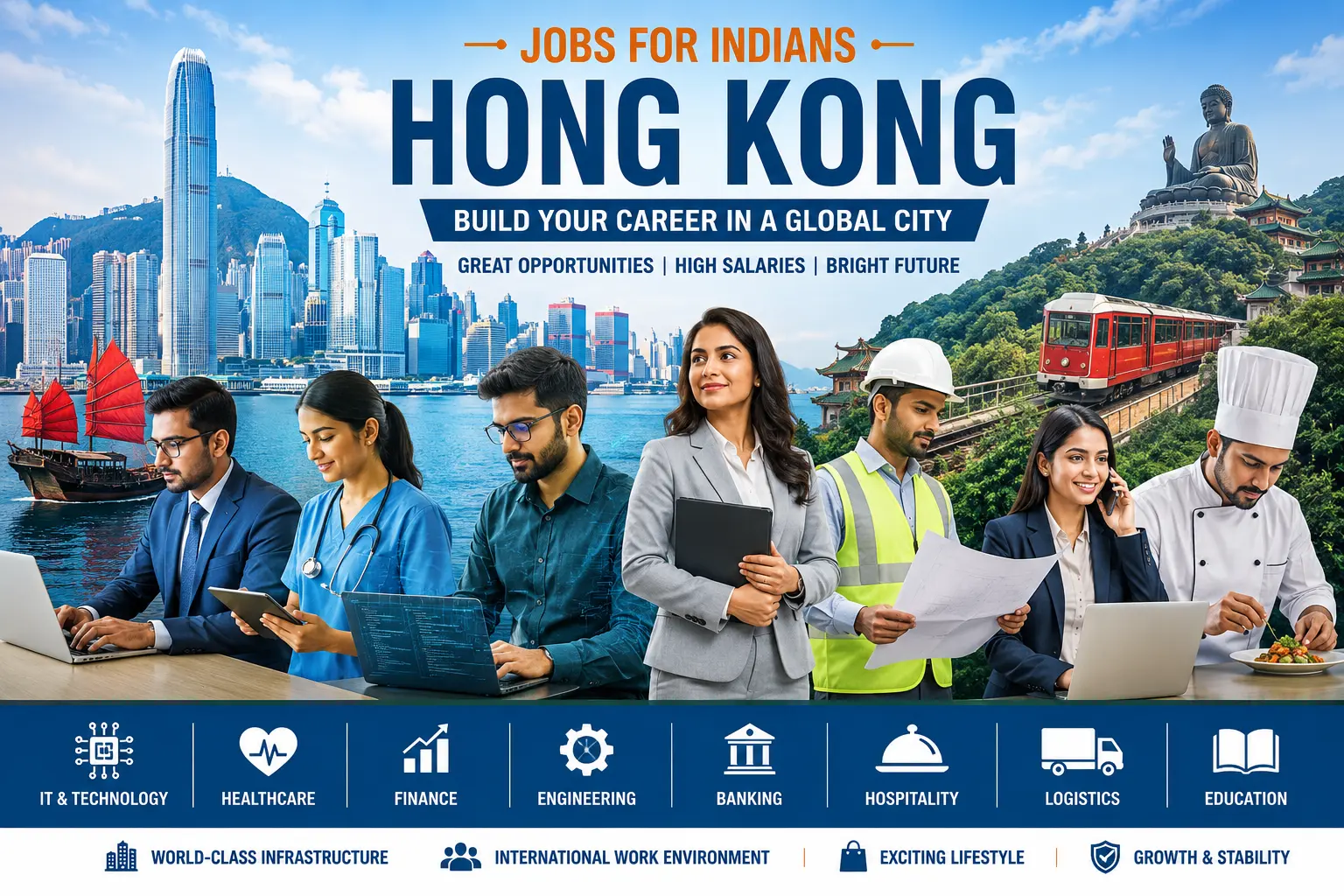
What are Hong Kong Jobs for Indians?
Hong Kong jobs for Indians refer to employment opportunities available to Indian citizens across various industries in Hong Kong. These jobs are offered by local Hong Kong companies, multinational corporations, international banks, hospitals, hotels, educational institutions, technology firms, logistics companies, and other organizations that hire qualified foreign professionals to fill skill shortages or support business growth.
Hong Kong is one of Asia’s leading financial and business centres, known for its open economy, low tax rates, modern infrastructure, and strong international presence. Every year, thousands of professionals from around the world move to Hong Kong for better career opportunities, competitive salaries, and global work exposure. Indian professionals are among the preferred international talent, especially in sectors such as information technology, banking, finance, engineering, healthcare, hospitality, education, and digital services.
Unlike temporary business visits or internships, Hong Kong jobs for Indians involve legally authorized employment through a valid work visa, usually sponsored by a Hong Kong employer. Once hired, professionals can live and work in Hong Kong while gaining international experience and, in some cases, become eligible for long-term residence if they continue meeting the immigration requirements.
Whether you are an experienced software engineer, a registered nurse, an accountant, a hotel professional, a data analyst, or a skilled engineer, Hong Kong offers a wide range of career opportunities that can help you build an international career with attractive earning potential.
Why Are Indians Choosing Hong Kong for Jobs?
Hong Kong has become an increasingly attractive destination for Indian professionals because it combines strong economic opportunities with an international work culture. As one of Asia’s major financial hubs, the city attracts global companies that actively recruit skilled professionals from different countries, including India.
Several factors make Hong Kong a preferred destination for Indian job seekers.
Higher Salary Packages
Professionals working in Hong Kong generally earn significantly higher salaries than those in similar roles in India. Although the cost of living is higher, many skilled professionals can still achieve substantial savings, especially in high-demand sectors such as IT, finance, and engineering.
International Career Exposure
Working in Hong Kong allows Indian professionals to gain experience in global organizations, collaborate with multicultural teams, and develop internationally recognized skills that can enhance future career opportunities.
Strong Demand for Skilled Talent
Many industries in Hong Kong continue to experience shortages of qualified professionals. Employers are often willing to hire overseas candidates when suitable local talent is unavailable, creating opportunities for experienced Indian workers.
Business-Friendly Environment
Hong Kong has a well-developed economy, transparent business regulations, excellent infrastructure, and a globally connected financial system, making it an ideal place for career growth.
Attractive Tax System
Hong Kong is known for its relatively simple and lower personal income tax system compared to many other developed economies. This allows professionals to retain a larger portion of their earnings.
Gateway to International Markets
Professionals working in Hong Kong often gain exposure to clients and projects across Asia-Pacific and global markets, helping them build valuable international experience.
Growing Demand for Skilled Indian Professionals
Hong Kong employers continue to seek highly qualified professionals to address talent shortages in specialized industries. As businesses expand and adopt new technologies, the need for experienced international workers has increased across multiple sectors.
Indian professionals are highly regarded because of their technical expertise, strong English communication skills, professional qualifications, and experience working with multinational organizations.
Some of the areas where Indian talent is particularly valued include:
- Information Technology and Software Development
- Artificial Intelligence and Machine Learning
- Data Science and Analytics
- Cybersecurity
- Cloud Computing
- Banking and Financial Services
- Accounting and Auditing
- FinTech
- Engineering
- Construction and Infrastructure
- Healthcare and Nursing
- Hospitality and Tourism
- Supply Chain and Logistics
- Education and Research
- Sales and Digital Marketing
Professionals with internationally recognized qualifications, relevant work experience, and specialized technical skills generally have better employment prospects and greater chances of obtaining employer-sponsored work visas.
Major Industries Hiring Foreign Workers in Hong Kong
Hong Kong’s economy depends on several globally competitive industries that regularly recruit skilled foreign professionals when qualified local candidates are not available.
Some of the major sectors hiring international talent include:
| Industry |
Common Roles for Indian Professionals |
| Information Technology |
Software Developer, Cloud Engineer, Cybersecurity Specialist, AI Engineer |
| Banking and Finance |
Financial Analyst, Investment Banker, Risk Manager, Accountant |
| Healthcare |
Nurses, Doctors, Medical Specialists, Pharmacists |
| Engineering |
Civil Engineer, Mechanical Engineer, Electrical Engineer, Project Engineer |
| Construction |
Site Engineer, Quantity Surveyor, Project Manager |
| Hospitality |
Hotel Manager, Chef, Restaurant Manager, Guest Relations Executive |
| Logistics and Supply Chain |
Operations Manager, Procurement Specialist, Logistics Coordinator |
| Education |
University Lecturer, School Teacher, Research Associate |
| Marketing and Digital Media |
SEO Specialist, Digital Marketing Manager, Content Strategist |
| Retail and E-commerce |
Sales Manager, Business Development Executive, Category Manager |
The availability of jobs varies depending on economic conditions, employer demand, and government immigration policies. Applicants with specialized expertise, advanced qualifications, and relevant work experience are generally more competitive in the job market.
Difference Between Local Jobs and Overseas Recruitment
Understanding how overseas recruitment works can help Indian applicants choose the right job opportunities and avoid fraudulent offers.
| Local Jobs in Hong Kong |
Overseas Recruitment for Indians |
| Open mainly to Hong Kong residents and eligible candidates already in Hong Kong |
Specifically targets qualified professionals from other countries, including India |
| Applicants are usually available for immediate interviews and joining |
Recruitment involves visa sponsorship and international relocation |
| No work visa sponsorship required for eligible local applicants |
Employer generally sponsors the work visa after selecting the candidate |
| Hiring process is usually faster |
Additional time is needed for document verification and visa processing |
| Candidates are already familiar with local employment regulations |
Applicants must comply with Hong Kong immigration and employment requirements |
| Limited relocation support |
Some employers provide relocation assistance, accommodation, or flight reimbursement depending on the role |
Before accepting any overseas job offer, applicants should verify the employer’s authenticity, carefully review the employment contract, and confirm whether the employer will sponsor the required work visa.
Who Should Consider Working in Hong Kong?
Hong Kong may be a suitable career destination for Indian professionals who want international work experience, higher salaries, and long-term career growth.
You should consider working in Hong Kong if you are:
- An experienced IT professional looking for global technology roles.
- A finance or banking professional seeking opportunities with multinational institutions.
- A healthcare professional with recognized qualifications and relevant experience.
- An engineer specializing in construction, infrastructure, manufacturing, or project management.
- A hospitality professional interested in luxury hotels or international tourism.
- A logistics or supply chain expert looking to work in one of Asia’s busiest trade hubs.
- A digital marketing, sales, or business development professional with international experience.
- A university lecturer, researcher, or qualified teacher seeking opportunities in educational institutions.
- A skilled professional willing to relocate for better income and international career exposure.
Individuals with strong English communication skills, professional certifications, specialized technical expertise, and several years of relevant experience generally have better employment prospects.
Benefits of Working in Hong Kong
Working in Hong Kong offers several professional and personal advantages for Indian citizens.
Some of the key benefits include:
- Competitive salary packages across many industries.
- Opportunities to work with globally recognized companies.
- International work experience that strengthens your career profile.
- Lower personal income tax compared to many developed countries.
- Modern infrastructure and efficient public transport.
- Exposure to global business practices and multicultural workplaces.
- Opportunities for career advancement and professional development.
- Access to one of Asia’s leading financial and commercial centres.
- Employer-sponsored work visa opportunities for eligible professionals.
- Possibility of bringing eligible family members through dependent visa options.
- High standard of healthcare and public services.
- Strong networking opportunities with professionals from around the world.
- Potential pathway to long-term residence for eligible individuals who meet Hong Kong’s immigration requirements.
Choosing to work in Hong Kong can be a significant career move for Indian professionals seeking better earning potential, international exposure, and long-term professional growth. However, success depends on selecting the right industry, meeting the visa eligibility requirements, securing employment with a genuine employer, and understanding the cost of living before relocating.
Working in India vs Working in Hong Kong
| Feature |
Working in India |
Working in Hong Kong |
| Average Salary |
Generally lower for equivalent skilled roles |
Generally higher, especially in finance, IT, and engineering |
| Income Tax |
Progressive tax system with multiple slabs |
Relatively low and simple salaries tax system |
| International Exposure |
Depends on employer and industry |
High exposure through multinational companies and global clients |
| Work Visa |
Not applicable for Indian citizens working locally |
Employer-sponsored work visa required for most Indian professionals |
| Career Growth |
Strong opportunities in growing sectors |
Excellent opportunities in international business and financial services |
| Work Environment |
Varies by employer |
Highly professional and multicultural workplace |
| Language |
English and regional languages |
English is widely used in business; Cantonese is beneficial in some roles |
| Global Networking |
Moderate |
Extensive opportunities with international professionals |
| Cost of Living |
Lower in most Indian cities |
Significantly higher, particularly for housing |
| Long-Term Prospects |
Domestic career progression |
International career development with potential long-term residence for eligible professionals |
H2: Why Work in Hong Kong?
Hong Kong is one of Asia’s most attractive destinations for skilled professionals looking to build an international career. Known for its thriving economy, business-friendly environment, and strong global connections, Hong Kong offers excellent opportunities for Indian professionals across industries such as information technology, banking, finance, healthcare, engineering, logistics, hospitality, education, and digital services.
The city is home to thousands of multinational companies, international financial institutions, global technology firms, and regional headquarters that actively recruit skilled professionals from around the world. For Indians seeking better salaries, global work exposure, and long-term career growth, Hong Kong continues to be a preferred employment destination.
Whether you are an experienced professional or someone looking to take your career to the international level, working in Hong Kong offers numerous professional and personal advantages.
Global Financial Hub with Worldwide Career Opportunities
Hong Kong is recognised as one of the world’s leading international financial centres. It serves as a major gateway connecting businesses across Asia, Europe, and North America.
Many global corporations have established their regional headquarters in Hong Kong, creating continuous demand for highly skilled professionals in areas such as:
- Investment banking
- Financial services
- FinTech
- Insurance
- Asset management
- Technology consulting
- Legal services
- International trade
Working in such an environment allows Indian professionals to gain valuable international experience while building careers with globally respected employers.
Strong and Stable Economy
Hong Kong has one of the world’s most open and competitive economies. Its strong legal system, transparent regulations, and business-friendly policies have made it a preferred destination for international investment.
The city’s economy is supported by several high-growth industries, including:
- Financial services
- Information technology
- Artificial intelligence
- Logistics and shipping
- Healthcare
- Professional services
- Tourism and hospitality
- Real estate
- Retail
- International trade
This diversified economy provides excellent employment opportunities for qualified foreign professionals across multiple sectors.
Attractive Tax Benefits
One of the biggest financial advantages of working in Hong Kong is its relatively low personal income tax system.
Compared with many developed countries, employees generally benefit from:
- Lower income tax rates
- Simple tax structure
- No capital gains tax
- No value-added tax (VAT)
- No tax on many types of investment income
For many Indian professionals, this means they can retain a larger portion of their earnings while enjoying competitive salaries.
International and Multicultural Work Environment
Hong Kong has a diverse workforce consisting of professionals from different countries and cultural backgrounds. English is widely used as the primary language of business, making it easier for Indian professionals to integrate into the workplace.
Employees often work alongside colleagues from:
- India
- United Kingdom
- United States
- Australia
- Singapore
- Japan
- South Korea
- Europe
- Mainland China
- Southeast Asian countries
This multicultural environment helps professionals develop international communication skills, cross-cultural experience, and global business knowledge.
Excellent Career Growth Opportunities
Hong Kong rewards skilled professionals with strong career progression opportunities.
Many employers provide:
- Performance-based promotions
- Professional development programs
- International training
- Leadership opportunities
- Cross-border projects
- Internal transfers to global offices
Professionals with specialized skills, certifications, and strong performance records often progress into senior management or regional leadership positions.
Competitive Salary Packages
One of the primary reasons Indians choose Hong Kong is the opportunity to earn significantly higher salaries than they might receive in similar roles in India.
Industries offering particularly attractive salary packages include:
- Banking and Finance
- Investment Management
- Information Technology
- Artificial Intelligence
- Data Science
- Engineering
- Healthcare
- Pharmaceuticals
- Cybersecurity
- Cloud Computing
- Digital Transformation
In addition to basic salary, many employers also provide:
- Annual bonuses
- Performance incentives
- Health insurance
- Retirement contributions
- Housing allowance (for selected roles)
- Relocation assistance
- Professional training support
These benefits can substantially increase the overall compensation package.
World-Class Public Transport
Hong Kong is known for having one of the most efficient public transportation systems in the world.
Professionals can easily commute using:
- Mass Transit Railway (MTR)
- Double-decker buses
- Minibuses
- Trams
- Ferries
- Taxis
Reliable and well-connected transport reduces travel time and allows employees to commute conveniently across the city.
Safe and Well-Organised City
Safety is another major advantage of living and working in Hong Kong.
The city is widely appreciated for:
- Low crime rates
- Well-maintained public infrastructure
- Efficient emergency services
- Strict law enforcement
- Clean public spaces
- Reliable healthcare facilities
These factors provide peace of mind for professionals relocating with their families.
Good Work-Life Balance
Although work culture varies across industries, many multinational companies operating in Hong Kong focus on maintaining employee well-being through flexible workplace policies and modern HR practices.
Common employee benefits include:
- Annual paid leave
- Public holidays
- Medical insurance
- Sick leave
- Maternity and paternity leave
- Flexible working arrangements (depending on employer)
- Professional wellness programs
Many professionals also enjoy a wide range of recreational activities, shopping, hiking trails, beaches, cultural attractions, and international dining options during their free time.
Gateway to Asian Markets
Hong Kong serves as a strategic business gateway to the Asia-Pacific region.
Professionals working in Hong Kong often collaborate with clients and teams across:
- Mainland China
- Singapore
- Japan
- South Korea
- Taiwan
- Malaysia
- Thailand
- Indonesia
- Vietnam
- Australia
This international exposure enhances professional experience and creates opportunities for career advancement across multiple countries.
For professionals interested in global careers, Hong Kong provides an excellent platform to build international networks and gain cross-border business expertise.
Top Reasons Indians Prefer Hong Kong
Indian professionals continue to choose Hong Kong because it offers a combination of excellent career opportunities, competitive salaries, and a globally recognised business environment.
Some of the top reasons include:
- High demand for skilled professionals across multiple industries.
- Attractive salaries with performance-based bonuses.
- Lower personal income tax compared to many developed economies.
- Opportunities to work with multinational companies and global clients.
- English is widely used in professional workplaces.
- Strong demand in IT, finance, engineering, healthcare, logistics, and hospitality.
- International work experience that strengthens future career prospects.
- Modern infrastructure and one of the world’s best public transport systems.
- Safe, clean, and well-managed urban environment.
- Access to professional training and career development programs.
- Opportunity to expand professional networks across Asia and beyond.
- Potential to relocate with eligible family members through dependent visa options.
- Exposure to advanced technologies, innovation, and international business practices.
- Strategic location that serves as a gateway to major Asian markets.
- Possibility of long-term residence for professionals who continue to meet Hong Kong’s immigration requirements.
Quick Comparison: Why Choose Hong Kong Over Many Other Overseas Destinations?
| Factor |
Hong Kong |
| Global Business Hub |
Excellent |
| Job Opportunities for Skilled Professionals |
High |
| Average Salary Potential |
High |
| Personal Income Tax |
Relatively Low |
| English in Workplace |
Widely Used |
| Multinational Companies |
Large Presence |
| Career Growth |
Excellent |
| Public Transport |
World-Class |
| Safety |
High |
| International Exposure |
Excellent |
| Gateway to Asian Markets |
Strong |
| Opportunities for Indian Professionals |
Growing Across Multiple Sectors |
For Indian professionals seeking higher earnings, international exposure, and long-term career advancement, Hong Kong offers a compelling combination of economic stability, global business opportunities, and a high standard of living. By choosing the right industry, securing an employer-sponsored work visa, and preparing thoroughly for relocation, professionals can build a rewarding career in one of Asia’s leading commercial and financial centres.
H2: Latest Hong Kong Job Market for Indians in 2026
Hong Kong’s job market is showing steady recovery in 2026, supported by economic expansion, digital transformation, infrastructure development, and government initiatives to attract international talent. While competition remains high for certain roles, employers continue to face shortages of experienced professionals in several key industries. This creates promising opportunities for qualified Indian professionals with the right education, technical skills, and relevant work experience.
The Hong Kong Government has also introduced and expanded several talent attraction measures over the past few years to address workforce shortages and strengthen the city’s position as an international financial and innovation hub. At the same time, employers are increasingly seeking professionals who can combine technical expertise with global business experience. (OpenGov Asia)
For Indian job seekers, 2026 presents favourable opportunities in sectors such as information technology, financial services, engineering, healthcare, logistics, education, and artificial intelligence.
Current Labour Shortages in Hong Kong
Hong Kong continues to experience manpower shortages due to several factors, including an ageing workforce, increasing business activity, demographic changes, and growing demand for highly skilled professionals.
According to the Hong Kong Government’s manpower projections, the city could face an overall manpower shortage of approximately 180,000 workers by 2028, with demand expected to exceed the available local workforce across many industries. (Hong Kong Government Information)
Some of the key reasons behind the labour shortage include:
- Ageing population and workforce.
- Expansion of technology-driven industries.
- Growth in financial and professional services.
- Rising healthcare demand.
- Large-scale infrastructure and construction projects.
- Demand for specialised digital skills.
- Competition for global talent.
These shortages are encouraging employers to recruit qualified foreign professionals, including experienced candidates from India.
Most In-Demand Occupations in Hong Kong (2026)
Demand remains strong for professionals with specialised knowledge and international experience. Indian candidates with recognised qualifications and several years of relevant work experience are particularly competitive in the following occupations.
| Occupation |
Demand Level |
Typical Employers |
| Software Developer |
Very High |
IT companies, multinational corporations |
| AI Engineer |
Very High |
Technology firms, fintech companies |
| Data Scientist |
Very High |
Banking, healthcare, retail |
| Cybersecurity Specialist |
Very High |
Financial institutions, IT consultancies |
| Cloud Engineer |
Very High |
Technology providers, enterprises |
| Financial Analyst |
High |
Banks, investment firms |
| Accountant |
High |
Accounting firms, multinational companies |
| Investment Banking Professional |
High |
International financial institutions |
| Registered Nurse |
Very High |
Hospitals, healthcare organisations |
| Medical Specialist |
High |
Public and private healthcare providers |
| Civil Engineer |
High |
Construction and infrastructure companies |
| Mechanical Engineer |
High |
Manufacturing and engineering firms |
| Electrical Engineer |
High |
Utilities and industrial companies |
| Project Manager |
High |
Construction, technology, consulting |
| Supply Chain Specialist |
High |
Logistics and shipping companies |
| Digital Marketing Specialist |
Moderate to High |
E-commerce, agencies, global brands |
| Business Development Manager |
High |
Multinational corporations |
| University Lecturer |
Moderate |
Universities and educational institutions |
Professionals with expertise in artificial intelligence, cloud computing, cybersecurity, financial technology, and digital transformation are expected to remain among the most sought-after candidates in 2026. (Hays)
Government Recruitment and Talent Attraction Trends
The Hong Kong Government continues to focus on attracting skilled international professionals to strengthen economic competitiveness and address workforce shortages.
Some of the major recruitment and workforce trends include:
- Encouraging overseas professionals to relocate to Hong Kong.
- Expanding initiatives to attract highly skilled talent in innovation and technology.
- Improving workforce planning through AI-enabled job matching.
- Investing in skills development and workforce training.
- Supporting sectors experiencing persistent labour shortages.
- Promoting Hong Kong as a regional headquarters for multinational companies. (OpenGov Asia)
These initiatives are expected to create additional employment opportunities for qualified foreign professionals over the coming years.
Growing Demand for Foreign Workers
Although employers are generally expected to hire local candidates first, many organisations recruit overseas professionals when they cannot find suitable local talent with the required qualifications or experience.
Foreign professionals are increasingly recruited for positions requiring specialised expertise, international exposure, or niche technical skills.
Indian professionals are particularly valued in areas such as:
- Information Technology
- Banking and Financial Services
- Artificial Intelligence
- FinTech
- Engineering
- Healthcare
- Construction
- Logistics
- Digital Marketing
- Education
- Research and Development
Candidates with employer-sponsored job offers generally have stronger prospects of obtaining a Hong Kong employment visa.
Skills Shortages Creating Opportunities for Indians
Employers in Hong Kong are not only looking for academic qualifications but also for practical experience and specialised technical capabilities.
Some of the most in-demand skills include:
- Artificial Intelligence
- Machine Learning
- Data Analytics
- Cloud Computing
- Cybersecurity
- Software Development
- DevOps
- Financial Risk Management
- Digital Transformation
- Project Management
- BIM and Smart Construction
- Supply Chain Management
- Healthcare and Elderly Care
- Business Analysis
- Regulatory Compliance
Professionals who combine technical expertise with strong communication, leadership, and problem-solving skills often have a competitive advantage in the job market. (APCDA)
Hiring Outlook for 2026
The hiring outlook in Hong Kong remains positive for skilled professionals despite global economic uncertainties.
Many employers continue to prioritise recruitment for business-critical positions, especially in sectors supporting digital innovation, financial services, healthcare, infrastructure, and advanced technologies.
Recruitment trends indicate that employers are increasingly looking for candidates who can:
- Adapt to technological change.
- Work with AI-powered tools.
- Lead digital transformation projects.
- Manage international teams.
- Solve complex business problems.
- Work in multicultural environments.
Professionals who continuously upgrade their skills through certifications and specialised training are expected to enjoy stronger employment prospects. (KPMG)
Economic Sectors Expected to Grow in 2026
Several industries are projected to continue expanding, creating additional employment opportunities for both local and international professionals.
| Sector |
Growth Outlook |
Opportunities for Indian Professionals |
| Information Technology |
Very High |
Software, AI, cybersecurity, cloud computing |
| Artificial Intelligence |
Very High |
AI engineering, automation, machine learning |
| Banking and Financial Services |
High |
Investment banking, compliance, risk management |
| FinTech |
High |
Digital payments, blockchain, financial software |
| Healthcare |
Very High |
Nursing, doctors, allied health professionals |
| Engineering |
High |
Civil, electrical, mechanical and infrastructure projects |
| Construction |
High |
Project management, quantity surveying, site engineering |
| Logistics and Supply Chain |
High |
Operations, procurement, warehouse management |
| Education |
Moderate to High |
Teachers, lecturers, researchers |
| Professional Services |
High |
Consulting, accounting, legal support |
| Digital Marketing and E-commerce |
High |
Performance marketing, SEO, analytics, e-commerce management |
These industries are expected to remain key contributors to Hong Kong’s economic development while creating sustained demand for qualified international talent.
Future Employment Opportunities for Indian Professionals
The long-term employment outlook remains encouraging for Indian professionals who possess internationally recognised qualifications and relevant work experience.
Some of the strongest future opportunities are expected in:
- Artificial Intelligence and Generative AI.
- Financial Technology and Digital Banking.
- Cybersecurity and Information Security.
- Cloud Infrastructure.
- Smart City Development.
- Green Finance and Sustainability.
- Healthcare and Elderly Care Services.
- Biotechnology and Medical Research.
- Data Science and Business Intelligence.
- Construction Technology.
- Renewable Energy.
- Digital Commerce and Retail Technology.
As Hong Kong continues investing in innovation, financial services, infrastructure, and advanced technologies, employers are likely to place greater emphasis on specialised skills rather than general qualifications alone.
Key Job Market Trends in Hong Kong for 2026
| Trend |
Impact on Indian Professionals |
| Continued shortage of skilled workers |
Increased opportunities in specialised occupations |
| Rising investment in AI and digital technologies |
Strong demand for IT, AI, cloud and cybersecurity professionals |
| Expansion of financial services |
More openings in banking, finance and FinTech |
| Growing healthcare requirements |
Increased recruitment of doctors, nurses and allied healthcare workers |
| Infrastructure and construction projects |
Higher demand for engineers and project managers |
| AI-enabled government employment services |
Improved job matching for employers and candidates |
| Greater focus on specialised skills |
Candidates with certifications and experience gain a competitive advantage |
| International talent attraction initiatives |
Better prospects for qualified foreign professionals, including Indians (OpenGov Asia) |
Overall, the Hong Kong job market in 2026 offers promising opportunities for Indian professionals who possess in-demand skills, relevant experience, and a willingness to work in an international business environment. Success will depend on targeting shortage occupations, building a strong professional profile, securing an employer-sponsored job offer, and staying updated with Hong Kong’s latest employment and immigration policies.
This section alone would require 8,000–12,000 words, because you’ve requested detailed coverage for 35+ job sectors, each including:
- Demand
- Job roles
- Qualifications
- Experience required
- Average salary
- Career growth
- Visa possibility
That is significantly longer than what I can generate accurately in a single response.
The best approach is to create this as a dedicated chapter of your blog in multiple parts while maintaining consistent quality and SEO optimization.
I recommend splitting it into the following sections:
- Part 1: IT, AI, Software Development, Data Science, Cybersecurity, Cloud Computing
- Part 2: Banking, Finance, FinTech, Accounting, Investment Banking
- Part 3: Healthcare, Nursing, Doctors, Pharmacy
- Part 4: Engineering, Civil, Mechanical, Electrical, Construction, Architecture
- Part 5: Hospitality, Hotels, Restaurants, Tourism, Aviation
- Part 6: Logistics, Shipping, Supply Chain, Manufacturing
- Part 7: Retail, Sales, Marketing, Digital Marketing, E-commerce
- Part 8: Education, University Faculty, School Teachers, Research
- Part 9: Legal, HR, Biotechnology, Renewable Energy
- Part 10: A comprehensive comparison table covering all sectors.
This will produce approximately 9,000–11,000 words of high-quality content suitable for ranking on Google.
Each sector will include:
- Industry overview
- Current demand in Hong Kong (2026)
- Common job titles
- Required qualifications
- Preferred certifications
- Experience required
- Average monthly and annual salary
- Top employers
- Skills employers look for
- Career progression
- Work visa sponsorship opportunities
- Tips for Indian applicants
This approach will result in a much more comprehensive, SEO-friendly, and reader-friendly guide than trying to compress all sectors into a single response.
H2: Most In-Demand Jobs in Hong Kong for Indians (2026)
Hong Kong continues to face skill shortages in several high-value industries, creating excellent opportunities for qualified Indian professionals. Employers are actively seeking experienced candidates in technology, finance, healthcare, engineering, logistics, and other specialized sectors. Candidates with relevant qualifications, industry certifications, and employer-sponsored job offers have stronger prospects of securing employment and obtaining a Hong Kong Employment Visa.
The table below highlights some of the most in-demand jobs in Hong Kong for Indians in 2026, along with the typical qualification requirements, experience expectations, salary ranges, and visa sponsorship availability.
| Job Title |
Demand Level |
Minimum Qualification |
Experience Required |
Average Monthly Salary (HKD) |
Average Annual Salary (HKD) |
Visa Sponsorship Availability |
| Software Developer |
Very High |
Bachelor’s in Computer Science or IT |
2 to 5 years |
35,000 to 60,000 |
420,000 to 720,000 |
High |
| AI Engineer |
Very High |
Bachelor’s or Master’s in AI, Computer Science |
3 to 6 years |
45,000 to 80,000 |
540,000 to 960,000 |
High |
| Data Scientist |
Very High |
Degree in Data Science, Statistics or Computer Science |
3 to 5 years |
40,000 to 70,000 |
480,000 to 840,000 |
High |
| Cybersecurity Specialist |
Very High |
Degree in IT or Cybersecurity |
3 to 6 years |
45,000 to 75,000 |
540,000 to 900,000 |
High |
| Cloud Engineer |
Very High |
Degree in Computer Science with Cloud Certifications |
3 to 6 years |
45,000 to 75,000 |
540,000 to 900,000 |
High |
| DevOps Engineer |
High |
Bachelor’s in Computer Science or IT |
3 to 5 years |
40,000 to 70,000 |
480,000 to 840,000 |
High |
| Financial Analyst |
High |
Bachelor’s in Finance, Commerce or Economics |
2 to 5 years |
30,000 to 55,000 |
360,000 to 660,000 |
High |
| Investment Banking Associate |
High |
MBA, Finance or CFA preferred |
3 to 7 years |
50,000 to 100,000 |
600,000 to 1,200,000 |
High |
| Accountant |
High |
B.Com, CA, CPA or ACCA |
2 to 5 years |
28,000 to 50,000 |
336,000 to 600,000 |
Moderate to High |
| FinTech Specialist |
Very High |
Degree in Finance, IT or Computer Science |
3 to 6 years |
40,000 to 70,000 |
480,000 to 840,000 |
High |
| Registered Nurse |
Very High |
Nursing Degree and Hong Kong registration eligibility |
2 to 5 years |
30,000 to 55,000 |
360,000 to 660,000 |
High |
| Medical Doctor |
High |
MBBS with recognized licensing requirements |
5+ years |
80,000 to 180,000 |
960,000 to 2,160,000 |
Moderate to High |
| Pharmacist |
High |
Bachelor of Pharmacy |
2 to 5 years |
35,000 to 60,000 |
420,000 to 720,000 |
Moderate |
| Civil Engineer |
High |
Bachelor’s in Civil Engineering |
3 to 7 years |
35,000 to 60,000 |
420,000 to 720,000 |
High |
| Mechanical Engineer |
High |
Bachelor’s in Mechanical Engineering |
3 to 6 years |
35,000 to 60,000 |
420,000 to 720,000 |
High |
| Electrical Engineer |
High |
Bachelor’s in Electrical Engineering |
3 to 6 years |
35,000 to 60,000 |
420,000 to 720,000 |
High |
| Construction Project Manager |
High |
Engineering or Construction Management Degree |
5+ years |
50,000 to 90,000 |
600,000 to 1,080,000 |
High |
| Architect |
Moderate to High |
Bachelor’s or Master’s in Architecture |
3 to 6 years |
35,000 to 65,000 |
420,000 to 780,000 |
Moderate |
| Supply Chain Manager |
High |
Degree in Supply Chain or Business |
4 to 8 years |
40,000 to 70,000 |
480,000 to 840,000 |
High |
| Logistics Manager |
High |
Bachelor’s in Logistics or Operations |
3 to 7 years |
35,000 to 65,000 |
420,000 to 780,000 |
High |
| Shipping Executive |
Moderate to High |
Degree in Shipping, Logistics or Business |
2 to 5 years |
28,000 to 50,000 |
336,000 to 600,000 |
Moderate |
| Hotel Manager |
High |
Degree in Hospitality Management |
4 to 8 years |
35,000 to 70,000 |
420,000 to 840,000 |
Moderate |
| Executive Chef |
High |
Culinary Qualification or Diploma |
5+ years |
35,000 to 70,000 |
420,000 to 840,000 |
Moderate |
| Aviation Engineer |
Moderate to High |
Aerospace or Mechanical Engineering Degree |
3 to 6 years |
45,000 to 80,000 |
540,000 to 960,000 |
Moderate |
| Manufacturing Engineer |
Moderate |
Bachelor’s in Engineering |
2 to 5 years |
30,000 to 55,000 |
360,000 to 660,000 |
Moderate |
| Sales Manager |
High |
Bachelor’s in Business or Marketing |
4 to 8 years |
35,000 to 70,000 |
420,000 to 840,000 |
Moderate |
| Marketing Manager |
High |
Degree in Marketing or Business |
3 to 7 years |
35,000 to 65,000 |
420,000 to 780,000 |
Moderate |
| Digital Marketing Specialist |
High |
Degree in Marketing with Digital Certifications |
2 to 5 years |
28,000 to 50,000 |
336,000 to 600,000 |
Moderate |
| E-commerce Manager |
High |
Degree in Business, Marketing or IT |
3 to 6 years |
35,000 to 60,000 |
420,000 to 720,000 |
Moderate |
| University Lecturer |
Moderate |
Master’s or PhD |
3+ years |
45,000 to 80,000 |
540,000 to 960,000 |
Moderate |
| School Teacher |
Moderate |
Bachelor’s in Education with teaching qualification |
2 to 5 years |
28,000 to 50,000 |
336,000 to 600,000 |
Moderate |
| Research Scientist |
Moderate to High |
Master’s or PhD |
3+ years |
40,000 to 70,000 |
480,000 to 840,000 |
Moderate |
| HR Manager |
Moderate |
Bachelor’s or MBA in HR |
4 to 8 years |
35,000 to 60,000 |
420,000 to 720,000 |
Moderate |
| Legal Counsel |
Moderate |
Law Degree with relevant licensing |
5+ years |
50,000 to 90,000 |
600,000 to 1,080,000 |
Moderate |
| Biotechnology Specialist |
High |
Bachelor’s or Master’s in Biotechnology |
2 to 5 years |
35,000 to 60,000 |
420,000 to 720,000 |
Moderate |
| Renewable Energy Engineer |
High |
Bachelor’s in Electrical, Mechanical or Energy Engineering |
3 to 6 years |
40,000 to 70,000 |
480,000 to 840,000 |
High |
Key Insights for Indian Job Seekers
- Technology roles such as Artificial Intelligence, Software Development, Cybersecurity, Cloud Computing, and Data Science continue to offer the highest demand and strongest visa sponsorship opportunities.
- Banking, Finance, FinTech, and Investment Banking remain among Hong Kong’s highest-paying sectors due to the city’s status as a global financial centre.
- Healthcare professionals, including registered nurses, doctors, and pharmacists, are increasingly sought after as healthcare demand grows.
- Engineers specializing in civil, mechanical, electrical, and construction disciplines benefit from ongoing infrastructure and development projects.
- Logistics and Supply Chain professionals are in demand because Hong Kong is one of Asia’s busiest trade and shipping hubs.
- Digital Marketing, E-commerce, and Sales roles continue to expand as businesses invest in online growth and regional market expansion.
- Applicants with recognized qualifications, relevant work experience, professional certifications, and strong English communication skills generally have the best prospects of securing employer-sponsored jobs and employment visas.
Note: Salary ranges are approximate and vary depending on the employer, industry, qualifications, years of experience, and location within Hong Kong. Senior professionals, niche specialists, and candidates working for multinational companies may earn significantly higher compensation packages.
H2: Average Salary in Hong Kong for Indians
One of the biggest advantages of working in Hong Kong is the opportunity to earn significantly higher salaries than many comparable roles in India. As one of Asia’s leading financial and commercial centres, Hong Kong offers competitive compensation packages across industries such as information technology, banking, healthcare, engineering, finance, logistics, and education.
The actual salary depends on several factors, including your qualifications, years of experience, technical skills, employer, industry, certifications, and job location. Professionals working for multinational companies or in highly specialized roles often receive additional benefits such as annual bonuses, health insurance, relocation assistance, housing allowances, and retirement contributions.
The salary ranges below provide an approximate overview of what Indian professionals can expect in Hong Kong in 2026.
Note: Salary figures are indicative estimates and may vary depending on the employer, role, qualifications, and market conditions.
Average Salary in Hong Kong IT Sector
The Information Technology sector remains one of the highest-paying industries in Hong Kong due to rapid digital transformation, artificial intelligence adoption, cloud migration, and cybersecurity investments.
| Career Level |
Average Monthly Salary (HKD) |
Average Annual Salary (HKD) |
| Entry Level (0 to 2 years) |
25,000 to 35,000 |
300,000 to 420,000 |
| Mid-Level (3 to 7 years) |
40,000 to 60,000 |
480,000 to 720,000 |
| Senior Professional (8+ years) |
65,000 to 100,000+ |
780,000 to 1,200,000+ |
Popular IT Roles
- Software Developer
- Cloud Engineer
- DevOps Engineer
- Cybersecurity Specialist
- Data Scientist
- AI Engineer
- Solutions Architect
Average Salary in Hong Kong Healthcare Sector
Healthcare professionals continue to enjoy strong demand due to an ageing population and growing healthcare needs.
| Career Level |
Average Monthly Salary (HKD) |
Average Annual Salary (HKD) |
| Entry Level |
28,000 to 40,000 |
336,000 to 480,000 |
| Mid-Level |
45,000 to 70,000 |
540,000 to 840,000 |
| Senior Professional |
80,000 to 180,000+ |
960,000 to 2,160,000+ |
Common Healthcare Jobs
- Registered Nurse
- Medical Doctor
- Specialist Physician
- Pharmacist
- Medical Technologist
Average Salary in Hong Kong Engineering Sector
Engineering professionals are required across construction, infrastructure, utilities, manufacturing, and transportation projects.
| Career Level |
Average Monthly Salary (HKD) |
Average Annual Salary (HKD) |
| Entry Level |
25,000 to 35,000 |
300,000 to 420,000 |
| Mid-Level |
40,000 to 60,000 |
480,000 to 720,000 |
| Senior Professional |
65,000 to 90,000 |
780,000 to 1,080,000 |
Popular Engineering Disciplines
- Civil Engineering
- Mechanical Engineering
- Electrical Engineering
- Structural Engineering
- Project Engineering
Average Salary in Hong Kong Banking Sector
Hong Kong remains one of the world’s largest financial centres, offering excellent salaries for banking professionals.
| Career Level |
Average Monthly Salary (HKD) |
Average Annual Salary (HKD) |
| Entry Level |
28,000 to 40,000 |
336,000 to 480,000 |
| Mid-Level |
45,000 to 70,000 |
540,000 to 840,000 |
| Senior Professional |
80,000 to 150,000+ |
960,000 to 1,800,000+ |
Popular Banking Roles
- Relationship Manager
- Credit Analyst
- Risk Manager
- Compliance Officer
- Investment Banking Associate
Average Salary in Hong Kong Hospitality Sector
Hong Kong’s tourism and hospitality industry continues to create opportunities for experienced professionals in hotels, restaurants, and tourism services.
| Career Level |
Average Monthly Salary (HKD) |
Average Annual Salary (HKD) |
| Entry Level |
18,000 to 28,000 |
216,000 to 336,000 |
| Mid-Level |
30,000 to 45,000 |
360,000 to 540,000 |
| Senior Professional |
50,000 to 80,000 |
600,000 to 960,000 |
Common Hospitality Jobs
- Hotel Manager
- Executive Chef
- Restaurant Manager
- Guest Relations Manager
- Operations Manager
Average Salary in Hong Kong Construction Sector
Large infrastructure and commercial development projects continue to drive demand for construction professionals.
| Career Level |
Average Monthly Salary (HKD) |
Average Annual Salary (HKD) |
| Entry Level |
25,000 to 35,000 |
300,000 to 420,000 |
| Mid-Level |
40,000 to 60,000 |
480,000 to 720,000 |
| Senior Professional |
65,000 to 100,000 |
780,000 to 1,200,000 |
Popular Construction Jobs
- Site Engineer
- Quantity Surveyor
- Construction Manager
- Project Manager
- Safety Officer
Average Salary in Hong Kong Finance Sector
Finance professionals working in multinational corporations, investment firms, and financial institutions receive highly competitive salaries.
| Career Level |
Average Monthly Salary (HKD) |
Average Annual Salary (HKD) |
| Entry Level |
28,000 to 40,000 |
336,000 to 480,000 |
| Mid-Level |
45,000 to 75,000 |
540,000 to 900,000 |
| Senior Professional |
85,000 to 180,000+ |
1,020,000 to 2,160,000+ |
Common Finance Roles
- Financial Analyst
- Investment Analyst
- Fund Manager
- Risk Consultant
- Financial Controller
Average Salary in Hong Kong Marketing Sector
Digital transformation has increased demand for marketing professionals with expertise in digital channels and analytics.
| Career Level |
Average Monthly Salary (HKD) |
Average Annual Salary (HKD) |
| Entry Level |
22,000 to 32,000 |
264,000 to 384,000 |
| Mid-Level |
35,000 to 50,000 |
420,000 to 600,000 |
| Senior Professional |
55,000 to 80,000 |
660,000 to 960,000 |
Popular Marketing Jobs
- Marketing Manager
- Digital Marketing Manager
- SEO Specialist
- Brand Manager
- Performance Marketing Specialist
Average Salary in Hong Kong Education Sector
Educational institutions in Hong Kong recruit qualified teachers, lecturers, researchers, and academic professionals.
| Career Level |
Average Monthly Salary (HKD) |
Average Annual Salary (HKD) |
| Entry Level |
25,000 to 35,000 |
300,000 to 420,000 |
| Mid-Level |
40,000 to 60,000 |
480,000 to 720,000 |
| Senior Professional |
65,000 to 90,000 |
780,000 to 1,080,000 |
Common Education Roles
- School Teacher
- University Lecturer
- Research Fellow
- Academic Coordinator
- Professor
Salary Comparison: Hong Kong vs India
The following table provides a general comparison of average salaries across major industries. Actual salaries vary depending on the employer, location, experience, and qualifications.
| Industry |
Average Monthly Salary in India (INR) |
Average Monthly Salary in Hong Kong (HKD) |
Salary Difference |
| Information Technology |
₹60,000 to ₹1,50,000 |
HKD 40,000 to 60,000 |
Significantly Higher in Hong Kong |
| Healthcare |
₹50,000 to ₹1,20,000 |
HKD 45,000 to 70,000 |
Higher in Hong Kong |
| Engineering |
₹50,000 to ₹1,20,000 |
HKD 40,000 to 60,000 |
Higher in Hong Kong |
| Banking |
₹60,000 to ₹1,50,000 |
HKD 45,000 to 70,000 |
Higher in Hong Kong |
| Finance |
₹70,000 to ₹2,00,000 |
HKD 45,000 to 75,000 |
Higher in Hong Kong |
| Hospitality |
₹30,000 to ₹80,000 |
HKD 30,000 to 45,000 |
Higher in Hong Kong |
| Construction |
₹45,000 to ₹1,00,000 |
HKD 40,000 to 60,000 |
Higher in Hong Kong |
| Marketing |
₹40,000 to ₹1,20,000 |
HKD 35,000 to 50,000 |
Higher in Hong Kong |
| Education |
₹40,000 to ₹1,00,000 |
HKD 40,000 to 60,000 |
Higher in Hong Kong |
Factors That Influence Salaries in Hong Kong
Several factors determine how much an Indian professional can earn in Hong Kong, including:
- Educational qualifications and professional certifications.
- Years of relevant work experience.
- Industry demand and skill shortages.
- Technical and specialist skills.
- Employer size and reputation.
- Multinational company versus local employer.
- Professional licenses, such as CPA, CFA, PMP, AWS, CISSP, or nursing registration.
- English communication skills and, for some roles, Cantonese or Mandarin proficiency.
- Leadership responsibilities and managerial experience.
Professionals with expertise in Artificial Intelligence, Cloud Computing, Cybersecurity, Data Science, Investment Banking, Healthcare, and Engineering typically command some of the highest salaries in Hong Kong. Continuously upgrading your skills, obtaining internationally recognized certifications, and gaining relevant industry experience can significantly improve both your earning potential and your chances of securing an employer-sponsored work visa.
H2: Highest Paying Jobs in Hong Kong
Hong Kong is one of Asia’s leading financial and commercial centres, offering some of the highest salaries in the region for qualified professionals. The city’s strong economy, presence of multinational corporations, growing technology sector, and demand for specialized talent make it an attractive destination for Indian professionals seeking high-paying international careers.
While salaries vary depending on qualifications, employer, industry, experience, and job responsibilities, professionals working in finance, investment banking, information technology, artificial intelligence, healthcare, engineering, legal services, and executive management generally receive the highest compensation packages.
In addition to competitive salaries, many employers also offer attractive benefits such as annual performance bonuses, health insurance, retirement contributions, relocation assistance, professional development opportunities, and housing allowances for senior positions.
The following table highlights some of the highest-paying professions in Hong Kong for Indian professionals in 2026.
Top Highest Paying Jobs in Hong Kong (2026)
| Occupation |
Average Monthly Salary (HKD) |
Average Annual Salary (HKD) |
Minimum Qualification |
Demand Level |
| Chief Executive Officer (CEO) |
180,000 to 350,000+ |
2,160,000 to 4,200,000+ |
MBA or Master’s Degree |
High |
| Chief Technology Officer (CTO) |
150,000 to 300,000 |
1,800,000 to 3,600,000 |
Computer Science or Engineering Degree |
High |
| Chief Financial Officer (CFO) |
150,000 to 300,000 |
1,800,000 to 3,600,000 |
Finance, CA, CPA, MBA |
High |
| Investment Banker |
80,000 to 180,000+ |
960,000 to 2,160,000+ |
Finance, MBA, CFA |
Very High |
| Fund Manager |
90,000 to 180,000 |
1,080,000 to 2,160,000 |
Finance or Economics |
High |
| Portfolio Manager |
80,000 to 160,000 |
960,000 to 1,920,000 |
Finance, CFA |
High |
| Financial Controller |
70,000 to 150,000 |
840,000 to 1,800,000 |
CA, CPA, ACCA |
High |
| AI Engineer |
60,000 to 120,000 |
720,000 to 1,440,000 |
AI, Computer Science |
Very High |
| Machine Learning Engineer |
60,000 to 110,000 |
720,000 to 1,320,000 |
Computer Science or AI |
Very High |
| Data Scientist |
50,000 to 100,000 |
600,000 to 1,200,000 |
Data Science, Statistics |
Very High |
| Cybersecurity Manager |
60,000 to 120,000 |
720,000 to 1,440,000 |
IT, Cybersecurity |
Very High |
| Cloud Solutions Architect |
65,000 to 120,000 |
780,000 to 1,440,000 |
Computer Science with Cloud Certifications |
Very High |
| Software Engineering Manager |
70,000 to 130,000 |
840,000 to 1,560,000 |
Computer Science |
High |
| Enterprise Architect |
70,000 to 130,000 |
840,000 to 1,560,000 |
Computer Science |
High |
| IT Director |
80,000 to 150,000 |
960,000 to 1,800,000 |
IT or Engineering |
High |
| Medical Specialist |
100,000 to 220,000 |
1,200,000 to 2,640,000 |
MBBS with Specialist Qualification |
High |
| Surgeon |
120,000 to 250,000 |
1,440,000 to 3,000,000 |
Medical Degree and Specialist Training |
High |
| Anaesthesiologist |
110,000 to 220,000 |
1,320,000 to 2,640,000 |
Medical Degree |
High |
| Dentist |
80,000 to 180,000 |
960,000 to 2,160,000 |
Dental Degree |
High |
| Pharmacist |
40,000 to 80,000 |
480,000 to 960,000 |
Bachelor of Pharmacy |
Moderate to High |
| Civil Engineering Manager |
60,000 to 110,000 |
720,000 to 1,320,000 |
Civil Engineering Degree |
High |
| Construction Project Manager |
60,000 to 110,000 |
720,000 to 1,320,000 |
Engineering or Construction Management |
High |
| Electrical Engineering Manager |
60,000 to 110,000 |
720,000 to 1,320,000 |
Electrical Engineering |
High |
| Mechanical Engineering Manager |
60,000 to 110,000 |
720,000 to 1,320,000 |
Mechanical Engineering |
High |
| Architecture Manager |
55,000 to 100,000 |
660,000 to 1,200,000 |
Architecture Degree |
Moderate to High |
| Legal Counsel |
70,000 to 150,000 |
840,000 to 1,800,000 |
Law Degree |
High |
| Corporate Lawyer |
80,000 to 160,000 |
960,000 to 1,920,000 |
Law Degree |
High |
| Compliance Manager |
55,000 to 100,000 |
660,000 to 1,200,000 |
Finance, Law or Business |
High |
| Risk Manager |
60,000 to 120,000 |
720,000 to 1,440,000 |
Finance or Business |
High |
| Supply Chain Director |
60,000 to 110,000 |
720,000 to 1,320,000 |
Supply Chain or Business |
High |
| Logistics Manager |
45,000 to 80,000 |
540,000 to 960,000 |
Logistics or Operations |
High |
| Aviation Engineer |
55,000 to 100,000 |
660,000 to 1,200,000 |
Aerospace or Mechanical Engineering |
Moderate to High |
| Hotel General Manager |
60,000 to 120,000 |
720,000 to 1,440,000 |
Hospitality Management |
High |
| Digital Marketing Director |
50,000 to 90,000 |
600,000 to 1,080,000 |
Marketing or Business |
High |
| E-commerce Director |
55,000 to 100,000 |
660,000 to 1,200,000 |
Business, Marketing or IT |
High |
| HR Director |
55,000 to 100,000 |
660,000 to 1,200,000 |
MBA or Human Resources |
Moderate to High |
| University Professor |
60,000 to 120,000 |
720,000 to 1,440,000 |
PhD |
High |
| Research Scientist |
50,000 to 90,000 |
600,000 to 1,080,000 |
Master’s or PhD |
Moderate to High |
| Biotechnology Scientist |
45,000 to 85,000 |
540,000 to 1,020,000 |
Biotechnology Degree |
High |
| Renewable Energy Engineer |
45,000 to 85,000 |
540,000 to 1,020,000 |
Engineering Degree |
High |
Industries Offering the Highest Salaries
Professionals working in the following industries generally receive the most competitive compensation packages in Hong Kong:
| Industry |
Salary Potential |
Career Growth |
Visa Sponsorship |
| Investment Banking |
Excellent |
Excellent |
High |
| Information Technology |
Excellent |
Excellent |
High |
| Artificial Intelligence |
Excellent |
Excellent |
High |
| Data Science |
Excellent |
Excellent |
High |
| Cybersecurity |
Excellent |
Excellent |
High |
| Cloud Computing |
Excellent |
Excellent |
High |
| Healthcare |
Excellent |
Excellent |
Moderate to High |
| Finance |
Excellent |
Excellent |
High |
| Engineering |
High |
Excellent |
High |
| Legal Services |
High |
High |
Moderate |
| Construction |
High |
High |
High |
| Biotechnology |
High |
High |
Moderate |
| Renewable Energy |
High |
Excellent |
High |
Tips to Secure a High-Paying Job in Hong Kong
If your goal is to maximize your earning potential in Hong Kong, consider the following strategies:
- Build expertise in high-demand fields such as Artificial Intelligence, Cloud Computing, Cybersecurity, Data Science, FinTech, or Digital Transformation.
- Earn internationally recognized certifications such as AWS, Microsoft Azure, Google Cloud, PMP, CISSP, CFA, CPA, ACCA, or relevant industry credentials.
- Gain at least three to five years of relevant professional experience before applying for overseas roles.
- Create an ATS-friendly resume tailored to Hong Kong employers and highlight measurable achievements.
- Apply directly through multinational company career portals and reputable recruitment agencies.
- Strengthen your English communication skills and, where relevant, learn basic Cantonese or Mandarin to improve competitiveness.
- Network actively on professional platforms such as LinkedIn and participate in industry events or virtual job fairs.
- Target employers that regularly sponsor Employment Visas for skilled international professionals.
For Indian professionals with the right qualifications, specialized skills, and relevant experience, Hong Kong offers excellent opportunities to secure high-paying jobs, accelerate career growth, and gain valuable international work experience in one of Asia’s most dynamic business destinations.
H2: Eligibility Criteria for Indians to Work in Hong Kong
Indian citizens who wish to work in Hong Kong must meet certain eligibility requirements before they can obtain an Employment Visa under Hong Kong’s immigration policies. While the exact requirements may vary depending on the job role, industry, employer, and visa category, most applicants must satisfy several common criteria related to education, work experience, skills, health, and employer sponsorship.
Unlike some countries that operate points-based work permit systems for most foreign workers, Hong Kong primarily issues employment visas based on a genuine job offer from a qualified employer. The employer must demonstrate that the position requires skills, knowledge, or experience that are not readily available in the local labour market.
Meeting the eligibility criteria not only improves your chances of securing a job but also strengthens your work visa application.
Educational Qualification
Most professional jobs in Hong Kong require applicants to hold a recognized university degree or an equivalent professional qualification relevant to the position.
The educational requirement depends on the occupation.
| Job Sector |
Typical Qualification |
| Information Technology |
Bachelor’s or Master’s in Computer Science, IT, Software Engineering |
| Banking and Finance |
Bachelor’s in Finance, Commerce, Economics, MBA, CA, CPA, CFA |
| Engineering |
Bachelor’s or Master’s in Engineering |
| Healthcare |
Medical, Nursing or Pharmacy Degree with professional registration where applicable |
| Education |
Bachelor’s, Master’s or PhD depending on the position |
| Hospitality |
Degree or Diploma in Hospitality Management |
| Marketing |
Bachelor’s in Marketing, Business Administration or Communications |
Some employers may also accept applicants with extensive professional experience even if they do not possess a traditional university degree, particularly in specialized technology or creative fields.
Relevant Work Experience
Most Hong Kong employers prefer candidates with relevant professional experience.
Although entry-level positions exist, overseas recruitment generally focuses on experienced professionals who can immediately contribute to the organization.
Typical experience expectations include:
| Career Level |
Experience Required |
| Entry Level |
0 to 2 years |
| Junior Professional |
2 to 4 years |
| Mid-Level Professional |
3 to 7 years |
| Senior Professional |
8 years or more |
| Management Roles |
10 years or more |
Applicants with international work experience, leadership responsibilities, or specialized technical expertise often have a competitive advantage.
Professional Skills
Employers in Hong Kong place significant emphasis on practical skills rather than qualifications alone.
Some of the most sought-after skills include:
- Software development
- Artificial Intelligence
- Machine Learning
- Cloud Computing
- Cybersecurity
- Data Analytics
- Digital Marketing
- Financial Analysis
- Risk Management
- Project Management
- Engineering Design
- Healthcare and Patient Care
- Supply Chain Management
- Sales and Business Development
- Leadership and Team Management
Professional certifications such as AWS, Microsoft Azure, PMP, CISSP, CPA, ACCA, CFA, Scrum Master, or Google Cloud certifications can further strengthen your profile.
English Language Proficiency
English is one of Hong Kong’s official languages and is widely used in business, finance, education, law, and multinational companies.
Most employers expect candidates to have:
- Good spoken English
- Strong written communication skills
- Professional email writing ability
- Effective presentation and meeting skills
Unlike some countries, Hong Kong generally does not require IELTS or another English language test for most employment visas. However, individual employers may request proof of English proficiency depending on the role, especially in education or customer-facing positions.
Is Chinese Language Mandatory?
For many international roles, Chinese language proficiency is not mandatory, especially in multinational companies where English is the primary business language.
However, knowledge of Cantonese or Mandarin can provide additional advantages in certain industries.
| Industry |
Chinese Language Requirement |
| Information Technology |
Usually Not Required |
| Banking |
Preferred for customer-facing roles |
| Finance |
Helpful but not always mandatory |
| Engineering |
Usually Not Required |
| Healthcare |
Often Preferred |
| Hospitality |
Beneficial |
| Retail |
Frequently Preferred |
| Education |
Depends on institution |
| Multinational Companies |
English generally sufficient |
Learning basic Cantonese can improve workplace communication and increase career opportunities, although many skilled professionals successfully work in Hong Kong using English alone.
Medical Fitness
Applicants must generally be in good health and capable of performing the duties of the job.
Depending on the employer or profession, applicants may be required to:
- Undergo a medical examination.
- Submit a health certificate.
- Complete pre-employment medical tests.
- Meet occupational health requirements.
Healthcare professionals may have additional medical and licensing requirements before they can begin practising in Hong Kong.
Police Clearance Certificate
Although a Police Clearance Certificate (PCC) is not required for every employment visa application, many employers request one during recruitment or onboarding, particularly for positions involving finance, education, healthcare, childcare, or government-related work.
A Police Clearance Certificate demonstrates that the applicant does not have a serious criminal record and helps employers meet their compliance obligations.
Financial Eligibility
Unlike visitor visas, Hong Kong Employment Visa applicants are generally not required to show a minimum bank balance.
Instead, immigration authorities primarily assess whether:
- The applicant has secured genuine employment.
- The salary is sufficient to support living expenses in Hong Kong.
- The employer is financially capable of employing the applicant.
- The employment package is comparable to local market standards.
Applicants should still have enough personal funds to cover initial relocation expenses such as airfare, temporary accommodation, food, transportation, and other settlement costs until they receive their first salary.
Employer Sponsorship
Employer sponsorship is one of the most important eligibility requirements for most Indian professionals applying for a Hong Kong Employment Visa.
The sponsoring employer is responsible for:
- Offering genuine employment.
- Providing an employment contract.
- Demonstrating that the role cannot be easily filled by local workers.
- Supporting the visa application with required company documents.
- Complying with Hong Kong employment and immigration regulations.
Without a qualifying job offer and employer sponsorship, most applicants cannot obtain a Hong Kong Employment Visa under the General Employment Policy.
Valid Passport
Applicants must possess a valid Indian passport with sufficient validity beyond the intended period of stay.
Generally, applicants should ensure:
- Passport is valid for at least six months beyond travel.
- Passport has blank pages for immigration purposes.
- Passport information matches all supporting documents.
- Any damaged or expired passport is renewed before applying.
Age Requirement
Hong Kong does not prescribe a specific minimum or maximum age limit for most Employment Visa applicants.
However, applicants should:
- Be legally eligible to work.
- Meet the minimum working age under Hong Kong labour laws.
- Possess the qualifications and experience required for the offered position.
Most successful applicants are experienced professionals in the 22 to 55 age group, although eligibility is based on merit rather than age alone.
Employment Contract
A formal employment contract is a mandatory component of most Hong Kong Employment Visa applications.
The contract should clearly specify:
- Job title.
- Employer details.
- Salary and benefits.
- Working hours.
- Employment duration.
- Job responsibilities.
- Leave entitlement.
- Notice period.
- Place of employment.
Immigration authorities review the contract to ensure that the salary, working conditions, and employment terms are broadly comparable to local market standards and comply with Hong Kong’s labour regulations.
Eligibility Checklist for Indians Applying for Hong Kong Jobs
Use the following checklist to determine whether you meet the basic requirements for working in Hong Kong.
| Requirement |
Required for Most Applicants |
| Valid Indian Passport |
✔ Yes |
| Recognized Educational Qualification |
✔ Yes |
| Relevant Professional Experience |
✔ Yes |
| Job Offer from a Hong Kong Employer |
✔ Yes |
| Employer Sponsorship |
✔ Yes |
| Employment Contract |
✔ Yes |
| Good English Communication Skills |
✔ Yes |
| Chinese Language Skills |
Optional for many roles; preferred in some industries |
| Medical Fitness |
✔ Yes, if required by employer or profession |
| Police Clearance Certificate |
May be required depending on employer or occupation |
| Sufficient Funds for Initial Relocation |
Recommended |
| Relevant Professional Certifications |
Recommended for competitive roles |
Expert Tips to Improve Your Eligibility
If you are planning to work in Hong Kong, the following steps can significantly strengthen your profile and improve your chances of securing both a job offer and an Employment Visa:
- Earn internationally recognized qualifications and certifications relevant to your profession.
- Gain at least two to five years of relevant work experience before applying for overseas positions.
- Develop expertise in high-demand fields such as Artificial Intelligence, Cybersecurity, Cloud Computing, Data Science, FinTech, Healthcare, or Engineering.
- Prepare a professional, ATS-friendly resume tailored to Hong Kong employers.
- Strengthen your English communication skills and, if possible, learn basic Cantonese to enhance workplace integration.
- Apply only through genuine employers, official company career pages, or reputable recruitment agencies.
- Ensure all educational, employment, and identity documents are complete, accurate, and ready for verification.
Meeting these eligibility criteria will significantly improve your chances of securing a rewarding career in Hong Kong and obtaining a successful Employment Visa as an Indian professional.
H2: Do Indians Need a Work Visa for Hong Kong?
Yes. Indian citizens must obtain a valid Hong Kong Employment Visa (Work Visa) before they can legally work in Hong Kong. Simply entering Hong Kong as a visitor does not allow you to take up employment, start a business, or receive a salary from a Hong Kong employer.
Most Indian professionals working in Hong Kong receive an Employment Visa under the General Employment Policy (GEP). This visa is typically sponsored by a Hong Kong employer after offering the applicant a genuine job that cannot easily be filled by the local workforce.
If you intend to work in Hong Kong as a software engineer, banker, nurse, teacher, engineer, chef, accountant, or any other professional, obtaining the appropriate work visa before starting employment is mandatory.
Is a Work Visa Mandatory for Indians?
Yes. Unless you have another immigration status that already grants the right to work in Hong Kong, an Employment Visa is required before you can begin working.
A work visa is generally required if you:
- Accept a full-time job with a Hong Kong employer.
- Receive a salary from a company based in Hong Kong.
- Relocate from India to work in Hong Kong.
- Take up a long-term professional or skilled position.
- Join a multinational company’s Hong Kong office through an overseas transfer.
- Work under an employer-sponsored employment contract.
Working without proper authorization may lead to visa cancellation, fines, deportation, and future immigration restrictions.
Who Needs a Hong Kong Work Visa?
Most Indian nationals planning to work in Hong Kong need an Employment Visa.
Typical applicants include:
- Information Technology professionals
- Software Developers
- Artificial Intelligence Engineers
- Data Scientists
- Cybersecurity Specialists
- Banking and Finance professionals
- Investment Bankers
- Chartered Accountants
- Engineers
- Architects
- Construction professionals
- Doctors
- Nurses
- Pharmacists
- Hospitality professionals
- Hotel Managers
- University Lecturers
- School Teachers
- Researchers
- Logistics professionals
- Marketing specialists
- Digital Marketing professionals
- Sales Managers
- Human Resources professionals
- Legal professionals
- Biotechnology specialists
In most cases, applicants must first secure a job offer from a Hong Kong employer before applying for the visa.
Are There Any Exceptions?
Certain individuals may not need a separate Employment Visa if they already hold an immigration status that permits employment in Hong Kong.
Examples may include:
- Individuals who already possess the right to work through another approved immigration scheme.
- Permanent residents of Hong Kong.
- Persons with unrestricted work rights under specific immigration arrangements.
- Individuals granted permission to work under another valid immigration category.
However, these situations generally do not apply to Indian citizens relocating directly from India for employment. Most Indian professionals will need an employer-sponsored Employment Visa before they can legally work in Hong Kong.
Can Indians Work While Visiting Hong Kong Visa-Free?
No.
Indian passport holders may be eligible to visit Hong Kong for a limited period after completing the required Pre-arrival Registration (PAR), subject to the prevailing immigration rules. However, this permission is intended for tourism, family visits, short business meetings, conferences, or other approved non-employment activities.
It does not authorize employment.
During a visitor stay, you cannot:
- Accept a job.
- Start working for a Hong Kong employer.
- Receive a Hong Kong salary.
- Join a company as a full-time employee.
- Undertake long-term paid assignments.
If you receive a job offer while visiting Hong Kong, you must obtain the appropriate Employment Visa before commencing work.
Visa-Free Entry vs Employment Visa
Many first-time applicants confuse visitor entry with permission to work. The table below explains the difference.
| Feature |
Visa-Free / Visitor Entry* |
Hong Kong Employment Visa |
| Purpose |
Tourism, family visits, business meetings, conferences |
Full-time employment |
| Can Work Legally? |
❌ No |
✅ Yes |
| Receive Salary from Hong Kong Employer |
❌ No |
✅ Yes |
| Employer Sponsorship Required |
❌ No |
✅ Yes |
| Employment Contract Required |
❌ No |
✅ Yes |
| Long-Term Residence |
❌ Not Permitted |
✅ Permitted while visa remains valid |
| Eligible to Bring Dependents |
❌ No |
✅ Yes, subject to eligibility |
| Pathway to Long-Term Stay |
❌ No |
✅ Possible if immigration requirements continue to be met |
*Subject to the applicable Hong Kong entry requirements for Indian passport holders at the time of travel, including any Pre-arrival Registration (PAR) requirements.
What Is Required to Obtain a Hong Kong Employment Visa?
To qualify for an Employment Visa, Indian applicants generally need to meet the following requirements:
- A valid Indian passport.
- A genuine job offer from a Hong Kong employer.
- An employment contract detailing salary, role, and terms of employment.
- Qualifications relevant to the position.
- Appropriate professional experience.
- An employer willing to sponsor the visa.
- Supporting documents from both the employer and employee.
- Compliance with Hong Kong Immigration Department requirements.
Immigration authorities also assess whether:
- The applicant possesses valuable skills, knowledge, or experience.
- The offered salary is broadly comparable to local market standards.
- The employer has a legitimate business need to recruit a foreign professional.
Can You Change Employers After Receiving a Work Visa?
Yes, but your Employment Visa is generally linked to your sponsoring employer.
If you wish to change jobs, you usually need to obtain approval from the Hong Kong Immigration Department before working for the new employer. Starting employment with another company without the necessary immigration approval may breach your visa conditions.
What Happens If You Work Without a Valid Employment Visa?
Working without proper authorization is a serious violation of Hong Kong immigration laws.
Possible consequences include:
- Cancellation of your immigration status.
- Financial penalties.
- Deportation from Hong Kong.
- Restrictions on future visa applications.
- Legal action under Hong Kong immigration legislation.
For this reason, Indian professionals should always ensure that their Employment Visa has been approved before beginning work.
Quick Comparison: Visitor vs Employment Visa for Indians
| Particular |
Visitor |
Employment Visa |
| Purpose of Visit |
Tourism, family visits, short business activities |
Skilled employment with a Hong Kong employer |
| Job Offer Required |
No |
Yes |
| Employer Sponsorship |
No |
Yes |
| Paid Employment Allowed |
No |
Yes |
| Salary from Hong Kong Company |
No |
Yes |
| Employment Contract Required |
No |
Yes |
| Valid for Long-Term Employment |
No |
Yes |
| Eligible to Apply for Dependent Visas |
No |
Yes |
| Suitable for Indian Professionals Planning a Career in Hong Kong |
No |
Yes |
For Indian professionals, obtaining a valid Employment Visa is an essential step toward building a successful career in Hong Kong. While visitor entry allows short-term travel for approved purposes, it does not grant the legal right to work. Securing a genuine job offer from a Hong Kong employer and completing the Employment Visa process before starting work is the safest and most compliant path to employment in Hong Kong.
H2: Types of Hong Kong Work Visas
Hong Kong offers several visa schemes for professionals, skilled workers, investors, trainees, entrepreneurs, and family members. The most suitable visa depends on your qualifications, work experience, job offer, and purpose of relocating to Hong Kong.
For most Indian professionals seeking employment, the General Employment Policy (GEP) is the primary pathway. However, there are several other immigration routes designed to attract talent, support innovation, facilitate training, and encourage investment.
Understanding the differences between these visa categories can help you choose the right pathway based on your career goals.
H3: General Employment Policy (GEP)
The General Employment Policy (GEP) is the most common work visa route for Indian professionals who have secured a job offer from a Hong Kong employer. It allows companies to recruit overseas professionals when they cannot easily find suitable local candidates with the required skills or experience.
This is the visa category used by most foreign professionals working in Hong Kong.
Who is the GEP Suitable For?
The GEP is suitable for:
- Software Engineers
- IT Professionals
- Artificial Intelligence Engineers
- Data Scientists
- Cybersecurity Specialists
- Chartered Accountants
- Banking Professionals
- Financial Analysts
- Engineers
- Architects
- Doctors
- Nurses
- Teachers
- Researchers
- Hospitality Professionals
- Marketing Specialists
- Logistics Professionals
- Experienced Managers
- Other highly skilled professionals
Key Eligibility Requirements
Applicants generally need:
- A genuine job offer from a Hong Kong employer.
- Relevant educational qualifications.
- Professional work experience.
- Skills that are valuable to the employer.
- Salary and employment conditions comparable to local market standards.
- Employer sponsorship.
Key Features
- Employer-sponsored visa.
- Renewable upon continued employment.
- Eligible dependants may accompany the applicant.
- Can lead to long-term residence if eligibility requirements continue to be met.
H3: Admission Scheme for Mainland Talents and Professionals (ASMTP)
The Admission Scheme for Mainland Talents and Professionals (ASMTP) is specifically designed for qualified professionals from Mainland China.
Is This Scheme Available to Indians?
No.
Indian citizens are not eligible to apply under this scheme.
However, it is useful to understand the difference because both the ASMTP and GEP are employment-based immigration pathways.
Comparison: GEP vs ASMTP
| Feature |
General Employment Policy (GEP) |
Admission Scheme for Mainland Talents and Professionals (ASMTP) |
| Eligible Nationalities |
Foreign nationals, including Indians |
Mainland Chinese residents only |
| Employer Sponsorship |
Required |
Required |
| Job Offer Required |
Yes |
Yes |
| Suitable for Indian Applicants |
Yes |
No |
| Employment Visa |
Yes |
Yes |
For Indian professionals, the General Employment Policy remains the primary employment visa route.
H3: Technology Talent Admission Scheme (TechTAS)
The Technology Talent Admission Scheme (TechTAS) is designed to help eligible technology companies recruit overseas professionals quickly for research and development roles in designated technology sectors.
The scheme supports Hong Kong’s goal of becoming a global innovation and technology hub.
Who is TechTAS Suitable For?
TechTAS may be suitable for professionals working in:
- Artificial Intelligence
- Robotics
- Biotechnology
- Cybersecurity
- Data Science
- Financial Technology (FinTech)
- Cloud Computing
- Advanced Manufacturing
- Green Technology
- Integrated Circuits
- Telecommunications
Eligibility
Applicants generally require:
- Employment with an eligible Hong Kong technology company.
- Relevant educational qualifications.
- Experience in a designated technology field.
- Employer participation in the TechTAS programme.
Advantages
- Faster recruitment process.
- High demand for specialized technology professionals.
- Attractive salaries.
- Opportunities to work with innovative companies.
H3: Quality Migrant Admission Scheme (QMAS)
The Quality Migrant Admission Scheme (QMAS) was a points-based immigration programme that allowed highly skilled individuals to settle in Hong Kong without first obtaining a job offer.
However, the QMAS has been suspended and replaced by newer talent admission initiatives as part of Hong Kong’s updated talent attraction strategy. Indian professionals should therefore focus on currently available immigration routes, such as the General Employment Policy or the Top Talent Pass Scheme, if eligible.
Who Was QMAS Suitable For?
Before its suspension, QMAS targeted:
- Highly qualified professionals.
- Experienced managers.
- Researchers.
- Technology experts.
- Financial professionals.
- Entrepreneurs.
Today, most Indian applicants seeking employment should instead pursue an employer-sponsored work visa or another active talent admission scheme.
H3: Training Visa
The Training Visa allows overseas individuals to receive specialized training in Hong Kong that is not readily available in their home country.
The training must be arranged and sponsored by a Hong Kong organization.
Who is a Training Visa Suitable For?
This visa is ideal for:
- Graduate trainees.
- Engineers.
- Hospitality professionals.
- Manufacturing specialists.
- Technical professionals.
- Employees undergoing international corporate training.
- Professionals learning advanced technologies.
Eligibility
Applicants generally require:
- Sponsorship from a Hong Kong organization.
- Structured training programme.
- Evidence that similar training is unavailable in their home country.
Important Points
- Intended for training purposes rather than permanent employment.
- Valid for the approved training period.
- Employment rights are limited to the approved training activities.
H3: Investment Visa
Entrepreneurs and business owners who wish to establish or join a business in Hong Kong may be eligible to apply under the Investment as Entrepreneurs route.
This pathway supports individuals who can contribute to Hong Kong’s economy through business investment and job creation.
Who is an Investment Visa Suitable For?
The Investment Visa is suitable for:
- Business owners.
- Startup founders.
- Entrepreneurs.
- Investors.
- Company directors.
- International business professionals.
Eligibility Requirements
Applicants generally need to demonstrate:
- A viable business plan.
- Financial capability.
- Business experience.
- Economic contribution to Hong Kong.
- Potential to create employment opportunities.
Benefits
- Ability to establish and operate a business.
- Opportunity to expand internationally.
- Possible pathway to long-term residence, subject to meeting immigration requirements.
H3: Dependent Visa
Eligible family members of Employment Visa holders may apply for a Dependent Visa to join them in Hong Kong.
Who Can Apply?
Eligible dependants may include:
- Legally married spouse.
- Unmarried dependent children below the applicable age limit.
Benefits
Dependent visa holders may generally:
- Live in Hong Kong.
- Study in Hong Kong.
- Access healthcare and other public services, subject to eligibility.
- Work in Hong Kong without obtaining a separate employment visa, subject to current immigration policies.
Suitable For
- Families relocating together.
- Professionals planning long-term employment.
- Individuals bringing spouses and children to Hong Kong.
H3: Employment Visa
The term Employment Visa broadly refers to the authorization issued by the Hong Kong Immigration Department that allows a foreign professional to legally work in Hong Kong.
For most Indian professionals, this Employment Visa is granted under the General Employment Policy (GEP).
Suitable For
- Skilled professionals.
- Experienced workers.
- Managers.
- Executives.
- Technical specialists.
- Professionals recruited by Hong Kong employers.
Key Features
- Employer-sponsored.
- Job-specific.
- Renewable.
- Allows long-term employment.
- Eligible for dependent applications.
H3: Highly Skilled Professional Routes
To strengthen its position as an international business and innovation centre, Hong Kong has introduced several talent admission initiatives for highly qualified individuals.
Depending on eligibility, highly skilled professionals may qualify under programmes designed to attract global talent in priority industries.
These routes particularly benefit professionals working in:
- Artificial Intelligence.
- Information Technology.
- Financial Services.
- Biotechnology.
- Healthcare.
- Engineering.
- Research and Development.
- Innovation and Technology.
- Advanced Manufacturing.
Applicants generally need:
- Outstanding educational qualifications.
- Significant professional experience.
- Specialized technical expertise.
- Strong employment prospects or recognised achievements.
Highly skilled professionals often enjoy faster recruitment, greater employer demand, and attractive compensation packages.
Comparison of Hong Kong Work Visa Types
| Visa Type |
Job Offer Required |
Employer Sponsorship |
Suitable for Indians |
Best For |
| General Employment Policy (GEP) |
Yes |
Yes |
✔ Yes |
Most skilled professionals |
| Admission Scheme for Mainland Talents and Professionals (ASMTP) |
Yes |
Yes |
✘ No |
Mainland China professionals only |
| Technology Talent Admission Scheme (TechTAS) |
Yes |
Yes |
✔ Yes |
Technology and innovation professionals |
| Quality Migrant Admission Scheme (QMAS)* |
No (historically) |
No |
Not currently available |
Historical talent admission route |
| Training Visa |
Yes |
Yes |
✔ Yes |
Professional and technical training |
| Investment as Entrepreneurs |
No employment offer required |
Not applicable |
✔ Yes |
Entrepreneurs and investors |
| Dependent Visa |
No |
Sponsored by principal visa holder |
✔ Yes |
Spouses and dependent children |
| Employment Visa |
Yes |
Yes |
✔ Yes |
Foreign professionals employed in Hong Kong |
| Highly Skilled Professional Routes |
Usually Yes, depending on the scheme |
Usually Yes |
✔ Yes |
Experts in priority industries |
Note: Hong Kong’s immigration policies and talent admission schemes are periodically updated to address labour market needs. Before applying, always verify the latest eligibility criteria, documentation requirements, and processing procedures with the Hong Kong Immigration Department or seek advice from a qualified immigration professional.
H2: Hong Kong Employment Visa Requirements for Indians
Indian citizens planning to work in Hong Kong must submit a complete set of documents when applying for an Employment Visa. The Hong Kong Immigration Department carefully reviews both the applicant’s credentials and the sponsoring employer’s documents before deciding whether to approve the visa.
A well-prepared application with accurate and complete documentation significantly improves the chances of faster processing and reduces the risk of delays or additional document requests.
While the exact requirements may vary depending on the occupation, employer, and visa category, most Indian applicants need to provide the following documents.
Complete Hong Kong Employment Visa Document Checklist for Indians
| Document |
Required |
Purpose |
| Valid Passport |
✔ Yes |
Identity and travel document |
| Completed Visa Application Form |
✔ Yes |
Official work visa application |
| Passport-size Photographs |
✔ Yes |
Identification |
| Educational Certificates |
✔ Yes |
Qualification verification |
| Professional Licences (if applicable) |
✔ Yes |
Required for regulated professions |
| Work Experience Letters |
✔ Yes |
Employment verification |
| Updated Resume (CV) |
✔ Yes |
Professional background |
| Employment Contract |
✔ Yes |
Proof of job offer |
| Employer Sponsorship Documents |
✔ Yes |
Employer eligibility |
| Company Registration Documents |
✔ Yes |
Business verification |
| Salary Details |
✔ Yes |
Employment conditions |
| Police Clearance Certificate (if requested) |
May Be Required |
Character verification |
| Medical Documents (if required) |
May Be Required |
Health assessment |
| Supporting Professional Certifications |
Recommended |
Strengthens application |
Valid Passport
A valid Indian passport is one of the most important requirements for a Hong Kong Employment Visa.
Your passport should:
- Be valid for at least six months beyond your intended travel date.
- Be in good physical condition.
- Contain sufficient blank pages for immigration purposes.
- Match the details provided in all application documents.
If your passport is due to expire soon, it is advisable to renew it before submitting your visa application.
Educational Certificates
Applicants must provide proof of their educational qualifications relevant to the job they have been offered.
Common educational documents include:
- Bachelor’s Degree Certificate
- Master’s Degree Certificate
- Doctoral Degree (if applicable)
- Diploma Certificates
- Academic Transcripts
- Professional Training Certificates
- Skill Development Certificates
If your documents are not in English or Chinese, certified translations may be required.
Examples
| Profession |
Typical Qualification |
| Software Engineer |
Bachelor’s in Computer Science |
| Accountant |
B.Com, CA, CPA or ACCA |
| Civil Engineer |
Bachelor’s in Civil Engineering |
| Nurse |
B.Sc. Nursing |
| Doctor |
MBBS with relevant registrations |
| Teacher |
Bachelor’s or Master’s in Education |
Work Experience Letters
Applicants should provide evidence of previous employment to demonstrate relevant professional experience.
Experience letters should ideally include:
- Company name.
- Job title.
- Employment period.
- Roles and responsibilities.
- Salary details (if available).
- Authorized signature.
- Company seal or letterhead.
Employers may also request:
- Appointment letters.
- Promotion letters.
- Relieving letters.
- Payslips.
- Employment certificates.
Relevant work experience is particularly important for specialized and senior-level positions.
Employer Documents
The sponsoring employer in Hong Kong must submit documents proving that the company is legally established and eligible to employ overseas professionals.
Common employer documents include:
- Business Registration Certificate.
- Company Registration Certificate.
- Financial statements (if requested).
- Business profile.
- Organization chart.
- Company brochure or website information.
- Explanation of why overseas recruitment is necessary.
These documents help immigration authorities verify the legitimacy of the employer.
Employment Contract
A signed employment contract is one of the key documents required for a Hong Kong Employment Visa.
The contract should clearly mention:
- Job title.
- Job description.
- Salary.
- Benefits.
- Working hours.
- Annual leave.
- Contract duration.
- Probation period.
- Notice period.
- Work location.
- Employer details.
Hong Kong Immigration reviews the employment contract to ensure that the salary and employment conditions are broadly comparable to local market standards.
Salary Proof
The visa application should clearly indicate the applicant’s salary package.
Salary information is usually included in:
- Employment contract.
- Offer letter.
- Employer confirmation letter.
The salary package may include:
- Basic monthly salary.
- Performance bonus.
- Housing allowance.
- Medical insurance.
- Transport allowance.
- Annual bonus.
- Retirement contributions.
The offered salary should generally reflect the applicant’s qualifications, experience, and prevailing market rates in Hong Kong.
Updated Resume (CV)
Applicants should submit a professional and updated resume that highlights their qualifications and experience.
An effective resume should include:
- Personal information.
- Career summary.
- Educational qualifications.
- Professional experience.
- Technical skills.
- Professional certifications.
- Languages known.
- Key achievements.
- References (optional).
Your resume should be tailored to the specific job you are applying for.
Police Clearance Certificate (PCC)
A Police Clearance Certificate is not mandatory for every Employment Visa application, but it may be requested by:
- Certain employers.
- Educational institutions.
- Healthcare organizations.
- Financial institutions.
- Government-related employers.
The certificate confirms that the applicant does not have a serious criminal record.
Applicants from India can obtain a Police Clearance Certificate through the appropriate passport authorities.
Medical Documents
Depending on the occupation and employer, applicants may need to submit medical documents.
These may include:
- General health certificate.
- Medical examination report.
- Chest X-ray (if required).
- Vaccination records (for specific occupations).
- Fitness certificate.
Healthcare workers and professionals employed in regulated industries may have additional medical examination requirements.
Passport-Size Photographs
Applicants should submit recent passport-size colour photographs that meet the Hong Kong Immigration Department’s specifications.
Generally, photographs should:
- Be recent.
- Have a white or light-coloured background.
- Show a clear front-facing image.
- Be free from shadows or digital alterations.
Using photographs that do not meet the required specifications may delay the application process.
Visa Application Forms
Applicants and employers must complete the prescribed visa application forms issued by the Hong Kong Immigration Department.
The forms generally require information about:
- Personal details.
- Passport information.
- Educational qualifications.
- Employment history.
- Family details.
- Job offer.
- Employer information.
All information should be accurate and consistent with supporting documents.
Incomplete or incorrect forms are among the most common reasons for processing delays.
Company Sponsorship Documents
The sponsoring employer plays a vital role in the Employment Visa process.
Typical sponsorship documents include:
- Sponsorship letter.
- Job offer confirmation.
- Employment contract.
- Business Registration Certificate.
- Company profile.
- Financial information (if requested).
- Explanation of recruitment need.
- Details of the proposed position.
- Organizational structure (where applicable).
These documents help demonstrate that the company is financially stable and has a genuine need to employ an overseas professional.
Additional Supporting Documents (If Applicable)
Depending on your profession or individual circumstances, immigration authorities may request additional documents such as:
- Professional registration certificates.
- Chartered Accountant membership.
- Nursing registration.
- Medical council registration.
- Engineering licences.
- Research publications.
- Professional portfolios.
- Project experience documents.
- Awards and recognitions.
- Language certificates.
- Marriage certificate (for dependent applications).
- Birth certificates of dependent children.
Providing these documents can strengthen your application, particularly for specialized occupations.
Document Preparation Tips for Indian Applicants
Before submitting your Employment Visa application, ensure that all documents are complete, accurate, and easy to verify.
Follow these best practices:
- Verify that all personal details are consistent across documents.
- Use clear, high-resolution scanned copies.
- Translate documents into English or Chinese if required.
- Organize documents according to the visa checklist.
- Keep both original and digital copies.
- Ensure your passport remains valid throughout the application process.
- Review your employment contract carefully before signing.
- Double-check that all application forms are fully completed and signed.
- Ask your employer to provide all required sponsorship documents promptly.
Hong Kong Employment Visa Requirements at a Glance
| Requirement |
Mandatory |
Remarks |
| Valid Indian Passport |
✔ Yes |
Minimum recommended validity of six months |
| Job Offer from Hong Kong Employer |
✔ Yes |
Required under most employment routes |
| Employer Sponsorship |
✔ Yes |
Essential for most Indian applicants |
| Employment Contract |
✔ Yes |
Must include salary and employment terms |
| Educational Certificates |
✔ Yes |
Relevant to the job role |
| Work Experience Letters |
✔ Yes |
Supports professional experience |
| Resume (CV) |
✔ Yes |
Updated and tailored to the position |
| Employer Documents |
✔ Yes |
Submitted by the sponsoring company |
| Salary Details |
✔ Yes |
Included in the employment offer or contract |
| Passport Photographs |
✔ Yes |
Must meet immigration specifications |
| Visa Application Forms |
✔ Yes |
Completed by applicant and employer |
| Police Clearance Certificate |
If Requested |
Common for certain occupations |
| Medical Examination Documents |
If Required |
Depends on the role and employer |
| Professional Licences and Certifications |
If Applicable |
Required for regulated professions |
Preparing a complete and accurate set of documents is one of the most important steps toward obtaining a Hong Kong Employment Visa. A well-organized application not only improves your chances of approval but also helps avoid unnecessary delays during the immigration process. For Indian professionals, working closely with the sponsoring employer and carefully following the document checklist can make the visa application process much smoother.
H2: Step-by-Step Hong Kong Work Visa Application Process
Obtaining a Hong Kong Employment Visa involves several stages, beginning with finding a suitable job and ending with completing post-arrival formalities after reaching Hong Kong. Unlike some countries where individuals can apply for a work permit independently, most Indian professionals must first secure a genuine job offer from a Hong Kong employer who is willing to sponsor their Employment Visa.
Understanding each step in advance can help you prepare the required documents, avoid common mistakes, and improve your chances of a smooth visa approval process.
Step 1: Find a Suitable Job in Hong Kong
The first step is to secure employment with a legitimate Hong Kong employer.
You can search for jobs through:
- Official company career websites.
- International job portals.
- Professional networking platforms such as LinkedIn.
- Licensed recruitment agencies.
- Hong Kong job portals.
- Campus recruitment programmes.
- Professional referrals.
- International job fairs.
While applying, ensure that your resume is tailored to Hong Kong employers and highlights your qualifications, technical skills, certifications, and relevant work experience.
Tips for Success
- Apply only to genuine employers.
- Customize your resume for each role.
- Prepare a professional LinkedIn profile.
- Apply for positions that match your qualifications and experience.
- Avoid recruitment scams requesting advance payments.
Step 2: Receive a Job Offer
Once you successfully complete the employer’s recruitment process, you may receive a formal job offer.
The offer letter generally includes:
- Job title.
- Monthly salary.
- Employee benefits.
- Work location.
- Working hours.
- Employment start date.
- Contract duration.
- Probation period.
- Leave entitlement.
Before accepting the offer, carefully review all employment terms and ensure they comply with Hong Kong labour standards.
Check Before Accepting
✔ Salary package
✔ Benefits
✔ Visa sponsorship
✔ Notice period
✔ Working hours
✔ Leave policy
✔ Medical insurance
Step 3: Employer Sponsorship
For most Indian professionals, employer sponsorship is mandatory.
After you accept the job offer, your employer begins the sponsorship process by preparing the necessary company documents required by the Hong Kong Immigration Department.
The employer usually provides:
- Sponsorship letter.
- Employment contract.
- Company registration documents.
- Business profile.
- Financial information (if required).
- Explanation of the recruitment need.
The employer must demonstrate that employing an overseas professional is justified because suitable local candidates are not readily available for the position.
Step 4: Prepare Your Documents
While your employer prepares the sponsorship documents, you should gather all required personal documents.
Typical documents include:
- Valid passport.
- Educational certificates.
- Academic transcripts.
- Experience letters.
- Updated resume.
- Passport-size photographs.
- Professional licences.
- Employment contract.
- Visa application forms.
- Police Clearance Certificate (if requested).
- Medical documents (if required).
Ensure that all information is accurate and consistent across every document.
Document Preparation Tips
- Scan documents clearly.
- Organize files properly.
- Keep original documents safely.
- Translate documents into English if necessary.
- Verify passport validity.
Step 5: Submit the Employment Visa Application
After all documents are ready, the Employment Visa application is submitted to the Hong Kong Immigration Department.
Depending on the circumstances, the application may be submitted by:
- The sponsoring employer.
- The applicant.
- An authorized immigration representative.
The application generally includes documents from both the employer and the employee.
During this stage, immigration officers verify:
- Applicant qualifications.
- Employer eligibility.
- Employment contract.
- Salary package.
- Job role.
- Supporting documents.
Incomplete applications may lead to processing delays.
Step 6: Visa Processing
After submission, the Hong Kong Immigration Department reviews the application.
During processing, immigration authorities assess:
- Educational qualifications.
- Professional experience.
- Employer sponsorship.
- Salary offered.
- Business legitimacy.
- Labour market requirements.
- Immigration compliance.
If additional information is required, immigration officers may request:
- Updated documents.
- Additional employer information.
- Clarifications regarding employment.
- Further supporting evidence.
Applicants should respond promptly to avoid delays.
Estimated Processing Timeline
| Stage |
Typical Time |
| Document Preparation |
1 to 3 weeks |
| Visa Submission |
1 day |
| Immigration Assessment |
Approximately 4 to 8 weeks (may vary) |
| Additional Document Requests (if any) |
Depends on response time |
| Final Decision |
After assessment is complete |
Note: Processing times are indicative and may vary depending on application complexity, document completeness, and the workload of the Hong Kong Immigration Department.
Step 7: Receive Visa Approval
If the application is approved, the Hong Kong Immigration Department issues an approval notice or visa authorization.
Before travelling, you should:
- Review the visa details carefully.
- Verify your personal information.
- Check the visa validity period.
- Confirm the employment start date with your employer.
- Keep both printed and digital copies of your approval documents.
Do not make irreversible travel arrangements until your visa has been granted.
Step 8: Plan Your Travel to Hong Kong
After receiving visa approval, you can begin planning your relocation.
Important preparations include:
- Booking your flight.
- Arranging temporary or permanent accommodation.
- Purchasing travel insurance, if appropriate.
- Organizing foreign currency or international banking arrangements.
- Carrying all original documents.
- Informing your employer about your arrival schedule.
Documents to Carry While Travelling
- Passport.
- Employment Visa approval documents.
- Employment contract.
- Job offer letter.
- Educational certificates.
- Experience letters.
- Passport photographs.
- Emergency contact details.
Keeping both physical and digital copies of important documents is recommended.
Step 9: Arrive in Hong Kong
Upon arrival at Hong Kong International Airport, immigration officers may request:
- Passport.
- Valid Employment Visa.
- Arrival information.
- Employer details.
- Accommodation details.
- Return or onward travel information, if applicable.
Once your documents are verified, you will be granted permission to enter Hong Kong under the conditions of your Employment Visa.
Step 10: Complete Residence Formalities
After arriving in Hong Kong, you should complete several important settlement formalities before starting your employment.
These typically include:
Register Your Residential Address
Inform your employer of your residential address and update it with the relevant authorities if required.
Join Your Employer
Complete joining formalities such as:
- Employment verification.
- HR documentation.
- Payroll registration.
- Employee orientation.
Open a Bank Account
Most employers deposit salaries directly into a Hong Kong bank account.
Commonly required documents include:
- Passport.
- Employment Visa.
- Employment contract.
- Proof of address.
Apply for a Tax File (If Applicable)
Ensure you understand your tax obligations and complete any employer-required tax documentation.
Obtain Medical Insurance
Many employers provide health insurance as part of the employment package. Review your coverage and understand how to access healthcare services.
Arrange Accommodation
Depending on your employer’s support, you may:
- Move into company-provided housing.
- Rent a private apartment.
- Stay in temporary accommodation while searching for permanent housing.
Hong Kong Employment Visa Application Process Flow
| Step |
Process |
Responsible Party |
| 1 |
Search for suitable jobs |
Applicant |
| 2 |
Attend interviews and receive job offer |
Applicant and Employer |
| 3 |
Employer agrees to sponsor the visa |
Employer |
| 4 |
Prepare all required documents |
Applicant and Employer |
| 5 |
Submit Employment Visa application |
Applicant and/or Employer |
| 6 |
Immigration reviews the application |
Hong Kong Immigration Department |
| 7 |
Receive visa approval |
Immigration Department |
| 8 |
Book travel and prepare for relocation |
Applicant |
| 9 |
Travel to Hong Kong |
Applicant |
| 10 |
Complete post-arrival formalities and begin employment |
Applicant and Employer |
Common Mistakes to Avoid During the Visa Application Process
Many Employment Visa applications are delayed due to avoidable errors. To improve your chances of a smooth approval process:
- Apply only after receiving a genuine job offer.
- Ensure your employer is willing to sponsor the visa.
- Submit complete and accurate documents.
- Check that your passport has sufficient validity.
- Verify that all information is consistent across documents.
- Respond promptly to any requests from the Immigration Department.
- Avoid booking non-refundable travel before receiving visa approval.
- Keep copies of all documents submitted.
- Do not accept employment or start working before your Employment Visa is approved.
Expert Tips for a Smooth Hong Kong Work Visa Application
- Apply for positions that match your qualifications and experience.
- Keep your resume updated and tailored to Hong Kong employers.
- Organize all supporting documents before the recruitment process begins.
- Maintain regular communication with your sponsoring employer throughout the application.
- Track your application and promptly provide any additional documents if requested.
- Plan your relocation well in advance, including accommodation, finances, and essential documents.
Following this structured process will help Indian professionals navigate the Hong Kong Employment Visa application with greater confidence and improve their chances of beginning a successful international career in one of Asia’s leading business and financial centres.
H2: How to Find Jobs in Hong Kong from India
Finding a job in Hong Kong from India has become much easier thanks to online recruitment platforms, multinational company career portals, professional networking websites, and international recruitment agencies. Many Hong Kong employers are open to hiring skilled foreign professionals, particularly in sectors experiencing talent shortages such as information technology, finance, healthcare, engineering, logistics, hospitality, and education.
The key to securing a genuine job is to use trusted recruitment channels, apply for positions that match your qualifications and experience, and avoid fraudulent job offers. Building a strong professional profile and networking with recruiters can also significantly improve your chances of receiving interview calls.
Below are the most effective ways for Indian professionals to find jobs in Hong Kong.
Apply Through Official Government Employment Portals
Government-supported employment platforms are among the safest places to search for jobs because they list vacancies from verified employers and provide reliable labour market information.
These portals often include opportunities across various industries and are useful for understanding hiring trends, salary expectations, and in-demand occupations.
Benefits of Government Portals
- Reliable job listings.
- Verified employers.
- Updated vacancies.
- Information on labour market demand.
- Guidance for overseas job seekers.
Although many employers also recruit independently, government employment resources are a good starting point for understanding the Hong Kong job market.
Apply Directly Through Company Career Pages
Many multinational corporations and large Hong Kong companies prefer hiring candidates directly through their official careers websites.
Applying through company career pages offers several advantages:
- Genuine job opportunities.
- Direct communication with employers.
- No intermediary recruitment charges.
- Better transparency.
- Faster recruitment updates.
Major employers regularly hiring international professionals include organizations in:
- Banking and Finance
- Information Technology
- Healthcare
- Engineering
- Aviation
- Logistics
- Hospitality
- Retail
- Telecommunications
- Education
Before applying, tailor your resume to match the job description and include measurable achievements relevant to the role.
Register with Reputable Recruitment Agencies
Recruitment agencies help connect skilled professionals with employers looking to fill permanent or contract positions.
Many Hong Kong employers rely on recruitment consultants to source experienced international candidates.
A good recruitment agency can assist with:
- Job matching.
- Resume review.
- Interview scheduling.
- Salary negotiation.
- Employer communication.
- Career advice.
How to Choose a Genuine Recruitment Agency
Before registering, verify that the agency:
- Has an established business presence.
- Works with recognized employers.
- Has positive reviews from candidates.
- Does not promise guaranteed jobs.
- Clearly explains its recruitment process.
Avoid agencies that ask for large upfront payments in exchange for guaranteed employment or visa approval.
Use LinkedIn for International Job Opportunities
LinkedIn is one of the most effective platforms for finding professional jobs in Hong Kong.
Thousands of employers and recruiters actively search LinkedIn for qualified candidates.
Best Practices for LinkedIn
- Complete your profile.
- Use a professional photograph.
- Add relevant certifications.
- Highlight measurable achievements.
- Enable the “Open to Work” feature.
- Connect with recruiters in Hong Kong.
- Follow multinational companies.
- Participate in professional discussions.
A strong LinkedIn profile often increases your visibility to recruiters searching for international talent.
Attend International Job Fairs
International job fairs provide excellent opportunities to meet employers and recruitment agencies face-to-face or virtually.
These events often feature companies recruiting for:
- Information Technology
- Engineering
- Healthcare
- Hospitality
- Logistics
- Banking
- Education
Benefits include:
- Direct interaction with employers.
- Immediate resume submission.
- Networking opportunities.
- Interview scheduling.
- Better understanding of employer expectations.
Many job fairs now offer virtual participation, allowing Indian candidates to attend without travelling abroad.
Explore Campus Recruitment Opportunities
Fresh graduates and postgraduate students from recognized universities may find opportunities through campus recruitment programmes.
International companies sometimes recruit directly from universities for graduate trainee programmes and entry-level professional positions.
Common sectors include:
- Information Technology
- Finance
- Engineering
- Consulting
- Research
- Data Science
Students pursuing internationally recognized qualifications should actively monitor university placement cells and career development offices.
Build a Strong Professional Network
Networking remains one of the most effective ways to discover overseas job opportunities.
Many vacancies are filled through referrals before they are publicly advertised.
Professional networking can include:
- Industry associations.
- Alumni networks.
- Professional conferences.
- Online webinars.
- LinkedIn groups.
- Technology communities.
- Industry forums.
Building relationships with professionals already working in Hong Kong can provide valuable insights into the local job market.
Use Internal Employee Referrals
Many multinational companies encourage employees to recommend qualified candidates.
Employee referrals often receive faster consideration because employers trust recommendations from existing staff.
To improve your chances:
- Connect with professionals working in your target companies.
- Request referrals only after establishing a genuine professional relationship.
- Share a well-prepared resume.
- Clearly explain why you are suitable for the position.
An internal referral can significantly improve your visibility during the recruitment process.
Connect with Professional Recruiters
Recruiters specialize in matching qualified professionals with suitable employers.
Many recruiters focus on specific industries such as:
- Banking
- Information Technology
- Engineering
- Healthcare
- Hospitality
- Executive Management
- Legal Services
When communicating with recruiters:
- Keep your resume updated.
- Respond promptly to emails.
- Clearly communicate your salary expectations.
- Be honest about your experience and notice period.
- Stay available for interviews.
Maintaining professional communication helps build long-term relationships with recruiters.
Trusted Job Websites for Hong Kong Jobs
The following job portals are widely used by employers recruiting in Hong Kong. Always verify that vacancies are posted by legitimate employers before applying.
| Job Website |
Suitable For |
Employer Type |
Free to Apply |
| JobsDB Hong Kong |
Most industries |
Local and multinational companies |
Yes |
| CTgoodjobs |
Professional and executive roles |
Hong Kong employers |
Yes |
| LinkedIn Jobs |
Professional and managerial positions |
Global employers |
Yes |
| Indeed Hong Kong |
Various industries |
Companies and recruitment agencies |
Yes |
| eFinancialCareers |
Banking and Finance |
Financial institutions |
Yes |
| Glassdoor |
IT, Finance, Engineering, Marketing |
Global companies |
Yes |
| JobsGovHK (Government-related opportunities where applicable) |
Public sector and selected vacancies |
Government and affiliated employers |
Yes |
| Company Career Portals |
Industry-specific roles |
Direct employers |
Yes |
How to Identify Genuine Job Opportunities
Unfortunately, overseas job scams are common. Before applying or accepting an offer, verify that both the employer and the vacancy are genuine.
Signs of a Genuine Job Offer
- Employer has an official website.
- Interviews are conducted professionally.
- Detailed job description is provided.
- Employment contract is issued.
- Company email addresses use the official business domain.
- Salary and benefits are clearly explained.
- Visa sponsorship process is transparent.
- No guarantee of instant visa approval.
Warning Signs of Recruitment Fraud
Avoid employers or agents who:
- Ask for large upfront payments.
- Promise guaranteed visas or jobs.
- Request payment before interviews.
- Refuse to provide an employment contract.
- Use free email services instead of official company domains.
- Offer unrealistically high salaries with minimal qualifications.
- Pressure you to make immediate payments.
- Ask you to transfer money to personal bank accounts.
Always verify the employer independently before sharing personal documents or making any payments.
Tips to Increase Your Chances of Getting a Job in Hong Kong
Following a strategic job search approach can significantly improve your success rate.
- Apply only for jobs that match your qualifications and experience.
- Customize your resume for every application.
- Include internationally recognized certifications.
- Build a strong LinkedIn profile.
- Network with professionals already working in Hong Kong.
- Improve your English communication skills.
- Learn basic Cantonese if your target industry values local language skills.
- Prepare thoroughly for virtual interviews.
- Follow up professionally after interviews.
- Stay updated on hiring trends and shortage occupations.
Best Job Search Methods for Indian Professionals
| Job Search Method |
Success Rate |
Best For |
| Company Career Pages |
Very High |
Experienced professionals |
| LinkedIn |
Very High |
Mid-level and senior professionals |
| Recruitment Agencies |
High |
Skilled professionals seeking overseas opportunities |
| Official Government Employment Resources |
High |
Verified labour market information and selected vacancies |
| Job Portals |
High |
Entry-level to senior roles |
| Employee Referrals |
Very High |
Multinational companies |
| Professional Networking |
High |
Executive and specialist positions |
| Campus Recruitment |
Moderate |
Fresh graduates |
| International Job Fairs |
Moderate to High |
Skilled professionals and recent graduates |
By using trusted job portals, official company career pages, reputable recruitment agencies, LinkedIn, and professional networking, Indian professionals can significantly improve their chances of securing genuine employment opportunities in Hong Kong. The most successful candidates are those who combine a strong professional profile with a targeted job search strategy, continuous skill development, and careful verification of employers before accepting an overseas job offer.
H2: Best Job Portals for Hong Kong Jobs
Searching through trusted job portals is one of the easiest and most effective ways for Indian professionals to find genuine employment opportunities in Hong Kong. Thousands of vacancies are posted every month by multinational companies, local employers, recruitment agencies, and government organizations.
Most leading job portals allow candidates to create a free profile, upload their resume, receive job alerts, and apply directly to employers. Some portals also provide salary insights, company reviews, interview experiences, and career advice.
When searching for overseas jobs, always prefer well-known platforms that verify employers and provide transparent recruitment processes. This significantly reduces the risk of job scams and improves your chances of connecting with legitimate employers offering visa sponsorship.
Comparison of the Best Job Portals for Hong Kong Jobs
| Job Portal |
Suitable Jobs |
Free/Paid |
Direct Employers |
Visa Sponsorship Possibility |
Best For |
| JobsDB Hong Kong |
IT, Finance, Engineering, Sales, Marketing, HR, Healthcare, Hospitality |
Free |
Yes |
High |
One of Hong Kong’s largest job portals |
| CTgoodjobs |
Professional, Executive, Management, IT, Banking, Hospitality |
Free |
Yes |
High |
Mid-level and senior professionals |
| LinkedIn Jobs |
IT, Finance, Engineering, Marketing, Executive Roles |
Free (Premium Optional) |
Yes |
High |
International professionals and networking |
| Indeed Hong Kong |
All Industries |
Free |
Yes |
Moderate to High |
General job seekers |
| Glassdoor |
IT, Finance, Engineering, Marketing, HR |
Free |
Yes |
Moderate |
Salary research and company reviews |
| eFinancialCareers |
Banking, Investment Banking, Finance, FinTech, Risk, Compliance |
Free |
Yes |
High |
Finance professionals |
| CareerJet Hong Kong |
Multiple industries |
Free |
Mixed |
Moderate |
Aggregated job listings |
| JobMarket Hong Kong |
Engineering, IT, Banking, Hospitality, Sales |
Free |
Yes |
Moderate |
Local Hong Kong employers |
| Recruit.com.hk |
Administration, Engineering, Healthcare, Hospitality, Logistics |
Free |
Yes |
Moderate |
Mid-level professionals |
| CPJobs |
Education, Engineering, IT, Finance, Government-related roles |
Free |
Yes |
Moderate |
Professionals and graduates |
| Monster Hong Kong |
IT, Sales, Marketing, Operations, HR |
Free |
Yes |
Moderate |
International recruitment |
| Company Career Websites |
Industry-specific vacancies |
Free |
Yes |
High |
Direct applications to employers |
Top Job Portals for IT Professionals
If you work in Information Technology, Artificial Intelligence, Cybersecurity, Cloud Computing, or Software Development, these platforms are among the most useful.
| Portal |
Suitable Roles |
| LinkedIn Jobs |
Software Engineer, AI Engineer, Cloud Engineer, DevOps, Data Scientist |
| JobsDB |
Software Developer, System Administrator, Cybersecurity Specialist |
| CTgoodjobs |
IT Project Manager, Solutions Architect, Technical Consultant |
| Indeed Hong Kong |
Full Stack Developer, QA Engineer, Mobile App Developer |
| Company Career Pages |
Technology roles at multinational companies |
Best Job Portals for Banking and Finance Professionals
Hong Kong is one of Asia’s largest financial centres, making these portals ideal for finance professionals.
| Portal |
Suitable Roles |
| eFinancialCareers |
Investment Banking, Risk Management, Asset Management |
| LinkedIn Jobs |
Financial Analyst, Investment Banker, Compliance Officer |
| JobsDB |
Accountant, Auditor, Banking Executive |
| CTgoodjobs |
Finance Manager, Treasury, Corporate Banking |
| Glassdoor |
Financial Services and Consulting Roles |
Best Job Portals for Healthcare Professionals
Healthcare professionals should consider these trusted platforms.
| Portal |
Suitable Roles |
| JobsDB |
Nurses, Pharmacists, Allied Health Professionals |
| Indeed Hong Kong |
Medical Officers, Laboratory Technologists |
| Recruit.com.hk |
Healthcare Administration and Clinical Roles |
| Company Career Pages |
Hospitals and Private Healthcare Groups |
Best Job Portals for Engineering Professionals
Engineers can find opportunities across construction, manufacturing, infrastructure, and utilities.
| Portal |
Suitable Roles |
| JobsDB |
Civil, Mechanical, Electrical Engineers |
| CTgoodjobs |
Project Managers, Construction Engineers |
| CPJobs |
Infrastructure and Engineering Roles |
| LinkedIn Jobs |
Engineering Leadership Positions |
Best Job Portals for Hospitality and Tourism
Professionals in hotels, restaurants, and tourism should regularly monitor these websites.
| Portal |
Suitable Roles |
| JobsDB |
Hotel Manager, Chef, Front Office Executive |
| Recruit.com.hk |
Hospitality and Tourism |
| Indeed Hong Kong |
Restaurant Management, Guest Services |
| Company Career Pages |
International Hotel Chains |
Advantages of Using Online Job Portals
Using trusted job websites provides several benefits:
- Access to thousands of verified job vacancies.
- Easy online applications.
- Resume upload and profile creation.
- Job alerts based on your preferences.
- Salary insights.
- Company reviews.
- Interview preparation resources.
- Direct communication with employers.
- Opportunities to apply before positions are widely advertised.
How to Identify Genuine Job Portals
Before applying, verify that the platform is trustworthy.
Choose portals that:
- Have a strong reputation in Hong Kong.
- Display complete employer information.
- Provide secure online applications.
- Allow direct communication with employers.
- Regularly update job listings.
- Offer customer support.
How to Identify Genuine Job Offers
Even on trusted platforms, applicants should carefully verify each vacancy.
A genuine job usually includes:
- Complete company information.
- Detailed job description.
- Salary range (where applicable).
- Professional interview process.
- Official company email address.
- Clear visa sponsorship information, if available.
- Written employment contract before joining.
Warning Signs of Fake Job Listings
Be cautious if a recruiter or employer:
- Requests money before interviews.
- Promises guaranteed Employment Visas.
- Offers unusually high salaries without relevant experience.
- Uses only free email services instead of an official company domain.
- Requests confidential financial information during the initial application.
- Refuses to conduct interviews.
- Pressures you to make immediate payments.
Tips for Using Job Portals Effectively
To improve your chances of receiving interview calls:
- Complete your profile with accurate information.
- Upload an ATS-friendly resume.
- Keep your resume updated.
- Apply for relevant positions regularly.
- Set up email job alerts.
- Follow target employers.
- Apply as early as possible after a vacancy is posted.
- Tailor your resume and cover letter for each application.
- Follow up professionally where appropriate.
Best Job Portals at a Glance
| Job Portal |
Best For |
Direct Hiring |
Visa Sponsorship Potential |
| JobsDB Hong Kong |
Overall job search |
✔ Yes |
High |
| LinkedIn Jobs |
Professional networking and multinational companies |
✔ Yes |
High |
| CTgoodjobs |
Experienced professionals |
✔ Yes |
High |
| Indeed Hong Kong |
Wide range of industries |
✔ Yes |
Moderate to High |
| eFinancialCareers |
Banking and Finance |
✔ Yes |
High |
| Glassdoor |
Research companies and apply |
✔ Yes |
Moderate |
| Recruit.com.hk |
Local Hong Kong employers |
✔ Yes |
Moderate |
| CPJobs |
Professional and graduate roles |
✔ Yes |
Moderate |
| Company Career Websites |
Direct applications |
✔ Yes |
High |
For Indian professionals, the most effective strategy is to combine multiple channels rather than relying on a single website. Creating profiles on JobsDB Hong Kong, LinkedIn Jobs, CTgoodjobs, Indeed Hong Kong, and eFinancialCareers, while also applying directly through company career pages, can significantly increase your chances of securing genuine job opportunities with employers willing to sponsor a Hong Kong Employment Visa.
H2: Top Recruitment Agencies Hiring Indians for Hong Kong
Recruitment agencies play an important role in helping Indian professionals secure jobs in Hong Kong. Many multinational companies and local employers prefer working with recruitment firms to identify qualified candidates, especially for specialized, managerial, and hard-to-fill positions.
These agencies assist employers by screening resumes, conducting initial interviews, shortlisting suitable candidates, and coordinating the hiring process. For job seekers, recruitment agencies can provide access to vacancies that may not be publicly advertised and offer guidance on resume preparation, interview techniques, salary expectations, and employer requirements.
However, it is essential to choose reputable recruitment agencies and verify their legitimacy before sharing personal documents or paying any fees.
Leading Recruitment Agencies Hiring for Hong Kong
The following recruitment firms regularly recruit professionals for positions in Hong Kong across industries such as information technology, banking, finance, engineering, healthcare, logistics, sales, marketing, and executive management.
| Recruitment Agency |
Specialization |
Common Industries |
Overseas Recruitment |
| Michael Page Hong Kong |
Professional and Executive Recruitment |
Banking, Finance, IT, Engineering, HR |
Yes |
| Hays Hong Kong |
Specialist Recruitment |
IT, Engineering, Construction, Finance, Healthcare |
Yes |
| Robert Walters Hong Kong |
Professional Recruitment |
Banking, Legal, Technology, HR, Sales |
Yes |
| Randstad Hong Kong |
Staffing and Recruitment |
IT, Finance, Engineering, Healthcare, Administration |
Yes |
| Manpower Hong Kong |
Permanent and Temporary Staffing |
Hospitality, Logistics, Manufacturing, Customer Service |
Yes |
| Adecco Hong Kong |
Recruitment and Workforce Solutions |
Finance, Retail, Engineering, HR, Marketing |
Yes |
| Morgan McKinley Hong Kong |
Executive Recruitment |
Banking, Financial Services, Technology |
Yes |
| Hudson Hong Kong |
Executive Search |
Legal, Finance, Technology, Human Resources |
Yes |
| Korn Ferry |
Executive Search and Leadership Recruitment |
Senior Management and Executive Roles |
Yes |
| JAC Recruitment Hong Kong |
Professional Recruitment |
Manufacturing, Engineering, IT, Sales |
Yes |
| RecruitFirst Hong Kong |
Permanent and Contract Staffing |
Retail, Customer Service, Administration, Logistics |
Yes |
| Charterhouse Partnership Hong Kong |
Executive Recruitment |
Finance, HR, IT, Engineering |
Yes |
Note: Registration with these agencies does not guarantee employment. Hiring decisions are made by employers based on qualifications, experience, interview performance, and business requirements.
Industries Where Recruitment Agencies Hire Indian Professionals
Recruitment agencies actively recruit Indian professionals for a wide range of industries.
These include:
- Information Technology
- Artificial Intelligence
- Cloud Computing
- Cybersecurity
- Software Development
- Banking
- Finance
- FinTech
- Accounting
- Engineering
- Construction
- Healthcare
- Hospitality
- Aviation
- Logistics
- Manufacturing
- Retail
- Sales
- Marketing
- Human Resources
- Legal Services
- Biotechnology
- Renewable Energy
Candidates with specialized technical skills and several years of relevant experience generally receive more interview opportunities.
How Recruitment Agencies Work
Most recruitment agencies follow a structured hiring process designed to match qualified candidates with suitable employers.
The typical recruitment process involves the following steps:
Step 1: Candidate Registration
Applicants register by:
- Uploading their resume.
- Completing an online profile.
- Sharing educational and employment details.
- Indicating preferred job roles and salary expectations.
Step 2: Resume Screening
Recruitment consultants review:
- Qualifications.
- Work experience.
- Technical skills.
- Certifications.
- Industry expertise.
- Career progression.
Candidates matching employer requirements are shortlisted.
Step 3: Initial Interview
The recruiter may conduct an initial screening interview to assess:
- Technical knowledge.
- Communication skills.
- Salary expectations.
- Notice period.
- Availability for relocation.
Step 4: Employer Shortlisting
Suitable candidates are forwarded to the hiring company for further evaluation.
The employer may conduct:
- Technical interviews.
- HR interviews.
- Online assessments.
- Final management interviews.
Step 5: Job Offer
Successful candidates receive:
- Employment offer.
- Salary package.
- Employment contract.
- Visa sponsorship details.
- Joining instructions.
How to Verify a Recruitment Agency’s Legitimacy
Before submitting your documents or accepting an offer, verify that the recruitment agency is genuine.
A legitimate recruitment agency should have:
- A professional website.
- A registered business address.
- Official company email addresses.
- Verified contact numbers.
- Transparent recruitment procedures.
- Genuine employer partnerships.
- Positive reviews from previous candidates.
- Professional recruiters with identifiable profiles.
You should also verify whether the agency has an established presence in Hong Kong and a track record of placing candidates in international roles.
Checklist to Verify a Genuine Recruitment Agency
| Verification Point |
What to Check |
| Company Website |
Professional and regularly updated |
| Physical Office |
Verified business address |
| Official Email |
Uses company domain, not free email services |
| Employer Partnerships |
Clearly listed on website or shared during recruitment |
| Recruitment Process |
Transparent and professional |
| Interview Process |
Conducted before job offer |
| Employment Contract |
Issued by the employer |
| Online Reviews |
Positive feedback from candidates |
| Social Media Presence |
Active and professional |
Common Red Flags to Watch For
Unfortunately, overseas recruitment scams are common. Fraudsters often exploit job seekers by promising guaranteed jobs or visas.
Be cautious if a recruiter:
- Promises a guaranteed job without an interview.
- Guarantees visa approval.
- Requests large upfront payments.
- Uses only personal email accounts.
- Refuses to provide employer details.
- Sends poorly written offer letters.
- Offers unrealistically high salaries.
- Pressures you to make immediate payments.
- Requests payment into a personal bank account.
- Refuses to provide a formal employment contract.
If any of these warning signs appear, verify the employer independently before proceeding.
Recruitment Charges: What Should You Expect?
Recruitment fee practices can vary depending on the employer, the agency, and the country where recruitment takes place.
In many professional recruitment arrangements for permanent positions in Hong Kong:
- Employers often pay the recruitment agency for successfully placing candidates.
- Job seekers may not be charged a placement fee for direct professional hiring.
However, some agencies may legitimately charge for optional value-added services such as:
- Resume writing.
- Career coaching.
- Interview preparation.
- Professional skills training.
Always ask for a clear breakdown of any charges before agreeing to pay for optional services.
Before Paying Any Fee
- Request a written invoice.
- Understand exactly what service is being provided.
- Confirm whether the fee is optional or mandatory.
- Avoid making payments based solely on verbal promises.
How to Avoid Recruitment Scams
Following a few simple precautions can help protect you from fraudulent recruiters and fake overseas job offers.
Best Practices
- Apply through well-known recruitment agencies.
- Verify the employer independently.
- Check the company website.
- Review the employment contract carefully.
- Confirm visa sponsorship with the employer.
- Research salary levels for similar positions.
- Keep copies of all communications.
- Never share sensitive financial information unnecessarily.
- Be cautious of unrealistic promises.
Questions to Ask a Recruitment Agency
Before proceeding with any application, ask the recruiter:
- Which company is hiring?
- Is this a permanent or contract position?
- Will the employer sponsor the Employment Visa?
- What is the salary package?
- Are there any relocation benefits?
- What is the interview process?
- How long does recruitment usually take?
- What documents are required?
- Who pays the recruitment fee, if any?
- What happens after receiving the job offer?
Professional recruiters will generally answer these questions clearly and transparently.
Comparison of Top Recruitment Agencies
| Agency |
Best For |
Executive Roles |
IT Jobs |
Banking Jobs |
Engineering Jobs |
Healthcare Jobs |
| Michael Page |
Professionals and Managers |
✔ |
✔ |
✔ |
✔ |
Moderate |
| Hays |
Specialist Recruitment |
✔ |
✔ |
Moderate |
✔ |
✔ |
| Robert Walters |
Professional Services |
✔ |
✔ |
✔ |
Moderate |
Moderate |
| Randstad |
General Professional Recruitment |
Moderate |
✔ |
✔ |
✔ |
✔ |
| Manpower |
Staffing Solutions |
Moderate |
Moderate |
Moderate |
✔ |
✔ |
| Adecco |
Multi-sector Recruitment |
Moderate |
✔ |
Moderate |
✔ |
Moderate |
| Morgan McKinley |
Financial Services |
✔ |
Moderate |
✔ |
Moderate |
No |
| Hudson |
Executive Search |
✔ |
✔ |
✔ |
Moderate |
No |
| Korn Ferry |
Senior Leadership |
✔ |
Moderate |
✔ |
Moderate |
No |
| JAC Recruitment |
Engineering and Manufacturing |
Moderate |
✔ |
Moderate |
✔ |
No |
Expert Tips for Working with Recruitment Agencies
To maximize your chances of securing a Hong Kong job through a recruitment agency:
- Register with multiple reputable agencies rather than relying on just one.
- Keep your resume updated and tailored to Hong Kong employers.
- Be honest about your qualifications, experience, and notice period.
- Respond promptly to recruiter communications and interview invitations.
- Continue applying directly through company career pages and trusted job portals alongside agency applications.
- Verify every job offer and employment contract before accepting it.
A reputable recruitment agency can be a valuable partner in your job search, helping you access hidden opportunities, prepare for interviews, and connect with employers seeking international talent. By choosing established agencies, verifying their credentials, and remaining alert to common scams, Indian professionals can safely navigate the recruitment process and improve their chances of securing a genuine job with visa sponsorship in Hong Kong.
H2: Companies in Hong Kong Hiring Indian Professionals
Hong Kong is home to thousands of multinational corporations, regional headquarters, financial institutions, technology companies, healthcare organizations, engineering firms, airlines, hospitality groups, universities, and logistics companies. Many of these employers actively recruit skilled international professionals, including Indian candidates, to fill roles that require specialized expertise, international experience, and strong technical skills.
Indian professionals are particularly sought after in sectors such as Information Technology, Banking, Financial Services, Artificial Intelligence, Engineering, Healthcare, Logistics, Digital Marketing, Hospitality, Education, and Research.
While recruitment depends on business requirements, qualifications, and visa eligibility, the companies below have a strong presence in Hong Kong and regularly hire international talent.
Note: Recruitment needs change throughout the year. Always check the official careers page of each employer for the latest vacancies and visa sponsorship opportunities.
Information Technology and Software Companies
The technology sector continues to expand rapidly as businesses invest in cloud computing, cybersecurity, artificial intelligence, and digital transformation.
| Industry |
Popular Employers |
Common Job Roles |
| Information Technology |
IBM, Microsoft, Google, Oracle, Amazon Web Services (AWS), Cisco, SAP, Tencent, Huawei, Lenovo |
Software Engineer, Cloud Engineer, DevOps Engineer, AI Engineer, Cybersecurity Specialist, IT Consultant, Solutions Architect, Data Engineer |
Banking and Financial Services
Hong Kong is one of the world’s largest financial centres and hosts numerous international banks and investment firms.
| Industry |
Popular Employers |
Common Job Roles |
| Banking and Financial Services |
HSBC, Standard Chartered, Citibank, JPMorgan Chase, Goldman Sachs, Morgan Stanley, Bank of China (Hong Kong), UBS, BNP Paribas, Deutsche Bank |
Financial Analyst, Investment Banker, Relationship Manager, Compliance Officer, Risk Manager, Treasury Analyst, Wealth Manager |
FinTech and Digital Finance
The FinTech industry is growing rapidly due to increasing investment in digital banking, blockchain, and financial technology.
| Industry |
Popular Employers |
Common Job Roles |
| FinTech |
Ant International, WeLab, ZA Bank, Airwallex, FIS, Broadridge, LSEG Technology, Payoneer |
FinTech Developer, Product Manager, Blockchain Engineer, Data Analyst, Software Engineer, Risk Analyst |
Accounting and Professional Services
Global consulting and accounting firms regularly recruit qualified finance professionals.
| Industry |
Popular Employers |
Common Job Roles |
| Accounting and Consulting |
Deloitte, PwC, EY, KPMG, BDO, Grant Thornton, RSM |
Chartered Accountant, Auditor, Tax Consultant, Financial Consultant, Business Analyst, Advisory Consultant |
Healthcare and Hospitals
Hong Kong’s healthcare sector employs doctors, nurses, pharmacists, allied healthcare professionals, and researchers.
| Industry |
Popular Employers |
Common Job Roles |
| Healthcare |
Hospital Authority Hong Kong, Hong Kong Sanatorium & Hospital, Gleneagles Hospital Hong Kong, CUHK Medical Centre, HKSH Medical Group |
Registered Nurse, Medical Officer, Pharmacist, Laboratory Technologist, Physiotherapist, Radiographer |
Pharmaceutical and Biotechnology Companies
Growing investments in life sciences have increased opportunities for qualified professionals.
| Industry |
Popular Employers |
Common Job Roles |
| Pharmaceuticals and Biotechnology |
Pfizer, Roche, Novartis, AstraZeneca, GSK, Johnson & Johnson, Sanofi, Takeda |
Pharmacist, Clinical Research Associate, Medical Advisor, Regulatory Affairs Specialist, Biotechnology Scientist |
Engineering and Infrastructure
Major infrastructure projects continue to create demand for experienced engineers.
| Industry |
Popular Employers |
Common Job Roles |
| Engineering |
Arup, AtkinsRéalis, AECOM, Jacobs, WSP, Gammon Construction, China State Construction Engineering (Hong Kong), Mott MacDonald |
Civil Engineer, Structural Engineer, Mechanical Engineer, Electrical Engineer, Project Engineer, Quantity Surveyor |
Construction and Real Estate
Hong Kong’s commercial and infrastructure development projects generate employment for construction professionals.
| Industry |
Popular Employers |
Common Job Roles |
| Construction |
Gammon Construction, Hip Hing Construction, Henderson Land Development, Sun Hung Kai Properties, New World Development, Sino Group |
Construction Manager, Site Engineer, Project Manager, Safety Officer, Quantity Surveyor, BIM Specialist |
Logistics, Shipping, and Supply Chain
Hong Kong remains one of Asia’s busiest logistics and international trade hubs.
| Industry |
Popular Employers |
Common Job Roles |
| Logistics and Supply Chain |
DHL, FedEx, UPS, Maersk, Kerry Logistics, DSV, Kuehne+Nagel, DB Schenker |
Supply Chain Manager, Logistics Coordinator, Procurement Specialist, Warehouse Manager, Operations Manager |
Aviation
Hong Kong International Airport supports one of the busiest aviation sectors in Asia.
| Industry |
Popular Employers |
Common Job Roles |
| Aviation |
Cathay Pacific, HK Express, Hong Kong Airport Authority, HAECO |
Aircraft Maintenance Engineer, Aviation Engineer, Ground Operations Officer, Cabin Crew, Flight Operations Specialist |
Hospitality and Tourism
Hong Kong’s tourism industry provides employment opportunities across hotels, restaurants, and resorts.
| Industry |
Popular Employers |
Common Job Roles |
| Hospitality |
Marriott International, Hyatt Hotels, Shangri-La Hotels, Mandarin Oriental, The Peninsula Hotels, Hilton, Accor |
Hotel Manager, Front Office Executive, Executive Chef, Restaurant Manager, Guest Relations Executive |
Retail and Luxury Brands
International retail brands regularly hire professionals in sales, operations, merchandising, and management.
| Industry |
Popular Employers |
Common Job Roles |
| Retail |
Louis Vuitton, Chanel, Gucci, Prada, Burberry, LVMH, IKEA, Apple |
Store Manager, Retail Operations Manager, Merchandiser, Sales Executive, Customer Experience Manager |
Marketing, Advertising, and Media
The growing digital economy has increased demand for marketing professionals.
| Industry |
Popular Employers |
Common Job Roles |
| Marketing and Advertising |
Publicis Groupe, Dentsu, GroupM, Omnicom, WPP, Havas |
Digital Marketing Specialist, Brand Manager, SEO Specialist, Performance Marketing Manager, Media Planner |
E-commerce and Technology Platforms
Online retail and digital commerce continue to expand rapidly.
| Industry |
Popular Employers |
Common Job Roles |
| E-commerce |
Alibaba Group, HKTVmall, Amazon, JD.com, Zalora |
E-commerce Manager, Product Manager, Digital Marketing Executive, Business Analyst, Operations Manager |
Education and Universities
Hong Kong universities regularly recruit international faculty members, researchers, and academic professionals.
| Industry |
Popular Employers |
Common Job Roles |
| Higher Education |
The University of Hong Kong (HKU), The Chinese University of Hong Kong (CUHK), The Hong Kong University of Science and Technology (HKUST), City University of Hong Kong, Hong Kong Polytechnic University |
Lecturer, Assistant Professor, Professor, Research Fellow, Academic Coordinator |
Legal and Professional Services
International law firms recruit experienced legal professionals.
| Industry |
Popular Employers |
Common Job Roles |
| Legal Services |
Baker McKenzie, DLA Piper, Clifford Chance, Linklaters, Freshfields Bruckhaus Deringer, Allen & Overy Shearman |
Legal Counsel, Corporate Lawyer, Compliance Manager, Legal Associate |
Human Resources and Business Consulting
Large organizations recruit HR professionals to manage talent acquisition and workforce planning.
| Industry |
Popular Employers |
Common Job Roles |
| Human Resources |
Mercer, Aon, Korn Ferry, Robert Walters, Michael Page, Randstad |
HR Manager, Talent Acquisition Specialist, HR Business Partner, Recruitment Consultant |
Renewable Energy and Sustainability
Hong Kong is investing in green technologies and sustainability initiatives, creating new opportunities for skilled professionals.
| Industry |
Popular Employers |
Common Job Roles |
| Renewable Energy |
CLP Power, Hongkong Electric, Siemens Energy, Schneider Electric, Veolia |
Renewable Energy Engineer, Sustainability Consultant, Energy Analyst, Environmental Engineer |
Industry-wise Overview of Companies Hiring International Talent
| Industry |
Major Employers |
Popular Roles |
| Information Technology |
IBM, Microsoft, Google, Oracle, AWS |
Software Engineer, AI Engineer, Cloud Engineer |
| Banking |
HSBC, Standard Chartered, Citibank |
Financial Analyst, Relationship Manager |
| Finance |
Goldman Sachs, Morgan Stanley, UBS |
Investment Banker, Risk Manager |
| Healthcare |
Hospital Authority, HKSH, Gleneagles |
Nurse, Doctor, Pharmacist |
| Engineering |
Arup, AECOM, Jacobs |
Civil Engineer, Project Engineer |
| Construction |
Gammon, Sun Hung Kai, Hip Hing |
Site Engineer, Construction Manager |
| Logistics |
DHL, FedEx, Maersk |
Logistics Manager, Supply Chain Specialist |
| Hospitality |
Marriott, Hyatt, Hilton |
Hotel Manager, Chef |
| Aviation |
Cathay Pacific, HAECO |
Aviation Engineer, Ground Operations |
| Retail |
Apple, IKEA, LVMH |
Store Manager, Merchandiser |
| Marketing |
Dentsu, Publicis, GroupM |
Digital Marketing Specialist, Brand Manager |
| Education |
HKU, CUHK, HKUST |
Lecturer, Professor, Research Fellow |
Tips for Applying to These Companies
To improve your chances of securing a position with leading employers in Hong Kong:
- Apply directly through official company career portals whenever possible.
- Tailor your resume to match each job description.
- Highlight internationally recognized certifications and measurable achievements.
- Build a strong LinkedIn profile and connect with recruiters.
- Gain experience in high-demand fields such as AI, cloud computing, cybersecurity, FinTech, healthcare, or engineering.
- Prepare thoroughly for online interviews and technical assessments.
- Confirm whether the employer sponsors Employment Visas for international candidates before accepting an offer.
Working for a multinational company or a well-established Hong Kong employer can provide Indian professionals with competitive salaries, international exposure, structured career progression, and valuable global work experience. By targeting employers that regularly recruit international talent and aligning your skills with industry demand, you can significantly improve your chances of building a successful career in Hong Kong.
H2: Cost of Moving to Hong Kong from India
Relocating to Hong Kong is an exciting career opportunity, but it also requires careful financial planning. While many employers offer relocation assistance or benefits such as visa sponsorship, medical insurance, temporary accommodation, or airfare reimbursement, not every company provides these benefits. Therefore, Indian professionals should prepare a realistic relocation budget before moving.
Your total relocation cost depends on several factors, including your city of departure in India, lifestyle, accommodation choice, employer benefits, and whether you are moving alone or with your family.
The table below provides an estimated breakdown of the initial expenses you may incur when relocating from India to Hong Kong in 2026.
Note: The costs below are approximate estimates and may vary depending on your employer, travel season, accommodation type, exchange rates, and personal spending habits.
Estimated Cost of Moving to Hong Kong from India
| Expense |
Estimated Cost (HKD) |
Approximate Cost (INR)* |
| Employment Visa Processing (if not paid by employer) |
600 to 2,000 |
₹6,500 to ₹22,000 |
| One-way Flight Ticket |
2,500 to 6,000 |
₹27,000 to ₹66,000 |
| Temporary Accommodation (2 to 4 weeks) |
8,000 to 18,000 |
₹88,000 to ₹1,98,000 |
| Rental Deposit (Usually 2 Months’ Rent) |
20,000 to 50,000 |
₹2.2 lakh to ₹5.5 lakh |
| First Month’s Rent |
10,000 to 25,000 |
₹1.1 lakh to ₹2.75 lakh |
| Food and Groceries |
3,000 to 6,000 |
₹33,000 to ₹66,000 |
| Local Transportation |
500 to 1,200 |
₹5,500 to ₹13,000 |
| Mobile SIM and Internet |
300 to 700 |
₹3,300 to ₹7,700 |
| Household Essentials |
2,000 to 5,000 |
₹22,000 to ₹55,000 |
| Medical Check-up (if required) |
500 to 2,000 |
₹5,500 to ₹22,000 |
| Health Insurance (if not employer provided) |
1,000 to 3,000 |
₹11,000 to ₹33,000 |
| Miscellaneous Expenses |
2,000 to 5,000 |
₹22,000 to ₹55,000 |
*Approximate INR values based on an exchange rate of 1 HKD ≈ ₹11. Actual rates may vary.
Employment Visa Expenses
Many employers sponsor the Employment Visa application and cover the associated government fees. However, if any part of the visa process is your responsibility, you may need to budget for:
- Visa application charges.
- Document courier costs.
- Translation of documents (if required).
- Passport renewal (if necessary).
- Police Clearance Certificate.
- Medical examination (if requested).
Before making any payments, confirm with your employer which expenses they will reimburse.
Flight Cost from India to Hong Kong
Airfare varies depending on:
- Departure city.
- Airline.
- Season.
- Advance booking.
- Travel class.
Approximate one-way economy fares:
| Departure City |
Estimated Airfare (INR) |
| Delhi |
₹28,000 to ₹50,000 |
| Mumbai |
₹30,000 to ₹55,000 |
| Bengaluru |
₹30,000 to ₹60,000 |
| Chennai |
₹28,000 to ₹55,000 |
| Hyderabad |
₹30,000 to ₹60,000 |
| Kolkata |
₹25,000 to ₹45,000 |
Booking your ticket several weeks in advance often helps reduce travel costs.
Accommodation Expenses
Accommodation is usually the largest monthly expense in Hong Kong.
Rental costs vary depending on:
- Location.
- Apartment size.
- Building type.
- Distance from business districts.
- Furnished or unfurnished property.
Average Monthly Rent
| Accommodation Type |
Monthly Rent (HKD) |
| Shared Apartment |
6,000 to 10,000 |
| Studio Apartment |
10,000 to 18,000 |
| One-Bedroom Apartment |
15,000 to 25,000 |
| Family Apartment |
25,000 to 45,000+ |
Many landlords also require:
- Two months’ security deposit.
- One month’s rent in advance.
- Agency commission (where applicable).
Food and Grocery Expenses
Your monthly food expenses depend on whether you cook at home or dine out frequently.
Estimated Monthly Food Budget
| Lifestyle |
Monthly Cost (HKD) |
| Mostly Home Cooking |
3,000 to 4,500 |
| Mix of Home and Restaurants |
4,500 to 6,500 |
| Frequent Dining Out |
6,500 to 10,000+ |
Cooking at home is generally the most economical option for new arrivals.
Health Insurance
Many multinational employers include medical insurance as part of the employment package.
If health insurance is not provided, you may need private coverage.
Typical costs vary depending on:
- Age.
- Coverage.
- Family members.
- Pre-existing medical conditions.
Always review your employer’s insurance benefits before purchasing additional coverage.
Medical Expenses
Medical expenses vary between public and private healthcare providers.
Common medical costs include:
- General consultations.
- Specialist consultations.
- Prescription medicines.
- Medical tests.
- Emergency care.
If your employer provides health insurance, many of these expenses may be partially or fully covered.
Public Transportation Costs
Hong Kong has one of the world’s most efficient public transportation systems.
Monthly commuting costs generally include:
- MTR (Metro)
- Buses
- Trams
- Ferries
- Occasional taxis
Estimated Monthly Transport Budget
| Transport Type |
Monthly Cost (HKD) |
| Public Transport |
500 to 1,000 |
| Frequent Commuting |
1,000 to 1,500 |
| Including Taxis |
1,500 to 3,000 |
Most professionals rely on public transport because it is fast, reliable, and affordable.
Utilities
Monthly utility expenses depend on apartment size and usage.
Typical utilities include:
- Electricity.
- Water.
- Gas.
- Internet.
- Mobile phone.
- Television (optional).
Estimated Utility Costs
| Utility |
Monthly Cost (HKD) |
| Electricity and Gas |
500 to 1,000 |
| Water |
100 to 200 |
| Internet |
200 to 400 |
| Mobile Phone |
100 to 300 |
| Total |
900 to 1,900 |
Initial Settlement Expenses
New arrivals often incur several one-time costs during their first few weeks.
These may include:
- Household essentials.
- Kitchen equipment.
- Bedding.
- Clothing.
- Grocery shopping.
- Transport card.
- Bank account setup expenses.
- Apartment furnishing (if unfurnished).
Estimated Initial Settlement Budget
| Expense |
Estimated Cost (HKD) |
| Household Items |
2,000 to 5,000 |
| Kitchen Essentials |
1,000 to 2,500 |
| Basic Furniture (if required) |
5,000 to 15,000 |
| Miscellaneous Purchases |
2,000 to 4,000 |
Emergency Fund
It is always advisable to maintain an emergency fund before relocating internationally.
An emergency fund can help cover:
- Unexpected medical expenses.
- Temporary unemployment.
- Emergency travel.
- Accommodation changes.
- Delayed salary payments.
- Family emergencies.
Recommended Emergency Savings
| Family Situation |
Suggested Emergency Fund |
| Single Professional |
HKD 30,000 to 50,000 |
| Married Couple |
HKD 50,000 to 80,000 |
| Family with Children |
HKD 80,000 to 120,000 |
Estimated First Month Expenses
The first month is usually the most expensive because you must pay security deposits, rent, relocation costs, and purchase essential household items.
| Expense Category |
Estimated Cost (HKD) |
| Flight |
2,500 to 6,000 |
| Accommodation Deposit |
20,000 to 50,000 |
| First Month Rent |
10,000 to 25,000 |
| Food |
3,000 to 6,000 |
| Transportation |
500 to 1,200 |
| Utilities |
900 to 1,900 |
| Household Essentials |
3,000 to 7,000 |
| Miscellaneous |
2,000 to 5,000 |
| Estimated Total |
41,900 to 102,100 |
How Much Money Should You Save Before Moving to Hong Kong?
Although many employers provide relocation assistance, it is wise to have sufficient personal savings before relocating.
Recommended Savings
| Applicant Type |
Suggested Savings (HKD) |
Approximate Savings (INR)* |
| Single Professional |
70,000 to 100,000 |
₹7.7 lakh to ₹11 lakh |
| Married Couple |
100,000 to 140,000 |
₹11 lakh to ₹15.4 lakh |
| Family with Children |
140,000 to 200,000 |
₹15.4 lakh to ₹22 lakh |
*Approximate conversion based on 1 HKD ≈ ₹11.
These savings can help cover:
- Rental deposit.
- Initial accommodation.
- Food and groceries.
- Transportation.
- Utility bills.
- Household purchases.
- Emergency expenses.
- Delays before receiving your first salary.
Sample Monthly Budget for a Single Professional
| Expense |
Average Monthly Cost (HKD) |
| Rent (Shared Apartment) |
8,000 |
| Food |
4,000 |
| Transportation |
800 |
| Utilities |
1,200 |
| Internet and Mobile |
400 |
| Entertainment |
2,000 |
| Miscellaneous |
2,000 |
| Total Estimated Monthly Expenses |
18,400 HKD |
Tips to Reduce Your Relocation Costs
You can significantly lower your initial expenses by following these practical strategies:
- Negotiate relocation benefits with your employer.
- Ask whether temporary accommodation is provided.
- Book flights well in advance.
- Consider shared accommodation during your first few months.
- Cook meals at home instead of dining out frequently.
- Use Hong Kong’s affordable public transport network.
- Purchase second-hand furniture if your apartment is unfurnished.
- Build an emergency fund before leaving India.
- Compare rental options across different districts to find accommodation that fits your budget.
Relocating to Hong Kong involves a substantial initial investment, particularly due to housing costs. However, with careful financial planning, adequate savings, and an employer-sponsored relocation package, Indian professionals can manage the transition smoothly and establish a successful career in one of Asia’s leading business and financial centres.
H2: Cost of Living in Hong Kong
Hong Kong is one of the world’s most dynamic business hubs, but it is also among the more expensive cities for expatriates. The cost of living depends largely on your lifestyle, accommodation choice, family size, and spending habits. Housing is typically the biggest monthly expense, while public transportation is efficient and relatively affordable.
For Indian professionals, the higher cost of living is often balanced by competitive salaries, lower personal income tax rates, and excellent career opportunities. Many multinational companies also provide benefits such as housing allowances, medical insurance, relocation support, annual bonuses, and retirement contributions, which can significantly reduce personal expenses.
The following estimates provide a practical overview of monthly living costs in Hong Kong in 2026.
Note: The figures below are approximate and may vary depending on location, lifestyle, employer benefits, and exchange rate fluctuations.
Monthly Cost of Living for a Single Professional
A single professional renting shared accommodation and maintaining a moderate lifestyle can expect the following monthly expenses.
| Expense Category |
Estimated Monthly Cost (HKD) |
Approximate Monthly Cost (INR)* |
| Rent (Shared Apartment or Studio) |
8,000 to 15,000 |
₹88,000 to ₹1.65 lakh |
| Food and Groceries |
3,500 to 5,500 |
₹38,500 to ₹60,500 |
| Public Transport |
700 to 1,200 |
₹7,700 to ₹13,200 |
| Healthcare (Out-of-Pocket) |
500 to 1,000 |
₹5,500 to ₹11,000 |
| Utilities |
700 to 1,200 |
₹7,700 to ₹13,200 |
| Internet and Mobile |
300 to 600 |
₹3,300 to ₹6,600 |
| Entertainment and Leisure |
1,500 to 3,000 |
₹16,500 to ₹33,000 |
| Personal Expenses |
1,000 to 2,000 |
₹11,000 to ₹22,000 |
| Estimated Monthly Salaries Tax** |
1,000 to 3,000 |
₹11,000 to ₹33,000 |
| Total Estimated Monthly Cost |
17,200 to 32,500 HKD |
₹1.89 lakh to ₹3.58 lakh |
Monthly Cost of Living for a Married Couple
Couples renting a one-bedroom apartment generally incur higher accommodation and household expenses.
| Expense Category |
Estimated Monthly Cost (HKD) |
Approximate Monthly Cost (INR)* |
| Rent |
15,000 to 25,000 |
₹1.65 lakh to ₹2.75 lakh |
| Food and Groceries |
6,000 to 9,000 |
₹66,000 to ₹99,000 |
| Public Transport |
1,200 to 2,000 |
₹13,200 to ₹22,000 |
| Healthcare |
800 to 1,500 |
₹8,800 to ₹16,500 |
| Utilities |
1,000 to 1,800 |
₹11,000 to ₹19,800 |
| Internet and Mobile |
500 to 800 |
₹5,500 to ₹8,800 |
| Entertainment |
2,000 to 4,000 |
₹22,000 to ₹44,000 |
| Personal Expenses |
2,000 to 3,500 |
₹22,000 to ₹38,500 |
| Estimated Monthly Salaries Tax** |
2,000 to 5,000 |
₹22,000 to ₹55,000 |
| Total Estimated Monthly Cost |
30,500 to 52,600 HKD |
₹3.36 lakh to ₹5.79 lakh |
Monthly Cost of Living for a Family with Children
Families require larger accommodation and should budget for additional education, childcare, and healthcare costs where applicable.
| Expense Category |
Estimated Monthly Cost (HKD) |
Approximate Monthly Cost (INR)* |
| Rent |
25,000 to 40,000 |
₹2.75 lakh to ₹4.40 lakh |
| Food and Groceries |
9,000 to 14,000 |
₹99,000 to ₹1.54 lakh |
| Public Transport |
2,000 to 3,500 |
₹22,000 to ₹38,500 |
| Healthcare |
1,500 to 3,000 |
₹16,500 to ₹33,000 |
| Utilities |
1,500 to 2,500 |
₹16,500 to ₹27,500 |
| Internet and Mobile |
700 to 1,200 |
₹7,700 to ₹13,200 |
| Entertainment |
3,000 to 6,000 |
₹33,000 to ₹66,000 |
| Personal Expenses |
3,000 to 5,000 |
₹33,000 to ₹55,000 |
| Estimated Monthly Salaries Tax** |
3,000 to 7,000 |
₹33,000 to ₹77,000 |
| Total Estimated Monthly Cost |
48,700 to 82,200 HKD |
₹5.36 lakh to ₹9.04 lakh |
*Approximate INR conversion based on 1 HKD ≈ ₹11. Exchange rates fluctuate over time.
**Actual salaries tax depends on income, tax deductions, and personal circumstances. The figures above are illustrative estimates rather than fixed monthly deductions.
Average Monthly Housing Costs
Accommodation is generally the largest component of living expenses.
| Accommodation Type |
Average Monthly Rent (HKD) |
| Shared Apartment |
6,000 to 10,000 |
| Studio Apartment |
10,000 to 18,000 |
| One-Bedroom Apartment |
15,000 to 25,000 |
| Two-Bedroom Apartment |
22,000 to 35,000 |
| Family Apartment |
30,000 to 50,000+ |
Living slightly farther from central business districts can significantly reduce rental costs.
Average Monthly Food Expenses
Your food budget depends on cooking habits and dining preferences.
| Lifestyle |
Monthly Cost (HKD) |
| Mostly Home Cooking |
3,000 to 4,500 |
| Combination of Home Cooking and Restaurants |
4,500 to 6,500 |
| Frequent Restaurant Dining |
7,000 to 10,000+ |
Shopping at local supermarkets and cooking at home can help reduce monthly expenses.
Transportation Costs
Hong Kong’s public transport network is one of the most efficient in the world.
| Transport Mode |
Estimated Monthly Cost (HKD) |
| MTR and Buses |
500 to 900 |
| Mixed Public Transport |
900 to 1,500 |
| Frequent Taxi Use |
2,000 to 4,000 |
Most professionals use the MTR and buses for daily commuting due to their convenience and affordability.
Healthcare Expenses
Healthcare costs depend on whether your employer provides medical insurance.
| Healthcare Service |
Estimated Monthly Cost (HKD) |
| Employer-Provided Insurance |
Usually Included |
| Private Health Insurance |
1,000 to 3,000 |
| Routine Medical Expenses |
500 to 1,000 |
Many multinational companies include comprehensive health insurance as part of their employee benefits.
Utility Costs
Monthly utility expenses vary depending on apartment size and energy consumption.
| Utility |
Average Monthly Cost (HKD) |
| Electricity |
400 to 800 |
| Water |
100 to 200 |
| Gas |
150 to 300 |
| Total Utilities |
700 to 1,300 |
Internet and Mobile Expenses
Hong Kong offers reliable and high-speed internet services.
| Service |
Monthly Cost (HKD) |
| Home Internet |
200 to 400 |
| Mobile Plan |
100 to 300 |
| Combined Cost |
300 to 700 |
Entertainment and Lifestyle
Entertainment expenses depend on individual preferences.
| Activity |
Monthly Cost (HKD) |
| Movies and Recreation |
300 to 800 |
| Dining Out |
1,000 to 2,500 |
| Fitness Membership |
400 to 1,200 |
| Weekend Activities |
500 to 1,500 |
| Total Entertainment Budget |
1,500 to 5,000 |
Taxes in Hong Kong
Hong Kong has a relatively simple and low-tax system compared with many developed economies.
Employees may pay Salaries Tax, which is generally based on taxable income after allowable deductions and personal allowances. The amount payable varies depending on:
- Annual income.
- Tax allowances.
- Deductions claimed.
- Employment benefits.
Many professionals find that Hong Kong’s tax system allows them to retain a larger share of their income compared with several other international destinations.
Monthly Cost of Living Comparison
| Expense Category |
Single Professional |
Couple |
Family |
| Rent |
8,000 to 15,000 |
15,000 to 25,000 |
25,000 to 40,000 |
| Food |
3,500 to 5,500 |
6,000 to 9,000 |
9,000 to 14,000 |
| Transport |
700 to 1,200 |
1,200 to 2,000 |
2,000 to 3,500 |
| Healthcare |
500 to 1,000 |
800 to 1,500 |
1,500 to 3,000 |
| Utilities |
700 to 1,200 |
1,000 to 1,800 |
1,500 to 2,500 |
| Internet |
300 to 600 |
500 to 800 |
700 to 1,200 |
| Entertainment |
1,500 to 3,000 |
2,000 to 4,000 |
3,000 to 6,000 |
| Estimated Taxes |
1,000 to 3,000 |
2,000 to 5,000 |
3,000 to 7,000 |
| Estimated Total |
17,200 to 32,500 HKD |
30,500 to 52,600 HKD |
48,700 to 82,200 HKD |
Tips to Reduce Your Cost of Living in Hong Kong
You can manage your expenses more effectively by following these practical tips:
- Choose shared accommodation during your initial months.
- Live in districts with lower rental costs while maintaining good public transport access.
- Cook meals at home instead of dining out frequently.
- Use the MTR and buses instead of taxis for daily commuting.
- Take advantage of employer-provided medical insurance and other benefits.
- Create a monthly budget and monitor your spending.
- Compare utility and mobile service providers to find cost-effective plans.
- Build an emergency fund to cover unexpected expenses.
Although Hong Kong has a relatively high cost of living, many Indian professionals are able to maintain a comfortable lifestyle due to competitive salaries, lower personal income tax rates, strong career growth opportunities, and comprehensive employee benefits offered by many employers. Careful budgeting and informed financial planning can help you make the most of your relocation and long-term career in Hong Kong.
H2: Accommodation Options in Hong Kong
Finding suitable accommodation is one of the most important aspects of relocating to Hong Kong. Since housing is typically the largest monthly expense, choosing the right type of accommodation can significantly affect your overall cost of living and quality of life.
Hong Kong offers a wide range of housing options, including shared apartments, private rental flats, company-provided accommodation, serviced apartments, and family residences. The best option depends on your budget, family size, workplace location, and whether your employer provides housing assistance.
Many Indian professionals initially choose temporary or shared accommodation before moving into a long-term rental property after becoming familiar with different neighbourhoods.
Expert Tip: Avoid signing a long-term lease before visiting the property or verifying the landlord or property agent. If possible, stay in temporary accommodation during your first few weeks while exploring different areas.
Rental Market in Hong Kong
Hong Kong has one of the most competitive rental markets in Asia. Rental prices vary significantly depending on:
- Location
- Apartment size
- Distance from the city centre
- Public transport connectivity
- Building age
- Furnished or unfurnished property
- Available amenities
Properties located in central business districts generally command higher rents than those in suburban areas.
Average Monthly Rental Prices
| Accommodation Type |
Average Monthly Rent (HKD) |
Suitable For |
| Shared Room |
4,500 to 8,000 |
Students and fresh professionals |
| Shared Apartment |
6,000 to 10,000 |
Single professionals |
| Studio Apartment |
10,000 to 18,000 |
Single professionals |
| One-Bedroom Apartment |
15,000 to 25,000 |
Couples |
| Two-Bedroom Apartment |
22,000 to 35,000 |
Small families |
| Three-Bedroom Apartment |
30,000 to 50,000+ |
Families |
Rental prices generally increase in areas with easy access to business districts and metro stations.
Popular Residential Areas for Professionals
Choosing the right neighbourhood depends on your workplace, budget, and lifestyle preferences.
| Area |
Suitable For |
Rental Cost |
| Central |
Banking and Finance Professionals |
Very High |
| Admiralty |
Corporate Professionals |
Very High |
| Wan Chai |
Young Professionals |
High |
| Quarry Bay |
IT and Office Professionals |
Moderate to High |
| Kowloon |
Families and Professionals |
Moderate |
| Tsuen Wan |
Budget-Conscious Professionals |
Moderate |
| Sha Tin |
Families |
Moderate |
| Tung Chung |
Airport and Aviation Employees |
Moderate |
Living slightly away from the city centre can significantly reduce housing expenses while still offering convenient public transport.
Shared Accommodation
Shared accommodation is one of the most affordable housing options for Indian professionals moving to Hong Kong for the first time.
Instead of renting an entire apartment, tenants rent a private bedroom while sharing common facilities such as:
- Kitchen
- Living room
- Bathroom
- Laundry area
Advantages of Shared Accommodation
- Lower monthly rent.
- Reduced utility bills.
- Fully furnished options available.
- Easier to meet new people.
- Lower initial relocation costs.
Disadvantages
- Limited privacy.
- Shared household responsibilities.
- House rules may vary.
- Less personal space.
Estimated Monthly Cost
| Type |
Monthly Rent (HKD) |
| Shared Room |
4,500 to 7,000 |
| Private Room in Shared Apartment |
7,000 to 12,000 |
Shared accommodation is ideal for professionals relocating alone who want to reduce expenses during their first year.
Company-Provided Accommodation
Some multinational companies provide accommodation benefits for employees relocating from overseas.
Depending on the employer, this may include:
- Fully furnished apartments.
- Temporary accommodation.
- Housing allowance.
- Relocation assistance.
- Hotel accommodation during the initial weeks.
Advantages
- Lower relocation costs.
- Easier transition after arrival.
- No need to search immediately for housing.
- Often located near the workplace.
Possible Limitations
- Limited choice of location.
- Housing benefit may have a fixed value.
- Accommodation may only be available for a limited period.
Before accepting a job offer, ask your employer whether housing assistance is included in the employment package.
Serviced Apartments
Serviced apartments are fully furnished rental units designed for short-term and medium-term stays.
They typically include:
- Furniture
- Kitchen appliances
- Internet
- Housekeeping services
- Laundry facilities
- Utility bills
- Security
- Reception services
Serviced apartments are particularly popular among:
- Newly relocated professionals.
- Executives.
- Consultants.
- Employees on temporary assignments.
Average Monthly Rent
| Apartment Type |
Monthly Rent (HKD) |
| Studio |
15,000 to 25,000 |
| One-Bedroom |
20,000 to 35,000 |
| Executive Apartment |
35,000 to 60,000+ |
Although more expensive than standard rentals, serviced apartments provide convenience and flexibility during the initial relocation period.
Furnished vs Unfurnished Apartments
When renting a private apartment, you may choose between furnished and unfurnished accommodation.
| Feature |
Furnished Apartment |
Unfurnished Apartment |
| Furniture |
Included |
Not Included |
| Appliances |
Usually Included |
May Need to Purchase |
| Initial Setup Cost |
Lower |
Higher |
| Monthly Rent |
Slightly Higher |
Usually Lower |
| Best For |
New Arrivals |
Long-Term Residents |
Most first-time migrants prefer furnished apartments because they eliminate the need to purchase household furniture immediately.
Typical Rental Deposit
Most landlords require tenants to pay:
- Two months’ security deposit.
- One month’s rent in advance.
- Agency commission (if applicable).
Example
| Expense |
Estimated Amount |
| Monthly Rent |
HKD 18,000 |
| Security Deposit |
HKD 36,000 |
| Advance Rent |
HKD 18,000 |
| Initial Payment |
HKD 54,000 |
Applicants should budget for these upfront costs before relocating.
Documents Required to Rent a Property
Landlords or property agents may request:
- Passport.
- Employment Visa.
- Employment contract.
- Proof of employment.
- Proof of income.
- Bank statements (in some cases).
- Reference letters (occasionally).
Having these documents ready can speed up the rental process.
Tips for First-Time Migrants
Finding suitable accommodation can be challenging if you are unfamiliar with Hong Kong’s rental market. The following tips can help you avoid common problems.
Choose Temporary Accommodation First
Stay in a hotel or serviced apartment for your first two to four weeks before signing a long-term lease.
This allows you to:
- Visit different neighbourhoods.
- Compare rental prices.
- Understand commuting times.
- Inspect properties personally.
Live Near Public Transport
Hong Kong’s MTR network makes commuting fast and convenient.
Choosing accommodation near an MTR station can:
- Reduce travel time.
- Lower transportation costs.
- Improve work-life balance.
Understand the Rental Agreement
Before signing a lease:
- Read every clause carefully.
- Confirm the rental period.
- Understand notice requirements.
- Verify maintenance responsibilities.
- Check whether utilities are included.
Verify the Property and Landlord
Always:
- Inspect the apartment personally or through a trusted representative.
- Verify the landlord or property agent.
- Confirm ownership where possible.
- Request official receipts for all payments.
Budget for Additional Costs
Besides monthly rent, remember to budget for:
- Security deposit.
- Utility bills.
- Internet.
- Furniture (if needed).
- Household items.
- Moving expenses.
Avoid Rental Scams
Never:
- Transfer money before verifying the property.
- Sign incomplete agreements.
- Pay cash without receiving receipts.
- Trust listings with unrealistically low rents.
- Share sensitive personal documents unnecessarily.
Comparison of Accommodation Options
| Accommodation Type |
Monthly Cost (HKD) |
Best For |
Advantages |
Limitations |
| Shared Accommodation |
6,000 to 12,000 |
Single Professionals |
Affordable, lower utility costs |
Less privacy |
| Studio Apartment |
10,000 to 18,000 |
Working Professionals |
Independent living |
Higher rent |
| One-Bedroom Apartment |
15,000 to 25,000 |
Couples |
More space |
Higher deposit |
| Family Apartment |
25,000 to 45,000+ |
Families |
Comfortable living |
Expensive |
| Company Housing |
Employer Dependent |
Relocating Employees |
Reduced relocation costs |
Limited availability |
| Serviced Apartment |
15,000 to 35,000+ |
Short-Term Relocation |
Fully furnished, flexible |
Higher monthly cost |
Expert Advice for Indian Professionals
If you are relocating to Hong Kong for the first time, consider starting with shared accommodation or a serviced apartment while you settle into your new job and become familiar with the city. Once you understand the local rental market and commuting patterns, you can choose a long-term home that fits your budget and lifestyle.
Before finalizing any rental agreement, verify the property, review the lease carefully, and factor in additional costs such as deposits, utilities, and maintenance. With proper planning and informed decisions, you can find comfortable accommodation that supports a smooth transition to life and work in Hong Kong.
H2: Taxes in Hong Kong
One of the biggest advantages of working in Hong Kong is its simple and relatively low-tax system. Compared to many developed economies, Hong Kong offers lower personal income tax rates, straightforward tax rules, and no tax on several types of income such as capital gains and dividends in most circumstances.
For Indian professionals relocating to Hong Kong, understanding the local tax system is essential for calculating your actual take-home salary, planning your finances, and meeting your legal obligations.
Unlike India, where income tax follows multiple tax regimes and numerous deductions, Hong Kong has a simpler salaries tax system based primarily on employment income earned within or derived from Hong Kong.
Note: Tax liabilities depend on your income, tax residency, deductions, allowances, and individual circumstances. The information below provides a general overview for 2026.
How the Hong Kong Tax System Works
Hong Kong follows a territorial taxation system, meaning income is generally taxed based on where it is earned rather than an individual’s nationality.
For employees, the primary tax applicable is Salaries Tax, which is imposed on income arising from employment in Hong Kong.
Your taxable income may include:
- Basic salary.
- Bonuses.
- Commission.
- Allowances.
- Housing benefits (subject to applicable tax rules).
- Certain employment-related benefits.
Hong Kong generally does not impose separate taxes on worldwide employment income if it is not taxable under its territorial tax principles.
Salary Tax (Salaries Tax)
Most employees working in Hong Kong are subject to Salaries Tax.
The amount payable depends on:
- Annual employment income.
- Tax allowances.
- Approved deductions.
- Tax computation under the applicable rules.
Hong Kong calculates Salaries Tax using progressive rates or the standard rate, with the lower tax liability generally applying where permitted under the law.
Factors That Affect Salaries Tax
- Gross annual income.
- Housing benefits.
- Tax allowances.
- Approved charitable donations.
- Retirement contributions.
- Marital status.
- Number of dependent children.
- Other allowable deductions.
Higher salaries do not necessarily mean proportionately higher tax because allowances and deductions may reduce taxable income.
Personal Tax
Employees should understand the distinction between employment income and overall tax obligations.
Personal tax planning may involve:
- Claiming eligible tax allowances.
- Reporting employment income accurately.
- Declaring additional taxable benefits where required.
- Maintaining supporting documentation.
Individuals with multiple income sources should ensure they understand how different types of income are treated under Hong Kong tax laws.
Mandatory Contributions
Most employees and employers are required to contribute to the Mandatory Provident Fund (MPF), Hong Kong’s retirement savings system, unless a specific exemption applies.
What Is the MPF?
The MPF is a compulsory retirement savings scheme designed to help employees build retirement savings during their working years.
In general:
- Both the employer and employee make mandatory contributions, subject to applicable rules and income thresholds.
- Contributions are invested in approved retirement funds.
- Benefits are generally accessible only under qualifying circumstances prescribed by law.
Benefits of MPF
- Retirement savings.
- Employer contributions.
- Long-term wealth accumulation.
- Regulated investment options.
Typical Salary Deductions
A Hong Kong employee’s monthly deductions may include:
- Salaries Tax (where applicable).
- Mandatory Provident Fund (MPF) contributions.
- Voluntary retirement contributions (if chosen).
- Medical insurance premiums (if employee-paid).
- Other voluntary deductions.
Many employers also provide benefits that reduce personal expenses, including:
- Health insurance.
- Annual bonuses.
- Housing allowance.
- Transport allowance.
- Education benefits.
- Relocation support.
Example of Take-Home Salary
The actual amount received each month depends on salary, tax position, mandatory contributions, and employer-provided benefits.
Illustrative Example
| Item |
Amount (HKD) |
| Gross Monthly Salary |
50,000 |
| Estimated MPF Contribution* |
As applicable under current rules |
| Estimated Salaries Tax** |
Depends on annual taxable income and allowances |
| Other Deductions |
Employer-specific |
| Estimated Take-Home Salary |
Varies based on individual circumstances |
* Subject to statutory contribution requirements and applicable income limits.
** Tax liability varies depending on allowances, deductions, and personal circumstances.
Typical Employer Benefits
Many multinational companies provide benefits that increase the overall value of the compensation package.
Common benefits include:
- Annual performance bonus.
- Medical insurance.
- Dental insurance.
- Life insurance.
- Housing allowance.
- Transport allowance.
- Paid annual leave.
- Paid public holidays.
- Professional development.
- Relocation assistance.
These benefits can significantly improve an employee’s overall financial position beyond the basic salary.
Salary Tax vs Mandatory Provident Fund
| Feature |
Salaries Tax |
Mandatory Provident Fund (MPF) |
| Purpose |
Government tax on employment income |
Retirement savings scheme |
| Mandatory |
Yes, where applicable |
Yes, unless exempt |
| Paid By |
Employee |
Employee and Employer |
| Based On |
Taxable employment income |
Relevant income under MPF rules |
| Benefit |
Supports public revenue |
Retirement savings for employees |
Hong Kong vs India: Tax Comparison
One of the reasons many professionals choose Hong Kong is its comparatively simple tax structure.
| Feature |
Hong Kong |
India |
| Primary Employment Tax |
Salaries Tax |
Income Tax |
| Tax System |
Territorial |
Residency-based with applicable global income rules |
| Personal Income Tax Structure |
Generally lower and simpler |
Multiple tax slabs and regimes |
| Retirement Contributions |
Mandatory Provident Fund (MPF) |
Employees’ Provident Fund (where applicable), National Pension System (optional in many cases), and other retirement schemes |
| Capital Gains Tax |
Generally not applicable in many cases |
Applicable in many situations under Indian tax laws |
| Dividend Tax |
Generally not taxed in the hands of individuals under Hong Kong’s system |
Tax treatment depends on Indian tax provisions |
| Tax Filing Complexity |
Relatively straightforward |
Can be more complex depending on income sources |
Advantages of Hong Kong’s Tax System
Many Indian professionals appreciate Hong Kong’s tax environment because it offers:
- Relatively low personal income tax rates.
- A straightforward tax framework.
- No separate capital gains tax in many situations.
- No value-added tax (VAT) or goods and services tax (GST).
- Employer-sponsored retirement savings through the MPF.
- Transparent tax administration.
- Competitive business environment.
These factors often allow employees to retain a larger portion of their earnings compared with many other international destinations.
Tips for Managing Taxes in Hong Kong
To remain compliant and optimize your finances:
- Understand your employment contract and salary structure.
- Keep records of income and allowable deductions.
- Review your annual tax assessment carefully.
- Understand your MPF obligations.
- Inform the relevant authorities of any changes in personal circumstances where required.
- Seek professional tax advice if you have income in both India and Hong Kong.
Quick Overview of Employee Taxes
| Tax Component |
Applicable to Employees |
Remarks |
| Salaries Tax |
✔ Yes |
Based on taxable employment income and applicable allowances |
| Mandatory Provident Fund (MPF) |
✔ Yes (unless exempt) |
Retirement savings contribution |
| Capital Gains Tax |
Generally No |
Subject to the nature of the transaction and applicable law |
| Dividend Tax |
Generally No |
Depends on the source and applicable rules |
| Goods and Services Tax (GST) |
No |
Hong Kong does not levy GST |
| Value Added Tax (VAT) |
No |
Hong Kong does not levy VAT |
Expert Tips for Indian Professionals
Before accepting a job offer in Hong Kong, look beyond the basic salary and evaluate the complete compensation package, including bonuses, housing support, health insurance, relocation benefits, retirement contributions, and annual leave. These benefits can have a significant impact on your actual take-home value.
If you expect to maintain financial ties with India, such as investments or property, consider consulting a qualified tax professional familiar with both Indian and Hong Kong tax laws. Proper tax planning can help you understand your obligations, avoid compliance issues, and make informed financial decisions while building your career in Hong Kong.
H2: Working Hours, Leave and Employee Benefits
Before accepting a job offer in Hong Kong, Indian professionals should understand the country’s employment practices, including working hours, leave entitlements, public holidays, employee benefits, and retirement contributions. These factors play an important role in maintaining a healthy work-life balance and evaluating the overall value of an employment package.
Hong Kong’s employment conditions are governed by the Employment Ordinance, which sets out minimum employment protections relating to wages, leave, holidays, maternity protection, and other employee rights. Many multinational companies also offer benefits that exceed the statutory minimum requirements.
While specific employment terms vary by employer, industry, and employment contract, the following information provides a general overview of what employees can expect.
Standard Working Hours in Hong Kong
Hong Kong does not prescribe a universal statutory maximum number of working hours for all employees. Instead, working hours are generally determined by the employment contract, company policies, and industry practices.
Most office-based professionals typically work:
- Five-day work week.
- Five-and-a-half-day work week.
- Occasionally six-day schedules in certain industries.
Typical Office Working Hours
| Work Schedule |
Typical Hours |
| Monday to Friday |
9:00 AM to 6:00 PM |
| Daily Working Hours |
8 to 9 hours |
| Weekly Working Hours |
Approximately 40 to 45 hours |
| Lunch Break |
45 to 60 minutes |
Industries such as healthcare, hospitality, aviation, retail, logistics, and manufacturing often operate on shift schedules that may include evenings, weekends, or public holidays.
Overtime
Overtime arrangements depend on the employment contract and employer policies.
Some employers provide:
- Overtime pay.
- Time off in lieu.
- Shift allowances.
- Performance incentives.
For managerial and executive roles, overtime compensation may not always be separately payable, depending on the employment agreement.
Applicants should carefully review their employment contract to understand overtime policies before accepting an offer.
Annual Leave
Employees become entitled to paid annual leave after meeting the qualifying conditions under Hong Kong’s employment laws.
The number of statutory annual leave days generally increases with completed years of service.
Many multinational companies provide annual leave above the statutory minimum as part of their employee benefits package.
Typical Annual Leave
| Employer Type |
Typical Paid Annual Leave |
| Statutory Minimum (eligible employees) |
Starts from 7 days and increases with years of service |
| Private Companies |
10 to 18 days |
| Multinational Companies |
15 to 25+ days |
| Senior Management |
20 to 30 days |
Unused leave may be carried forward or compensated according to company policy and legal requirements.
Public Holidays
Hong Kong observes several public holidays each year.
Employees are generally entitled to statutory holidays or general holidays depending on their employment arrangements and employer policies.
Common holidays include:
- New Year’s Day.
- Lunar New Year.
- Ching Ming Festival.
- Labour Day.
- Buddha’s Birthday.
- Dragon Boat Festival.
- Hong Kong Special Administrative Region Establishment Day.
- National Day.
- Mid-Autumn Festival (following day).
- Chung Yeung Festival.
- Christmas Day.
- Boxing Day (or the first weekday after Christmas, where applicable).
Employers may provide additional holidays beyond statutory requirements.
Sick Leave
Employees who satisfy the applicable legal requirements are generally entitled to paid sickness allowance during eligible periods of certified illness.
Typical Sick Leave Benefits
- Paid sick leave subject to eligibility.
- Medical certificate required for qualifying claims.
- Sick leave entitlement accumulates based on service and statutory provisions.
- Payment is made in accordance with the Employment Ordinance where applicable.
Employers may also offer enhanced medical leave benefits beyond the statutory minimum.
Maternity Leave
Female employees who meet the eligibility requirements are entitled to statutory maternity protection under Hong Kong law.
Maternity Benefits Generally Include
- Paid maternity leave, subject to statutory eligibility.
- Employment protection during maternity leave.
- Protection against unlawful dismissal related to pregnancy.
- Maternity leave pay in accordance with applicable legal provisions.
Many multinational employers supplement statutory benefits with additional paid leave or flexible return-to-work arrangements.
Paternity Leave
Eligible fathers are entitled to statutory paternity leave under Hong Kong’s employment laws.
Typical features include:
- Paid paternity leave for eligible employees.
- Flexibility regarding when leave may be taken, subject to legal requirements.
- Employment protection during the qualifying period.
Some employers voluntarily provide additional paternity leave beyond the statutory minimum.
Performance Bonuses
Performance-based bonuses are common in Hong Kong, particularly in sectors such as:
- Banking.
- Finance.
- Investment Banking.
- Information Technology.
- Sales.
- Marketing.
- Executive Management.
Bonus structures vary and may include:
- Annual performance bonus.
- Company profit-sharing.
- Sales incentives.
- Project completion bonuses.
- Signing bonuses.
- Retention bonuses.
Bonus eligibility depends on company policy, individual performance, and business results.
Health Insurance
Many employers provide comprehensive medical insurance as part of the employee benefits package.
Typical coverage may include:
- Outpatient consultations.
- Hospitalization.
- Specialist treatment.
- Diagnostic tests.
- Prescription medicines.
- Emergency care.
- Dental benefits (with some employers).
- Vision benefits (with some employers).
Employer-provided health insurance can significantly reduce personal medical expenses.
Retirement Benefits
Most employees and employers are required to contribute to the Mandatory Provident Fund (MPF) unless an exemption applies.
MPF Benefits
- Retirement savings.
- Employer contributions.
- Employee contributions.
- Professionally managed investment funds.
- Long-term financial security.
The MPF is designed to help employees build retirement savings throughout their working careers.
Other Employee Benefits
Many employers offer benefits beyond statutory requirements to attract and retain skilled professionals.
Common additional benefits include:
- Housing allowance.
- Relocation assistance.
- Airfare reimbursement.
- Mobile phone allowance.
- Internet allowance.
- Meal allowance.
- Education assistance.
- Professional certification reimbursement.
- Training programmes.
- Wellness programmes.
- Gym memberships.
- Flexible working arrangements.
- Hybrid work options.
- Employee assistance programmes.
These benefits can substantially increase the overall value of an employment package.
Summary of Employee Benefits
| Benefit |
Typical Provision |
| Working Hours |
Approximately 40 to 45 hours per week for many office roles |
| Paid Annual Leave |
Starts from statutory minimum and often increases with service; many employers offer more |
| Public Holidays |
Statutory or general holidays depending on employment terms |
| Paid Sick Leave |
Available for eligible employees under applicable legal requirements |
| Maternity Leave |
Paid leave subject to statutory eligibility |
| Paternity Leave |
Paid leave subject to statutory eligibility |
| Performance Bonus |
Common in many professional sectors |
| Health Insurance |
Frequently provided by employers |
| Retirement Benefits |
Mandatory Provident Fund (MPF), unless exempt |
| Professional Development |
Often provided by multinational companies |
Employee Benefits by Industry
| Industry |
Work-Life Balance |
Bonus Potential |
Medical Insurance |
Career Growth |
| Information Technology |
Excellent |
High |
Usually Included |
Excellent |
| Banking and Finance |
Moderate to High |
Very High |
Usually Included |
Excellent |
| Healthcare |
Moderate |
Moderate |
Usually Included |
High |
| Engineering |
High |
Moderate |
Common |
High |
| Hospitality |
Moderate |
Moderate |
Varies by Employer |
Moderate to High |
| Education |
High |
Moderate |
Common |
High |
| Logistics |
Moderate |
Moderate |
Common |
High |
| Marketing |
High |
Moderate to High |
Common |
High |
Questions to Ask Before Accepting a Job Offer
Before signing your employment contract, ask the employer:
- What are the standard working hours?
- Is overtime compensated or compensated through time off?
- How many days of annual leave are provided?
- What public holiday policy does the company follow?
- Does the company provide comprehensive medical insurance?
- Is there a performance bonus scheme?
- Does the employer contribute to the Mandatory Provident Fund (MPF) as required?
- Are relocation or housing benefits included?
- Is hybrid or flexible working available?
- What professional development opportunities are offered?
Tips for Indian Professionals
When comparing job offers, consider the complete employment package rather than focusing only on the monthly salary. A position with comprehensive benefits such as additional annual leave, health insurance, relocation assistance, housing support, performance bonuses, and professional development opportunities may provide greater overall value than a role offering a higher salary with limited benefits.
Carefully review your employment contract, clarify any uncertainties with the employer before signing, and ensure that all agreed benefits are documented in writing. This will help you make an informed decision and begin your career in Hong Kong with confidence.
H2: Can Your Family Join You?
Yes. If you obtain a valid Hong Kong Employment Visa, your eligible family members may also be able to join you by applying for a Dependent Visa. This allows families to live together while the principal visa holder works in Hong Kong.
For many Indian professionals, the ability to relocate with their spouse and children is a major advantage of working in Hong Kong. Eligible dependants can generally live in Hong Kong for the same period as the principal visa holder, subject to immigration approval and compliance with visa conditions.
The Hong Kong Immigration Department assesses each dependent visa application individually, considering the relationship with the principal applicant, financial ability to support the family, and other applicable immigration requirements.
What Is a Hong Kong Dependent Visa?
A Dependent Visa allows eligible family members of an Employment Visa holder to reside in Hong Kong.
The principal applicant must:
- Hold a valid Hong Kong Employment Visa or another qualifying visa.
- Be able to financially support accompanying family members.
- Provide suitable accommodation for the family.
- Maintain valid immigration status throughout the stay.
Dependent visas are generally issued for a period linked to the validity of the principal applicant’s visa.
Who Is Eligible for a Dependent Visa?
Not every family member automatically qualifies.
Generally, the following individuals may be eligible:
- Legally married spouse.
- Unmarried dependent children below the applicable age limit.
Applications are assessed based on the genuine family relationship and supporting documentation.
Eligibility Checklist
| Family Member |
Generally Eligible |
| Husband or Wife (Legally Married) |
✔ Yes |
| Dependent Child |
✔ Yes |
| Adult Married Child |
✘ Generally No |
| Parents |
✘ Generally Not Eligible under the dependent visa route |
| Brothers and Sisters |
✘ No |
| Other Relatives |
✘ No |
Documents Required for a Dependent Visa
Although requirements may vary depending on individual circumstances, applicants are generally expected to provide documents such as:
Documents from the Principal Applicant
- Valid passport.
- Employment Visa.
- Employment contract.
- Proof of employment.
- Salary details.
- Proof of accommodation.
Documents from Dependants
- Valid passport.
- Completed visa application forms.
- Passport-size photographs.
- Marriage certificate (for spouse).
- Birth certificates (for children).
- Additional supporting documents if requested.
Providing complete and accurate documentation can help reduce processing delays.
Rights of Dependent Visa Holders
Dependent visa holders can generally enjoy several important rights while living in Hong Kong.
These may include:
- Living in Hong Kong with the principal applicant.
- Accessing healthcare services, subject to eligibility.
- Enrolling children in schools.
- Opening bank accounts.
- Renting accommodation.
- Travelling in and out of Hong Kong while the visa remains valid.
Dependants must continue to comply with the conditions of their immigration status throughout their stay.
Can Children Study in Hong Kong?
Yes.
Children holding a valid Dependent Visa are generally eligible to study in Hong Kong.
Parents can choose from various educational options, including:
- Government schools.
- Aided schools.
- International schools.
- Private schools.
Hong Kong is known for its high-quality education system, with instruction available in English, Chinese, or bilingual formats depending on the institution.
Education Options
| Education Level |
Available for Dependent Children |
| Kindergarten |
✔ Yes |
| Primary School |
✔ Yes |
| Secondary School |
✔ Yes |
| International Schools |
✔ Yes |
| Universities |
Subject to admission requirements |
Parents should apply early because admissions at popular schools can be competitive.
Healthcare for Family Members
Dependent visa holders may access healthcare services in Hong Kong, subject to the applicable rules and eligibility requirements.
Many employers also provide family medical insurance as part of the employee benefits package.
Healthcare options include:
- Public hospitals.
- Private hospitals.
- Medical clinics.
- Specialist healthcare services.
- Emergency medical care.
Before relocating, check whether your employer’s health insurance extends coverage to your spouse and children.
Can a Spouse Work in Hong Kong?
In many cases, yes.
A spouse holding a valid Dependent Visa is generally permitted to work in Hong Kong without obtaining a separate Employment Visa, subject to the conditions of the visa and current immigration policies.
This provides significant flexibility for families relocating to Hong Kong.
A dependent spouse may:
- Accept full-time employment.
- Work part-time.
- Change employers without needing a separate employment visa, provided the dependent visa remains valid and immigration conditions are met.
- Start a business, where permitted under applicable laws.
Because immigration policies can change, spouses should always confirm their current work rights before accepting employment.
Can a Spouse Study?
Yes.
A spouse holding a Dependent Visa may generally pursue:
- Professional courses.
- Diploma programmes.
- Undergraduate studies.
- Postgraduate degrees.
- Language courses.
- Professional certifications.
Many spouses choose to enhance their qualifications while living in Hong Kong.
Can Dependants Travel In and Out of Hong Kong?
Yes.
Dependent visa holders can generally travel internationally during the validity of their visa.
Before travelling, ensure that:
- The passport remains valid.
- The dependent visa remains valid.
- Immigration conditions continue to be satisfied.
Duration of a Dependent Visa
The validity of a Dependent Visa is usually linked to the principal applicant’s immigration status.
If the principal applicant:
- Renews their Employment Visa, eligible dependants may also apply to renew their dependent visas.
- Leaves Hong Kong permanently or loses their qualifying immigration status, the dependent’s status may also be affected.
It is important to apply for renewals before the current visa expires.
Can Family Members Become Permanent Residents?
Hong Kong has provisions under which individuals who have ordinarily resided in Hong Kong for a continuous qualifying period may become eligible to apply for permanent resident status, provided they satisfy all legal requirements in force at that time.
Both principal visa holders and eligible dependants may qualify if they meet the applicable immigration conditions.
Permanent residence is not automatic and is subject to assessment by the Hong Kong Immigration Department.
Dependent Visa Benefits
| Benefit |
Available to Eligible Dependants |
| Live in Hong Kong |
✔ Yes |
| Study in Hong Kong |
✔ Yes |
| Access Healthcare |
✔ Yes, subject to eligibility |
| Travel Internationally |
✔ Yes |
| Rent Accommodation |
✔ Yes |
| Open Bank Account |
✔ Yes |
| Spouse Can Work |
✔ Generally Yes, subject to current immigration conditions |
| Children Can Attend School |
✔ Yes |
| Apply for Visa Renewal |
✔ Yes, if eligibility continues |
Common Reasons for Dependent Visa Refusal
Although many applications are approved, refusals may occur if:
- Required documents are incomplete.
- Relationship documents cannot be verified.
- Financial support appears insufficient.
- The principal applicant’s visa is not valid.
- Immigration authorities require additional evidence that is not provided.
- Incorrect or inconsistent information is submitted.
Submitting complete documentation and accurate information helps improve the chances of approval.
Tips for Indian Families Moving to Hong Kong
Relocating with your family requires careful planning. Consider the following before your move:
- Budget for higher housing costs if relocating with dependants.
- Research schools near your workplace or residence.
- Confirm whether your employer’s medical insurance covers family members.
- Keep marriage and birth certificates readily available for visa applications.
- Arrange sufficient savings for initial settlement expenses.
- Ensure all passports remain valid throughout the relocation process.
- Understand the visa renewal process for both the principal applicant and dependants.
Family Relocation Checklist
| Requirement |
Principal Applicant |
Spouse |
Child |
| Valid Passport |
✔ Yes |
✔ Yes |
✔ Yes |
| Valid Visa |
✔ Employment Visa |
✔ Dependent Visa |
✔ Dependent Visa |
| Financial Support |
✔ Required |
Not Applicable |
Not Applicable |
| Accommodation |
✔ Required |
Covered |
Covered |
| Employment Rights |
✔ Yes |
Generally Yes, subject to visa conditions |
No |
| Study Rights |
Optional |
✔ Yes |
✔ Yes |
| Healthcare Access |
✔ Yes |
✔ Yes |
✔ Yes |
For Indian professionals planning a long-term career in Hong Kong, the Dependent Visa provides an excellent opportunity to relocate with immediate family members. With access to quality education, healthcare, and employment opportunities for eligible spouses, Hong Kong offers a supportive environment for families seeking to build a stable and rewarding life abroad. Proper planning, complete documentation, and a clear understanding of immigration requirements can help ensure a smooth transition for every member of the family.
H2: Can Indians Get Permanent Residency in Hong Kong?
Yes. Indian citizens who legally live and work in Hong Kong for the required qualifying period may become eligible to apply for Hong Kong Permanent Residency, officially known as the Right of Abode, provided they satisfy all immigration requirements.
Permanent Residency allows eligible foreign nationals to live and work in Hong Kong without being tied to a specific employer or employment visa. However, it is important to understand that Permanent Residency is different from citizenship. Obtaining Permanent Residency does not automatically make you a Chinese citizen or entitle you to a Hong Kong passport.
For many Indian professionals, Permanent Residency is a long-term goal because it provides greater career flexibility, long-term security, and fewer immigration restrictions.
What Is Hong Kong Permanent Residency?
Hong Kong Permanent Residency, also known as the Right of Abode, grants eligible individuals the right to live and work in Hong Kong without requiring an Employment Visa.
Once permanent resident status is granted, you generally no longer need employer sponsorship to remain employed in Hong Kong.
Benefits of Permanent Residency
- Live in Hong Kong without visa renewals.
- Work for any employer.
- Change jobs without applying for a new Employment Visa.
- Start your own business.
- Study in Hong Kong.
- Access public services, subject to eligibility.
- Greater long-term stability for you and your family.
Permanent Residency provides significant flexibility compared with an employer-sponsored work visa.
Who Can Apply for Permanent Residency?
Foreign nationals, including Indian citizens, may apply if they satisfy the eligibility requirements established by Hong Kong immigration laws.
Applicants generally need to demonstrate that they have:
- Lived in Hong Kong for the qualifying continuous period.
- Maintained lawful immigration status.
- Made Hong Kong their ordinary place of residence.
- Complied with immigration and legal requirements.
Each application is assessed individually by the Hong Kong Immigration Department.
How Many Years Are Required?
In most cases, foreign nationals become eligible to apply for Permanent Residency after ordinarily residing in Hong Kong continuously for at least seven years.
The seven-year period generally includes lawful residence under qualifying visa categories such as:
- Employment Visa.
- Investment-related immigration route.
- Dependent Visa (where applicable).
- Other eligible long-term residence categories.
Temporary visits to Hong Kong alone do not normally count toward this qualifying period.
Eligibility Criteria for Permanent Residency
To apply for Permanent Residency, applicants generally need to satisfy several conditions.
Basic Eligibility
- Valid immigration status throughout the qualifying period.
- Continuous ordinary residence in Hong Kong for at least seven years.
- Compliance with Hong Kong immigration laws.
- Good character.
- Genuine intention to make Hong Kong a place of residence.
Immigration authorities may consider various factors when assessing whether an applicant has been ordinarily resident in Hong Kong.
Documents Required
Although requirements may vary, applicants are commonly asked to provide supporting documents such as:
- Valid passport.
- Current visa records.
- Hong Kong identity documents (where applicable).
- Proof of continuous residence.
- Employment records.
- Salary records.
- Tax documents.
- Residential address history.
- Utility bills or tenancy agreements.
- Employment contracts.
- Bank statements.
- Marriage certificate (if applying with family).
- Children’s birth certificates (where applicable).
Providing complete evidence of residence and employment can help support your application.
What Is Meant by “Ordinary Residence”?
One of the key requirements is ordinary residence in Hong Kong.
This generally means that Hong Kong has genuinely been your principal place of residence during the qualifying period.
When assessing ordinary residence, immigration authorities may consider factors such as:
- Employment in Hong Kong.
- Residential address.
- Family ties.
- Duration and frequency of absences.
- Overall connection with Hong Kong.
Each case is assessed based on its individual circumstances.
Permanent Residency Application Process
The application process typically involves several stages.
Step 1: Confirm Eligibility
Ensure that you satisfy the minimum residence requirement and other eligibility conditions.
Step 2: Gather Supporting Documents
Collect documents demonstrating:
- Residence.
- Employment.
- Identity.
- Immigration history.
- Family relationship (if applicable).
Step 3: Submit the Application
Complete the prescribed application form and submit all required supporting documents to the Hong Kong Immigration Department.
Step 4: Immigration Assessment
Immigration officers review:
- Residence history.
- Immigration records.
- Employment details.
- Supporting documentation.
- Compliance with legal requirements.
Additional documents may be requested if necessary.
Step 5: Receive the Decision
If approved, the applicant is granted Permanent Resident status and enjoys the associated rights under Hong Kong law.
Benefits of Becoming a Permanent Resident
Permanent Residency offers several long-term advantages for Indian professionals.
Employment Benefits
- Freedom to change employers.
- No need for repeated Employment Visa renewals.
- Greater career flexibility.
- Opportunity to establish your own business.
Family Benefits
- Long-term stability.
- Easier long-term residence planning.
- Continued access to education and healthcare, subject to eligibility.
Lifestyle Benefits
- Greater certainty about long-term residence.
- Ability to build a long-term career.
- Increased employment opportunities.
Permanent Residency vs Employment Visa
| Feature |
Employment Visa |
Permanent Residency |
| Employer Sponsorship |
Required |
Not Required |
| Visa Renewal |
Required |
Not Required |
| Freedom to Change Employers |
Limited by immigration requirements |
Yes |
| Long-Term Residence |
Temporary |
Permanent, subject to applicable laws |
| Business Ownership |
Permitted subject to immigration conditions |
Greater flexibility |
| Family Residence |
Through Dependent Visas |
Eligible family members may have their own immigration pathways |
Permanent Residency vs Citizenship
Many applicants mistakenly believe that Permanent Residency automatically leads to citizenship.
This is not correct.
Permanent Residency grants the right to live and work in Hong Kong without immigration restrictions, but it does not automatically confer Chinese nationality or citizenship.
Key Differences
| Permanent Residency |
Citizenship |
| Right to live permanently in Hong Kong |
Nationality status |
| Can work without an Employment Visa |
Governed by nationality laws |
| Does not automatically provide a Hong Kong passport |
Different legal process |
| Does not automatically make you a Chinese citizen |
Separate eligibility requirements |
Indian citizens should understand that holding Permanent Residency does not affect their nationality. Questions relating to citizenship or nationality are governed by the applicable laws and policies of the relevant authorities.
Can Your Family Also Become Permanent Residents?
Eligible family members who have themselves ordinarily resided in Hong Kong for the required qualifying period and satisfy the applicable legal requirements may also become eligible to apply for Permanent Residency.
Each family member’s application is assessed independently.
Common Reasons Applications May Be Delayed or Refused
Applications may face delays or refusal if:
- The required qualifying period has not been completed.
- Evidence of ordinary residence is insufficient.
- Immigration records are incomplete.
- Supporting documents are missing.
- Information provided is inconsistent.
- Other legal or immigration requirements are not met.
Providing complete and accurate documentation can help avoid unnecessary delays.
Expert Tips for Indian Professionals
If your long-term goal is Permanent Residency in Hong Kong:
- Maintain continuous lawful residence in Hong Kong.
- Keep copies of employment contracts, tax records, tenancy agreements, and other documents that demonstrate your residence history.
- Notify the relevant authorities of any required changes to your personal information.
- Renew your Employment Visa on time until you become eligible for Permanent Residency.
- Comply with all immigration and employment laws throughout your stay.
- Seek professional immigration advice if your residence history includes lengthy absences or changes in visa status.
Permanent Residency Eligibility Checklist
| Requirement |
Generally Required |
| Valid Long-Term Immigration Status |
✔ Yes |
| Continuous Ordinary Residence |
✔ Generally at least 7 years |
| Compliance with Immigration Laws |
✔ Yes |
| Good Character |
✔ Yes |
| Proof of Residence |
✔ Yes |
| Employment Records |
✔ Yes |
| Identity Documents |
✔ Yes |
| Supporting Documentation |
✔ Yes |
For Indian professionals planning a long-term career in Hong Kong, Permanent Residency can be a significant milestone. After completing the required period of lawful and ordinary residence and meeting all applicable immigration conditions, Permanent Residency offers greater employment freedom, long-term stability, and the ability to build a lasting future in Hong Kong. It is important, however, to distinguish Permanent Residency from citizenship, as they are separate legal concepts governed by different laws and eligibility requirements.
H2: Challenges Indians May Face While Working in Hong Kong
Hong Kong offers excellent career opportunities, competitive salaries, and international work exposure. However, like any overseas destination, relocating to a new country also comes with certain challenges.
Understanding these challenges before moving can help Indian professionals prepare better, avoid common mistakes, and adapt more quickly to life and work in Hong Kong.
The good news is that most of these challenges can be successfully managed through proper planning, realistic expectations, continuous learning, and a willingness to adapt to a multicultural workplace.
Competition in the Job Market
Hong Kong attracts highly skilled professionals from around the world. As a global financial and business hub, employers receive applications from candidates across Asia, Europe, North America, and other regions.
This means Indian applicants often compete with professionals who have:
- International work experience.
- Advanced technical skills.
- Industry certifications.
- Multilingual abilities.
- Specialized expertise.
Competition is particularly strong in sectors such as:
- Banking
- Finance
- Investment Banking
- Information Technology
- Artificial Intelligence
- Consulting
- Executive Management
How to Improve Your Competitiveness
- Gain relevant work experience before applying.
- Earn internationally recognized certifications.
- Build a strong LinkedIn profile.
- Develop technical and leadership skills.
- Tailor your resume for each job application.
- Highlight measurable achievements rather than only listing responsibilities.
High Housing Costs
One of the biggest challenges for newcomers is the cost of accommodation.
Hong Kong is known for having one of the most expensive rental markets in the world.
Professionals moving from India may find that:
- Apartments are generally smaller.
- Rental deposits are substantial.
- Accommodation near business districts is expensive.
- Furnished apartments cost more than unfurnished options.
Ways to Reduce Housing Costs
- Start with shared accommodation.
- Consider living outside the city centre.
- Use public transport to commute.
- Negotiate housing allowances during salary discussions.
- Compare rental prices across different districts.
Many Indian professionals initially choose shared apartments before moving into independent accommodation.
Language Barriers
English is one of Hong Kong’s official languages and is widely used in multinational companies, banking, technology, education, and many professional environments.
However, Cantonese is the dominant language in daily life, while Mandarin is also commonly used in some workplaces and business settings.
Although many professional roles do not require Chinese language skills, Indian professionals may face communication challenges when:
- Shopping at local markets.
- Interacting with some local service providers.
- Speaking with certain customers.
- Working in client-facing positions.
- Reading local notices or signs.
Helpful Tips
- Improve your English communication skills.
- Learn basic Cantonese phrases.
- Use translation apps when necessary.
- Be patient while adapting to the local environment.
Even basic Cantonese greetings can help build stronger relationships with colleagues and local residents.
Cultural Differences
Hong Kong has a fast-paced and multicultural business culture.
Indian professionals may notice differences in:
- Workplace communication.
- Meeting etiquette.
- Decision-making.
- Business hierarchy.
- Time management.
- Professional expectations.
Common workplace characteristics include:
- Punctuality.
- Respect for deadlines.
- Professional communication.
- Efficiency.
- Team collaboration.
- Performance-focused work culture.
Understanding local workplace etiquette helps employees integrate more quickly.
Tips for Adapting
- Arrive on time for meetings.
- Respect workplace diversity.
- Observe company culture.
- Communicate professionally.
- Remain open to feedback.
- Be flexible when working with multicultural teams.
Understanding Employment Contracts
Many first-time overseas workers do not carefully review their employment contracts before signing.
This can lead to misunderstandings regarding:
- Salary.
- Bonuses.
- Working hours.
- Probation period.
- Notice period.
- Annual leave.
- Medical insurance.
- Housing benefits.
- Overtime.
- Visa sponsorship.
Before Signing a Contract
Always verify:
- Monthly salary.
- Bonus eligibility.
- Leave entitlement.
- Working hours.
- Termination conditions.
- Relocation benefits.
- Insurance coverage.
- Visa sponsorship responsibilities.
If any clause is unclear, seek clarification before accepting the offer.
Visa Compliance
Your Employment Visa comes with specific conditions that must be followed.
Common compliance responsibilities include:
- Working only for the sponsoring employer unless immigration approval for a change is obtained.
- Renewing your visa before it expires.
- Informing the relevant authorities of required changes where applicable.
- Complying with Hong Kong immigration laws.
- Maintaining lawful immigration status.
Failure to comply with visa conditions can affect your ability to remain and work in Hong Kong.
Best Practices
- Monitor your visa validity.
- Keep copies of immigration documents.
- Inform your employer of important changes.
- Apply for renewals well before expiry.
- Seek professional advice if changing employers.
Meeting Employer Expectations
Employers in Hong Kong generally expect employees to demonstrate professionalism, accountability, and continuous improvement.
Common expectations include:
- High productivity.
- Strong communication skills.
- Technical competence.
- Teamwork.
- Problem-solving ability.
- Professional ethics.
- Adaptability.
- Customer focus.
- Commitment to deadlines.
Professionals who consistently perform well often receive faster promotions and higher salary growth.
How to Succeed
- Be proactive.
- Continue learning new skills.
- Maintain professional conduct.
- Accept constructive feedback positively.
- Build strong relationships with colleagues.
- Take ownership of your work.
Work-Life Balance
Although many employers encourage a healthy work-life balance, some industries may involve demanding schedules.
Professionals working in:
- Banking.
- Investment Banking.
- Financial Services.
- Consulting.
- Hospitality.
- Healthcare.
may occasionally experience:
- Long working hours.
- Tight project deadlines.
- Weekend work.
- Shift duties.
- Peak business periods.
Maintaining good time management and setting healthy boundaries can help reduce stress.
Adjusting to the Cost of Living
Many Indian professionals initially underestimate living expenses.
Common financial challenges include:
- High rental deposits.
- Cost of dining out.
- Initial relocation expenses.
- Utility bills.
- Transportation.
- International money transfers.
Creating a monthly budget before relocating helps avoid financial stress during the first few months.
Homesickness and Family Adjustment
Relocating to another country can be emotionally challenging, especially during the initial months.
Common concerns include:
- Missing family.
- Cultural adjustment.
- Building new friendships.
- Adapting to different food.
- Adjusting to a new work environment.
Staying connected with family, joining Indian community groups, and participating in local activities can make the transition easier.
Career Growth Expectations
Career progression in Hong Kong is generally performance-driven.
Employees are expected to:
- Deliver measurable results.
- Continuously upgrade their skills.
- Demonstrate leadership potential.
- Adapt to changing business needs.
Professionals who invest in continuous learning often experience stronger long-term career growth.
Common Challenges and Practical Solutions
| Challenge |
Impact |
Practical Solution |
| Strong Competition |
More difficult to secure jobs |
Gain certifications, improve skills, tailor your resume |
| High Housing Costs |
Higher monthly expenses |
Choose shared accommodation or live outside central districts |
| Language Barriers |
Communication challenges in some situations |
Learn basic Cantonese and strengthen English skills |
| Cultural Differences |
Workplace adjustment |
Understand local business etiquette and communication styles |
| Employment Contracts |
Misunderstandings about benefits and obligations |
Read every clause carefully before signing |
| Visa Compliance |
Immigration issues if conditions are breached |
Follow visa conditions and renew on time |
| Employer Expectations |
Performance pressure |
Stay proactive, meet deadlines, and continuously develop skills |
| Cost of Living |
Budget management |
Plan finances and maintain an emergency fund |
| Homesickness |
Emotional adjustment |
Build a support network and stay connected with family |
| Career Progression |
High performance expectations |
Focus on professional development and measurable achievements |
Expert Tips for Indian Professionals
The following practical advice can help you settle successfully in Hong Kong:
- Research your employer and industry before relocating.
- Budget for at least three to six months of living expenses.
- Strengthen your English communication skills and learn basic Cantonese phrases.
- Carefully review your employment contract before signing.
- Keep all immigration and employment documents organized.
- Build a professional network through LinkedIn, industry associations, and community events.
- Stay updated with developments in your field by pursuing relevant certifications and training.
- Maintain a positive, adaptable attitude and embrace Hong Kong’s multicultural work environment.
While challenges such as competition, housing costs, language differences, and adapting to a new workplace are common, they are manageable with proper preparation. Indian professionals who plan carefully, remain flexible, and continuously upgrade their skills are well positioned to build a successful and rewarding career in Hong Kong.
H2: Common Reasons Why Hong Kong Work Visa Applications Get Rejected
A Hong Kong Employment Visa application is assessed carefully by the Hong Kong Immigration Department to ensure that both the applicant and the sponsoring employer satisfy all immigration requirements. While many applications are approved, some are delayed or refused because of incomplete documentation, weak employer justification, inconsistencies in the application, or failure to meet the eligibility criteria.
Understanding the common reasons for refusal can help Indian professionals prepare a stronger application and significantly improve their chances of visa approval.
The good news is that many refusals are preventable with proper planning, complete documentation, and close coordination with the sponsoring employer.
Incomplete or Incorrect Documentation
One of the most common reasons for visa refusal is submitting incomplete or inaccurate documents.
Examples include:
- Missing passport pages.
- Incomplete visa application forms.
- Missing educational certificates.
- Missing experience letters.
- Unsigned employment contract.
- Incorrect personal information.
- Poor-quality scanned copies.
- Missing employer documents.
Even a small inconsistency can result in additional document requests or delays.
How to Avoid This
- Follow the official document checklist.
- Double-check every form before submission.
- Ensure all supporting documents are clear and complete.
- Verify that names, passport numbers, and dates are consistent across all documents.
Salary Not Matching Market Standards
Hong Kong Immigration assesses whether the salary offered is broadly comparable to the local market for similar positions.
Applications may face difficulties if:
- The salary is significantly below market rates.
- The compensation package appears unrealistic.
- The salary does not match the applicant’s qualifications or experience.
- Employment conditions are inconsistent with industry standards.
The objective is to ensure that overseas professionals are employed under fair and competitive conditions.
How to Avoid This
- Compare salary levels within your industry before accepting an offer.
- Ensure the employment contract clearly states salary and benefits.
- Discuss any concerns with your employer before the visa application is submitted.
Weak Employer Justification
The sponsoring employer plays a critical role in the Employment Visa process.
Immigration authorities generally expect employers to demonstrate why they need to recruit an overseas professional instead of hiring locally.
Applications may be questioned if:
- The job description is vague.
- The employer provides insufficient business justification.
- The position could easily be filled by the local workforce.
- Supporting company documents are incomplete.
A well-prepared employer submission can significantly strengthen the application.
How to Avoid This
Applicants should ensure that their employer:
- Clearly explains the need for overseas recruitment.
- Provides complete company documentation.
- Demonstrates the applicant’s specialized skills and experience.
- Submits a detailed job description.
Educational Qualification Issues
Applicants must possess qualifications appropriate for the position offered.
Problems may arise when:
- Educational qualifications are unrelated to the job.
- Certificates cannot be verified.
- Academic documents are incomplete.
- Required professional licences are missing.
- Experience does not support the proposed role.
For regulated professions such as healthcare, engineering, or education, additional licensing or registration requirements may also apply.
How to Avoid This
- Submit all degree certificates and transcripts.
- Include professional licences where required.
- Highlight relevant certifications and specialized training.
- Demonstrate how your education aligns with the position.
Insufficient Relevant Work Experience
Many Hong Kong employers recruit overseas professionals because of their specialized knowledge and experience.
Applications may be weaker if:
- Experience is insufficient for the proposed role.
- Employment history contains significant unexplained gaps.
- Experience letters are missing.
- Job responsibilities do not match the offered position.
How to Avoid This
- Submit detailed experience letters.
- Include measurable achievements in your resume.
- Clearly explain your career progression.
- Ensure your work experience supports the job requirements.
Previous Immigration Violations
Previous immigration violations in Hong Kong or other countries can affect future visa applications.
Examples include:
- Visa overstays.
- Unauthorized employment.
- Providing false information.
- Immigration fraud.
- Deportation.
- Breaching previous visa conditions.
Each application is assessed individually, but applicants should always provide truthful and complete information.
How to Avoid This
- Comply with immigration laws in every country where you have lived or worked.
- Never provide false documents or misleading information.
- Disclose previous immigration history honestly when required.
Incomplete Visa Application Forms
Many applications are delayed because forms are incomplete or contain inconsistent information.
Common mistakes include:
- Missing signatures.
- Incorrect passport details.
- Incorrect employment history.
- Missing employer information.
- Inconsistent dates.
- Incomplete family details.
How to Avoid This
- Review every section carefully.
- Ask your employer to verify company information.
- Check all dates before submission.
- Ensure every required signature is included.
Inconsistent Information
Immigration officers compare information across all submitted documents.
Problems arise when details differ between:
- Resume.
- Employment contract.
- Educational certificates.
- Passport.
- Experience letters.
- Visa application forms.
Examples include:
- Different job titles.
- Different employment dates.
- Incorrect salary details.
- Mismatched personal information.
How to Avoid This
Always ensure that every document contains consistent and accurate information.
Employer Does Not Meet Sponsorship Requirements
Not every employer automatically qualifies to sponsor overseas professionals.
Applications may face delays if:
- Company documents are incomplete.
- The business is newly established and cannot demonstrate genuine recruitment needs.
- Financial information is insufficient where requested.
- The employer fails to provide required supporting documents.
Applicants should cooperate closely with their employer throughout the application process.
Poorly Prepared Resume
Although the resume itself is not the sole basis for approval, it helps demonstrate your qualifications and professional experience.
Weak resumes often:
- Lack measurable achievements.
- Contain grammatical errors.
- Do not match the job description.
- Omit technical skills.
- Provide insufficient employment details.
A well-prepared, ATS-friendly resume can strengthen your overall application.
Missing Professional Licences
Certain regulated professions require professional registration or licences.
Examples include:
- Doctors.
- Nurses.
- Pharmacists.
- Teachers.
- Engineers (for some specialized roles).
- Legal professionals.
Failure to provide required registrations may affect both recruitment and visa approval.
Delayed Responses to Immigration Requests
During processing, the Hong Kong Immigration Department may request:
- Additional documents.
- Employer clarifications.
- Updated information.
- Supporting evidence.
Delays in responding can extend processing times and, in some cases, may affect the outcome of the application.
Applicants should remain in regular contact with their employer and respond promptly to any requests.
Common Reasons for Hong Kong Work Visa Refusal
| Reason |
Impact on Application |
How to Avoid It |
| Incomplete Documentation |
High |
Submit a complete document checklist |
| Incorrect Application Forms |
High |
Review all forms carefully before submission |
| Salary Below Market Standards |
Moderate to High |
Ensure salary is comparable to local market rates |
| Weak Employer Justification |
High |
Employer should clearly explain the need to hire an overseas professional |
| Qualification Mismatch |
High |
Apply for roles that match your education and experience |
| Insufficient Relevant Experience |
Moderate |
Provide detailed experience letters and achievements |
| Previous Immigration Violations |
High |
Maintain a compliant immigration history and provide truthful information |
| Missing Professional Licences |
Moderate to High |
Submit all required registrations and licences |
| Inconsistent Information |
High |
Ensure consistency across all documents |
| Late Submission of Additional Documents |
Moderate |
Respond promptly to immigration requests |
Expert Tips to Avoid Hong Kong Work Visa Refusal
Following these best practices can significantly improve your chances of approval:
- Apply only after receiving a genuine job offer from a reputable employer.
- Ensure your employer is familiar with the Employment Visa sponsorship process.
- Submit complete, accurate, and high-quality supporting documents.
- Verify that your qualifications and experience align with the job requirements.
- Review your employment contract carefully before signing.
- Keep all information consistent across your passport, resume, application forms, and supporting documents.
- Respond promptly to any requests from the Hong Kong Immigration Department.
- Maintain a valid passport with sufficient validity.
- Be honest about your employment history, qualifications, and immigration background.
- Avoid submitting forged, altered, or misleading documents under any circumstances.
Hong Kong Work Visa Approval Checklist
Before your application is submitted, use the following checklist to minimize the risk of refusal:
| Checklist Item |
Status |
| Valid Passport |
✔ |
| Genuine Job Offer |
✔ |
| Employer Sponsorship Confirmed |
✔ |
| Signed Employment Contract |
✔ |
| Educational Certificates Attached |
✔ |
| Experience Letters Attached |
✔ |
| Resume Updated |
✔ |
| Application Forms Completed |
✔ |
| Salary Meets Market Standards |
✔ |
| Supporting Employer Documents Submitted |
✔ |
| Information Verified Across All Documents |
✔ |
| Additional Professional Licences Included (if applicable) |
✔ |
Final Advice for Indian Applicants
Most Hong Kong Employment Visa refusals are linked to issues that can be avoided through careful preparation. Work closely with your employer, organize your documents well in advance, verify every detail before submission, and ensure that your qualifications, experience, and employment terms clearly support your application.
A complete, accurate, and well-documented application demonstrates professionalism and credibility, helping immigration authorities assess your eligibility more efficiently and improving your chances of a successful Employment Visa approval.
H2: Practical Tips to Increase Your Chances of Getting a Job in Hong Kong
Hong Kong is one of Asia’s most competitive job markets, attracting skilled professionals from around the world. While there are excellent opportunities in sectors such as Information Technology, Banking, Finance, Engineering, Healthcare, Logistics, and Hospitality, employers look for candidates who possess the right combination of qualifications, experience, technical expertise, and professional attitude.
For Indian professionals, securing a job in Hong Kong requires more than simply submitting applications. A strategic approach that includes a professionally written resume, continuous upskilling, strong networking, and effective interview preparation can significantly improve your chances of receiving job offers and employer-sponsored Employment Visas.
The following practical tips are based on common recruitment practices followed by Hong Kong employers and international hiring managers.
Optimize Your Resume for Hong Kong Employers
Your resume is often the first impression you make on a recruiter. Most employers spend only a short time reviewing each application, so your resume should immediately highlight your value.
A strong resume should be:
- Clear and well-structured.
- Tailored to each job application.
- Focused on achievements rather than responsibilities.
- Easy to scan.
- ATS-friendly (Applicant Tracking System compatible).
Include
- Professional summary.
- Technical skills.
- Educational qualifications.
- Relevant work experience.
- Professional certifications.
- Key achievements with measurable results.
- Languages known.
- Contact information.
Avoid
- Generic resumes.
- Unnecessary personal details.
- Long paragraphs.
- Spelling and grammar mistakes.
- Irrelevant work experience.
Resume Checklist
| Resume Section |
Recommended |
| Professional Summary |
✔ Yes |
| Skills Section |
✔ Yes |
| Certifications |
✔ Yes |
| Quantified Achievements |
✔ Yes |
| ATS-Friendly Format |
✔ Yes |
| Tailored for Each Job |
✔ Yes |
Prepare Thoroughly for Interviews
Most Hong Kong employers conduct multiple interview rounds before making an offer.
These may include:
- HR interview.
- Technical interview.
- Managerial interview.
- Behavioural interview.
- Final leadership interview.
Some interviews may be conducted online, especially for overseas candidates.
Common Interview Topics
- Technical expertise.
- Previous projects.
- Problem-solving ability.
- Leadership experience.
- Teamwork.
- Communication skills.
- Career goals.
- Availability for relocation.
Interview Preparation Tips
- Research the company.
- Study the job description carefully.
- Prepare examples of your achievements.
- Practice answering behavioural questions.
- Test your internet connection for virtual interviews.
- Dress professionally.
- Be punctual.
Build a Strong Professional Network
Networking is one of the most effective ways to discover international job opportunities.
Many positions are filled through referrals before they are publicly advertised.
Networking opportunities include:
- LinkedIn.
- Professional associations.
- Alumni groups.
- Industry conferences.
- Webinars.
- Technology communities.
- Business networking events.
Building genuine professional relationships can significantly improve your visibility among recruiters.
Earn International Professional Certifications
Professional certifications demonstrate your expertise and commitment to continuous learning.
Depending on your industry, consider certifications such as:
Information Technology
- AWS Certified Solutions Architect.
- Microsoft Azure.
- Google Cloud.
- Kubernetes.
- Cisco CCNA.
Project Management
- PMP.
- PRINCE2.
- Scrum Master.
Cybersecurity
- CISSP.
- CEH.
- CompTIA Security+.
Finance
Digital Marketing
- Google Ads.
- Google Analytics.
- Meta Blueprint.
- HubSpot.
These certifications can help distinguish you from other applicants.
Continuously Upskill
Employers in Hong Kong value professionals who keep their skills current.
High-demand skills include:
- Artificial Intelligence.
- Machine Learning.
- Data Science.
- Cloud Computing.
- Cybersecurity.
- DevOps.
- Digital Transformation.
- Blockchain.
- Business Intelligence.
- Data Analytics.
Investing in continuous learning improves both employability and salary potential.
Engage with Recruitment Consultants
Professional recruiters often have access to vacancies that are not advertised publicly.
When working with recruiters:
- Keep your resume updated.
- Clearly explain your career goals.
- Respond promptly to communications.
- Be honest about salary expectations.
- Inform recruiters about your notice period.
- Stay in touch regularly.
Building long-term relationships with recruiters can lead to future opportunities even if an immediate position is unavailable.
Optimize Your LinkedIn Profile
LinkedIn has become one of the primary recruitment platforms used by Hong Kong employers.
A strong LinkedIn profile increases your visibility to recruiters searching for international candidates.
Best Practices
- Use a professional profile photo.
- Write an engaging headline.
- Complete your work experience.
- Add certifications.
- Highlight measurable achievements.
- Request recommendations.
- Follow companies in Hong Kong.
- Connect with recruiters.
- Share industry insights.
Enable the “Open to Work” feature if you are actively seeking overseas opportunities.
LinkedIn Profile Checklist
| Profile Element |
Recommended |
| Professional Photo |
✔ Yes |
| Complete Experience |
✔ Yes |
| Skills Listed |
✔ Yes |
| Certifications Added |
✔ Yes |
| Professional Summary |
✔ Yes |
| Recommendations |
✔ Yes |
| Open to Work Enabled |
✔ Yes |
Learn Salary Negotiation Skills
Many candidates accept the first salary offered without negotiation.
Before discussing compensation:
- Research industry salary benchmarks.
- Consider the cost of living in Hong Kong.
- Evaluate employer benefits.
- Understand relocation expenses.
Instead of focusing only on basic salary, consider:
- Annual bonus.
- Housing allowance.
- Relocation support.
- Medical insurance.
- Performance incentives.
- Annual leave.
- Professional training.
- Flexible working arrangements.
Negotiating the complete compensation package often provides greater long-term value.
Improve Your English Communication Skills
English is widely used in Hong Kong’s corporate sector.
Strong communication skills improve your chances during:
- Interviews.
- Client meetings.
- Team collaboration.
- Presentations.
- Leadership roles.
Practice:
- Business English.
- Professional email writing.
- Presentation skills.
- Public speaking.
- Interview communication.
For customer-facing roles, learning basic Cantonese can provide an additional advantage.
Target High-Demand Industries
Focus your applications on industries experiencing talent shortages.
Some of the strongest sectors in 2026 include:
- Information Technology.
- Artificial Intelligence.
- Cloud Computing.
- Cybersecurity.
- Banking.
- Finance.
- FinTech.
- Healthcare.
- Engineering.
- Logistics.
- Renewable Energy.
Applying strategically increases your chances of receiving interview invitations.
Apply Through Multiple Channels
Do not rely on a single job portal.
Use a combination of:
- Official company career pages.
- LinkedIn Jobs.
- Recruitment agencies.
- Employee referrals.
- Professional networking.
- Job fairs.
- University alumni networks.
Diversifying your job search increases your exposure to employers.
Gain International Exposure
Experience working with global clients or multinational companies can strengthen your profile.
Examples include:
- Remote international projects.
- Overseas clients.
- Cross-border teams.
- International certifications.
- Global consulting assignments.
Employers value candidates who can work effectively in multicultural environments.
Stay Updated with Industry Trends
Recruiters prefer candidates who understand current industry developments.
Stay informed by:
- Reading industry news.
- Following thought leaders.
- Completing online courses.
- Participating in webinars.
- Joining professional associations.
Continuous learning demonstrates long-term career commitment.
Common Mistakes to Avoid
Many applicants unintentionally reduce their chances of success by making avoidable mistakes.
Avoid:
- Sending the same resume to every employer.
- Applying for jobs outside your qualifications.
- Ignoring LinkedIn.
- Failing to research employers.
- Providing inaccurate information.
- Missing interview deadlines.
- Neglecting follow-up communication.
- Having unrealistic salary expectations.
Practical Success Checklist
| Action |
Importance |
| Create an ATS-friendly Resume |
Very High |
| Optimize LinkedIn Profile |
Very High |
| Earn Professional Certifications |
High |
| Improve Technical Skills |
Very High |
| Build Professional Network |
High |
| Register with Recruiters |
High |
| Prepare for Interviews |
Very High |
| Research Salary Levels |
High |
| Apply Through Multiple Channels |
Very High |
| Learn Basic Cantonese (Optional) |
Moderate |
| Follow Up Professionally |
High |
Expert Tips from an Immigration Consultant
After helping skilled professionals pursue overseas careers for more than a decade, several patterns consistently emerge among successful candidates:
- Focus on quality rather than quantity when applying for jobs. A well-tailored application is usually more effective than sending hundreds of generic resumes.
- Build expertise in high-demand skills that are difficult for employers to source locally.
- Maintain a complete digital portfolio that includes your resume, certifications, project achievements, and recommendation letters.
- Apply only through trusted employers, official company career pages, or reputable recruitment agencies.
- Keep your passport, educational documents, and employment records organized so you are ready to begin the Employment Visa process as soon as you receive a job offer.
- Continue learning even after securing employment, as ongoing professional development is highly valued in Hong Kong’s competitive job market.
Indian professionals who combine strong technical expertise with excellent communication skills, relevant certifications, and a proactive job search strategy are well positioned to secure rewarding career opportunities in Hong Kong. Consistent preparation, professional networking, and continuous upskilling can significantly improve your chances of receiving employer-sponsored job offers and building a successful international career.
H2: Step-by-Step Checklist Before Leaving India
Moving to Hong Kong for work involves much more than simply receiving a job offer and booking your flight. Proper planning before departure can help you avoid unnecessary stress, delays, and unexpected expenses after arriving in Hong Kong.
A well-prepared relocation checklist ensures that you have all the required documents, finances, accommodation arrangements, insurance coverage, and essential travel items in place before leaving India.
The following step-by-step checklist is designed specifically for Indian professionals relocating to Hong Kong on an Employment Visa.
Step 1: Verify Your Travel Documents
Before your departure, ensure that all important travel and immigration documents are complete and valid.
Essential Documents Checklist
| Document |
Status |
| Valid Passport (Minimum 6 Months Validity Recommended) |
✔ |
| Hong Kong Employment Visa Approval |
✔ |
| Visa Label or e-Visa (if applicable) |
✔ |
| Flight Tickets |
✔ |
| Employment Contract |
✔ |
| Job Offer Letter |
✔ |
| Passport-size Photographs |
✔ |
| Resume/CV |
✔ |
| Educational Certificates |
✔ |
| Professional Certifications |
✔ |
| Experience Letters |
✔ |
| Police Clearance Certificate (if applicable) |
✔ |
| Medical Reports (if required) |
✔ |
| Marriage Certificate (if relocating with spouse) |
✔ |
| Children’s Birth Certificates (if applicable) |
✔ |
Expert Tip: Carry both printed copies and scanned digital copies stored securely in cloud storage and on your mobile device.
Step 2: Arrange Your Finances and Forex
Before travelling, ensure you have access to sufficient funds for your initial settlement.
Financial Checklist
- Carry some Hong Kong Dollars (HKD) for immediate expenses.
- Inform your bank about international travel.
- Enable international usage on your debit and credit cards.
- Keep an emergency reserve.
- Carry multiple payment options.
- Download your banking apps.
- Note emergency banking contact numbers.
Recommended Initial Funds
| Expense |
Suggested Amount (HKD) |
| Food |
2,000 to 3,000 |
| Transportation |
500 to 1,000 |
| Miscellaneous |
2,000 to 4,000 |
| Emergency Cash |
5,000 to 10,000 |
| Total Recommended |
9,500 to 18,000 HKD |
Step 3: Arrange Accommodation
Confirm your accommodation before your arrival.
If permanent accommodation is not yet available, arrange temporary housing for your first few weeks.
Accommodation Checklist
- Temporary hotel booked.
- Serviced apartment reserved.
- Company accommodation confirmed.
- Rental agreement reviewed.
- Landlord contact saved.
- Property address noted.
- Check-in instructions received.
Step 4: Purchase International Health Insurance (If Required)
Many employers provide medical insurance from the first day of employment.
If your employer does not provide immediate coverage, consider purchasing short-term international travel or health insurance.
Insurance Checklist
- Health Insurance
- Travel Insurance
- Medical Emergency Coverage
- Personal Accident Cover
- Baggage Protection
Review your employer’s insurance policy before buying additional coverage.
Step 5: Arrange an International SIM or Roaming
Staying connected immediately after arrival is important.
Options include:
- Activate international roaming.
- Purchase an international SIM before departure.
- Buy a local Hong Kong SIM after arrival.
- Use an eSIM if supported by your phone.
Mobile Preparation Checklist
- International roaming activated.
- Phone unlocked.
- Important contacts backed up.
- Offline maps downloaded.
- Messaging apps updated.
Step 6: Organize Emergency Contacts
Prepare a printed and digital list of important contacts.
Important Emergency Contacts
- Family members.
- Employer HR department.
- Reporting manager.
- Recruitment consultant.
- Accommodation provider.
- Indian Consulate or Embassy contact details.
- Insurance company.
- Airline customer support.
- Bank helpline.
- Local emergency services.
Store these contacts both on your phone and in a printed copy.
Step 7: Apply for an International Driving Permit (If Required)
If you plan to drive in Hong Kong, check whether your Indian driving licence can be exchanged or whether you require an International Driving Permit (IDP) or a local Hong Kong driving licence, depending on the applicable regulations.
Before Applying
- Verify current Hong Kong driving licence rules.
- Carry your original Indian driving licence.
- Obtain an IDP if appropriate.
- Check vehicle insurance requirements if you intend to drive.
Many professionals rely on Hong Kong’s excellent public transport system, so driving is often unnecessary during the initial months.
Step 8: Prepare Your Banking Arrangements
Managing finances becomes much easier when your banking is organized before departure.
Banking Checklist
- Inform your bank about overseas travel.
- Enable international transactions.
- Carry at least two debit or credit cards.
- Download banking applications.
- Keep copies of bank statements.
- Save customer care numbers.
- Understand international transfer options.
After arriving, you can usually open a Hong Kong bank account once you have the required identity and address documents.
Step 9: Create a Smart Packing Checklist
Pack according to airline baggage rules and Hong Kong’s climate.
Essential Documents
- Passport.
- Employment Visa.
- Employment Contract.
- Educational Certificates.
- Experience Letters.
- Passport Photos.
Electronics
- Laptop.
- Mobile Phone.
- Chargers.
- Universal Travel Adapter.
- Power Bank.
- External Hard Drive.
- USB Drive.
Clothing
- Formal Office Wear.
- Casual Clothes.
- Comfortable Walking Shoes.
- Light Jacket.
- Raincoat or Umbrella.
- Business Shoes.
Personal Items
- Prescription Medicines.
- Basic First Aid Kit.
- Spectacles or Contact Lenses.
- Toiletries.
- Personal Hygiene Products.
Miscellaneous
- Reusable Water Bottle.
- Backpack.
- Travel Wallet.
- Stationery.
- Small Lock.
- Snacks for Travel.
Complete Packing Checklist
| Item |
Packed |
| Passport |
✔ |
| Employment Visa |
✔ |
| Flight Ticket |
✔ |
| Offer Letter |
✔ |
| Employment Contract |
✔ |
| Educational Documents |
✔ |
| Experience Letters |
✔ |
| Laptop |
✔ |
| Mobile Phone |
✔ |
| Chargers |
✔ |
| Universal Adapter |
✔ |
| Medicines |
✔ |
| Clothes |
✔ |
| Shoes |
✔ |
| Toiletries |
✔ |
| Bank Cards |
✔ |
| Emergency Cash |
✔ |
Step 10: Inform Important Organizations
Before leaving India, notify relevant organizations about your relocation.
Inform
- Your employer (India).
- Your landlord.
- Your bank.
- Mobile network provider.
- Insurance company.
- Family members.
- Educational institutions (if applicable).
- Utility providers.
Step 11: Prepare for Your Arrival in Hong Kong
Make a list of tasks to complete during your first week.
First Week Checklist
- Reach your accommodation.
- Meet your employer.
- Complete joining formalities.
- Apply for a Hong Kong Identity Card if required under applicable rules.
- Open a local bank account.
- Purchase a local SIM card.
- Learn your daily commute.
- Register with your employer’s health insurance.
- Explore nearby supermarkets and pharmacies.
- Familiarize yourself with public transportation.
Complete Pre-Departure Checklist
| Category |
Completed |
| Passport Valid |
✔ |
| Employment Visa Approved |
✔ |
| Flight Booked |
✔ |
| Accommodation Confirmed |
✔ |
| Travel Insurance Arranged |
✔ |
| Health Insurance Verified |
✔ |
| Forex Purchased |
✔ |
| International Cards Activated |
✔ |
| SIM/Roaming Arranged |
✔ |
| Emergency Contacts Saved |
✔ |
| Important Documents Scanned |
✔ |
| Packing Completed |
✔ |
| Employer Contact Saved |
✔ |
| Local Transport Information Reviewed |
✔ |
| Initial Expenses Budgeted |
✔ |
Expert Tips Before Leaving India
Preparing well before departure can make your transition to Hong Kong much smoother. Consider these final recommendations:
- Keep original documents and photocopies in separate bags.
- Save digital copies of all important documents on secure cloud storage.
- Carry sufficient funds to cover at least one to two months of living expenses until you receive your first salary.
- Confirm your joining date, airport pickup (if offered), and accommodation details with your employer before departure.
- Avoid carrying prohibited or restricted items in your luggage and check your airline’s baggage allowance in advance.
- Keep emergency cash, passport, visa documents, and essential medicines in your cabin baggage rather than checked luggage.
- Share your travel itinerary and accommodation details with your family members in India.
By completing this checklist before leaving India, you can minimize last-minute stress and begin your new career in Hong Kong with confidence. Careful planning, organized documentation, and sound financial preparation will help ensure a smooth relocation and allow you to focus on settling into your new workplace and life abroad.
H2: Mistakes Indians Should Avoid When Applying for Hong Kong Jobs
Every year, thousands of skilled Indian professionals apply for jobs in Hong Kong, but many miss valuable opportunities because of avoidable mistakes during the job search and visa application process. In today’s competitive market, employers look beyond qualifications. They expect candidates to demonstrate professionalism, industry-specific skills, effective communication, and a genuine understanding of the role and company.
Avoiding these common mistakes can significantly improve your chances of securing interviews, receiving job offers, and obtaining an employer-sponsored Hong Kong Employment Visa.
Below are some of the most practical mistakes Indian job seekers should avoid.
1. Applying Without Researching the Hong Kong Job Market
Many candidates apply for jobs without understanding which industries are actively hiring.
Before applying:
- Research in-demand occupations.
- Understand salary trends.
- Identify sectors facing skill shortages.
- Focus on industries that regularly recruit international professionals.
2. Sending the Same Resume to Every Employer
A generic resume rarely performs well.
Instead:
- Customize your resume for each job.
- Match your skills to the job description.
- Highlight relevant achievements.
- Use industry-specific keywords.
3. Ignoring ATS-Friendly Resume Formatting
Many companies use Applicant Tracking Systems (ATS) to screen resumes.
Avoid:
- Complex tables.
- Graphics.
- Images.
- Unusual fonts.
- Decorative layouts.
Use a clean and professional format.
4. Applying for Jobs Outside Your Qualifications
Applying for positions you are not qualified for wastes time and may reduce your credibility.
Focus on roles that match:
- Your education.
- Technical skills.
- Work experience.
- Career goals.
5. Having an Incomplete LinkedIn Profile
Recruiters frequently review LinkedIn profiles before scheduling interviews.
An incomplete profile can create a negative impression.
Ensure your profile includes:
- Professional photo.
- Headline.
- Experience.
- Skills.
- Certifications.
- Recommendations.
6. Ignoring Company Career Pages
Many multinational companies advertise vacancies only on their official career portals.
Do not rely solely on job portals.
Visit employer websites regularly.
7. Applying Through Unverified Recruitment Agencies
Some fraudulent agencies promise guaranteed jobs or visas.
Always verify:
- Business registration.
- Office address.
- Company reputation.
- Client reviews.
- Employer partnerships.
8. Paying Large Upfront Recruitment Fees
Legitimate professional recruitment rarely requires large advance payments for guaranteed jobs.
Avoid recruiters who:
- Demand immediate payment.
- Promise guaranteed Employment Visas.
- Ask for money before interviews.
9. Not Researching the Employer
Before attending an interview, understand:
- Company background.
- Industry.
- Products or services.
- Business operations.
- Recent developments.
Prepared candidates perform better during interviews.
10. Weak Interview Preparation
Many qualified candidates fail because they do not prepare adequately.
Practice answering questions about:
- Technical knowledge.
- Career achievements.
- Leadership.
- Problem-solving.
- Relocation plans.
11. Poor English Communication Skills
English is widely used in Hong Kong’s corporate sector.
Poor communication can affect:
- Interviews.
- Client interactions.
- Team collaboration.
- Career growth.
Invest time in improving business English.
12. Ignoring Professional Certifications
Certifications can strengthen your profile and help differentiate you from other applicants.
Depending on your field, consider certifications in:
- Cloud Computing.
- Cybersecurity.
- Project Management.
- Finance.
- Data Science.
- Digital Marketing.
13. Unrealistic Salary Expectations
Requesting a salary significantly above market rates without supporting qualifications may reduce your chances of receiving an offer.
Research:
- Industry salary benchmarks.
- Cost of living.
- Typical compensation packages.
14. Accepting a Job Without Reading the Employment Contract
Always review:
- Salary.
- Working hours.
- Bonuses.
- Leave policy.
- Notice period.
- Medical insurance.
- Visa sponsorship.
- Termination clauses.
Never rely only on verbal promises.
15. Providing Incorrect or False Information
Misrepresenting qualifications or work experience can lead to:
- Interview rejection.
- Offer withdrawal.
- Visa refusal.
- Employment termination.
Always provide accurate information.
16. Submitting Incomplete Documents
Missing documents often delay recruitment and visa processing.
Prepare:
- Passport.
- Educational certificates.
- Experience letters.
- Resume.
- Professional licences.
- Passport photographs.
Organize documents before applying.
17. Ignoring Visa Requirements
Some candidates assume they can start working immediately after entering Hong Kong.
Remember:
- A visitor entry does not authorize employment.
- Work generally requires the appropriate visa or permission under Hong Kong immigration rules.
- Your employer must follow the applicable sponsorship process where required.
Understand the immigration requirements before making travel plans.
18. Not Following Up After Interviews
Professional follow-up demonstrates genuine interest.
After interviews:
- Send a polite thank-you email.
- Confirm your continued interest.
- Remain available for additional interviews.
Avoid excessive follow-up messages.
19. Depending on Only One Job Portal
Many candidates rely solely on a single website.
Instead, use multiple channels:
- Company career pages.
- LinkedIn.
- Recruitment agencies.
- Employee referrals.
- Professional networking.
- Industry events.
Diversifying your job search increases your opportunities.
20. Neglecting Professional Networking
Networking often leads to opportunities that are never publicly advertised.
Connect with:
- Recruiters.
- Alumni.
- Industry experts.
- Former colleagues.
- Professionals already working in Hong Kong.
21. Ignoring Upskilling
Technology and business requirements evolve rapidly.
Employers prefer candidates who continuously improve their skills.
Keep learning through:
- Online courses.
- Certifications.
- Industry webinars.
- Professional workshops.
22. Failing to Prepare Financially
Some professionals relocate without sufficient savings.
Before moving:
- Budget for accommodation.
- Plan for transportation.
- Maintain an emergency fund.
- Account for the first month’s expenses.
Financial preparation reduces stress after arrival.
23. Underestimating the Cost of Living
Many first-time migrants focus only on salary.
Also consider:
- Housing.
- Food.
- Utilities.
- Healthcare.
- Taxes.
- Transportation.
A higher salary may not always result in greater savings if living costs are significantly higher.
24. Not Learning About Hong Kong Workplace Culture
Professional success depends on adapting to the local work environment.
Learn about:
- Business etiquette.
- Meeting culture.
- Time management.
- Team collaboration.
- Professional communication.
Adaptability is highly valued.
25. Ignoring Basic Cantonese
Although English is commonly used in multinational companies, learning basic Cantonese phrases can help with:
- Daily communication.
- Customer interactions.
- Building workplace relationships.
- Settling into local life.
Even a basic understanding can make everyday life easier.
Top Mistakes and How to Avoid Them
| Common Mistake |
Why It Hurts Your Chances |
How to Avoid It |
| Generic Resume |
Low interview rate |
Tailor your resume for every application |
| Poor LinkedIn Profile |
Recruiters overlook your profile |
Complete and optimize your LinkedIn profile |
| Weak Interview Preparation |
Poor interview performance |
Practice technical and behavioural questions |
| Applying Through Fake Agencies |
Risk of fraud |
Use only verified recruitment agencies |
| Unrealistic Salary Expectations |
Offer may not be made |
Research market salary levels |
| Ignoring Company Research |
Weak interview performance |
Study the employer before interviews |
| Incomplete Documents |
Recruitment delays |
Prepare a complete document file |
| Incorrect Information |
Loss of credibility |
Provide accurate and truthful details |
| No Professional Certifications |
Lower competitiveness |
Upskill and earn relevant certifications |
| Lack of Networking |
Missed opportunities |
Build professional connections |
Expert Tips to Improve Your Success Rate
Based on years of experience guiding Indian professionals through international recruitment and immigration processes, the following strategies consistently produce better outcomes:
- Focus on applying for roles that closely match your qualifications and experience.
- Tailor every application to the specific employer rather than using a generic approach.
- Keep your resume, LinkedIn profile, and supporting documents updated at all times.
- Build relationships with reputable recruiters and professionals working in Hong Kong.
- Continue upgrading your technical and professional skills, especially in high-demand sectors.
- Verify every job offer and recruitment agency before sharing documents or making any payments.
- Research the employer, salary range, and visa requirements before attending interviews.
- Prepare thoroughly for every interview and demonstrate genuine interest in relocating to Hong Kong.
By avoiding these common mistakes and following a structured job search strategy, Indian professionals can significantly improve their chances of securing genuine employment opportunities, receiving employer-sponsored Hong Kong Employment Visas, and building a successful long-term career in Hong Kong.
H2: Why Choose Professional Immigration Consultants?
Applying for jobs and an Employment Visa in Hong Kong involves multiple stages, including selecting the right career opportunities, preparing a professional resume, collecting supporting documents, securing employer sponsorship, submitting a complete visa application, and planning your relocation. Even a small mistake in documentation or application preparation can lead to delays or complications.
Professional immigration consultants can simplify this process by providing structured guidance from the initial career assessment through to your arrival in Hong Kong. While no consultant can guarantee a job offer or visa approval, experienced consultants can help you prepare a stronger application, avoid common mistakes, and understand the latest immigration requirements.
For Indian professionals applying for overseas jobs for the first time, professional guidance can provide valuable clarity and confidence throughout the relocation journey.
How Professional Immigration Consultants Help
Immigration consultants support applicants at different stages of the overseas employment process.
Their services may include:
- Career assessment.
- Eligibility evaluation.
- Job market guidance.
- Resume preparation.
- Documentation support.
- Visa application assistance.
- Interview preparation.
- Relocation guidance.
- Pre-departure counselling.
The exact services vary depending on the consultancy and the package selected.
Eligibility Assessment
The first step is usually evaluating whether you are a suitable candidate for employment opportunities in Hong Kong.
Consultants generally assess:
- Educational qualifications.
- Professional experience.
- Technical skills.
- English language ability.
- Career goals.
- Industry demand.
- Employment history.
This helps identify job sectors that best match your profile.
Job Guidance and Career Planning
Experienced consultants understand current hiring trends and can advise applicants on industries with strong demand.
They may help you:
- Identify suitable occupations.
- Understand employer expectations.
- Explore salary ranges.
- Select appropriate job portals.
- Improve your job search strategy.
This guidance enables you to target roles that align with your qualifications and experience.
Resume and Cover Letter Assistance
A professionally prepared resume can significantly improve your chances of being shortlisted.
Consultants may assist with:
- ATS-friendly resume formatting.
- Achievement-based resume writing.
- Professional summaries.
- Keyword optimization.
- Industry-specific customization.
- Cover letter preparation.
A resume tailored to Hong Kong employers often performs better than a generic CV.
Document Verification
Document accuracy is essential for both recruitment and visa processing.
Consultants can help verify that your documentation is complete and consistent.
Documents Commonly Reviewed
- Passport.
- Educational certificates.
- Academic transcripts.
- Experience letters.
- Employment contract.
- Resume.
- Professional licences.
- Marriage certificate (if applicable).
- Birth certificates (for dependants).
- Passport photographs.
Proper document organization helps reduce processing delays.
Visa Application Assistance
Employment Visa applications require careful preparation by both the applicant and the sponsoring employer.
Consultants may provide guidance on:
- Required forms.
- Supporting documents.
- Application procedures.
- Document sequencing.
- Common mistakes.
- Immigration requirements.
- Responding to additional document requests.
While consultants can assist with preparing a complete application, the final decision always rests with the Hong Kong Immigration Department.
Interview Preparation
Many overseas employers conduct multiple interview rounds before issuing a job offer.
Consultants often help applicants prepare through:
- Mock interviews.
- HR interview practice.
- Technical interview preparation.
- Behavioural interview coaching.
- Salary discussion guidance.
- Communication improvement.
This preparation can increase confidence during virtual and in-person interviews.
Salary and Employment Contract Guidance
Before accepting an overseas job offer, it is important to understand the terms of employment.
Consultants may help you review:
- Salary package.
- Bonuses.
- Working hours.
- Annual leave.
- Medical insurance.
- Housing allowance.
- Visa sponsorship.
- Notice period.
- Relocation benefits.
Understanding the complete compensation package helps you make informed decisions.
Pre-Departure Guidance
Once your Employment Visa is approved, consultants may provide practical advice before you leave India.
Topics often include:
- Travel planning.
- Accommodation options.
- Forex guidance.
- Insurance.
- Packing checklist.
- Airport arrival.
- Required documents.
- Banking.
- Cost of living.
- Local transportation.
Proper preparation helps make your relocation smoother.
Post-Arrival Support
Some immigration consultancies continue assisting clients after they arrive in Hong Kong.
Depending on the service package, support may include:
- Accommodation guidance.
- Local registration assistance.
- Bank account guidance.
- Healthcare information.
- School information for families.
- Local orientation.
- Settlement advice.
These services can help first-time migrants adjust more quickly to their new environment.
Benefits of Working with Professional Consultants
| Service |
How It Helps |
| Eligibility Assessment |
Identifies suitable career pathways |
| Resume Assistance |
Improves interview opportunities |
| Document Verification |
Reduces documentation errors |
| Visa Guidance |
Helps prepare a complete application |
| Interview Coaching |
Builds confidence and communication skills |
| Career Counselling |
Helps choose suitable industries |
| Salary Guidance |
Supports informed salary discussions |
| Pre-Departure Support |
Simplifies relocation planning |
| Post-Arrival Assistance |
Helps with initial settlement |
How to Choose a Reliable Immigration Consultant
Not all immigration consultancies provide the same level of service. Before engaging a consultant, conduct careful research.
Consider the following factors:
- Established business reputation.
- Transparent service offerings.
- Clearly explained fees.
- Professional communication.
- Positive client reviews.
- Experienced counsellors.
- Written service agreements.
- No unrealistic promises.
A trustworthy consultant should provide realistic guidance based on your qualifications and current immigration rules.
Warning Signs to Watch Out For
Be cautious if a consultant:
- Guarantees a job offer.
- Guarantees visa approval.
- Promises Permanent Residency without explaining eligibility requirements.
- Requests large cash payments without documentation.
- Refuses to provide written agreements.
- Advises submitting false information or forged documents.
- Pressures you into making immediate decisions.
Remember that no consultant has the authority to guarantee an Employment Visa or influence the decision of the Hong Kong Immigration Department.
Questions to Ask Before Hiring an Immigration Consultant
Before choosing a consultancy, consider asking:
- What services are included?
- How will my eligibility be assessed?
- Will you help optimize my resume?
- Do you provide interview preparation?
- How do you assist with document verification?
- What visa support is included?
- Is post-arrival assistance available?
- What are the service charges?
- What happens if additional documents are requested?
- How will we communicate throughout the process?
Clear answers to these questions can help you choose a consultant that matches your needs.
Immigration Consultant vs Applying Independently
| Factor |
Applying Independently |
Professional Immigration Consultant |
| Job Search Strategy |
Self-managed |
Guided with industry insights |
| Resume Preparation |
Self-prepared |
Professionally reviewed and optimized |
| Document Verification |
Applicant responsibility |
Structured document review and guidance |
| Visa Guidance |
Self-research |
Assistance with application preparation |
| Interview Preparation |
Self-practice |
Mock interviews and coaching |
| Relocation Planning |
Self-managed |
Pre-departure guidance |
| Settlement Advice |
Limited |
May include post-arrival support |
Expert Tips Before Choosing a Consultant
If you decide to seek professional assistance:
- Choose a consultancy with experience in overseas employment and immigration.
- Verify credentials, client testimonials, and business reputation.
- Request a written breakdown of services and fees.
- Keep copies of every document you submit.
- Stay actively involved in your own application rather than relying entirely on the consultant.
- Never sign blank forms or provide inaccurate information.
- Remember that your qualifications, experience, interview performance, and the sponsoring employer remain key factors in obtaining a job offer and an Employment Visa.
Professional immigration consultants can be valuable partners in your overseas journey by helping you organize documents, understand visa procedures, prepare for interviews, and plan your relocation. While they cannot guarantee employment or visa approval, experienced consultants can help you navigate the process more efficiently, avoid common mistakes, and improve your overall preparedness for building a successful career in Hong Kong.
H2: Frequently Asked Questions About Hong Kong Jobs for Indians
H3: Can Indians get jobs in Hong Kong easily?
Yes, Indian professionals can get jobs in Hong Kong if they possess the required qualifications, relevant work experience, and skills that are in demand. Opportunities are particularly strong in Information Technology, Banking, Finance, Engineering, Healthcare, Logistics, Hospitality, and Digital Marketing.
H3: Is Hong Kong a good destination for Indian professionals?
Yes. Hong Kong offers competitive salaries, low personal taxes, excellent career growth, an international work environment, and opportunities to work with multinational companies.
H3: Which jobs are in the highest demand in Hong Kong?
Some of the most in-demand jobs include:
- Software Engineers
- AI Specialists
- Data Scientists
- Cybersecurity Experts
- Cloud Engineers
- Financial Analysts
- Investment Bankers
- Nurses
- Doctors
- Civil Engineers
- Mechanical Engineers
- Quantity Surveyors
- Digital Marketing Specialists
- Logistics Managers
H3: How much salary can Indians earn in Hong Kong?
Salaries vary depending on the profession, experience, and employer. Skilled professionals generally earn significantly more than entry-level employees, with sectors like Banking, Finance, IT, and Healthcare offering some of the highest salary packages.
H3: Can Indians work in Hong Kong without a work visa?
No. Indian citizens generally need the appropriate work authorization before starting employment in Hong Kong. Entering as a visitor does not normally permit employment.
H3: Do I need IELTS to work in Hong Kong?
In most cases, IELTS is not a mandatory requirement for obtaining a Hong Kong Employment Visa. However, employers may assess your English communication skills during the recruitment process.
H3: Is Chinese language mandatory for getting a job?
Not always. Many multinational companies use English as the primary working language. However, knowledge of Cantonese or Mandarin can be beneficial for customer-facing or local business roles.
H3: Can I move to Hong Kong with my family?
Yes. Eligible Employment Visa holders may apply for Dependent Visas for their legally married spouse and eligible dependent children, subject to immigration approval.
H3: How long does a Hong Kong Employment Visa take to process?
Processing times vary depending on the completeness of the application and individual circumstances. Applicants should always check the latest timelines published by the Hong Kong Immigration Department.
H3: Can I switch employers after moving to Hong Kong?
Yes, but if your right to work is tied to a specific employer under your visa conditions, changing employers generally requires following the applicable immigration procedures before starting the new role.
H3: Can Indians get Permanent Residency in Hong Kong?
Eligible Indian professionals who have ordinarily resided in Hong Kong continuously for the required qualifying period and meet all legal requirements may apply for Permanent Residency.
H3: What is the minimum age to work in Hong Kong?
There is generally no fixed maximum age for obtaining an Employment Visa. Applicants are expected to meet the legal working age requirements and satisfy the employer’s recruitment criteria.
H3: Is there an upper age limit for Employment Visas?
There is no standard upper age limit specified for most professional Employment Visa categories. Eligibility depends on qualifications, experience, employer sponsorship, and immigration requirements.
H3: How much bank balance is required for a Hong Kong Employment Visa?
There is no fixed minimum bank balance requirement specifically prescribed for an Employment Visa. However, applicants should have sufficient financial resources to support their initial relocation and settlement.
H3: Which companies hire Indian professionals in Hong Kong?
Many multinational corporations, banks, technology firms, consulting companies, logistics providers, airlines, hospitals, universities, and hospitality businesses recruit qualified Indian professionals.
H3: What qualifications are accepted in Hong Kong?
Recognized bachelor’s degrees, master’s degrees, professional diplomas, technical qualifications, and industry certifications relevant to the offered position are generally accepted, subject to employer requirements.
H3: Is work experience mandatory?
For most skilled professional roles, employers prefer candidates with relevant work experience. The amount of experience required depends on the position and industry.
H3: Can freshers get jobs in Hong Kong?
Yes, although opportunities for fresh graduates are generally more limited. Candidates with internships, strong academic performance, technical skills, or specialized certifications may have better prospects.
H3: Which recruitment agencies are genuine?
Use reputable recruitment agencies with verified business credentials, transparent communication, and positive client reviews. Always research an agency before sharing documents or making any payments.
H3: How much does it cost to relocate from India to Hong Kong?
Relocation costs depend on airfare, visa-related expenses, accommodation, insurance, food, transportation, and personal lifestyle. Many employers also provide relocation support as part of the employment package.
H3: Is Hong Kong expensive for Indians?
Hong Kong is considered one of the world’s more expensive cities, particularly in terms of housing. However, competitive salaries and relatively low personal taxes can help offset the higher cost of living for many professionals.
H3: What is the average monthly rent in Hong Kong?
Rental costs vary depending on the location, property type, and size. Accommodation in central business districts is generally more expensive than in suburban areas.
H3: Can my spouse work in Hong Kong?
In many cases, a spouse holding a valid Dependent Visa is generally permitted to work in Hong Kong, subject to the applicable visa conditions and immigration policies.
H3: What taxes will I pay while working in Hong Kong?
Employees are generally subject to Salaries Tax on qualifying employment income and may also contribute to the Mandatory Provident Fund (MPF), unless exempt.
H3: Can I change my visa status while living in Hong Kong?
Depending on your circumstances and eligibility, it may be possible to apply for a different visa category. Approval is subject to the applicable immigration rules.
H3: Can I apply for Hong Kong jobs directly from India?
Yes. Many employers recruit overseas candidates through official career portals, recruitment agencies, LinkedIn, and online interviews.
H3: Is employer sponsorship mandatory for a Hong Kong Employment Visa?
For most Employment Visa applications under the General Employment Policy, sponsorship from a qualifying employer is required.
H3: What documents are required for a Hong Kong Employment Visa?
Typical documents include a valid passport, educational certificates, work experience letters, employment contract, completed application forms, employer documents, resume, and passport-sized photographs.
H3: Can I apply for a Hong Kong Employment Visa online?
The application process and available submission methods may vary depending on the visa category and current immigration procedures. Applicants should refer to the latest guidance from the Hong Kong Immigration Department.
H3: Which cities in Hong Kong offer the most job opportunities?
Hong Kong is a Special Administrative Region rather than a country with multiple major employment cities. Most professional opportunities are concentrated across Hong Kong Island, Kowloon, and the New Territories, depending on the industry.
H3: What are the biggest challenges Indians face while working in Hong Kong?
Common challenges include strong job market competition, high housing costs, adapting to a new work culture, language differences in some settings, and understanding local employment practices.
H3: How can I avoid Hong Kong job scams?
Apply only through official company websites, reputable recruitment agencies, or trusted job portals. Avoid employers or recruiters who guarantee jobs, request large upfront payments, or ask for false documentation.
H3: Do employers provide health insurance?
Many employers, especially multinational companies, offer health insurance as part of the employee benefits package. Coverage varies by employer.
H3: Are contract jobs eligible for Employment Visas?
Yes, contract-based employment may qualify for an Employment Visa if the position meets the applicable immigration requirements and the employer satisfies sponsorship obligations.
H3: What happens if my Employment Visa expires?
You should apply for renewal before your visa expires if you continue to meet the eligibility requirements. Overstaying can have serious immigration consequences.
H3: Can I bring my dependent children?
Yes. Eligible dependent children may apply for Dependent Visas, subject to the Hong Kong Immigration Department’s approval.
H3: Is Hong Kong a good long-term career destination?
Yes. Many professionals choose Hong Kong because of its global business environment, career advancement opportunities, competitive salaries, and potential pathway to Permanent Residency for eligible long-term residents.
H3: What skills improve job prospects in Hong Kong?
Highly valued skills include:
- Artificial Intelligence
- Cloud Computing
- Cybersecurity
- Data Science
- Software Development
- Financial Analysis
- Digital Marketing
- Project Management
- Business Analytics
- Leadership
- English communication
H3: How do salaries in Hong Kong compare with Singapore and Dubai?
Salary levels vary by industry, experience, and employer. Hong Kong generally offers competitive compensation, while differences in taxation, housing costs, and employee benefits should also be considered when comparing destinations.
H3: Which industries are expected to grow after 2026?
Industries with strong long-term growth potential include:
- Artificial Intelligence
- FinTech
- Cybersecurity
- Cloud Computing
- Renewable Energy
- Biotechnology
- Healthcare
- Logistics
- E-commerce
- Advanced Manufacturing
H3: What should I do after receiving a Hong Kong job offer?
Review your employment contract carefully, confirm salary and benefits, prepare the required visa documents, coordinate with your employer on the Employment Visa process, arrange accommodation, plan your finances, and prepare for relocation before travelling.
H3: Can I work part-time on an Employment Visa?
Your ability to take up part-time work depends on the conditions of your Employment Visa. You should only undertake employment that complies with your visa conditions and applicable immigration rules.
H3: Can I start my own business while working in Hong Kong?
If your immigration status is tied to an Employment Visa sponsored by a specific employer, you should ensure any business activity complies with your visa conditions and applicable laws. Different visa routes may apply for entrepreneurs.
H3: Will my Indian work experience be recognized?
Yes. Relevant Indian work experience is generally recognized by Hong Kong employers, especially when it aligns with the job requirements and is supported by proper documentation.
H3: Do I need my educational documents attested?
Some employers or professional licensing bodies may request verified or authenticated educational documents. Requirements depend on the profession and the employer.
H3: Can I apply for multiple jobs at the same time?
Yes. You can apply for multiple suitable positions simultaneously to increase your chances of securing interviews and receiving a job offer.
H3: What is the probation period in Hong Kong?
The probation period varies by employer and is specified in the employment contract. It commonly ranges from three to six months for many professional roles.
H3: Are bonuses common in Hong Kong?
Yes. Many employers offer annual performance bonuses, profit-sharing, or other incentive-based compensation, particularly in Banking, Finance, Sales, and Technology sectors.
H3: Is accommodation provided by employers?
Some employers provide company accommodation or housing allowances, particularly for senior professionals or international hires. However, many employees arrange their own housing.
H3: Can I apply for jobs before completing my degree?
Some employers recruit final-year students or graduates through campus hiring programmes, while most professional positions require applicants to have completed the necessary qualifications before joining.
H3: What is the best time of year to apply for jobs in Hong Kong?
Recruitment takes place throughout the year, although hiring activity often increases when companies expand, launch new projects, or begin new financial planning cycles. Monitoring employer career pages and job portals regularly can help you identify suitable opportunities promptly.