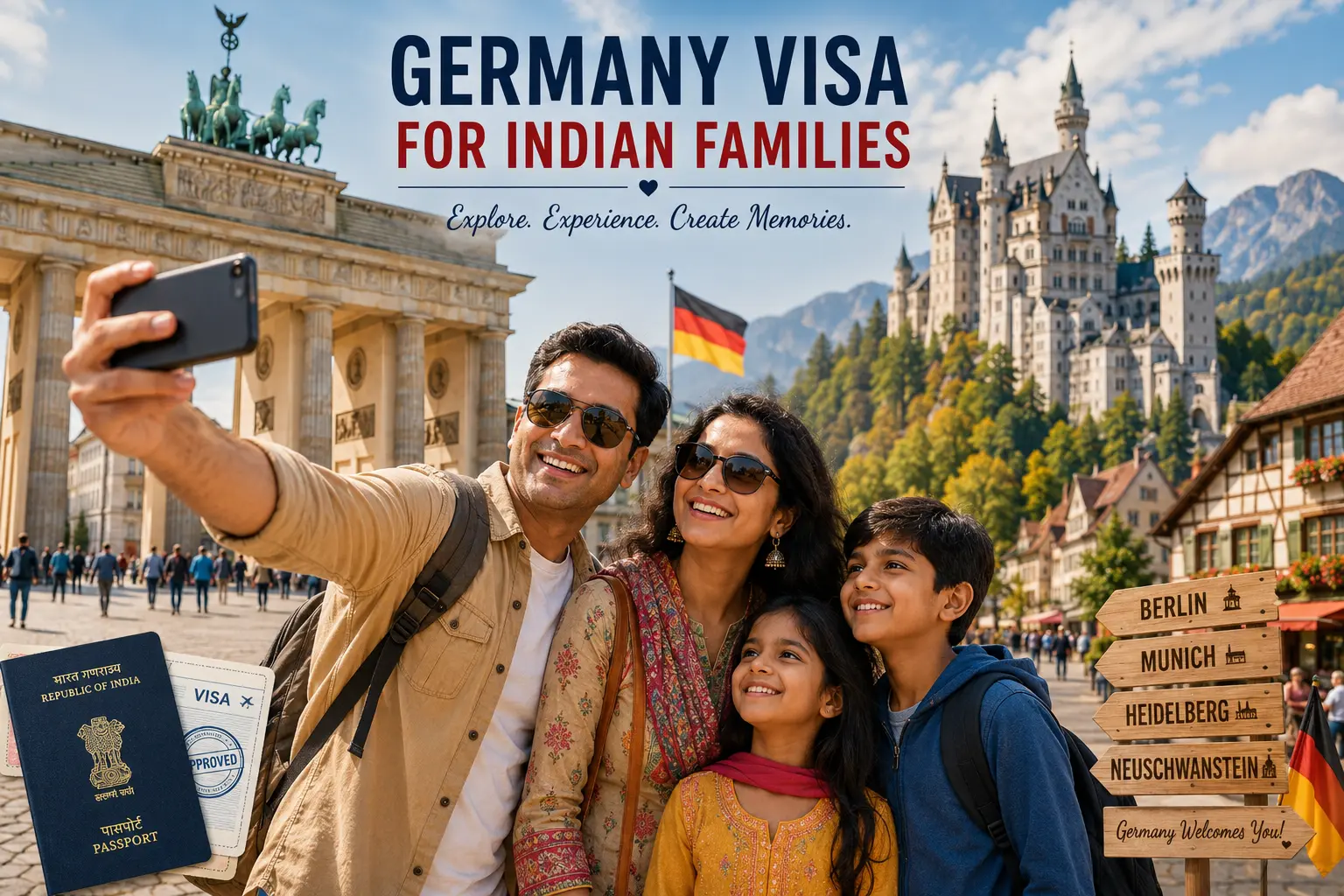
What is a Germany Visa for Indians?
A Germany visa is an official authorization that allows Indian citizens to enter Germany for a specific purpose and duration. Depending on the reason for travel, applicants may need a short-stay Schengen visa or a long-stay national visa. Germany is one of the most popular European destinations for Indian tourists, students, skilled professionals, entrepreneurs, and families because of its strong economy, world-class education system, excellent quality of life, and career opportunities.
For Indian passport holders, obtaining the correct visa is an essential step before travelling to Germany. The visa type you choose depends on whether you are visiting for tourism, business, higher education, employment, job seeking, family reunification, or long-term residence.
Germany follows strict immigration and border control procedures. Therefore, applicants must provide complete documentation, demonstrate the purpose of travel, and satisfy financial and eligibility requirements before receiving visa approval.
Understanding the Germany visa process in advance can help Indian applicants avoid delays, document issues, and unnecessary rejections.
Germany Visa Meaning
A Germany visa is a permit issued by German authorities that allows foreign nationals, including Indian citizens, to enter and stay in Germany for a specified period and purpose.
The visa acts as proof that the applicant has met Germany’s entry requirements and has been granted permission to travel. However, holding a visa does not automatically guarantee entry. Immigration officers at the port of entry have the authority to verify documents and confirm that travellers meet all conditions of admission.
Germany generally issues two broad categories of visas:
Short-Stay Schengen Visa (Type C)
This visa is intended for visits of up to 90 days within a 180-day period for purposes such as:
- Tourism
- Business meetings
- Visiting family and friends
- Attending conferences and events
- Medical treatment
- Short-term training programs
Long-Stay National Visa (Type D)
This visa is designed for individuals planning to stay in Germany for more than 90 days, including:
- Students pursuing higher education
- Skilled workers with employment offers
- Job seekers
- Researchers
- Family reunification applicants
- Opportunity Card holders
- Entrepreneurs and self-employed professionals
Choosing the correct visa category is one of the most important factors in a successful Germany visa application.
Why Indians Visit Germany
Germany has become one of the leading European destinations for Indian citizens. Every year, thousands of Indians travel to Germany for tourism, education, employment, business, and family-related purposes.
Some of the most common reasons Indians visit Germany include:
Tourism and Sightseeing
Germany is known for its historic castles, beautiful landscapes, modern cities, cultural festivals, museums, and scenic routes. Popular destinations include:
- Berlin
- Munich
- Hamburg
- Frankfurt
- Neuschwanstein Castle
- Black Forest
Higher Education
Germany is internationally recognized for its affordable and high-quality education system. Many public universities offer low-cost or tuition-free education, making Germany an attractive destination for Indian students seeking bachelor’s, master’s, and doctoral programs.
Employment Opportunities
Germany faces skilled worker shortages across various industries, creating opportunities for qualified international professionals. Indian workers are increasingly moving to Germany in sectors such as:
- Information Technology
- Engineering
- Healthcare
- Manufacturing
- Logistics
- Research and Development
Germany Opportunity Card and Job Seeker Programs
Recent immigration reforms have made it easier for skilled professionals to explore employment opportunities in Germany through pathways such as the Opportunity Card and skilled migration programs.
Business and Trade
Germany is Europe’s largest economy and an important trading partner for India. Business professionals frequently visit Germany to attend exhibitions, trade fairs, conferences, and client meetings.
Family Reunification
Many Indians travel to Germany to join spouses, parents, children, or relatives who are already living, studying, or working in the country.
Benefits of Travelling to Germany
Germany offers several advantages for Indian travellers, students, and professionals.
Access to a Strong Economy
Germany is one of the world’s leading industrial and economic powers. Its stable economy creates opportunities for employment, investment, innovation, and business expansion.
Excellent Quality of Life
Residents benefit from:
- Modern infrastructure
- Efficient public transportation
- High safety standards
- Advanced healthcare services
- Clean and well-planned cities
World-Class Education
German universities consistently rank among the best institutions globally and attract international students from across the world.
Career Growth Opportunities
Germany’s demand for skilled professionals provides long-term career prospects and pathways to residence permits for eligible applicants.
Rich Cultural Experiences
Travellers can experience:
- Historic landmarks
- Art galleries
- Museums
- Music festivals
- Christmas markets
- Traditional German culture
Central European Location
Germany’s strategic location makes it easy to explore other European countries during the same trip, especially within the Schengen Area.
Germany’s Importance in Europe
Germany plays a significant role in Europe’s political, economic, educational, and technological development.
As the largest economy in Europe, Germany serves as a major centre for:
- International trade
- Manufacturing
- Automotive innovation
- Research and development
- Engineering excellence
- Higher education
Several global companies have major operations in Germany, attracting skilled workers and business professionals from around the world.
Germany is also an influential member of:
- European Union
- Schengen Area
- NATO
- United Nations
- G7
Because of Germany’s strong position within Europe, many international students, professionals, and entrepreneurs view the country as a gateway to broader European opportunities.
Schengen Area Access Through Germany
One of the biggest advantages of obtaining a Germany Schengen visa is access to multiple European countries under a single visa.
Germany is part of the Schengen Area, a group of European countries that have abolished internal border controls for short-term travellers.
With a valid Germany-issued Schengen visa, eligible Indian travellers can generally visit other Schengen countries without applying for separate visas during the validity period, provided they comply with Schengen travel rules.
Popular Schengen destinations often visited alongside Germany include:
- France
- Italy
- Spain
- Netherlands
- Belgium
- Austria
- Switzerland
- Portugal
For Indian tourists, this means one visa can provide access to a wider European travel experience, making Germany an excellent starting point for exploring the continent.
Before travelling, applicants should ensure that Germany remains their primary destination or first point of entry if the visa application was submitted through German authorities. Following Schengen rules and maintaining accurate travel documentation can help avoid issues during future visa applications.
Do Indians Need a Visa for Germany?
Yes, Indian citizens generally need a visa to travel to Germany, regardless of whether the purpose of travel is tourism, business, studies, employment, family visits, or long-term residence. Germany is part of the Schengen Area, and Indian passport holders are not eligible for visa-free entry into Germany for short-term visits.
Before planning a trip, Indian travellers must identify the correct visa category based on the purpose and duration of their stay. Applying for the wrong visa type can lead to delays, requests for additional documents, or even visa refusal.
The good news is that Germany offers several visa options for tourists, students, skilled professionals, entrepreneurs, researchers, and family members. Understanding which visa is required is the first step toward a successful application.
Visa Requirements for Indian Passport Holders
Indian passport holders must obtain a valid visa before travelling to Germany. The visa application must be supported by documents that clearly demonstrate the purpose of travel, financial capability, accommodation arrangements, and compliance with German immigration requirements.
While document requirements vary by visa type, most applicants are expected to provide:
- A valid passport
- Completed visa application form
- Recent passport-size photographs
- Travel itinerary
- Accommodation proof
- Financial documents
- Travel insurance (where applicable)
- Employment or educational documents
- Supporting documents related to the purpose of travel
German authorities carefully review applications to ensure applicants meet all eligibility requirements before granting entry permission.
Key Requirement for Indian Applicants
Applicants should ensure that:
- Their passport remains valid for the required period.
- All submitted documents are genuine and consistent.
- Financial evidence is sufficient for the planned stay.
- The stated purpose of travel matches the supporting documents.
- Information provided in the application form is accurate and complete.
Even small inconsistencies can lead to delays or requests for clarification during processing.
Short-Stay vs Long-Stay Visas
Germany offers different visa categories depending on how long the applicant intends to stay in the country.
Understanding the difference between short-stay and long-stay visas is important because each category has different eligibility requirements, documentation standards, and immigration rules.
| Visa Type |
Purpose |
Typical Stay Duration |
| Short-Stay Schengen Visa (Type C) |
Tourism, business visits, family visits, conferences, short training programs |
Up to 90 days within a 180-day period |
| Long-Stay National Visa (Type D) |
Employment, studies, job seeking, family reunification, long-term residence |
More than 90 days |
Short-Stay Schengen Visa (Type C)
This visa is suitable for individuals who intend to visit Germany temporarily and return to India after their trip.
Common purposes include:
- Tourism and sightseeing
- Visiting friends and relatives
- Business meetings
- Trade fairs and exhibitions
- Medical treatment
- Cultural and sporting events
A Schengen visa also allows travel to other Schengen countries during its validity period, subject to applicable rules.
Long-Stay National Visa (Type D)
Applicants planning to live, study, or work in Germany for an extended period must apply for a national visa.
This category is commonly used for:
- University students
- Skilled workers
- Germany Opportunity Card holders
- Researchers
- Family reunification applicants
- Apprenticeship and vocational training candidates
After arriving in Germany, many long-stay visa holders must apply for a residence permit to continue their stay legally.
Situations Where a Visa Is Mandatory
For Indian citizens, a Germany visa is mandatory in almost all travel scenarios.
You must obtain a visa before travelling if you are visiting Germany for:
Tourism
Individuals planning holidays, sightseeing trips, or leisure travel must apply for a tourist visa.
Business Activities
Business travellers attending:
- Meetings
- Conferences
- Trade exhibitions
- Corporate events
- Client visits
must obtain the appropriate business visa.
Studying in Germany
Students enrolled in German universities, colleges, language courses, or vocational programs require a suitable student visa before entering Germany.
Employment
Professionals with a German job offer must secure the appropriate work visa or employment-based residence pathway.
Job Seeking
Qualified professionals wishing to search for employment opportunities in Germany may require a Job Seeker Visa or an Opportunity Card, depending on their eligibility.
Family Reunification
Spouses, children, and certain dependent family members joining relatives in Germany must obtain a family reunification visa.
Long-Term Residence
Any stay exceeding standard short-term visitor limits generally requires a long-stay national visa and subsequent residence authorization.
Duration of Stay Rules
The duration of stay allowed in Germany depends on the visa category issued.
Understanding stay limitations is extremely important because overstaying can result in penalties, future visa difficulties, or entry restrictions.
Short-Stay Schengen Visa Rule
Most Germany Schengen visas follow the:
90/180 Rule
This means travellers can stay in the Schengen Area for a maximum of 90 days within any rolling 180-day period.
For example:
- 15-day holiday in Germany
- 30-day business trip
- Multiple visits across Schengen countries
All days spent in Schengen countries count toward the 90-day limit.
Once the limit is reached, travellers generally need to remain outside the Schengen Area until sufficient days become available again under the rolling calculation.
Long-Stay National Visa Rule
National visas are generally issued for stays exceeding 90 days and may be valid for:
- Several months
- One year
- Multiple years through residence permits
The validity period depends on:
- Employment contract duration
- Academic program length
- Family reunification status
- Residence permit category
Multiple-Entry and Single-Entry Visas
Germany may issue:
| Entry Type |
Meaning |
| Single Entry |
One entry into the Schengen Area |
| Double Entry |
Two entries permitted |
| Multiple Entry |
Multiple entries during visa validity period |
Frequent travellers, business visitors, and individuals with strong travel histories may receive multiple-entry visas, depending on their circumstances.
Why Following Stay Rules Matters
Maintaining compliance with German immigration regulations helps travellers:
- Avoid overstaying penalties
- Preserve future visa eligibility
- Improve chances of obtaining multiple-entry visas
- Support future applications for study, work, or residence permits
Applicants should always check the validity dates, number of permitted entries, and authorized duration of stay printed on their visa before travelling to Germany.
Types of Germany Visas Available for Indians
Germany offers several visa categories to accommodate different travel, study, work, business, and family-related purposes. Choosing the correct visa type is one of the most important decisions during the application process because each category has its own eligibility criteria, documentation requirements, validity period, and conditions of stay.
Indian citizens should carefully assess the purpose of their visit before submitting an application. Applying under the wrong visa category can lead to delays, requests for additional documents, or visa refusal.
The following are the most common Germany visa types available to Indian applicants in 2026.
Germany Tourist Visa
A Germany Tourist Visa is designed for Indian citizens who wish to visit Germany for leisure, sightseeing, holidays, or recreational travel.
Purpose
This visa allows travellers to:
- Explore Germany’s cities and attractions
- Visit cultural and historical landmarks
- Attend festivals and tourism-related events
- Take short vacations within Germany and the Schengen Area
Validity
- Usually valid for short stays of up to 90 days within a 180-day period
- Can be issued as single-entry, double-entry, or multiple-entry depending on the applicant’s profile
Who Should Apply
- Tourists
- Holidaymakers
- Individuals planning European vacations
- Travelers visiting Germany for recreational purposes
Key Eligibility Requirements
- Valid passport
- Confirmed travel itinerary
- Hotel or accommodation booking
- Proof of sufficient funds
- Travel medical insurance
- Strong intention to return to India
Germany Business Visa
The Germany Business Visa is intended for professionals travelling to Germany for business-related activities.
Purpose
This visa permits activities such as:
- Business meetings
- Corporate events
- Trade fairs and exhibitions
- Client visits
- Contract negotiations
- Industry conferences
Validity
- Typically valid for stays up to 90 days within a 180-day period
- May be granted as a multiple-entry visa for frequent business travellers
Who Should Apply
- Company representatives
- Business owners
- Entrepreneurs
- Corporate executives
- Sales and marketing professionals
Key Eligibility Requirements
- Invitation letter from a German company
- Employer authorization letter
- Business registration documents (where applicable)
- Financial proof
- Travel insurance
- Evidence of business purpose
Germany Visitor Visa
A Germany Visitor Visa allows Indian citizens to visit family members, relatives, or friends residing in Germany.
Purpose
This visa is commonly used for:
- Family visits
- Visiting friends
- Attending personal celebrations
- Family gatherings
- Short-term private visits
Validity
- Usually issued for stays of up to 90 days within a 180-day period
Who Should Apply
- Individuals invited by family members
- Relatives of German residents
- Friends visiting hosts in Germany
Key Eligibility Requirements
- Invitation letter from host
- Host’s residence proof
- Accommodation confirmation
- Financial evidence
- Travel insurance
- Proof of relationship where applicable
Germany Student Visa
The Germany Student Visa is intended for Indian students who have secured admission to an approved educational institution in Germany.
Purpose
This visa enables students to:
- Pursue bachelor’s degrees
- Study master’s programs
- Complete doctoral studies
- Attend preparatory courses
- Participate in long-term educational programs
Validity
- Initially issued for entry into Germany
- Extended through a residence permit after arrival
- Usually covers the duration of the study program
Who Should Apply
- University students
- Postgraduate students
- Doctoral researchers
- International education applicants
Key Eligibility Requirements
- Admission letter from a recognized institution
- Financial proof such as a blocked account
- Educational certificates
- Health insurance
- Academic qualifications
- Genuine study intent
Germany Job Seeker Visa
The Germany Job Seeker Visa allows qualified professionals to enter Germany and search for employment opportunities.
Purpose
This visa enables applicants to:
- Explore the German job market
- Attend interviews
- Meet potential employers
- Seek suitable employment opportunities
Validity
- Generally issued for several months according to prevailing regulations
- Does not automatically authorize long-term employment without conversion to an appropriate work authorization
Who Should Apply
- Skilled professionals
- Engineers
- IT specialists
- Healthcare workers
- Qualified graduates
Key Eligibility Requirements
- Recognized educational qualifications
- Relevant work experience
- Proof of financial resources
- Professional background matching German labor market needs
- Genuine job-seeking intention
Germany Work Visa
The Germany Work Visa is designed for individuals who have secured employment with a German employer.
Purpose
This visa allows foreign nationals to:
- Work legally in Germany
- Relocate for employment
- Build long-term careers
- Obtain residence authorization linked to employment
Validity
- Usually linked to the employment contract
- Can lead to long-term residence opportunities
Who Should Apply
- Skilled workers
- Engineers
- IT professionals
- Healthcare professionals
- Technicians
- Qualified workers with job offers
Key Eligibility Requirements
- Valid employment contract
- Recognized qualifications
- Salary meeting applicable requirements
- Employer sponsorship where required
- Health insurance
- Supporting employment documentation
Germany Opportunity Card
The Germany Opportunity Card (Chancenkarte) is a points-based immigration pathway introduced to help qualified professionals enter Germany and search for employment.
Purpose
This pathway allows applicants to:
- Enter Germany without a prior job offer in many cases
- Search for employment opportunities
- Network with employers
- Explore long-term migration options
Validity
- Issued according to the applicable regulations at the time of approval
- May provide opportunities to transition into employment-based residence pathways
Who Should Apply
- Skilled professionals
- Qualified graduates
- Experienced workers
- Applicants meeting Germany’s points-based criteria
Key Eligibility Requirements
- Recognized qualifications
- Professional experience
- Language proficiency where applicable
- Financial self-support
- Sufficient points under the Opportunity Card system
Germany Family Reunion Visa
The Germany Family Reunion Visa allows eligible family members to join relatives legally residing in Germany.
Purpose
This visa supports family reunification by allowing close relatives to live together in Germany.
Validity
- Typically linked to the sponsor’s residence status
- May lead to residence permits after arrival
Who Should Apply
- Spouses
- Minor children
- Parents in specific circumstances
- Eligible dependent family members
Key Eligibility Requirements
- Proof of relationship
- Sponsor’s residence authorization
- Accommodation evidence
- Financial support requirements
- Language requirements in applicable cases
Germany Transit Visa
A Germany Transit Visa is intended for travellers passing through German airports while travelling to another destination.
Purpose
This visa permits airport transit under specific circumstances.
Validity
- Valid only for the approved transit period
- Does not generally allow regular entry into Germany
Who Should Apply
- Certain passengers transiting through Germany
- Travellers requiring airport transit authorization under applicable regulations
Key Eligibility Requirements
- Confirmed onward travel ticket
- Valid destination country visa where required
- Transit itinerary
- Passport validity requirements
Germany Visa Types at a Glance
| Visa Type |
Main Purpose |
Typical Stay Duration |
| Tourist Visa |
Holidays and sightseeing |
Up to 90 days |
| Business Visa |
Meetings and business activities |
Up to 90 days |
| Visitor Visa |
Visiting family and friends |
Up to 90 days |
| Student Visa |
Higher education and studies |
More than 90 days |
| Job Seeker Visa |
Searching for employment |
Long stay category |
| Work Visa |
Employment with a German employer |
Long stay category |
| Opportunity Card |
Job search through points-based pathway |
Long stay category |
| Family Reunion Visa |
Joining family members in Germany |
Long stay category |
| Transit Visa |
Airport transit |
Short transit duration |
Selecting the correct Germany visa category is the foundation of a successful application. Before submitting your visa request, ensure that your purpose of travel aligns with the visa type, and prepare documentation that clearly supports your intended activities in Germany.
Germany Visa Eligibility Criteria for Indian Citizens
Before applying for a Germany visa, Indian citizens must satisfy specific eligibility requirements established by German immigration authorities. These requirements help officials assess whether the applicant has a genuine reason for travel, sufficient financial resources, and the ability to comply with Germany’s immigration laws.
While the exact criteria vary depending on the visa category, several core requirements apply to most Germany visa applications. Understanding these requirements in advance can significantly improve your chances of visa approval and help you prepare a stronger application.
Applicants should remember that meeting the basic requirements does not automatically guarantee visa approval. German authorities evaluate each application individually based on the documents submitted and the applicant’s overall profile.
General Eligibility Requirements
All Indian applicants must satisfy certain general conditions before they can be considered for a Germany visa.
Valid Passport
Applicants must possess a valid Indian passport that:
- Has sufficient validity beyond the intended travel period
- Contains adequate blank pages for visa stamping
- Is in good physical condition and not damaged
Genuine Purpose of Travel
The purpose of the visit must be legitimate, clearly explained, and supported by relevant documents.
Examples include:
- Tourism
- Business travel
- Higher education
- Employment
- Job seeking
- Family reunification
- Medical treatment
Complete Visa Application
Applicants must:
- Submit an accurately completed visa application form
- Provide truthful information
- Sign all required declarations
- Submit supporting documentation as requested
Compliance with Immigration Rules
German authorities expect applicants to:
- Respect visa conditions
- Leave Germany before visa expiry (where applicable)
- Follow Schengen and German immigration regulations
Clean Documentation Record
All supporting documents should be:
- Genuine
- Verifiable
- Consistent across the application
- Free from alterations or misleading information
Providing false information or fraudulent documents can result in visa refusal and may negatively affect future applications.
Financial Requirements
One of the most important aspects of a Germany visa application is demonstrating sufficient financial capability.
German authorities want assurance that applicants can support themselves during their stay without relying on public funds.
Why Financial Proof Is Required
Financial documents help establish that the applicant can cover:
- Accommodation expenses
- Daily living costs
- Transportation costs
- Emergency expenses
- Return travel costs
Common Financial Documents Accepted
Depending on the visa type, applicants may provide:
- Recent bank statements
- Salary slips
- Income Tax Returns (ITR)
- Fixed deposit certificates
- Investment statements
- Business financial records
- Sponsorship documents
- Blocked account confirmation (for students)
Financial Expectations by Visa Category
| Visa Type |
Financial Evidence Commonly Required |
| Tourist Visa |
Personal savings and bank statements |
| Visitor Visa |
Personal funds or sponsor support |
| Business Visa |
Employer or company financial support |
| Student Visa |
Blocked account or approved financial proof |
| Job Seeker Visa |
Funds to support stay during job search |
| Opportunity Card |
Proof of self-sufficiency |
| Family Reunion Visa |
Sponsor’s financial capability where applicable |
Expert Tip
Large unexplained deposits shortly before visa submission may attract additional scrutiny. It is advisable to maintain consistent and transparent financial records.
Travel History Requirements
Although previous international travel is not mandatory for every Germany visa category, a positive travel history can strengthen an application.
Travel history helps visa officers assess whether an applicant has complied with immigration regulations in other countries.
Strong Travel History May Include
- Previous Schengen visas
- Visits to developed countries
- Timely exits from previous destinations
- Compliance with immigration rules
Applicants Without Travel History
First-time international travellers can still obtain a Germany visa if they provide:
- Strong financial evidence
- Genuine travel purpose
- Complete documentation
- Stable personal and professional background
Common Travel History Documents
- Previous passports
- Existing visas
- Entry and exit stamps
- Travel records
A lack of travel history alone is not typically a reason for refusal, provided the overall application is strong.
Purpose of Visit Requirements
German authorities must be satisfied that the reason for travel is genuine, clearly defined, and supported by evidence.
Applicants should provide documents that directly correspond to their chosen visa category.
For Tourist Visa Applicants
Supporting documents may include:
- Travel itinerary
- Hotel reservations
- Planned sightseeing schedule
- Return travel arrangements
For Business Visa Applicants
Applicants may need:
- Business invitation letter
- Conference registration
- Meeting schedules
- Company authorization letters
For Student Visa Applicants
Common requirements include:
- Admission letter
- Academic records
- Financial proof
- Study plan
For Work Visa Applicants
Applicants generally require:
- Employment contract
- Employer documents
- Qualification certificates
- Professional credentials
For Family Reunion Applicants
Required evidence may include:
- Marriage certificate
- Birth certificate
- Family relationship documents
- Sponsor documentation
Importance of Consistency
The stated purpose of travel should align with:
- Visa category selected
- Supporting documents
- Financial records
- Travel plans
Any inconsistencies may lead to additional verification or delays.
Health and Insurance Requirements
Germany places significant importance on health coverage and medical preparedness for visitors and residents.
Travel Medical Insurance
Most short-stay visa applicants must obtain travel medical insurance that:
- Covers medical emergencies
- Provides hospitalization coverage
- Remains valid throughout the travel period
- Meets Schengen visa requirements
Health Insurance for Long-Term Visas
Applicants for:
- Student visas
- Work visas
- Family reunion visas
- Opportunity Card pathways
may need health insurance arrangements that comply with German regulations.
Medical Examination Requirements
Depending on the visa category and individual circumstances, applicants may be asked to provide:
- Medical certificates
- Health declarations
- Additional medical documentation
Why Insurance Matters
Adequate insurance demonstrates that the applicant can handle unexpected medical situations during their stay and reduces the financial burden on public healthcare systems.
Return Intention Requirements
For short-term visa categories, one of the most important considerations is whether the applicant intends to return to India after the authorized stay.
German authorities evaluate various factors to determine the applicant’s ties to their home country.
Evidence of Strong Ties to India
Applicants may demonstrate return intentions through:
- Stable employment
- Ongoing business activities
- Family responsibilities
- Property ownership
- Educational commitments
- Financial assets
Employment-Based Evidence
Working professionals may provide:
- Employment letters
- Leave approval documents
- Salary records
- Employer confirmations
Business Owners May Submit
- Business registration documents
- GST registrations
- Company financial records
- Operational business evidence
Students Can Provide
- Enrollment certificates
- Academic commitments
- Future study plans
Why Return Intent Matters
Germany wants assurance that visitors using short-term visas will:
- Respect visa conditions
- Leave before visa expiration
- Not engage in unauthorized activities
A well-documented profile showing strong personal, financial, professional, or family ties to India can significantly strengthen a Germany visa application.
Quick Germany Visa Eligibility Checklist for Indians
Before applying, ensure you can demonstrate:
✔ Valid passport
✔ Genuine purpose of travel
✔ Complete and accurate documentation
✔ Sufficient financial resources
✔ Appropriate travel or health insurance
✔ Supporting documents for your visa category
✔ Strong ties to India (for short-stay visas)
✔ Compliance with previous immigration rules, if applicable
✔ Ability to support yourself during your stay
✔ Intention to follow German immigration regulations
Meeting these eligibility requirements and presenting clear, well-organized documentation can greatly improve your chances of obtaining a Germany visa successfully.
Germany Visa Document Checklist for Indians
Preparing the correct documents is one of the most important parts of a successful Germany visa application. In our experience assisting Indian applicants, most visa delays and refusals occur because of incomplete documentation, inconsistent information, or missing supporting evidence.
German authorities carefully review every application to verify the applicant’s identity, financial stability, purpose of travel, accommodation arrangements, and intention to comply with visa conditions. Therefore, all documents should be accurate, genuine, and organized before the visa appointment.
The exact document requirements may vary depending on whether you are applying for a tourist visa, business visa, visitor visa, student visa, work visa, Opportunity Card, Job Seeker Visa, or Family Reunion Visa. However, certain documents are required for almost every Germany visa application.
Passport Requirements
A valid passport is the most important document in your visa application.
Your passport should:
- Be valid for the required period beyond your planned stay
- Have sufficient blank pages for visa stamps
- Be in good physical condition
- Not contain damaged or missing pages
- Match all information provided in the application form
If you have previous passports containing travel history, visas, or immigration stamps, it is advisable to submit copies as supporting evidence.
Germany Visa Application Form
Every applicant must complete the Germany visa application form accurately.
The application form generally includes:
- Personal information
- Passport details
- Travel plans
- Employment information
- Financial details
- Purpose of visit
- Accommodation information
Any discrepancy between the form and supporting documents may result in delays or additional scrutiny.
Passport-Sized Photographs
Applicants must provide recent photographs that meet German visa photo specifications.
Typically, photographs should:
- Be recently taken
- Have a clear background
- Show a neutral facial expression
- Meet prescribed biometric standards
Photos that do not meet official requirements may be rejected during submission.
Travel Itinerary
A travel itinerary helps visa officers understand your planned trip.
The itinerary should include:
- Intended travel dates
- Cities to be visited
- Major planned activities
- Return travel plans
A detailed itinerary often strengthens tourist and visitor visa applications.
Flight Reservation
Applicants are generally required to provide proof of intended travel.
This may include:
- Round-trip flight reservation
- Confirmed travel booking
- Onward travel evidence where applicable
The reservation should match the travel dates mentioned in the application.
Hotel Booking Proof
Applicants must demonstrate where they intend to stay during their visit.
Acceptable accommodation evidence may include:
- Hotel reservations
- Guesthouse bookings
- Rental accommodation confirmations
- Host accommodation details for visitor visas
Accommodation documents should correspond to the travel itinerary.
Travel Insurance
Travel medical insurance is mandatory for most Germany Schengen visa applicants.
The insurance should:
- Cover medical emergencies
- Cover hospitalization expenses
- Remain valid throughout the trip
- Meet Schengen visa requirements
Applicants should ensure that the policy covers all intended travel dates.
Cover Letter
A well-written cover letter can significantly strengthen a Germany visa application.
The cover letter should explain:
- Purpose of travel
- Duration of stay
- Travel plans
- Source of funds
- Employment or business background
- Intention to return to India
For complex cases, a detailed cover letter can help visa officers better understand the applicant’s profile.
Bank Statements
Financial proof is one of the most closely reviewed aspects of a visa application.
Applicants typically submit:
- Recent bank statements
- Savings account statements
- Current account statements (for business applicants)
The statements should clearly demonstrate sufficient funds for the planned stay.
Income Tax Returns (ITR)
Income Tax Returns help establish:
- Financial stability
- Income consistency
- Compliance with tax regulations
Applicants are generally advised to submit recent ITR records where available.
Salary Slips
Salaried professionals should provide:
- Recent salary slips
- Salary certificates
- Employer-issued compensation documents
These documents help verify employment status and income level.
Employment Documents
Working professionals may need to submit:
- Employment verification letter
- No Objection Certificate (NOC)
- Leave approval letter
- Employment contract
- Company identification card
These documents help establish professional ties to India and support return intentions.
Business Ownership Documents
Business owners and self-employed applicants should provide evidence of their business activities.
Common documents include:
- Business registration certificate
- GST registration
- Company incorporation documents
- Partnership deed
- Business bank statements
- Financial reports
These documents demonstrate business ownership and financial capability.
Student Documents
Students applying for Germany visas may need:
- Bonafide certificate
- Student identification card
- Academic transcripts
- Admission letter
- Educational certificates
For student visa applicants, university admission documents become one of the primary eligibility requirements.
Sponsorship Documents
If another person is funding the trip, sponsorship documents may be required.
Common examples include:
- Sponsorship letter
- Sponsor’s bank statements
- Income proof
- Employment documents
- Identity documents
The sponsor must demonstrate sufficient financial resources to support the applicant.
Invitation Letter
An invitation letter may be necessary for:
- Business visas
- Visitor visas
- Family visits
- Conference participation
The invitation should clearly state:
- Purpose of invitation
- Duration of stay
- Relationship with applicant
- Host’s contact information
Marriage Certificate (Where Applicable)
Marriage certificates may be required for:
- Family reunion visas
- Spouse visas
- Joint travel applications
- Sponsored spouse applications
The document helps establish the legal relationship between spouses.
Birth Certificate (Where Applicable)
Birth certificates may be required when:
- Children are travelling
- Parents are sponsoring applicants
- Family reunion applications are submitted
- Relationship verification is necessary
The certificate should clearly establish family connections.
Mandatory Documents
The following documents are generally required for most Germany visa applications:
- Valid passport
- Visa application form
- Passport photographs
- Travel itinerary
- Flight reservation
- Accommodation proof
- Travel insurance
- Cover letter
- Financial documents
Without these documents, the application may be considered incomplete.
Supporting Documents
Supporting documents help strengthen the overall application and verify the applicant’s background.
Examples include:
- Salary slips
- Income Tax Returns
- Employment letters
- Business documents
- Educational records
- Previous travel history
- Property ownership documents
While some supporting documents may not be mandatory, they can significantly improve application credibility.
Additional Documents Based on Visa Type
Certain visa categories require specialized documentation.
| Visa Type |
Additional Documents Commonly Required |
| Tourist Visa |
Detailed travel itinerary, hotel bookings |
| Business Visa |
Business invitation letter, employer authorization |
| Visitor Visa |
Invitation letter, host’s residence documents |
| Student Visa |
Admission letter, academic records, financial proof |
| Work Visa |
Employment contract, qualification certificates |
| Job Seeker Visa |
Educational credentials, work experience proof |
| Opportunity Card |
Qualification recognition documents, experience records |
| Family Reunion Visa |
Marriage certificate, birth certificate, sponsor documents |
| Transit Visa |
Onward travel ticket, destination visa if applicable |
Germany Visa Document Checklist Table for Indians
The table below provides a practical checklist that applicants can use before scheduling their visa appointment.
| Document |
Tourist |
Business |
Visitor |
Student |
Work |
Opportunity Card |
Family Reunion |
| Valid Passport |
✔ |
✔ |
✔ |
✔ |
✔ |
✔ |
✔ |
| Visa Application Form |
✔ |
✔ |
✔ |
✔ |
✔ |
✔ |
✔ |
| Passport Photos |
✔ |
✔ |
✔ |
✔ |
✔ |
✔ |
✔ |
| Travel Itinerary |
✔ |
✔ |
✔ |
Optional |
Optional |
Optional |
Optional |
| Flight Reservation |
✔ |
✔ |
✔ |
✔ |
✔ |
✔ |
✔ |
| Accommodation Proof |
✔ |
✔ |
✔ |
✔ |
✔ |
✔ |
✔ |
| Travel Insurance |
✔ |
✔ |
✔ |
As applicable |
As applicable |
As applicable |
As applicable |
| Bank Statements |
✔ |
✔ |
✔ |
✔ |
✔ |
✔ |
✔ |
| Income Tax Returns |
Recommended |
Recommended |
Recommended |
Recommended |
Recommended |
Recommended |
Recommended |
| Salary Slips |
If employed |
If employed |
If employed |
If employed |
✔ |
✔ |
If employed |
| Employment Documents |
If employed |
✔ |
If employed |
Optional |
✔ |
Optional |
Optional |
| Business Documents |
If self-employed |
✔ |
If self-employed |
No |
If applicable |
If applicable |
No |
| Admission Letter |
No |
No |
No |
✔ |
No |
No |
No |
| Employment Contract |
No |
No |
No |
No |
✔ |
No |
No |
| Qualification Certificates |
Optional |
Optional |
Optional |
✔ |
✔ |
✔ |
Optional |
| Invitation Letter |
Optional |
✔ |
✔ |
No |
Sometimes |
Sometimes |
Sometimes |
| Sponsorship Documents |
If sponsored |
If sponsored |
If sponsored |
If sponsored |
If sponsored |
If sponsored |
If sponsored |
| Marriage Certificate |
If applicable |
If applicable |
If applicable |
If applicable |
If applicable |
If applicable |
✔ |
| Birth Certificate |
If applicable |
If applicable |
If applicable |
If applicable |
If applicable |
If applicable |
If applicable |
Expert Document Preparation Tips
Based on common issues seen in Germany visa applications from India, applicants should follow these best practices:
- Organize documents in the order requested by the visa center.
- Ensure names and dates are consistent across all documents.
- Avoid submitting incomplete forms.
- Carry original documents along with photocopies where required.
- Translate documents if requested by authorities.
- Double-check passport validity before booking appointments.
- Keep digital copies of all submitted documents.
- Submit only genuine and verifiable records.
A well-organized document file not only speeds up the visa submission process but also helps visa officers assess your application more efficiently, improving the overall chances of approval.
Germany Visa Fees for Indians in 2026
Understanding the complete Germany visa cost is essential before starting your application. Many applicants focus only on the embassy visa fee and overlook additional charges such as VFS service fees, courier services, travel insurance, and premium assistance services.
The total cost of a Germany visa application depends on:
- Visa category
- Applicant’s age
- Type of service selected
- Exchange rate at the time of payment
- Additional optional services
Applicants should note that visa fees are generally non-refundable, even if the visa is refused or withdrawn after submission.
Latest Schengen Visa Fees
Germany follows the standard Schengen visa fee structure established by the European Union for short-stay visas. As of 2026, the standard Schengen visa fee for adults is €90. (German Missions in India)
These fees typically apply to:
- Germany Tourist Visa
- Germany Business Visa
- Germany Visitor Visa
- Short-term Medical Visa
- Conference and Event Visas
Germany Schengen Visa Fees for Indians (2026)
| Applicant Category |
Fee (EUR) |
Approximate Fee (INR)* |
| Adults (12 years and above) |
€90 |
₹9,000 – ₹9,500 |
| Children (6–11 years) |
€45 |
₹4,500 – ₹4,800 |
| Children below 6 years |
Free |
Free |
*Actual INR amounts vary according to the exchange rate applied on the day of payment. (German Missions in India)
Long-Stay Visa Fees
Applicants planning to stay in Germany for more than 90 days generally require a National Visa (Type D).
This category includes:
- Germany Student Visa
- Germany Work Visa
- Germany Opportunity Card
- Germany Job Seeker Visa
- Germany Family Reunion Visa
Germany Long-Stay Visa Fees (2026)
| Visa Category |
Fee (EUR) |
Approximate Fee (INR)* |
| Student Visa |
€75 |
₹7,000 – ₹8,000 |
| Work Visa |
€75 |
₹7,000 – ₹8,000 |
| Opportunity Card |
€75 |
₹7,000 – ₹8,000 |
| Job Seeker Visa |
€75 |
₹7,000 – ₹8,000 |
| Family Reunion Visa |
€75 |
₹7,000 – ₹8,000 |
*Fees may change based on exchange rates and updated government regulations. Applicants should verify the latest charges before submitting their application. (VisaFlow)
VFS Service Charges
Most Germany visa applications from India are submitted through VFS Global, which collects service charges in addition to the embassy visa fee.
The VFS service fee covers:
- Appointment management
- Document handling
- Application transmission
- Administrative processing
- Passport return coordination
Typical VFS Charges
| Service |
Approximate Cost |
| VFS Service Fee |
₹1,800 – ₹3,000 per applicant |
The exact amount may vary depending on the visa category, location, and services offered at the visa application center. (Golden Future Education)
Biometric Charges
Biometric collection includes:
- Fingerprint capture
- Digital photograph
- Identity verification
For most Germany visa applicants, biometric enrollment is completed during the VFS appointment.
In many cases, biometric collection is included within the VFS service fee and is not charged separately. However, applicants should verify the latest fee structure at the time of booking. (Golden Future Education)
Who Must Provide Biometrics?
Biometrics are generally required for:
- First-time Schengen visa applicants
- Applicants whose previous biometrics have expired
- Individuals specifically requested to provide new biometric data
Children below certain age thresholds may be exempt according to applicable regulations.
Courier Charges
Applicants who prefer passport delivery to their home or office address can opt for courier services.
Benefits include:
- Avoiding additional travel to the visa center
- Convenient passport delivery
- Tracking support
Estimated Courier Costs
| Service |
Approximate Cost |
| Passport Courier Return |
₹300 – ₹1,000 |
The exact charge varies based on location and delivery requirements. (Golden Future Education)
Optional Premium Services
VFS centers offer additional services designed to improve convenience and applicant experience.
These services are entirely optional and do not influence visa approval decisions.
Common premium services include:
Premium Lounge Access
Provides:
- Dedicated assistance
- Priority processing support
- Comfortable waiting area
SMS and Notification Services
Applicants receive:
- Application updates
- Passport movement alerts
- Decision notifications
Document Printing and Photocopying
Useful for applicants who need:
- Last-minute document copies
- Additional printouts
- Form printing support
Form Filling Assistance
Professional assistance with:
- Application completion
- Data verification
- Submission guidance
Premium Appointment Services
May include:
- Faster appointment handling
- Dedicated counters
- Reduced waiting times
Typical Optional Service Costs
| Optional Service |
Approximate Cost |
| SMS Updates |
₹100 – ₹300 |
| Premium Lounge |
₹2,000 – ₹5,000 |
| Document Assistance |
₹200 – ₹1,000 |
| Courier Service |
₹300 – ₹1,000 |
| Photocopy and Printing |
₹10 – ₹50 per page |
Actual fees vary by VFS location and service package selected. (Schengen Terminal)
Germany Visa Fee Comparison Table for Indians (2026)
| Cost Component |
Tourist Visa |
Business Visa |
Student Visa |
Work Visa |
Opportunity Card |
| Embassy Visa Fee |
€90 |
€90 |
€75 |
€75 |
€75 |
| VFS Service Charge |
Extra |
Extra |
Extra |
Extra |
Extra |
| Biometric Collection |
Usually Included |
Usually Included |
Usually Included |
Usually Included |
Usually Included |
| Courier Service |
Optional |
Optional |
Optional |
Optional |
Optional |
| Premium Services |
Optional |
Optional |
Optional |
Optional |
Optional |
| Travel Insurance |
Mandatory |
Mandatory |
Required as applicable |
Required as applicable |
Required as applicable |
Estimated Total Germany Visa Cost for Indians in 2026
The overall budget depends on the visa type and services selected.
| Expense Category |
Estimated Cost Range |
| Embassy Visa Fee |
₹7,000 – ₹9,500 |
| VFS Service Charge |
₹1,800 – ₹3,000 |
| Travel Insurance |
₹500 – ₹5,000+ |
| Courier Service |
₹300 – ₹1,000 |
| Optional Premium Services |
₹100 – ₹5,000+ |
| Total Estimated Budget |
₹10,000 – ₹20,000+ |
Important Points About Germany Visa Fees
- Visa fees must usually be paid during the appointment process.
- Visa fees are generally non-refundable.
- Exchange rates can affect the INR amount payable.
- Additional services are optional and do not improve approval chances.
- Travel insurance costs are separate from visa fees.
- Applicants should always verify the latest fee schedule before booking an appointment.
A well-planned budget helps avoid last-minute surprises and ensures a smoother Germany visa application process for Indian travellers, students, skilled professionals, and families.
Step-by-Step Germany Visa Application Process for Indians
Applying for a Germany visa may seem complicated at first, but the process becomes much easier when broken down into clear steps. Whether you are applying for a tourist visa, business visa, student visa, work visa, Opportunity Card, or family reunion visa, following the correct procedure can help reduce delays and improve your chances of approval.
Based on our experience assisting Indian applicants, successful visa applications are usually the result of proper planning, accurate documentation, and timely submission. The following step-by-step guide explains the Germany visa application process in 2026.
Step 1: Determine the Correct Visa Category
The first and most important step is identifying the appropriate visa category based on the purpose of your visit.
Germany offers several visa types, including:
- Tourist Visa
- Business Visa
- Visitor Visa
- Student Visa
- Work Visa
- Job Seeker Visa
- Opportunity Card
- Family Reunion Visa
- Transit Visa
Applying under the wrong category can result in visa refusal even if your documents are otherwise complete.
Questions to Ask Yourself
- Am I travelling for tourism or business?
- Do I have a job offer from Germany?
- Have I received admission to a German university?
- Am I joining a family member in Germany?
- Am I planning to search for a job after arrival?
Your answers will help determine the correct visa pathway.
Consultant Tip
Do not choose a tourist visa if your actual purpose is employment, study, or long-term residence. German authorities carefully assess the genuine purpose of travel, and inconsistencies can negatively affect future applications.
Step 2: Gather Required Documents
Once you have selected the correct visa category, the next step is preparing your supporting documents.
German visa officers rely heavily on documentation to evaluate eligibility, financial stability, travel plans, and return intentions.
Typical documents include:
- Passport
- Visa application form
- Photographs
- Travel itinerary
- Flight reservation
- Hotel booking
- Travel insurance
- Bank statements
- Income Tax Returns
- Employment documents
- Invitation letters
- Academic records
- Sponsorship documents
The exact requirements depend on the visa category.
Consultant Tip
Create separate folders for:
- Identity documents
- Financial documents
- Travel documents
- Employment documents
- Educational records
Organized applications are easier to review and often create a more positive impression during assessment.
Step 3: Complete the Visa Application Form
Applicants must accurately complete the Germany visa application form before attending their appointment.
The form generally requires information regarding:
- Personal details
- Passport information
- Travel plans
- Employment status
- Financial background
- Accommodation details
- Purpose of visit
All information should exactly match the supporting documents.
Common Mistakes to Avoid
- Incorrect passport number
- Wrong travel dates
- Inconsistent employment information
- Missing signatures
- Incomplete sections
Consultant Tip
Review the completed application at least twice before submission. Even minor errors can result in additional verification requests or processing delays.
Step 4: Schedule a VFS Appointment
Most Germany visa applications from India are submitted through VFS Global Visa Application Centres.
After completing the application form, applicants must book an appointment for document submission and biometric collection.
During peak travel seasons, appointment availability may be limited.
Why Early Booking Matters
Appointment demand is often higher during:
- Summer holidays
- University admission seasons
- Festival periods
- Year-end travel months
Consultant Tip
Book your appointment as early as possible after finalizing your travel plans. For tourist visas, many applicants start the process several weeks before departure to avoid last-minute issues.
Step 5: Pay Visa Fees
Applicants must pay the applicable visa fees during the submission process.
The amount payable depends on:
- Visa category
- Applicant age
- Exchange rates
- Additional services selected
Additional charges may include:
- VFS service fees
- Courier charges
- SMS notification services
- Premium lounge services
Keep Payment Records
Always retain:
- Payment receipts
- Appointment confirmation
- Transaction records
These documents may be required later for reference.
Consultant Tip
Budget not only for visa fees but also for travel insurance, document preparation, translations, and courier services to avoid unexpected expenses.
Step 6: Attend Biometric Appointment
Most Germany visa applicants are required to provide biometric information during their appointment.
Biometric collection typically includes:
- Fingerprints
- Digital photograph
- Identity verification
Applicants must appear in person at the visa application center.
What to Bring
- Passport
- Appointment confirmation
- Visa application form
- Supporting documents
- Payment receipts
During the Appointment
Visa center staff may:
- Verify documents
- Review passport information
- Collect biometric data
- Confirm application completeness
Consultant Tip
Arrive at least 15 to 30 minutes before your scheduled appointment. Carry both originals and photocopies of important documents.
Step 7: Submit Documents
After biometric collection, your application package is formally submitted for processing.
Officials will review:
- Identity documents
- Financial records
- Purpose of travel evidence
- Accommodation details
- Supporting documents
If any required document is missing, you may be asked to provide additional information.
Document Verification Process
German authorities may verify:
- Employment details
- Financial information
- Educational qualifications
- Invitation letters
- Sponsorship documents
Consultant Tip
Never submit false, altered, or misleading documents. Germany has strict verification procedures, and document fraud can lead to visa refusal and future immigration complications.
Step 8: Track Application Status
After submission, applicants can usually monitor their application status using the tracking facilities provided by the visa application center.
Status updates may indicate:
- Application received
- Under processing
- Passport dispatched
- Decision completed
Tracking helps applicants stay informed throughout the process.
Consultant Tip
Avoid repeatedly contacting the embassy or visa center unless processing has exceeded normal timelines. Frequent enquiries generally do not speed up the decision-making process.
Step 9: Receive Visa Decision
Once processing is complete, applicants receive their passport with the final visa decision.
Possible outcomes include:
- Visa approved
- Additional document request
- Visa refused
If approved, applicants should carefully review the visa sticker.
Verify Important Details
Check:
- Name spelling
- Passport number
- Visa validity dates
- Number of entries
- Duration of stay allowed
Errors should be reported immediately.
Consultant Tip
Do not assume approval means unlimited travel. Always follow the conditions stated on the visa regarding entry dates, duration of stay, and permitted activities.
Step 10: Prepare for Travel
After receiving visa approval, applicants can begin preparing for their journey to Germany.
Before departure, ensure that all important travel documents are readily accessible.
Essential Travel Documents
Carry:
- Passport with visa
- Travel insurance certificate
- Flight tickets
- Hotel reservations
- Invitation letter (if applicable)
- Financial documents
- University admission documents (for students)
- Employment documents (for workers)
Arrival in Germany
Immigration officers may ask questions regarding:
- Purpose of travel
- Accommodation arrangements
- Duration of stay
- Financial resources
Applicants should be prepared to provide supporting documents if requested.
Consultant Tip
Keep printed copies of important documents in your hand luggage rather than checked baggage. This can save time and prevent difficulties during immigration checks.
Germany Visa Application Process at a Glance
| Step |
Action |
| Step 1 |
Determine the correct visa category |
| Step 2 |
Gather all required documents |
| Step 3 |
Complete the visa application form |
| Step 4 |
Schedule a VFS appointment |
| Step 5 |
Pay visa and service fees |
| Step 6 |
Attend biometric appointment |
| Step 7 |
Submit documents for processing |
| Step 8 |
Track application status |
| Step 9 |
Receive visa decision |
| Step 10 |
Prepare for travel to Germany |
Expert Advice for a Smooth Germany Visa Application
From years of assisting Indian applicants, the most successful Germany visa applications usually share these characteristics:
- Documents are complete and well-organized.
- Financial records clearly demonstrate stability.
- Travel plans are realistic and consistent.
- Information is accurate across all forms and supporting documents.
- Applications are submitted well before intended travel dates.
- Applicants fully understand the requirements of their chosen visa category.
A carefully prepared application not only reduces the likelihood of delays but also significantly improves the chances of obtaining a Germany visa successfully.
Germany Visa Appointment and Biometrics Process
After preparing your documents and completing the visa application form, the next important stage is attending the Germany visa appointment and biometric submission process. For most Indian applicants, this step takes place at a VFS Global Visa Application Centre, which handles visa application collection on behalf of German diplomatic missions.
Many applicants feel nervous about the appointment process, especially first-time international travellers. However, understanding what to expect can help you attend the appointment confidently and avoid common mistakes.
The appointment is primarily designed to verify your identity, collect biometric data, review your documents, and forward your application for assessment by German authorities.
Booking Appointments Through VFS
Germany visa applications in India are generally submitted through VFS Global centres located in major cities across the country.
Applicants must schedule an appointment before visiting a visa application centre. Walk-in submissions are usually not accepted except in limited circumstances or special service categories.
When Should You Book Your Appointment?
It is advisable to book your appointment as early as possible after finalizing your travel plans.
Appointment demand often increases during:
- Summer travel season
- University admission periods
- Christmas and New Year travel season
- Festival holidays
- Peak tourism months
For student and work visa applicants, appointment slots may be limited due to high demand.
Information Required for Appointment Booking
During appointment scheduling, applicants may need to provide:
- Full name
- Passport details
- Contact information
- Visa category
- Preferred appointment location
- Travel information
After booking, applicants receive an appointment confirmation that should be saved and carried to the visa centre.
Consultant Tip
Do not wait until the last minute to schedule your appointment. During peak periods, appointment availability can become limited, potentially affecting your travel plans.
Biometric Requirements
Germany participates in the Schengen Visa Information System (VIS), which requires most applicants to provide biometric information.
Biometric data helps authorities verify identity and improve border security across the Schengen Area.
What Biometric Data Is Collected?
Biometric collection generally includes:
- Fingerprints
- Digital facial photograph
The biometric information is securely stored according to applicable regulations.
Who Must Provide Biometrics?
Most applicants applying for a Germany visa must provide biometric data.
Biometrics are commonly required for:
- Tourist visa applicants
- Business visa applicants
- Visitor visa applicants
- Family visit applicants
- Other eligible Schengen visa categories
Biometric Exemptions
Certain applicants may be exempt from fingerprint collection, depending on age or specific circumstances under applicable regulations.
Requirements may change over time, so applicants should verify current rules before their appointment.
Consultant Tip
Ensure your fingers are free from cuts, injuries, heavy henna, or conditions that could affect fingerprint scanning on the day of the appointment.
What Happens During Biometrics?
Many applicants wonder what actually happens during the biometric appointment. In most cases, the process is straightforward and usually takes only a few minutes.
Arrival at the Visa Centre
Upon arrival, applicants generally:
- Present appointment confirmation
- Show passport
- Complete security procedures
- Receive a token or queue number
Document Verification
Visa centre staff may conduct an initial review of submitted documents to ensure:
- Required forms are present
- Passport information is correct
- Supporting documents are included
This review does not determine visa approval but helps ensure application completeness.
Fingerprint Collection
Applicants are asked to place their fingers on a biometric scanner.
The system records fingerprints electronically for identity verification purposes.
Digital Photograph Capture
A digital photograph is taken according to Schengen biometric standards.
Applicants should:
- Look directly at the camera
- Maintain a neutral expression
- Avoid tinted glasses or accessories that obstruct facial features
Completion of Submission
After biometric collection, the application is formally accepted and forwarded for processing.
Applicants receive:
- Submission receipt
- Tracking information
- Reference number for status updates
Consultant Tip
Dress neatly and professionally for the appointment. While appearance does not determine visa approval, presenting yourself professionally can help create a positive overall impression.
Interview Requirements
One of the most common questions Indian applicants ask is whether a Germany visa interview is mandatory.
The answer depends on the visa category and individual circumstances.
For Short-Stay Schengen Visas
Many tourist, business, and visitor visa applicants complete the application process without a formal embassy interview.
However, German authorities may request additional clarification or an interview if required.
For Long-Stay National Visas
Applicants for:
- Student visas
- Work visas
- Opportunity Cards
- Family reunion visas
- Job Seeker Visas
may be required to attend an interview depending on their application type and individual circumstances.
Common Interview Topics
Officials may ask questions about:
- Purpose of travel
- Employment background
- Educational qualifications
- Financial resources
- Accommodation arrangements
- Family situation
- Future plans
The objective is to verify the information submitted in the application.
How to Answer Interview Questions
Applicants should:
- Answer honestly
- Provide clear and concise responses
- Avoid memorized or rehearsed answers
- Remain consistent with submitted documents
Consultant Tip
Review your entire application before any interview. Many applicants make mistakes simply because they forget details they previously submitted.
Tips for Successful Appointments
A well-prepared appointment can help reduce stress and prevent avoidable delays.
Arrive Early
Plan to arrive at least 15 to 30 minutes before your appointment time.
This allows time for:
- Security checks
- Registration procedures
- Document organization
Carry Original Documents
Even if photocopies have been prepared, applicants should carry original documents whenever possible.
Examples include:
- Passport
- Employment letters
- Educational certificates
- Financial documents
- Invitation letters
Organize Documents Properly
Arrange documents according to the checklist provided for your visa category.
This makes verification faster and reduces the chance of missing paperwork.
Double-Check Your Application
Before attending the appointment, verify:
- Passport validity
- Travel dates
- Name spelling
- Supporting documents
- Contact information
Maintain Consistency
All information should match across:
- Application form
- Passport
- Financial records
- Employment documents
- Travel itinerary
Inconsistencies can lead to additional verification requests.
Be Honest
Never provide false information or fabricated documents.
German authorities conduct document verification and may reject applications that contain misleading information.
Stay Calm and Professional
Whether attending a simple biometric appointment or a visa interview, applicants should remain calm, respectful, and professional throughout the process.
Germany Visa Appointment Process at a Glance
| Stage |
What Happens |
| Appointment Booking |
Select visa category and schedule VFS appointment |
| Arrival at Centre |
Identity verification and security screening |
| Document Review |
Initial document completeness check |
| Biometric Collection |
Fingerprints and photograph captured |
| Submission |
Application officially accepted |
| Tracking |
Reference number issued |
| Processing |
Application forwarded to German authorities |
| Decision |
Visa approval, refusal, or additional request |
Common Mistakes to Avoid During the Appointment Process
- Booking the wrong visa category
- Arriving late for the appointment
- Carrying incomplete documents
- Providing inconsistent information
- Submitting outdated financial records
- Forgetting passport photocopies
- Ignoring photograph specifications
- Providing inaccurate travel details
- Failing to review the application before submission
By preparing carefully, organizing your documents properly, and understanding the appointment process in advance, Indian applicants can complete the Germany visa appointment and biometrics stage smoothly and move one step closer to receiving their visa approval.
Germany Visa Processing Time for Indians
One of the most common questions Indian applicants ask is, “How long does it take to get a Germany visa?” The answer depends on several factors, including the visa category, application volume, document completeness, background verification requirements, and the time of year when the application is submitted.
While some visa applications may be processed relatively quickly, others, particularly long-stay visas involving employment, education, or family reunification, can take significantly longer due to additional assessments and approvals.
Applicants should avoid making non-refundable travel arrangements until a visa decision has been received.
Tourist Visa Processing Time
The Germany Tourist Visa is generally one of the fastest visa categories to process because it involves short-term travel and relatively straightforward documentation.
Tourist visa applications are typically assessed based on:
- Travel purpose
- Financial capability
- Travel history
- Accommodation arrangements
- Return intentions
Typical Processing Time
| Visa Type |
Average Processing Time |
| Germany Tourist Visa |
Approximately 15 calendar days |
In some cases, processing may be completed sooner, while complex applications may require additional time.
Consultant Tip
Apply at least 4 to 8 weeks before your planned departure date, especially during peak travel seasons.
Business Visa Processing Time
Business visas generally follow timelines similar to tourist visas. However, additional verification may be required if the application involves corporate invitations, conferences, exhibitions, or commercial partnerships.
Factors Often Reviewed
- Invitation letters
- Company credentials
- Business purpose
- Travel schedule
- Employer documentation
Typical Processing Time
| Visa Type |
Average Processing Time |
| Germany Business Visa |
Approximately 15 calendar days |
Applications involving complex business activities may take longer.
Consultant Tip
Ensure that the invitation letter from the German company clearly explains the purpose, duration, and nature of the visit.
Student Visa Processing Time
Student visas often require more detailed assessments than short-stay visas because applicants intend to remain in Germany for an extended period.
Authorities may verify:
- University admission
- Financial resources
- Academic qualifications
- Language requirements
- Study intentions
Typical Processing Time
| Visa Type |
Average Processing Time |
| Germany Student Visa |
6 to 12 weeks or longer |
Some applications may be processed more quickly, while others can take several months depending on the institution, documentation, and verification procedures.
Consultant Tip
Apply immediately after receiving your university admission letter. Delaying the application could affect your ability to arrive before the academic session begins.
Work Visa Processing Time
Germany Work Visa applications often involve coordination between immigration authorities, labor offices, and other government departments.
Processing may include verification of:
- Employment contracts
- Professional qualifications
- Employer information
- Salary conditions
- Work authorization eligibility
Typical Processing Time
| Visa Type |
Average Processing Time |
| Germany Work Visa |
6 to 12 weeks or longer |
Specialized occupations and shortage professions may experience different processing timelines depending on individual circumstances.
Consultant Tip
Submit qualification certificates, employment contracts, and supporting documents in a well-organized format to avoid unnecessary requests for additional information.
Family Reunion Visa Processing Time
Family reunion visas often require extensive verification because authorities must confirm family relationships and the sponsor’s eligibility in Germany.
Assessments may include:
- Marriage verification
- Birth certificate verification
- Residence status of the sponsor
- Accommodation arrangements
- Financial capability
Typical Processing Time
| Visa Type |
Average Processing Time |
| Family Reunion Visa |
8 to 16 weeks or longer |
Applications involving additional document verification may require more time.
Consultant Tip
Ensure that relationship documents are complete, accurate, and properly legalized or translated if required.
Germany Visa Processing Time Comparison Table
The following table provides a general overview of expected processing timelines for major Germany visa categories.
| Visa Category |
Typical Processing Time |
| Tourist Visa |
Around 15 calendar days |
| Business Visa |
Around 15 calendar days |
| Visitor Visa |
Around 15 calendar days |
| Student Visa |
6 to 12 weeks or longer |
| Work Visa |
6 to 12 weeks or longer |
| Opportunity Card |
6 to 12 weeks or longer |
| Job Seeker Visa |
6 to 12 weeks or longer |
| Family Reunion Visa |
8 to 16 weeks or longer |
| Transit Visa |
Usually processed faster than standard visas |
These timelines are estimates and may vary based on individual circumstances.
Factors Affecting Processing Time
Several factors can influence how quickly a Germany visa application is processed.
Application Volume
During periods of high demand, visa offices receive a larger number of applications, which can increase processing times.
Visa Category
Long-stay visas generally require more extensive review than short-stay Schengen visas.
Background Verification
Applications requiring additional checks may take longer.
Documentation Quality
Incomplete applications frequently experience delays.
Security and Immigration Checks
Additional security screening may be conducted in certain cases.
Consultant Tip
The strongest applications are usually those with complete, organized, and easy-to-verify documentation.
Peak Season Delays
Processing times often increase during busy travel periods.
Common peak seasons include:
- May to August (summer travel season)
- September to October (student intake season)
- November to January (holiday travel season)
- Major trade fair and conference periods
During these months:
- Appointment availability may be limited.
- Processing times may increase.
- Additional planning becomes necessary.
Consultant Tip
Apply as early as possible during peak seasons to secure appointments and avoid last-minute travel stress.
Document Verification Delays
One of the most common reasons for extended processing is document verification.
Authorities may verify:
- Employment records
- Educational qualifications
- Financial documents
- Invitation letters
- Business registrations
- Family relationship documents
If discrepancies are discovered, additional documentation may be requested.
Common Reasons for Verification Delays
- Incomplete forms
- Missing signatures
- Unclear financial evidence
- Mismatched information
- Poor-quality photocopies
- Inaccurate translations
Consultant Tip
Review every document carefully before submission and ensure that information is consistent across all records.
How to Avoid Delays
Although applicants cannot control embassy workload, they can significantly reduce avoidable delays.
Submit a Complete Application
Ensure all required documents are included according to the visa checklist.
Apply Early
Start the application process several weeks or months before your planned travel date.
Maintain Consistent Information
Your application form, passport, financial records, and supporting documents should contain matching information.
Provide Strong Financial Evidence
Clear and verifiable financial documents help officers assess eligibility more efficiently.
Respond Quickly to Additional Requests
If authorities request further information, submit it promptly.
Use Accurate Supporting Documents
Avoid incomplete, outdated, or unofficial documentation.
Estimated Timeline from Application to Travel
| Stage |
Estimated Time |
| Document Preparation |
1 to 4 weeks |
| Appointment Availability |
Few days to several weeks |
| Visa Processing |
Depends on visa type |
| Passport Collection |
1 to 7 days |
| Travel Preparation |
1 to 3 weeks |
Expert Advice for Faster Germany Visa Processing
Based on experience assisting Indian applicants, the following practices often contribute to smoother processing:
- Apply well before your intended travel date.
- Choose the correct visa category.
- Submit a complete document package.
- Ensure financial records are clear and consistent.
- Double-check all forms before submission.
- Keep copies of all documents.
- Monitor application status regularly.
- Respond immediately if additional documents are requested.
A properly prepared Germany visa application not only improves approval chances but also helps minimize unnecessary delays, allowing applicants to focus on planning their studies, career opportunities, family reunification, or travel experience in Germany.
Common Reasons Germany Visa Applications Get Rejected
Receiving a Germany visa refusal can be disappointing, especially after investing time, effort, and money into the application process. However, many refusals occur because of avoidable mistakes that applicants often overlook during document preparation or submission.
German immigration authorities assess every application carefully to determine whether the applicant meets visa requirements, has a genuine purpose of travel, possesses sufficient financial resources, and intends to comply with immigration regulations.
Understanding the most common rejection reasons can help Indian applicants prepare stronger applications and significantly improve their chances of approval.
Incomplete Documentation
Incomplete documentation is one of the leading causes of Germany visa refusals.
Even if an applicant meets all eligibility requirements, missing documents can prevent visa officers from properly evaluating the application.
Common Documentation Issues
- Missing passport copies
- Incomplete application forms
- Missing signatures
- Absent financial documents
- Missing accommodation proof
- Missing invitation letters
- Incomplete employment records
- Missing educational certificates
Why It Causes Refusal
Visa officers rely entirely on submitted documents to assess eligibility. If important information is missing, they may be unable to verify the applicant’s circumstances.
Real-World Example
A tourist visa applicant submits bank statements but forgets to provide hotel reservations and return flight details. The visa officer may be unable to confirm travel plans, increasing the risk of refusal.
Insufficient Funds
Applicants must demonstrate that they can financially support themselves during their stay in Germany.
Insufficient financial evidence is another major reason for visa rejection.
Common Financial Issues
- Low account balance
- Unexplained cash deposits
- Inconsistent income records
- Lack of financial history
- Inadequate sponsorship evidence
- Missing financial documents
What Visa Officers Evaluate
Authorities generally assess whether the applicant can cover:
- Accommodation expenses
- Daily living costs
- Transportation expenses
- Emergency situations
- Return travel costs
Warning Sign
Large deposits made shortly before the visa application without a clear explanation may raise concerns about the actual source of funds.
Expert Insight
A stable financial history is usually viewed more positively than a temporary increase in account balance immediately before submission.
Incorrect Information
Providing inaccurate or inconsistent information can seriously affect visa approval chances.
Even unintentional errors may create doubts about the reliability of the application.
Common Information Errors
- Incorrect passport details
- Wrong travel dates
- Mismatched employment information
- Incorrect address details
- Errors in financial records
- Conflicting information across documents
Why Consistency Matters
German authorities often compare information across:
- Visa application forms
- Passports
- Bank statements
- Employment letters
- Invitation letters
- Travel itineraries
Any discrepancies may trigger additional verification or concerns.
Example
If the employment letter states one salary amount while salary slips show a different figure, the officer may request clarification or question the accuracy of the application.
Weak Travel Purpose
Applicants must clearly demonstrate why they are travelling to Germany.
A weak or poorly documented travel purpose may result in visa refusal.
Common Travel Purpose Problems
- Vague travel plans
- Missing itinerary
- Unclear business objectives
- Insufficient university information
- Weak explanation of visit
- Contradictory travel intentions
Tourist Visa Concerns
Tourist visa applicants should clearly explain:
- Planned destinations
- Duration of stay
- Accommodation arrangements
- Tourism activities
Business Visa Concerns
Business travellers should provide:
- Meeting schedules
- Invitation letters
- Event registrations
- Employer authorization
Student and Work Visa Concerns
Long-stay applicants should provide strong evidence supporting their educational or employment objectives.
Expert Insight
A clear, logical, and well-supported purpose of travel often strengthens the overall credibility of the application.
Travel Insurance Issues
Travel insurance is a mandatory requirement for most Germany Schengen visa applicants.
Problems with insurance documentation can lead to delays or refusals.
Common Insurance Problems
- Insufficient coverage
- Incorrect travel dates
- Expired insurance policies
- Missing policy documents
- Non-compliant insurance providers
What Visa Officers Look For
Insurance should:
- Cover the entire travel period
- Meet Schengen requirements
- Include medical emergency coverage
- Cover hospitalization expenses
Example
If a traveller plans to stay for 20 days but purchases insurance covering only 15 days, the application may face issues during assessment.
Lack of Supporting Evidence
Supporting evidence helps verify the information provided in the application.
Even when the main documents are submitted, insufficient supporting evidence can weaken the case.
Examples of Missing Supporting Documents
- Employment verification letters
- Salary slips
- Income Tax Returns
- Property ownership records
- Educational certificates
- Business registrations
- Family relationship documents
Why Supporting Evidence Matters
Supporting documents help establish:
- Financial stability
- Professional background
- Educational qualifications
- Family relationships
- Return intentions
The stronger the supporting evidence, the easier it becomes for visa officers to assess the applicant’s profile.
Germany Visa Rejection Reasons at a Glance
| Rejection Reason |
Impact on Application |
| Incomplete Documentation |
Application cannot be properly assessed |
| Insufficient Funds |
Financial capability questioned |
| Incorrect Information |
Credibility concerns arise |
| Weak Travel Purpose |
Genuine intent not established |
| Travel Insurance Issues |
Mandatory requirements not met |
| Lack of Supporting Evidence |
Important claims remain unverified |
How to Avoid Rejection
Although no visa approval can ever be guaranteed, applicants can significantly reduce refusal risks by following best practices.
Submit a Complete Document Package
Ensure all mandatory and supporting documents are included before the appointment.
Use a checklist and verify every document carefully.
Maintain Strong Financial Records
Provide:
- Consistent bank statements
- Income proof
- Salary records
- Tax returns
- Sponsorship evidence where applicable
Provide Accurate Information
Double-check:
- Passport details
- Travel dates
- Employment information
- Financial records
- Contact information
Consistency across all documents is essential.
Explain Your Purpose Clearly
Prepare a detailed cover letter that outlines:
- Why you are travelling
- What you plan to do in Germany
- How long you will stay
- How the trip will be funded
Purchase Appropriate Insurance
Ensure that travel insurance:
- Covers the entire trip
- Meets Germany and Schengen requirements
- Includes required medical coverage
Demonstrate Strong Ties to India
For short-stay visas, provide evidence such as:
- Employment
- Business ownership
- Family commitments
- Property ownership
- Educational enrollment
These documents help establish return intentions.
Expert Consultant Tip
Before submitting your application, review it from the perspective of a visa officer. Ask yourself whether every claim made in the application is supported by documentary evidence.
Reapplication Strategy After Refusal
A visa refusal does not necessarily mean future applications will be rejected.
Many applicants successfully obtain a Germany visa after correcting the issues that caused the initial refusal.
Step 1: Carefully Review the Refusal Letter
German authorities generally provide reasons for refusal.
Read the refusal notice carefully and identify:
- Missing documents
- Financial concerns
- Purpose-of-travel issues
- Documentation inconsistencies
Step 2: Identify the Root Cause
Avoid submitting a new application without understanding why the previous application was refused.
Simply reapplying with the same documents may lead to another refusal.
Step 3: Strengthen Weak Areas
Depending on the refusal reason, applicants may need to:
- Improve financial documentation
- Provide additional supporting evidence
- Clarify travel plans
- Strengthen employment proof
- Submit stronger sponsorship documents
Step 4: Update Documentation
Ensure all documents are:
- Current
- Accurate
- Complete
- Consistent
Outdated documents should be replaced before reapplication.
Step 5: Prepare a Strong Cover Letter
A revised cover letter can help explain:
- Changes made since the refusal
- Additional supporting evidence
- Clarifications regarding previous concerns
Step 6: Seek Professional Guidance
Complex refusals involving:
- Financial concerns
- Employment verification
- Family reunification
- Student visas
- Work visas
may benefit from professional review before reapplying.
Expert Advice for Improving Approval Chances
Based on practical visa application experience, applicants who are most successful typically:
- Apply under the correct visa category.
- Submit complete and organized documents.
- Maintain transparent financial records.
- Clearly explain their travel purpose.
- Provide strong supporting evidence.
- Demonstrate genuine intentions.
- Follow all Germany visa requirements carefully.
A Germany visa refusal can be frustrating, but it should also be viewed as an opportunity to identify weaknesses, strengthen your application, and prepare a more convincing case for future approval. Careful preparation, accurate documentation, and a clear travel purpose remain the strongest foundations of a successful Germany visa application.
Important Travel and Entry Rules After Germany Visa Approval
Receiving your Germany visa is an exciting milestone, but your journey does not end there. Many travellers mistakenly believe that a visa guarantees automatic entry into Germany. In reality, visa holders must still comply with immigration requirements when arriving in Germany and throughout their stay.
German border authorities have the right to verify your travel purpose, financial resources, accommodation arrangements, and supporting documents even after a visa has been issued.
Understanding the travel and entry rules before departure can help Indian travellers avoid complications at the airport and ensure a smooth arrival experience.
Carrying Documents During Travel
One of the most important travel rules is to carry all essential documents in your hand luggage rather than your checked baggage.
Even though your visa has already been approved, immigration officers may ask to review supporting documents upon arrival.
Essential Documents to Carry
All travellers should keep the following documents readily accessible:
- Valid passport with Germany visa
- Flight tickets and boarding passes
- Travel insurance certificate
- Hotel reservations or accommodation confirmation
- Travel itinerary
- Proof of funds
- Return or onward travel ticket
- Emergency contact information
Additional Documents Based on Visa Type
Tourist Visa Applicants
- Hotel bookings
- Sightseeing itinerary
- Return flight reservation
Business Visa Applicants
- Business invitation letter
- Meeting schedules
- Conference registrations
Student Visa Applicants
- University admission letter
- Tuition fee payment confirmation
- Accommodation details
- Financial proof
Work Visa Applicants
- Employment contract
- Employer details
- Work authorization documents
Family Reunion Applicants
- Family relationship documents
- Sponsor information
- Residence documents of the sponsor
Consultant Tip
Keep both printed and digital copies of important documents. Mobile phones can run out of battery, and internet access may not always be available when needed.
Immigration Checks at German Airports
After landing in Germany, travellers must pass through immigration control before entering the country.
Immigration officers may ask questions to verify that your travel plans match the information provided during the visa application process.
Common Questions Asked by Immigration Officers
You may be asked:
- Why are you visiting Germany?
- How long do you plan to stay?
- Where will you stay?
- How will you support yourself financially?
- Do you have return travel arrangements?
- Are you travelling alone or with family?
These questions are routine and should not be a cause for concern.
Documents Officers May Request
Immigration officers may ask to see:
- Passport
- Visa
- Accommodation proof
- Travel insurance
- Return ticket
- Financial documents
- Invitation letter
Stay Calm and Answer Honestly
Provide clear and truthful answers that are consistent with your visa application.
Consultant Tip
Review your visa application before travelling. Many travellers become nervous and accidentally provide information that differs from what was originally submitted.
Proof of Funds
Even after receiving a visa, travellers may be required to demonstrate that they have sufficient financial resources for their stay.
German authorities want to ensure that visitors can cover their expenses without relying on public assistance.
Acceptable Financial Evidence
Examples include:
- Bank statements
- International debit cards
- Credit cards
- Foreign exchange cards
- Cash (within legal limits)
- Sponsorship documents where applicable
Why Proof of Funds Is Important
Financial evidence helps demonstrate that you can pay for:
- Accommodation
- Meals
- Transportation
- Emergency expenses
- Return travel
Consultant Tip
Carry recent bank statements and evidence of available funds, especially if you are travelling on a tourist, visitor, or business visa.
Accommodation Proof
Travellers should be prepared to demonstrate where they will stay during their time in Germany.
Accommodation information should match the details provided in the visa application.
Common Accommodation Documents
- Hotel reservation confirmations
- Hostel bookings
- Rental accommodation agreements
- Invitation from host
- Proof of residence of the host
If Staying With Friends or Family
You may be asked to provide:
- Invitation letter
- Host’s address
- Contact details
- Residence permit or identification of the host
Why Accommodation Proof Matters
Accommodation evidence helps immigration officers verify:
- Travel plans
- Duration of stay
- Purpose of visit
Consultant Tip
Keep accommodation confirmations easily accessible during immigration checks, particularly if you plan to visit multiple cities within Germany.
Travel Insurance Requirements
Travel insurance remains important even after your visa has been approved.
Many travellers mistakenly assume that insurance is only needed during the visa application stage. In reality, you may be asked to provide proof of insurance during travel or at immigration control.
What Travel Insurance Should Cover
Travel insurance should typically include:
- Medical emergencies
- Hospitalization expenses
- Emergency medical treatment
- Repatriation coverage
- Emergency assistance services
Why Insurance Is Important
Medical treatment in Germany can be expensive for visitors who do not have adequate insurance coverage.
Travel insurance provides protection against unexpected situations such as:
- Illness
- Accidents
- Medical emergencies
- Travel disruptions
Long-Term Visa Holders
Students, workers, and family reunion applicants may need to arrange health insurance that complies with German regulations after arrival.
Consultant Tip
Carry both a printed insurance certificate and a digital copy throughout your trip.
Registration Requirements After Arrival
Certain travellers staying in Germany for an extended period must complete registration procedures after arrival.
This requirement primarily applies to long-term residents rather than short-term tourists.
Who May Need to Register?
Registration is commonly required for:
- Students
- Employees
- Opportunity Card holders
- Family reunion applicants
- Long-term residents
Why Registration Is Important
Registration helps authorities maintain accurate residence records and is often required for:
- Residence permits
- Bank account opening
- Tax registration
- Health insurance enrollment
- Employment formalities
Information Usually Required
Applicants may need:
- Passport
- Visa
- Residential address
- Accommodation confirmation
- Landlord documentation where applicable
Consequences of Missing Registration
Failure to complete required registration procedures may create difficulties with:
- Residence permit applications
- Employment processes
- Administrative services
Consultant Tip
Long-stay visa holders should familiarize themselves with local registration requirements immediately after securing accommodation in Germany.
Arrival Checklist for Germany Visa Holders
Before boarding your flight to Germany, ensure you have:
✔ Passport with valid visa
✔ Flight tickets
✔ Travel insurance certificate
✔ Hotel or accommodation confirmation
✔ Proof of sufficient funds
✔ Return or onward travel ticket
✔ Invitation letter (if applicable)
✔ University admission documents (for students)
✔ Employment contract (for workers)
✔ Family relationship documents (for family reunion applicants)
✔ Emergency contact information
Common Mistakes to Avoid After Visa Approval
Many travellers face avoidable issues because they assume the visa approval process is complete.
Avoid these common mistakes:
- Travelling without printed supporting documents
- Carrying insufficient proof of funds
- Forgetting accommodation confirmations
- Allowing travel insurance to expire before departure
- Providing inconsistent information during immigration checks
- Ignoring registration requirements after arrival
- Misunderstanding visa validity dates and stay limits
Expert Advice for a Smooth Entry into Germany
Based on practical experience with Germany visa applicants, travellers who have the smoothest arrival experience typically:
- Carry complete supporting documentation.
- Understand the purpose and conditions of their visa.
- Have clear travel and accommodation arrangements.
- Maintain adequate financial resources.
- Keep travel insurance active throughout the trip.
- Follow all post-arrival registration requirements when applicable.
A Germany visa allows you to travel legally to one of Europe’s most important destinations, but successful entry and compliance depend on understanding and following the rules that apply after visa approval. Proper preparation can help ensure a hassle-free arrival and a positive experience in Germany.
Germany Visa Success Tips from Immigration Experts
Germany receives thousands of visa applications from Indian citizens every year. While many applicants meet the basic eligibility requirements, approval often depends on how effectively they present their case through documentation, financial evidence, travel plans, and supporting records.
Based on practical immigration experience, successful Germany visa applications typically share certain characteristics: complete documentation, strong financial credibility, a genuine travel purpose, and consistent information throughout the application.
The following expert tips can help Indian applicants strengthen their Germany visa applications and improve their chances of approval.
Financial Documentation Best Practices
Financial documents are among the most important factors reviewed during a Germany visa assessment. Visa officers want to ensure that applicants can support themselves during their stay and do not pose a financial risk.
Maintain a Healthy Bank Balance
Your bank statements should demonstrate that you have sufficient funds available for:
- Accommodation expenses
- Daily living costs
- Transportation
- Emergency situations
- Return travel
A stable financial history is often viewed more favorably than a sudden increase in account balance.
Avoid Large Unexplained Deposits
One of the most common concerns raised by visa officers involves significant deposits made shortly before application submission.
If large transactions appear in your account:
- Maintain supporting documentation.
- Be prepared to explain the source of funds.
- Include additional evidence where necessary.
Submit Recent Financial Records
Financial documents should generally be:
- Current
- Complete
- Consistent
- Easy to verify
Common financial documents include:
- Bank statements
- Salary slips
- Income Tax Returns
- Fixed deposit records
- Investment statements
- Sponsorship documents
Organize Financial Documents Professionally
Arrange financial documents in chronological order.
This makes it easier for visa officers to review your financial profile and understand your funding arrangements.
Expert Tip
Applicants with stable employment, regular income, and transparent financial records generally present a stronger profile than applicants relying solely on recent account deposits.
Strong Cover Letter Tips
A cover letter is often one of the most underrated documents in a Germany visa application.
A well-written cover letter allows applicants to explain their circumstances directly and provide context for the supporting documents submitted.
What a Good Cover Letter Should Include
Your cover letter should clearly explain:
- Purpose of travel
- Travel dates
- Duration of stay
- Accommodation arrangements
- Source of funds
- Employment or educational background
- Intention to return to India
Keep the Content Clear and Honest
Avoid:
- Exaggerated claims
- Unnecessary personal stories
- Contradictory information
- Generic statements copied from templates
Instead, focus on facts supported by documents.
Address Any Special Circumstances
If your application includes unique situations, such as:
- Sponsorship arrangements
- Career breaks
- Recent employment changes
- Self-employment
- Family sponsorship
briefly explain them in the cover letter.
Recommended Cover Letter Structure
| Section |
Information to Include |
| Introduction |
Purpose of visa application |
| Travel Details |
Dates, itinerary, accommodation |
| Financial Information |
Source of funds |
| Professional Background |
Employment or business details |
| Return Intentions |
Ties to India |
| Closing Statement |
Request for visa consideration |
Expert Tip
The best cover letters are concise, professional, and fully supported by the accompanying documentation.
Interview Preparation
Although many Germany visa applicants may not be required to attend a formal interview, certain visa categories or individual cases may involve additional questioning.
Applicants should always be prepared to discuss their application confidently.
Review Your Application Thoroughly
Before any interview or immigration interaction, review:
- Visa application form
- Travel itinerary
- Financial documents
- Employment records
- Educational credentials
- Sponsorship details
Many applicants make mistakes simply because they forget information they previously submitted.
Understand Your Purpose of Travel
You should be able to clearly explain:
- Why you are visiting Germany
- How long you intend to stay
- Who will support your trip financially
- What activities you plan to undertake
Prepare for Common Questions
Examples include:
- Why did you choose Germany?
- Who is paying for your trip?
- What do you do in India?
- What are your plans after returning?
- Do you have family members in Germany?
Stay Professional and Honest
During any interview:
- Speak clearly
- Remain calm
- Answer honestly
- Avoid guessing answers
- Do not provide misleading information
Expert Tip
Visa officers are often more interested in consistency and credibility than memorized responses. Honest and straightforward answers generally create a stronger impression.
Travel History Improvement Tips
A positive travel history can strengthen future Germany visa applications.
While previous international travel is not mandatory, a good immigration record demonstrates responsible travel behavior.
Follow Visa Rules in Every Country
Whenever you travel internationally:
- Respect visa conditions
- Leave before visa expiry
- Avoid immigration violations
- Maintain lawful status
Build Gradually
For first-time international travellers, it can be beneficial to establish travel history through legitimate trips to countries with straightforward visa procedures.
Preserve Travel Records
Keep copies of:
- Previous visas
- Entry and exit stamps
- Travel itineraries
- Immigration approvals
These records may be useful for future applications.
Avoid Overstays
Even a single immigration violation in another country can negatively affect future visa applications.
First-Time Travellers Can Still Succeed
Applicants without international travel history can still obtain a Germany visa if they demonstrate:
- Strong finances
- Stable employment
- Genuine travel purpose
- Complete documentation
- Clear return intentions
Expert Tip
Travel history helps, but it does not replace strong documentation. Many first-time travellers successfully obtain Germany visas every year.
Application Accuracy Checks
One of the simplest yet most effective ways to improve approval chances is to thoroughly review the application before submission.
Many visa refusals occur because of avoidable mistakes.
Verify Personal Information
Check:
- Name spelling
- Date of birth
- Passport number
- Contact information
- Address details
Review Travel Information
Ensure consistency across:
- Visa application form
- Flight reservations
- Hotel bookings
- Travel itinerary
Cross-Check Financial Documents
Confirm that:
- Bank statements are current
- Account balances are accurate
- Income records are consistent
- Sponsorship documents match financial records
Review Employment and Educational Documents
Verify that:
- Employment letters contain correct information
- Salary details are accurate
- Academic records are complete
- Supporting documents are current
Confirm All Signatures
Missing signatures are among the most common administrative mistakes in visa applications.
Expert Tip
Before submission, imagine that you are the visa officer reviewing the application for the first time. If any statement requires additional explanation, provide supporting evidence before attending the appointment.
Germany Visa Success Checklist
Before submitting your application, ensure that you can answer “Yes” to the following questions:
| Checklist Item |
Yes/No |
| Have I selected the correct visa category? |
□ |
| Is my passport valid? |
□ |
| Have I completed the application form accurately? |
□ |
| Are my financial documents sufficient and current? |
□ |
| Have I provided a clear travel purpose? |
□ |
| Is my travel insurance compliant with requirements? |
□ |
| Are all supporting documents included? |
□ |
| Is all information consistent across documents? |
□ |
| Have I prepared for possible interview questions? |
□ |
| Have I demonstrated strong ties to India where applicable? |
□ |
Final Expert Recommendations
Successful Germany visa applications are rarely the result of luck. They are usually the outcome of careful planning, accurate documentation, and a genuine purpose of travel.
Immigration professionals consistently recommend that applicants:
- Apply under the correct visa category.
- Maintain transparent financial records.
- Submit complete and organized documentation.
- Write a clear and convincing cover letter.
- Review every document before submission.
- Be honest and consistent throughout the process.
- Apply well in advance of planned travel dates.
By following these proven best practices, Indian applicants can significantly improve their chances of obtaining a Germany visa and enjoy a smoother application experience from start to finish.
Germany Visa for Indians with Radvision World
Applying for a Germany visa can be a complex process, especially for first-time international travellers, students, skilled professionals, and families. From selecting the correct visa category to preparing documents, booking appointments, and responding to immigration requirements, every step requires careful attention.
This is where Radvision World helps simplify the journey.
With professional visa and immigration support, Radvision World assists Indian applicants throughout the Germany visa process by providing personalized guidance, document review, application support, and immigration consultation. Whether you are planning a short-term visit or exploring long-term opportunities in Germany, expert assistance can help reduce errors and improve application readiness.
Why Choose Radvision World
Germany immigration regulations, visa requirements, and documentation standards can change over time. Many applicants face challenges because they are unsure about eligibility criteria, required documents, or the most suitable visa pathway.
Radvision World helps applicants make informed decisions by providing professional guidance based on their individual goals and circumstances.
Benefits of Working with Radvision World
- Personalized visa assessment
- Professional application guidance
- Document checklist support
- Assistance with appointment preparation
- Help with visa category selection
- Support for students, workers, and families
- Guidance on Germany immigration pathways
- End-to-end process assistance
By identifying potential issues early, applicants can prepare stronger and more organized applications.
Germany Tourist Visa Assistance
Germany remains one of the most popular European destinations for Indian tourists. However, many tourist visa applications are delayed because of incomplete documentation or weak travel plans.
Radvision World assists applicants with:
- Tourist visa eligibility assessment
- Travel document preparation
- Visa document checklist guidance
- Travel itinerary planning support
- Financial documentation review
- Accommodation documentation assistance
- Application review before submission
Professional guidance helps ensure that travel plans are properly documented and presented.
Germany Work Visa Guidance
Germany continues to attract skilled professionals from India in sectors such as:
- Information Technology
- Engineering
- Healthcare
- Manufacturing
- Logistics
- Research and Development
Work visa applications often require careful preparation because authorities assess employment contracts, qualifications, professional experience, and supporting documentation.
Radvision World assists with:
- Work visa eligibility evaluation
- Qualification document review
- Employment contract assessment
- Documentation preparation
- Application filing guidance
- Immigration compliance support
This helps applicants understand the requirements associated with employment-based immigration pathways.
Germany Opportunity Card Support
Germany’s Opportunity Card (Chancenkarte) has created new possibilities for qualified professionals seeking employment opportunities in Germany.
Because the Opportunity Card uses a points-based framework, applicants must carefully assess their eligibility before applying.
Radvision World provides support with:
- Opportunity Card eligibility assessment
- Points calculation guidance
- Qualification review
- Work experience evaluation
- Documentation preparation
- Financial proof guidance
- Application process support
Applicants receive assistance in understanding how their profile aligns with Germany’s current Opportunity Card requirements.
Germany Job Seeker Visa Assistance
The Germany Job Seeker Visa remains an important pathway for qualified professionals who wish to explore employment opportunities directly within Germany.
Preparing a successful Job Seeker Visa application often requires strong documentation demonstrating:
- Educational qualifications
- Professional experience
- Financial capability
- Career objectives
Radvision World helps applicants by providing:
- Eligibility assessment
- Career profile review
- Documentation guidance
- Financial document preparation support
- Application review services
- Visa process consultation
This support helps applicants present a stronger and more organized application.
Student Visa Support
Germany has become one of the leading destinations for Indian students pursuing higher education abroad.
Student visa applications require detailed documentation, including academic credentials, admission records, financial evidence, and study plans.
Radvision World assists students with:
- Student visa guidance
- Admission-related documentation support
- Financial document review
- Application preparation
- Visa checklist assistance
- Pre-departure guidance
Students receive support throughout the visa process so they can focus on preparing for their academic journey.
Document Verification Services
One of the most common reasons for visa delays and refusals is incomplete or inconsistent documentation.
Radvision World helps applicants review and organize documents before submission.
Document Verification Support Includes
- Passport review
- Financial document review
- Employment document verification
- Educational document review
- Travel document assessment
- Supporting evidence evaluation
This process helps identify missing information before the visa appointment.
Application Filing Assistance
Completing visa forms accurately is essential for a successful application.
Errors in application forms can lead to:
- Processing delays
- Requests for additional information
- Application complications
Radvision World assists with:
- Form completion guidance
- Application review
- Information verification
- Document organization
- Submission readiness checks
Applicants receive support to ensure consistency across all submitted documents.
Visa Interview Preparation
Although not every Germany visa applicant is required to attend an interview, some visa categories may involve interviews or additional questioning.
Radvision World helps applicants prepare by providing:
- Interview guidance
- Common question preparation
- Application review sessions
- Travel purpose explanation support
- Confidence-building consultation
Proper preparation helps applicants answer questions clearly and consistently.
End-to-End Germany Immigration Solutions
For many applicants, the Germany visa journey involves multiple stages beyond the initial visa application.
Depending on the individual’s goals, future immigration pathways may include:
- Employment opportunities
- Higher education
- Family reunification
- Long-term residence
- Career advancement
Radvision World provides end-to-end support designed to help applicants navigate the entire process.
Services May Include
| Service Area |
Support Provided |
| Tourist Visa |
Documentation and application support |
| Business Visa |
Travel and invitation documentation guidance |
| Student Visa |
Admission and visa preparation assistance |
| Work Visa |
Employment-based immigration support |
| Opportunity Card |
Eligibility and documentation guidance |
| Job Seeker Visa |
Application preparation support |
| Family Reunion Visa |
Relationship and sponsor document guidance |
| Immigration Consultation |
Personalized pathway assessment |
How Radvision World Supports Applicants Throughout the Germany Visa Journey
The Germany visa process involves numerous requirements, deadlines, and documentation standards. A small mistake can lead to delays or additional scrutiny.
Radvision World supports Indian applicants at every stage of the journey:
Before Application
- Visa category selection
- Eligibility assessment
- Personalized consultation
- Immigration pathway guidance
During Documentation
- Checklist preparation
- Document review
- Financial documentation guidance
- Supporting evidence assessment
During Application Submission
- Form completion support
- Application verification
- Submission readiness review
- Appointment guidance
After Submission
- Process guidance
- Additional document support
- Interview preparation assistance
- Travel readiness consultation
Start Your Germany Journey with Confidence
Whether your goal is tourism, higher education, employment, family reunification, or long-term opportunities in Germany, proper planning and professional guidance can make the process significantly smoother.
Radvision World helps Indian applicants navigate Germany’s visa and immigration requirements with clarity, confidence, and professional support. From document preparation to application assistance and immigration guidance, the focus remains on helping applicants prepare complete, accurate, and well-organized applications for their Germany journey.
If you are planning to visit, study, work, or settle in Germany, expert guidance can help you understand your options and move forward with greater confidence throughout the visa application process.
Frequently Asked Questions About Germany Visa for Indians
1. Do Indian citizens need a visa to travel to Germany?
Yes, Indian passport holders generally require a visa to enter Germany, whether the purpose of travel is tourism, business, studies, employment, family visits, or long-term residence. The visa category depends on the purpose and duration of stay.
2. What are the eligibility requirements for a Germany visa?
The basic eligibility requirements typically include:
- A valid passport
- A genuine purpose of travel
- Sufficient financial resources
- Appropriate travel or health insurance
- Supporting documents related to the visa category
- Proof of accommodation
- Evidence of ties to India for short-term visas
Additional requirements may apply depending on the visa type.
3. How much does a Germany visa cost for Indians in 2026?
Germany visa fees vary depending on the visa category and applicant’s age.
Generally:
- Adult Schengen Visa Fee: €90
- Child Schengen Visa Fee (6–11 years): €45
- National Visa Fee (Student, Work, Family Reunion, Opportunity Card): Usually €75
Additional VFS service charges and optional service fees may apply.
4. How long does Germany visa processing take for Indian applicants?
Processing times vary according to the visa category.
| Visa Type |
Typical Processing Time |
| Tourist Visa |
Around 15 calendar days |
| Business Visa |
Around 15 calendar days |
| Visitor Visa |
Around 15 calendar days |
| Student Visa |
6–12 weeks or longer |
| Work Visa |
6–12 weeks or longer |
| Family Reunion Visa |
8–16 weeks or longer |
Processing times may increase during peak travel seasons.
5. Can I apply for a Germany visa without travel history?
Yes. Previous international travel is not mandatory.
Many first-time travellers successfully obtain Germany visas if they can demonstrate:
- Strong financial stability
- Genuine travel purpose
- Complete documentation
- Clear return intentions
A strong overall profile is more important than travel history alone.
6. What is the most common reason for Germany visa rejection?
Some of the most common reasons include:
- Incomplete documentation
- Insufficient financial evidence
- Incorrect information
- Weak travel purpose
- Inadequate travel insurance
- Lack of supporting documents
- Concerns regarding return intentions
Proper preparation can significantly reduce refusal risks.
7. Can I reapply after a Germany visa refusal?
Yes.
A visa refusal does not permanently prevent future applications. Applicants should first identify the refusal reason, strengthen their documentation, and address any concerns before submitting a new application.
Submitting the same application without correcting previous issues may result in another refusal.
8. Can a Germany tourist visa be extended?
Tourist visa extensions are generally granted only in exceptional circumstances.
Examples may include:
- Medical emergencies
- Humanitarian reasons
- Serious unforeseen events
Extensions are not normally granted simply because a traveller wishes to stay longer.
9. What is a multiple-entry Germany visa?
A multiple-entry visa allows travellers to enter and exit Germany and other Schengen countries multiple times during the visa’s validity period.
Frequent business travellers, regular visitors, and applicants with strong travel histories may receive multiple-entry visas depending on their circumstances.
10. How long can I stay in Germany with a Schengen visa?
Most Schengen visas allow a stay of up to 90 days within a rolling 180-day period.
This is commonly known as the:
90/180 Rule
The rule applies across the entire Schengen Area, not just Germany.
11. Is travel insurance mandatory for a Germany visa?
Yes, travel insurance is generally mandatory for short-stay Germany Schengen visa applicants.
The insurance should:
- Cover medical emergencies
- Include hospitalization coverage
- Remain valid throughout the travel period
- Meet Schengen visa requirements
Failure to provide compliant insurance may affect the application.
12. What happens during the biometric appointment?
Biometric collection usually includes:
- Fingerprint scanning
- Digital photograph capture
- Identity verification
The process is generally completed during the VFS appointment and typically takes only a few minutes.
13. Do all applicants need to provide biometrics?
Most Germany visa applicants must provide biometric information.
However, certain applicants may be exempt based on age or other circumstances under applicable regulations.
Applicants should verify the latest requirements before booking an appointment.
14. Can family members apply together for a Germany visa?
Yes.
Families travelling together can generally submit applications at the same time.
Common family applicants include:
- Spouses
- Parents
- Children
- Dependent family members
Each applicant must still submit their own application and supporting documents.
15. Can I sponsor my spouse or child for a Germany visa?
Yes.
Depending on the visa category, applicants may sponsor eligible family members by providing:
- Sponsorship documents
- Financial evidence
- Relationship proof
- Accommodation information
Additional requirements may apply based on the type of application.
16. Can I work in Germany on a tourist visa?
No.
A Germany Tourist Visa does not permit employment.
Individuals wishing to work in Germany must obtain an appropriate work authorization, such as:
- Germany Work Visa
- Opportunity Card pathway
- Other employment-related immigration categories
Working without authorization may result in serious immigration consequences.
17. Can international students work while studying in Germany?
Yes.
International students may be permitted to work under specific conditions established by German regulations.
The permitted work limits depend on the visa category and current immigration rules applicable at the time of study.
Students should always verify the latest regulations after arrival.
18. Can I convert a tourist visa into a work visa in Germany?
In most cases, applicants should obtain the appropriate visa category before travelling.
Whether a visa can be changed or converted depends on individual circumstances and applicable immigration regulations.
Applicants planning to work should generally apply under the correct employment-based visa pathway from the outset.
19. What documents should I carry when travelling to Germany after visa approval?
Travellers should carry:
- Passport with visa
- Travel insurance certificate
- Accommodation confirmation
- Return ticket
- Proof of funds
- Travel itinerary
- Invitation letter (if applicable)
- Employment or study documents where relevant
Immigration officers may request these documents upon arrival.
20. When should I apply for a Germany visa before travelling?
Although application timelines vary, it is generally advisable to apply well in advance.
Recommended timelines:
| Visa Type |
Suggested Application Timeline |
| Tourist Visa |
4–8 weeks before travel |
| Business Visa |
4–8 weeks before travel |
| Student Visa |
Immediately after receiving admission |
| Work Visa |
As soon as employment documents are ready |
| Family Reunion Visa |
Several months before planned relocation |
Applying early helps accommodate appointment availability, document preparation, and possible processing delays.
21. Can I visit other European countries with a Germany visa?
Yes, if you hold a valid Germany-issued Schengen visa.
The visa generally allows travel within other Schengen countries during its validity period, provided Schengen rules are followed and Germany remains the main destination or first point of entry where applicable.
22. How can I improve my chances of Germany visa approval?
Applicants can improve their approval chances by:
- Choosing the correct visa category
- Providing complete documentation
- Demonstrating sufficient financial resources
- Maintaining accurate information across all documents
- Purchasing compliant travel insurance
- Clearly explaining their travel purpose
- Showing strong ties to India where applicable
- Applying well before planned travel dates
Careful preparation, transparency, and strong supporting evidence remain the most important factors in a successful Germany visa application.